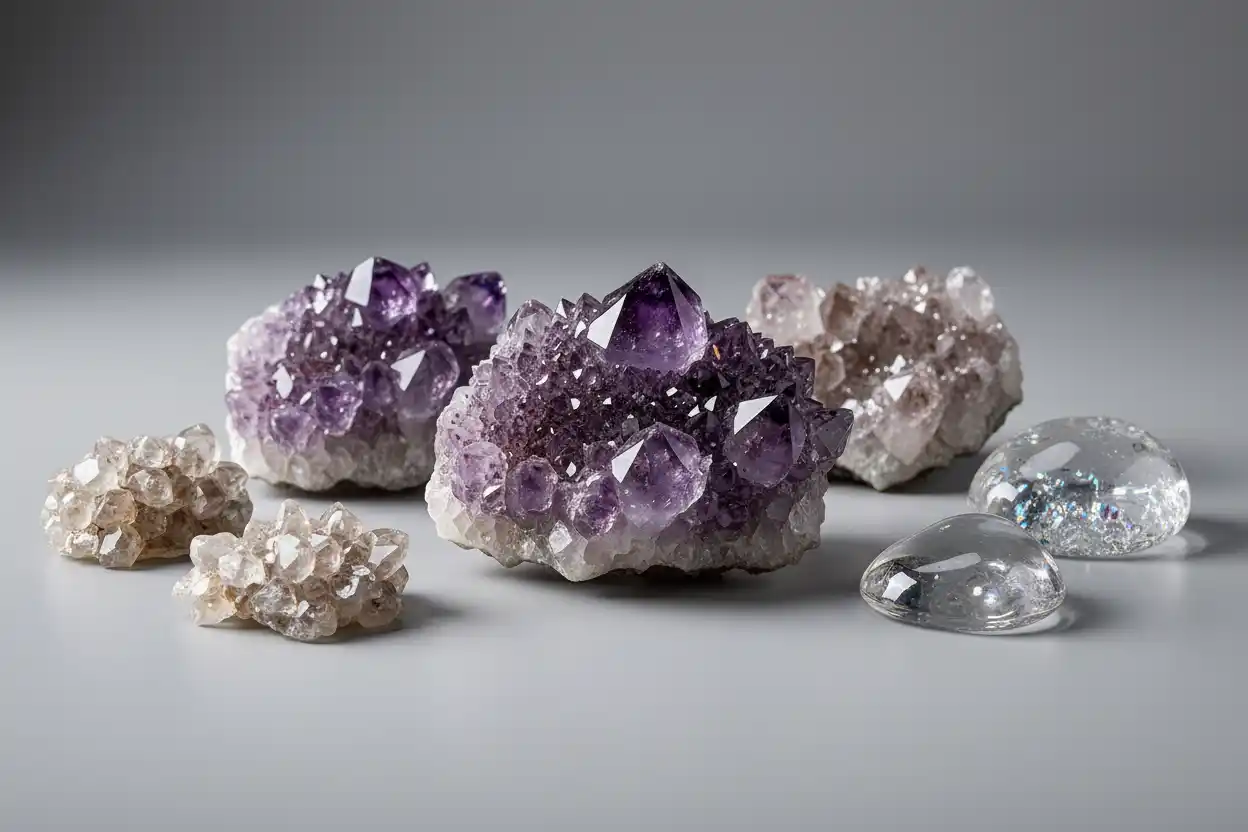
Where to Buy Real Spirit Quartz and Avoid Glued Crystal Fakes
Real Spirit Quartz is a distinctive South African Quartz growth form in which a larger central crystal is covered across its prism faces by hundreds or thousands of much smaller Quartz points. The main termination commonly remains larger and more visible, creating a cactus-like or porcupine-like profile.
The material is also called Cactus Quartz or Porcupine Quartz. Classic specimens come from Mpumalanga, South Africa, where the habit occurs in Amethyst, colorless Quartz, Smoky Quartz and iron-stained yellow, orange or brown forms.
The dense second-generation crystal coating produces exceptional sparkle, but it also makes specimens fragile. Broken microcrystals, repaired terminations and contact damage can greatly affect collector value.
Imitations include Quartz chips glued to a central point, resin casts covered in crystal fragments, glass, artificial druzy coatings and ordinary Quartz clusters marketed as source-specific Spirit Quartz. Natural specimens can also be dyed, heat-treated, irradiated or metallically coated.
The Spirit Quartz meaning and properties guide covers identity and traditional symbolism. This guide focuses on South African provenance, growth structure, condition, treatment, seller evidence and value.
Spirit Quartz Is a Growth Habit, Not a Mineral Species
Spirit Quartz is made primarily of Quartz, silicon dioxide.
The name describes how the crystals grew rather than a new mineral composition. The central crystal and most of the small overgrowths belong to the Quartz family.
The broader Quartz meaning and properties guide covers the parent mineral.
Depending on color, a specimen may also be described as:
- Amethyst Spirit Quartz
- Clear Spirit Quartz
- Smoky Spirit Quartz
- Iron-stained Spirit Quartz
- Yellow or citrine-colored Spirit Quartz
- Mixed-color Spirit Quartz
These names should describe observable mineral color rather than promise a particular treatment history.
A yellow specimen is not necessarily natural Citrine, and an orange surface may result from iron staining rather than Quartz body color.
How Spirit Quartz Grows
A larger Quartz crystal forms first.
Later, changing fluid conditions allow numerous smaller Quartz crystals to nucleate across the older prism faces. Those small points commonly point outward from the central core and form a dense sparkling crust.
The larger terminal faces may remain relatively open, although tiny crystals can partly cover them as well.
This two-stage relationship separates Spirit Quartz from an ordinary cluster containing several similarly sized crystals.
The overgrowth should be structurally connected to the central Quartz rather than held by glue or resin.
A natural broken edge can reveal that the small crystals grow directly from the older crystal surface.
Classic South African Provenance
The Spirit Quartz trade name is most strongly associated with cactus-like Quartz from Mpumalanga Province, South Africa.
A seller charging a source-specific premium should provide:
- A South African locality label
- The mine or collecting area when known
- A dealer or exporter record
- Photographs of the original parcel
- An older collection label for vintage specimens
- A clear explanation when the precise locality is uncertain
Quartz from another country can develop druzy or second-generation overgrowths. Such material may be entirely natural, but it should be described by its actual locality rather than automatically borrowing the classic South African trade identity.
Choose the Product Form Before Shopping
| Spirit Quartz product | Best source | Main buying concern |
|---|---|---|
| Natural single point | Specialist mineral dealer | Complete overgrowth, termination and repair |
| Cluster | Fine-mineral dealer | Matrix authenticity, broken microcrystals and glue |
| Amethyst specimen | Quartz specialist | Natural color, heat and coating |
| Smoky specimen | Mineral dealer | Irradiation, zoning and dark photography |
| Pale or colorless specimen | Geological supplier | Glass, bleaching claims and surface damage |
| Yellow-orange specimen | Specialist dealer | Iron staining versus Citrine or heat treatment |
| Mounted specimen | Mineral dealer | Adhesive, hidden damage and removable stand |
| Jewelry pendant | Independent jeweler | Fragility, glue and whether crystals are natural |
| Aura-coated specimen | Treatment-disclosing retailer | Metallic coating and underlying material |
| High-value locality specimen | Provenance-focused dealer | Original South African documentation |
Spirit Quartz is primarily a collector specimen. It is poorly suited to handling-heavy products, carving or ordinary bead manufacturing.
Where to Buy Genuine Spirit Quartz
Specialist mineral dealers
A specialist mineral dealer should understand the difference between natural secondary overgrowth and glued crystal chips.
Request high-resolution photographs of the entire specimen, central termination, base and damaged areas.
Ask whether the main point was reattached, whether any microcrystal zones were consolidated and whether the base was trimmed.
A complete condition report is more important than a vague “natural crystal” statement.
South African mineral suppliers
A seller with a traceable South African source can provide stronger locality evidence.
Ask whether the material was purchased directly from miners, obtained through an exporter or acquired from an older collection.
The seller should distinguish newly mined stock from pieces that have circulated without labels.
Because the material is fragile, request photographs immediately before packing.
Gem and mineral shows
Shows allow you to inspect the microcrystal attachment directly.
Use a loupe to look for:
- Continuous crystal growth
- Glue around crystal bases
- Resin pools
- Broken points
- Repaired main terminations
- Metallic coatings
- Dye concentrations
- Artificial base material
Do not rub the surface. Even genuine tiny crystals can detach under pressure.
Established online stores
The online gemstone buying guide explains seller identity, protected payments and return terms.
Request a continuous rotation in neutral light. Dense crystals can conceal damage when only the strongest face is shown.
Ask for close-ups of the base and central termination.
The listing should explain how the specimen will be immobilized during shipping. Loose packing can destroy hundreds of small crystals even when the main point survives.
What Genuine Spirit Quartz Looks Like
Natural specimens typically have one or more larger central points coated by small outward-growing crystals.
The tiny crystals may be:
- Clear
- White
- Pale lavender
- Purple
- Smoky gray
- Yellowish
- Orange-stained
- Brown-stained
- Mixed in color
Coverage can be complete or uneven. Contact with surrounding rock may leave one side less developed.
Natural crystal size also varies. Some overgrowths resemble fine sugar, while others have clearly visible individual points.
The specimen should not look perfectly factory-uniform. Minor gaps, broken tips, varying crystal sizes and contact zones are normal.
The main termination may be clear, Amethyst, smoky or zoned.
Spirit Quartz Versus Druzy Quartz
Druzy Quartz refers broadly to a surface covered by small Quartz crystals.
Spirit Quartz is a more specific cactus-like habit in which druzy or small crystal overgrowth covers a larger central Quartz point.
A druzy-lined Agate cavity is not Spirit Quartz because it lacks the central cactus structure.
Likewise, a flat slab coated with tiny crystals should remain Druzy Quartz unless its growth form and provenance justify the narrower name.
Spirit Quartz Versus an Ordinary Quartz Cluster
An ordinary cluster contains several Quartz crystals growing together from one matrix.
Spirit Quartz usually has small second-generation crystals covering larger first-generation points.
A cluster can contain both features. In that case, “Spirit Quartz cluster” may be accurate when the coated central points remain clear.
The name should describe the actual growth relationship rather than every sparkling group of Quartz crystals.
Spirit Quartz Versus Candle Quartz
Candle Quartz commonly has smaller parallel or stepped growths around a larger central Quartz crystal.
Its texture may resemble wax dripping down a candle.
Spirit Quartz generally carries far denser tiny points across the prism faces, producing a sparkling cactus-like surface.
The two trade habits can overlap visually. Locality, crystal scale and growth structure provide better separation than the name alone.
Spirit Quartz Versus Phantom Quartz
Phantom Quartz contains an internal outline of an earlier crystal growth stage.
The completed guide to buying real Phantom Quartz owns internal-growth geometry and inserted-layer risks.
Spirit Quartz is primarily an external overgrowth habit.
One specimen can contain an internal phantom and an external Spirit Quartz coating, but the two features should be described separately.
Spirit Quartz Versus Garden Quartz
Garden Quartz contains scenic mineral inclusions inside Quartz.
The completed guide to buying genuine Garden Quartz covers inclusion scenes, resin and inserted material.
Spirit Quartz gains its identity from the outer coating of small crystals, not from internal landscapes.
Amethyst Spirit Quartz
Amethyst Spirit Quartz ranges from pale lavender to saturated purple.
Color may concentrate in the main termination, the small points or both.
The Amethyst buying guide owns conventional Amethyst color and clarity, while the real-versus-fake Amethyst guide covers glass and broad identity checks.
Natural purple zoning can be uneven. Deep color should not be judged only from one backlit photograph.
The treated-Amethyst guide explains heat, irradiation, coating and synthetic Quartz concerns.
Clear and White Spirit Quartz
Clear Quartz Spirit Quartz can appear transparent, colorless, cloudy or frosted.
The completed guide to buying real Clear Quartz owns glass, synthetic Quartz and clear-crystal buying issues.
White areas may result from microscopic inclusions, surface frosting or densely packed tiny crystals.
A white coating that sits over every crystal face uniformly may indicate paint or artificial deposition.
Smoky Spirit Quartz
Smoky Quartz Spirit Quartz has gray, brown or nearly black color caused by color centers within Quartz.
The Smoky Quartz buying guide covers irradiation and natural smoky color.
Artificial irradiation can darken Quartz. In a dense Spirit Quartz specimen, treatment may affect the main crystal and the tiny points differently.
A nearly opaque black specimen should not receive a natural-smoky premium without strong evidence.
Yellow, Orange and “Citrine” Spirit Quartz
Citrine is yellow-to-orange Quartz whose natural and treated color origins require careful evaluation.
Spirit Quartz may appear yellow or orange because of:
- Quartz body color
- Iron-oxide staining
- Surface coatings
- Heat-altered Amethyst
- Associated iron minerals
- Photography under warm light
A seller should not label every iron-stained specimen natural Citrine Spirit Quartz.
Ask whether the yellow color occurs inside the Quartz, on the surface or along fractures.
Natural Iron Staining
Iron oxides and hydroxides can coat crystal surfaces or occupy fractures.
Natural staining may be yellow, orange, rust or brown and can emphasize the cactus texture.
A stained specimen remains genuine Spirit Quartz, although its color should not be described as pure Citrine without evidence.
Chemical cleaning can remove some surface iron staining, so ask whether the specimen was acid-cleaned or treated before sale.
Heat-Treated Spirit Quartz
Heating Amethyst can alter purple color toward yellow, orange, brown or colorless tones.
Because Spirit Quartz contains many small crystals, heating may create uneven color and can worsen existing fractures.
Heat-treated material remains natural Quartz with altered color.
The seller should disclose treatment rather than presenting every yellow-orange specimen as a rare natural variety.
Irradiation
Artificial irradiation can deepen smoky or other color centers in Quartz.
Irradiation may produce very dark surfaces or strong contrast between crystal generations.
Laboratory testing can sometimes provide evidence, but natural and artificial color origins may remain difficult to separate conclusively.
Known treatment history should therefore form part of the listing.
Metallic and Aura Coatings
Quartz can receive thin metallic films that create blue, gold, pink, purple or rainbow surfaces.
Aura-coated Spirit Quartz may look especially intense because thousands of small crystal faces reflect the coating.
Inspect broken tips, the base and areas between crystals. Metallic film may end abruptly or show color only at the surface.
Coated material can be decorative when disclosed. It should not be sold as a naturally colored rare Quartz variety.
The gemstone treatments guide explains surface coating and related enhancements.
Glued Crystal-Chip Imitations
Small Quartz points can be glued onto a larger crystal, glass form or resin core.
Warning signs include:
- Glossy adhesive between crystals
- Bubbles around the bases
- Tiny points lying sideways
- Loose chips rather than rooted crystals
- Identical crystal fragments
- A smooth core beneath detached areas
- Different crystal species mixed randomly
- An artificial base or mold seam
Natural overgrowth crystals enter the central Quartz surface coherently and commonly point outward according to growth conditions.
A repaired patch differs from a completely fabricated specimen, but both require disclosure.
Sugar, Salt and Synthetic Coatings
Resin objects can be coated with sugar-like glass particles or artificial crystals.
Some low-cost decorative products use salt or water-soluble materials that resemble Quartz druzy.
A suspicious coating may dissolve, soften or shed rapidly, but buyers should not use water as a destructive test.
Professional microscopy can identify glass fragments, adhesive and non-Quartz coating material.
Repaired Natural Specimens
Spirit Quartz is fragile, so repaired main terminations and reattached fragments are common.
A well-executed repair can preserve an important specimen. Nevertheless, location, extent and adhesive should appear in the condition report.
Inspect the central point’s base, large broken areas and matrix contacts.
A repaired natural specimen can retain value, while a fabricated cluster assembled from unrelated pieces belongs to a different category.
How to Evaluate the Central Crystal
Determine whether the main point is natural, broken and repolished, or repaired.
Inspect its termination faces for continuity beneath the small overgrowth.
A strong specimen commonly has one clearly visible central termination that rises above the surrounding small crystals.
However, multiple main points can form a natural cluster.
Evaluate whether the central crystal’s color and clarity complement the overgrowth rather than focusing on size alone.
How to Evaluate the Small Crystal Coating
Examine coverage, orientation and condition.
Fine specimens may have dense microcrystals across most prism faces, with individual points remaining sharp and lustrous.
A few bare contact areas are natural. Large smooth patches can indicate damage or incomplete growth.
Look for freshly broken pale areas and loose grains in the packaging.
The specimen should sparkle from many directions without relying on glitter, foil or metallic paint.
Buying Spirit Quartz Jewelry
Spirit Quartz is not suitable for conventional rings, bracelets or handling-heavy jewelry.
Tiny projections snag fabric, collect residue and break under minor impact.
Pendants can be made from small specimens, but the mount may require glue or wire wrapping.
Ask whether drilling damaged the crystal and whether adhesive holds the specimen.
A protective cage-style setting is safer than exposing the crystal points directly.
The gemstone hardness chart and gemstone toughness-versus-hardness guide explain why Quartz hardness does not protect delicate microcrystal tips.
Shipping and Unpacking
Ask the seller to immobilize the specimen inside a rigid inner box.
Soft loose fiber placed directly against the crystal points can break them during removal.
The specimen should not move when the outer package is shaken gently.
Photograph the unopened packaging and specimen immediately after delivery.
Open over a clean tray so detached crystals can be documented rather than lost.
A dealer should explain how shipping damage claims are handled.
Price and Value
Spirit Quartz value depends on:
- Credible South African provenance
- Complete cactus growth
- Intact microcrystals
- Main termination quality
- Color
- Luster
- Symmetry
- Size
- Cluster aesthetics
- Minimal repair
- Treatment disclosure
- Historic labels
A small, sharply formed Amethyst specimen can be more valuable than a large pale cluster with extensive damage.
Deep color alone does not establish value if the specimen was coated or heavily treated.
The gemstone pricing guide explains how rarity, condition and provenance affect collector prices.
Questions to Ask the Seller
Ask whether the specimen is natural South African Spirit Quartz or generic druzy-coated Quartz from another locality.
Request the mine, region or supplier information.
Confirm whether the small points grew naturally on the central crystal.
Ask about glue, repairs, resin, dye, heat, irradiation, acid cleaning and metallic coating.
Request close-ups of the base, central termination and any bare patches.
Ask how the specimen will be packed and how shipping damage is handled.
Finally, confirm a return policy that covers undisclosed fabrication or treatment.
Professional Identification
Microscopy can reveal natural crystal attachment, adhesive, coating, fractures and repair.
Raman spectroscopy can confirm Quartz and identify associated minerals.
Infrared spectroscopy and microscopy may assist with natural-versus-synthetic Quartz where that issue is significant.
Chemical analysis can characterize metallic coatings and iron staining.
Confirming Quartz does not prove South African locality, so documentary provenance remains essential.
Cleaning and Storage
Do not scrub Spirit Quartz.
Use a hand-operated air bulb or a very soft brush without pressing against the crystal tips.
Avoid ultrasonic and steam cleaning.
Do not soak repaired, coated, iron-stained or matrix-bearing specimens.
Display the specimen inside a covered cabinet where it cannot collect heavy dust or be touched accidentally.
Support it from the base rather than lifting it by a central point.
Frequently Asked Questions
1. What is Spirit Quartz?
Spirit Quartz is a South African Quartz growth habit in which hundreds of small crystals cover a larger central Quartz point.
2. Is Spirit Quartz a separate mineral species?
No. It is Quartz distinguished by its cactus-like second-generation crystal growth.
3. Is Spirit Quartz the same as Cactus Quartz?
Yes. Cactus Quartz and Spirit Quartz are common trade-name synonyms.
4. Does all Spirit Quartz come from South Africa?
The classic trade material comes from Mpumalanga, South Africa. Similar druzy overgrowths from elsewhere should retain their own locality descriptions.
5. Is all purple Spirit Quartz natural Amethyst?
The Quartz can be naturally purple, but dye, coating, heat and irradiation should still be considered.
6. Is yellow Spirit Quartz natural Citrine?
Not necessarily. Yellow and orange appearances can result from iron staining, heat treatment, coating or natural Quartz color.
7. How can glued Spirit Quartz be recognized?
Look for glossy adhesive, bubbles, sideways crystal chips, smooth core areas and points that are not rooted in the central Quartz.
8. Can natural Spirit Quartz be repaired?
Yes. Main points and fragments may be reattached because the specimens are fragile.
9. Can Spirit Quartz receive aura coating?
Yes. Metallic coatings can create intense blue, gold, pink or rainbow surfaces and should be disclosed.
10. Is Spirit Quartz suitable for jewelry?
It is best suited to protected pendants or specimen cages rather than rings and bracelets.
11. Do ordinary specimens need laboratory reports?
Usually not. Reports become more useful for expensive provenance, synthetic-host or unusual treatment claims.
12. What is the biggest warning sign in a listing?
Be cautious when crystal chips appear glued randomly around a molded core and the seller provides no South African locality or base photographs.
Buy the Natural Second Generation of Quartz Growth
Spirit Quartz earns its identity through the relationship between one older crystal and its dense younger overgrowth. That relationship should remain visible beneath the sparkle.
The purple crystals guide, purple gemstones guide, white crystals guide, S crystal directory and S gemstone directory provide wider comparisons. Choose a seller who documents growth, locality, treatment and condition before describing the specimen’s symbolism.
Safety note: Spirit Quartz has countless sharp, fragile crystal points. Handle it from the base, keep it away from children and pets, and do not place broken fragments in drinking water. Cutting or grinding Quartz requires wet methods, effective silica-dust extraction and suitable respiratory and eye protection.