Moissanite vs Diamond vs Lab Diamond: The 2026 Guide
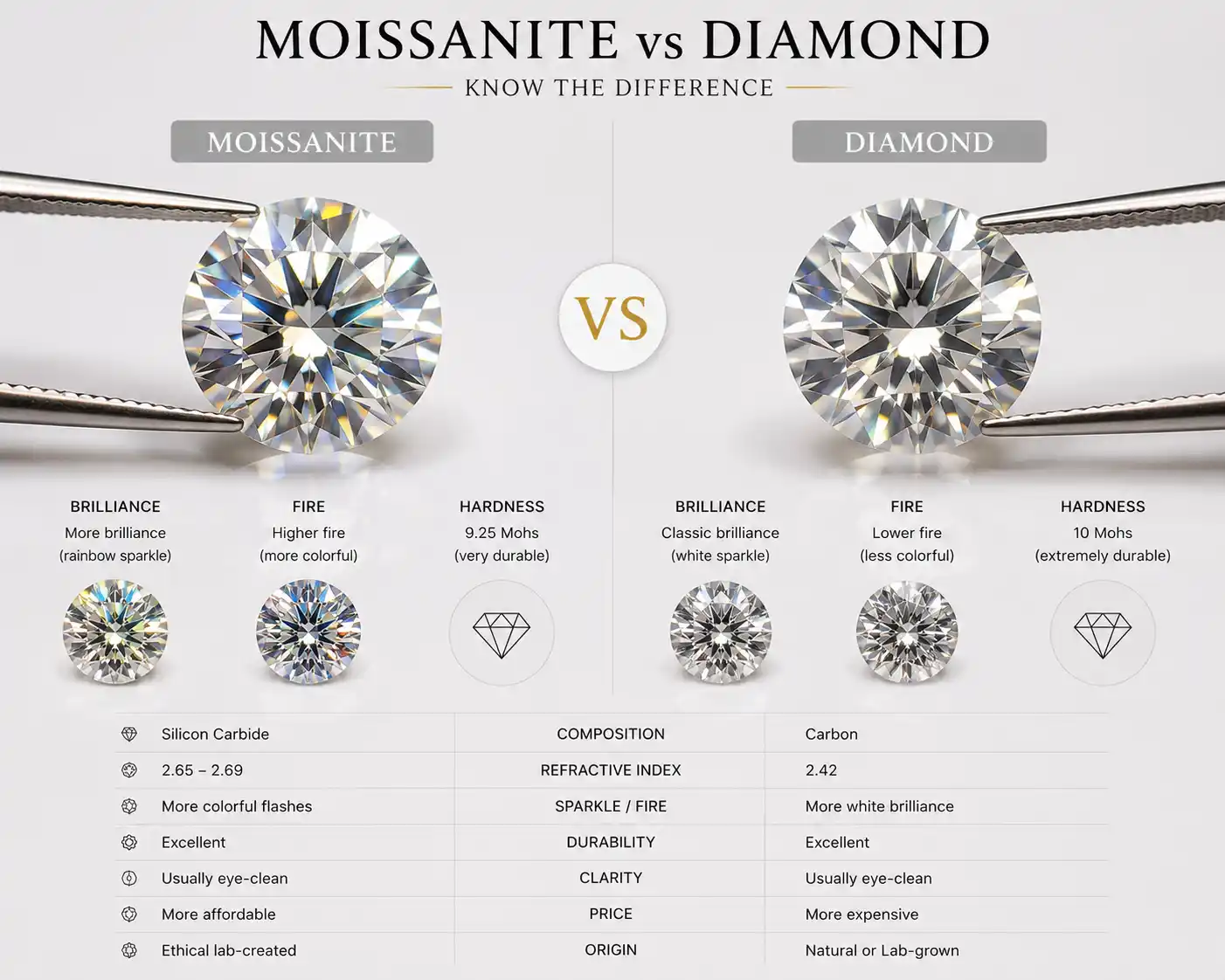
Moissanite, natural diamond and laboratory-grown diamond can all create durable, colorless, highly brilliant jewelry. Their visual overlap is strong enough that a casual observer may not identify them correctly from appearance alone.
The materials are nevertheless fundamentally different.
Natural and laboratory-grown diamonds consist of carbon arranged in the diamond crystal structure. Their principal physical and optical properties are nearly the same. They differ in origin, growth features, rarity, market structure and the laboratory techniques used to identify them.
Moissanite consists of silicon carbide. It is a separate laboratory-created gemstone commonly used as a diamond simulant. Its greater dispersion produces stronger rainbow fire, while double refraction can make its internal facet pattern look different from diamond.
This guide compares the three choices as they exist in 2026, including GIA’s current laboratory-grown diamond assessment approach. Detailed purchase and price workflows remain on their dedicated pages so this comparison does not absorb those separate intents.
Moissanite vs Natural Diamond vs Lab Diamond at a Glance
| Property | Moissanite | Natural diamond | Laboratory-grown diamond |
|---|---|---|---|
| Composition | Silicon carbide, SiC | Carbon, C | Carbon, C |
| Origin | Manufactured | Geological | Manufactured by HPHT or CVD |
| Material identity | Diamond simulant | Diamond | Diamond |
| Crystal properties | Different from diamond | Diamond structure | Diamond structure |
| Mohs hardness | Approximately 9.25 | 10 | 10 |
| Refractive character | Doubly refractive | Singly refractive | Singly refractive |
| Dispersion | Approximately 0.104 | Approximately 0.044 | Approximately 0.044 |
| Typical visual effect | Strong rainbow fire | Balanced brilliance, fire and scintillation | Diamond-like brilliance, fire and scintillation |
| Density | Approximately 3.22 | Approximately 3.52 | Approximately 3.52 |
| Commercial rarity | Manufactured supply | Limited natural supply | Expandable manufactured supply |
| Standard reports | Identification or manufacturer documentation | Natural-diamond grading reports | Laboratory-grown diamond reports or assessments |
| Price position | Usually lowest of the three | Usually highest | Generally below comparable natural diamond |
| Long-term scratch resistance | Excellent | Highest | Highest |
| Primary distinction | Different gemstone | Natural geological diamond | Manufactured diamond |
The Most Important Difference: Material Identity
Natural diamond and laboratory-grown diamond are both diamond.
They share the carbon crystal structure and nearly the same fundamental chemical, optical and physical properties. Laboratory-grown origin does not make the product cubic zirconia, Moissanite or glass.
Moissanite is not diamond. It is silicon carbide with a different crystal structure, density and optical behavior.
The Moissanite guide, Diamond guide and Lab Diamond guide own each material’s full identity.
Confusion usually arises because all three can be colorless, transparent and cut into familiar diamond shapes. A visual resemblance does not erase the material distinction.
Natural Diamond Formation
Natural diamonds formed deep within Earth under high pressure and temperature.
Most gem diamonds are millions to billions of years old. Volcanic eruptions later transported diamond-bearing rock toward the surface through kimberlite or related pipes.
Mining, sorting, cutting and trading create the modern natural-diamond supply chain.
Natural formation gives these diamonds geological rarity and individual growth histories. It does not automatically make every natural diamond high quality, ethically sourced or financially appreciating.
The Types of Diamond guide owns natural-diamond varieties, colors and classifications.
How Laboratory-Grown Diamonds Are Made
Laboratory-grown diamonds are manufactured mainly through high-pressure, high-temperature growth or chemical vapor deposition.
HPHT processes recreate high-pressure and high-temperature conditions around a diamond seed, allowing carbon to crystallize as diamond.
CVD processes introduce carbon-bearing gas into a chamber. Carbon deposits in layers on a diamond seed under controlled conditions.
Post-growth treatment may improve color in some laboratory-grown diamonds.
The Types of Lab Diamond guide explains HPHT, CVD, colors and growth-related features without turning this comparison into a production manual.
Both methods produce diamond. The distinction lies in manufactured origin rather than a different base material.
How Jewelry Moissanite Is Made
Commercial Moissanite is laboratory-created silicon carbide.
Natural Moissanite exists in extremely small and rare occurrences, but it does not supply the jewelry market.
Manufacturers grow silicon-carbide crystals, which are then cut and polished into gemstones.
Modern products can appear colorless, near-colorless, gray, green, blue, yellow or black. Selected fashion colors may involve coatings.
The Types of Moissanite guide owns color and cut varieties, while How to Spot Treated or Synthetic Moissanite covers coating and treatment boundaries.
Are Lab Diamonds Real Diamonds?
Yes, in material terms.
Laboratory-grown diamonds have the diamond carbon structure and corresponding diamond properties. They are not geological diamonds because they formed through manufacturing rather than within Earth.
The word real can create confusion because it may refer to material identity, natural origin or market category.
A clearer description is:
Natural diamond means diamond formed geologically.
Laboratory-grown or synthetic diamond means diamond formed through a manufacturing process.
Moissanite means silicon carbide and is not diamond.
The Lab Diamond Buying Guide should be used when purchasing a manufactured diamond rather than a simulant.
Brilliance
Brilliance describes the white light returned from a polished stone.
Diamond has an exceptionally high refractive index and produces strong brilliance when cut well. Natural and lab-grown diamonds behave similarly because they share the same structure.
Moissanite has an even higher refractive index and can appear extremely bright.
Brightness cannot be compared independently from cut. A poorly proportioned diamond can look less lively than a well-cut Moissanite.
Likewise, a deeply cut Moissanite may hide weight and lose face-up performance.
The material establishes the potential optical behavior, while cutting determines how effectively that potential is used.
Fire and Dispersion
Fire is the colored light created through dispersion.
Moissanite has substantially greater dispersion than diamond. It often displays conspicuous red, blue, green and yellow flashes under concentrated lighting.
Natural and laboratory-grown diamonds have the same diamond dispersion and therefore show similar material-level fire when cut comparably.
Diamond’s fire is generally more restrained than Moissanite’s and occurs within a different balance of brilliance and scintillation.
Some buyers regard Moissanite’s rainbow display as its greatest advantage. Others feel that large brilliant-cut Moissanites look less diamond-like because of it.
A comparison should be made in ordinary light as well as store spotlights.
Scintillation
Scintillation describes the pattern of light and dark flashes seen as the stone, observer or light source moves.
Diamond cutting traditions have been developed extensively to control brightness, fire and scintillation.
Moissanite may use diamond-inspired faceting, but its double refraction and higher dispersion change the resulting pattern.
Laboratory-grown and natural diamonds can have equivalent scintillation when their cut proportions and polish are equivalent.
Origin does not make one diamond automatically better cut than the other.
A high-quality comparison should examine specific stones rather than assign cut performance from origin alone.
Double Refraction
Most jewelry Moissanite is doubly refractive.
Through suitable directions, rear facet junctions may appear doubled. Modern cutters orient the material to minimize the effect face-up, but magnification can still reveal it.
Diamond is singly refractive. Natural and laboratory-grown diamond therefore do not show Moissanite-style facet doubling.
This difference helps gemologists identify Moissanite.
In large step cuts, the effect can be easier to observe. Brilliant cuts divide reflections into smaller patterns and may conceal it from casual viewing.
Color
Natural diamonds in the common D-to-Z range move from colorless toward increasing yellow or brown.
Laboratory-grown diamonds can also occur across colorless, near-colorless and fancy-color ranges. Growth and post-growth treatment influence their appearance.
Moissanite may be colorless or near-colorless but can show gray, yellow or green undertones in some directions or lighting.
The same metal affects each material visually. Yellow gold can reduce awareness of slight warmth, while white metals make undertones easier to see.
Color grades are not interchangeable across materials. A manufacturer’s Moissanite D–F description is not a GIA diamond color grade.
Clarity
Natural diamonds contain inclusions and blemishes formed through geological growth and later history.
Laboratory-grown diamonds can contain metallic flux inclusions, graphitic inclusions, growth features, graining or other characteristics connected with HPHT or CVD production.
Moissanite may contain needles, growth structures, cavities or reflective inclusions, although commercial stones are commonly clean to the unaided eye.
Diamond clarity grading does not apply automatically to Moissanite.
A visually clean stone often provides better practical value than paying for microscopic distinctions that do not change appearance.
Hardness
Diamond ranks 10 on the Mohs scale.
Natural and laboratory-grown diamonds share this hardness because both are diamond.
Moissanite ranks approximately 9.25 and remains one of the hardest common jewelry stones.
All three resist ordinary scratching exceptionally well. Diamond can scratch Moissanite, and one diamond can scratch another.
The Gemstone Hardness Chart provides broader context.
Hardness does not make a ring indestructible. Prongs, shanks and girdles can still be damaged by severe blows or bending.
Toughness and Chipping
Diamond has excellent hardness but can chip along vulnerable directions when struck sharply.
Moissanite also has good practical toughness and may chip under sufficient force.
Natural and laboratory-grown diamonds behave similarly at a material level, although the location of inclusions and cutting features can influence an individual stone.
The Gemstone Toughness vs Hardness guide explains why the hardest stone can still break.
Protective settings and reasonable removal habits matter for all three materials.
Weight and Size
Natural and laboratory-grown diamonds have approximately the same density.
A one-carat natural diamond and a one-carat laboratory-grown diamond cut to similar proportions will have similar dimensions.
Moissanite is less dense. A Moissanite with the same face-up dimensions as a diamond weighs less.
This is why Moissanite is often marketed through diamond-equivalent weight.
Millimeter dimensions provide the best cross-material comparison. Carat is a unit of weight, not visual size.
A buyer should compare length, width and depth rather than only carat labels.
Cut Grading
Natural diamonds are commonly evaluated through established diamond cut systems, particularly for standard round brilliants.
Laboratory-grown diamonds may be described through laboratory reports or manufacturer grading, but reporting practices differ by laboratory.
As of October 1, 2025, GIA uses an overall Premium or Standard quality assessment for eligible colorless-to-near-colorless laboratory-grown diamonds rather than describing them through the full natural-diamond color and clarity nomenclature in the previous way.
Natural GIA diamond reports continue to use the 4Cs, including the established natural-diamond color and clarity scales.
Moissanite does not receive a GIA diamond cut grade. Seller terms such as excellent or ideal may describe proprietary specifications rather than an independent diamond grade.
Reports in 2026
A natural-diamond grading report should identify natural origin and describe weight, measurements, color, clarity and other characteristics.
A laboratory-grown diamond document should identify manufactured origin clearly. Current GIA assessments for qualifying colorless-to-near-colorless stones classify overall quality as Premium or Standard and include a laboratory-grown inscription.
Other laboratories may continue to provide detailed color and clarity grades for laboratory-grown diamonds according to their own services.
Moissanite reports generally focus on material identification, dimensions and observable characteristics rather than diamond 4Cs.
The Gemstone Certification guide explains why reports from different laboratories should not be assumed interchangeable.
A report is evidence of identity and assessed characteristics, not a guarantee of future value.
Natural Diamond Pricing
Natural-diamond prices are influenced by carat weight, cut, color, clarity, shape, fluorescence, certification, market demand and supply.
Geological rarity and established trade structures contribute to pricing.
The dedicated Diamond Price Guide owns current cost rather than this comparison article.
Two natural diamonds of equal weight can differ substantially in price because of quality and cutting.
Retail price does not guarantee resale profit. Brand, setting, market conditions and transaction costs affect secondhand outcomes.
Laboratory-Grown Diamond Pricing
Laboratory-grown diamonds generally cost less than comparable natural diamonds.
Manufacturing capacity, production efficiency and technological change have increased supply. Retail and wholesale prices can therefore move differently from natural-diamond markets.
The Lab Diamond Price Guide owns current valuation.
A lower purchase price can allow greater size or higher apparent quality within a fixed budget.
The same lower entry price and expandable supply also affect resale expectations.
Moissanite Pricing
Moissanite usually occupies the lowest initial price position among these three materials when dimensions and setting are broadly comparable.
Brand, cut, color, coating and warranty can create meaningful price differences within the Moissanite market.
The Moissanite Price Guide owns current value.
Moissanite should not be priced through diamond carat scales merely because a seller uses diamond-equivalent size.
Its value proposition is visual performance and durability rather than natural rarity.
Resale and Long-Term Value
Natural diamond has the most established secondhand market of the three, although resale offers are commonly below retail.
Laboratory-grown diamond resale markets exist but are affected by changing production costs, abundant new supply and rapid retail-price adjustments.
Moissanite has limited material resale value outside branded or desirable finished jewelry.
None of the three should be purchased with a guaranteed appreciation claim.
Sentimental, design and use value can be more important than liquidation value for engagement and personal jewelry.
Environmental Claims
No universal statement that one material is environmentally harmless is reliable.
Natural-diamond impacts vary by mine type, energy source, land management, water use, labor standards and reclamation.
Laboratory-grown diamond and Moissanite impacts vary by electricity source, manufacturing efficiency, factory location, equipment, waste and supply-chain boundaries.
A product described as sustainable, carbon-neutral or ethical should have specific supporting evidence.
Manufactured origin does not automatically mean low carbon, while mined origin does not automatically describe one uniform environmental or labor record.
Ethical and Supply-Chain Considerations
Natural-diamond buyers may evaluate mine provenance, conflict controls, labor standards, traceability and company practices.
Laboratory-grown diamond and Moissanite buyers may evaluate factory labor, energy sourcing, manufacturing location and corporate transparency.
Ethical purchasing requires more than choosing a material category.
A seller should provide evidence for specific claims rather than relying on general phrases such as conflict-free, eco-friendly or ethical stone.
Engagement-Ring Suitability
All three materials can serve in durable engagement rings.
Natural diamond offers geological origin, traditional recognition and the broadest established trade market.
Laboratory-grown diamond offers diamond identity and diamond optics at a lower initial price than many comparable natural stones.
Moissanite offers strong durability, greater rainbow fire and larger visual size for the budget while remaining a different gem.
The dedicated Moissanite Engagement Ring guide, Diamond Engagement Ring guide and Lab Diamond Engagement Ring guide own the separate bridal workflows.
Which Looks Most Like a Diamond?
Laboratory-grown diamond looks and behaves like diamond because it is diamond.
Moissanite can look similar from ordinary viewing distance, especially in smaller round brilliant cuts. Its stronger fire and double refraction become more noticeable in larger sizes and selected cuts.
A well-cut natural diamond and a comparably cut lab diamond cannot be separated reliably by unaided sight.
The question should therefore be divided into appearance and identity.
For diamond appearance and diamond material identity, natural or lab-grown diamond is appropriate.
For a bright durable alternative with its own optics, Moissanite is appropriate.
Moissanite vs Cubic Zirconia
Cubic zirconia is another diamond simulant but should not be grouped with lab diamond.
CZ is stabilized zirconium oxide, is softer than Moissanite and is considerably denser.
The direct Moissanite vs Cubic Zirconia guide owns that comparison.
CZ may suit fashion, temporary or travel jewelry. Moissanite is generally stronger for long-term everyday rings.
Testing and Identification
A basic thermal tester may distinguish CZ from diamond but can register Moissanite as diamond.
Modern instruments use additional electrical or optical properties to separate Moissanite.
Natural and laboratory-grown diamonds are much harder to distinguish because they share diamond’s fundamental properties. Laboratories use spectroscopy, fluorescence imaging, growth features and other advanced methods.
The Real vs Fake Moissanite guide and Real vs Fake Diamond guide own the dedicated identification workflows.
A laser inscription should be checked against the issuing laboratory’s database because fraudulent inscriptions can occur.
Buying Natural Diamond
The Diamond Buying Guide owns the complete natural-diamond purchase process.
A buyer should compare cut before maximizing carat weight, verify the report, inspect the stone under ordinary lighting and understand fluorescence and shape-specific performance.
Natural origin should be confirmed by an appropriate report when value justifies it.
Buying Laboratory-Grown Diamond
The Lab Diamond Buying Guide owns HPHT, CVD, reports, treatments and quality selection.
The document should state laboratory-grown origin clearly.
Buyers should understand the issuing laboratory’s current assessment or grading system rather than assuming every report uses identical terminology.
Buying Moissanite
The Moissanite Buying Guide owns cut, color, size, coatings and brand comparison.
Request millimeter dimensions and video under ordinary light.
The invoice should state Moissanite clearly and identify any coated color.
The broader Best Diamond Alternatives guide can help when sapphire, spinel or another durable stone may better suit the buyer’s preferred appearance.
Online Purchase Protection
Follow How to Buy Gemstones Online Without Getting Scammed.
Verify the material name, report number, dimensions, treatment, metal and return policy.
A listing that alternates among diamond, diamond simulant, lab stone and Moissanite without clear distinctions should be treated cautiously.
The exact stone should be shown when purchasing a significant center rather than only a stock image.
Cleaning
Natural and laboratory-grown diamonds can be cleaned according to How to Clean Diamond Jewelry Safely and How to Clean Lab Diamond Jewelry Safely.
Moissanite should follow How to Clean Moissanite Jewelry Safely.
Warm water, mild soap and a soft brush are suitable routine methods for sound jewelry.
The setting and accompanying stones may require stricter care than the center.
Oil collects beneath all three materials and reduces apparent brilliance.
Which One Should You Choose?
Choose natural diamond when geological origin, established diamond tradition and a more developed secondhand market matter most.
Choose laboratory-grown diamond when diamond material identity and diamond optics matter, but a lower initial price is preferred.
Choose Moissanite when strong rainbow fire, durability, larger visual size and the lowest initial cost among these options matter more than diamond identity.
No answer is universally correct. The materials solve different priorities.
Frequently Asked Questions
1. Is Moissanite a diamond?
No. Moissanite is silicon carbide and is a separate gemstone used as a diamond simulant.
2. Is a lab-grown diamond a real diamond?
It is diamond in composition and crystal structure, but it has manufactured rather than geological origin.
3. Can you see the difference between natural and lab diamond?
Usually not by unaided sight. Advanced laboratory testing is used to determine growth origin.
4. Does Moissanite look different from diamond?
It usually shows stronger rainbow fire and may reveal doubled back facets, especially in larger stones.
5. Which material is hardest?
Natural and laboratory-grown diamonds rank 10. Moissanite ranks approximately 9.25.
6. Which option is least expensive?
Moissanite generally has the lowest initial price, followed by lab-grown diamond and then comparable natural diamond, although exact prices vary.
7. Which has the best resale value?
Natural diamond has the most established resale market, but secondhand offers are commonly below retail. None has guaranteed appreciation.
8. Do lab diamonds have the same 4Cs?
They can be evaluated for color, clarity, cut and carat, but laboratory reporting systems differ. GIA now uses Premium or Standard overall assessments for eligible colorless-to-near-colorless lab diamonds.
9. Can a basic diamond tester identify Moissanite?
Not reliably. Some thermal testers register Moissanite as diamond.
10. Which is best for an engagement ring?
All three are durable. The decision depends on origin preference, optics, price, reporting and personal values.
11. Is Moissanite more brilliant than diamond?
It has a higher refractive index and stronger dispersion, although perceived brilliance also depends on cut.
12. Which option is most sustainable?
No universal answer applies. Environmental performance depends on specific mining, manufacturing, energy and supply-chain practices.
Moissanite, natural diamond and laboratory-grown diamond should not be arranged on a ladder from fake to real. They belong to two material categories and three origin stories. Natural and manufactured diamonds share diamond identity, while Moissanite provides a distinct silicon-carbide alternative with stronger fire and a lower price. The best choice begins by deciding which differences actually matter.