Teal Gemstones: Names, Meanings and Uses
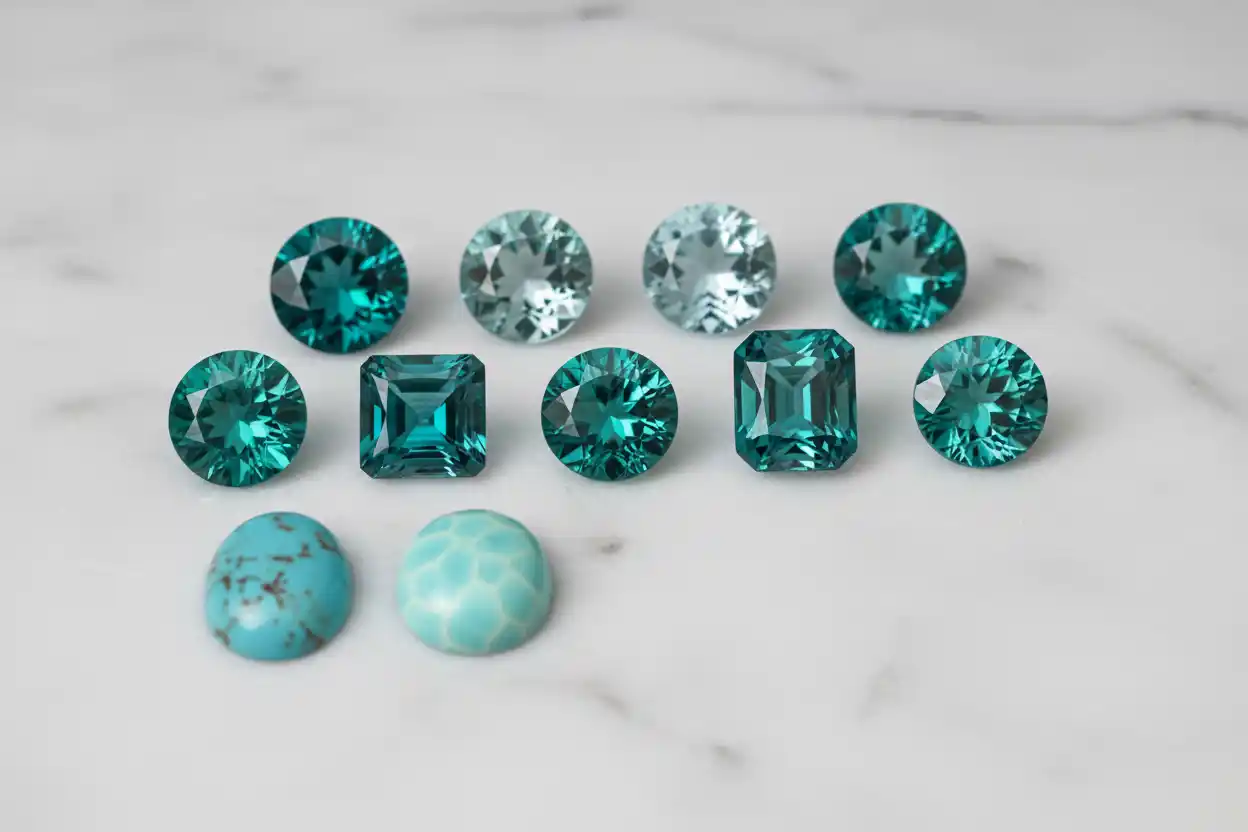
Teal gemstones combine visible blue and green in colors ranging from pale seafoam and aqua to deep peacock blue-green. The category includes transparent faceted gems, opaque ornamental stones and rare collector materials.
Teal is not a formal gemological variety. A seller may use the word for blue-green Sapphire, greenish-blue Tourmaline, strongly green Aquamarine or even dyed material, so the gemstone’s actual identity matters more than the color label.
The best teal gem depends on the intended use. Sapphire offers exceptional durability, Paraíba Tourmaline supplies vivid neon color, Aquamarine provides a lighter transparent option, and Turquoise creates an opaque traditional look.
Teal Gemstones Comparison
| Gemstone | Typical teal appearance | Mohs hardness | Best uses | Main buying concern |
|---|---|---|---|---|
| Teal Sapphire | Blue-green to green-blue | 9 | Rings and all jewelry | Heat, diffusion and color zoning |
| Paraíba Tourmaline | Neon blue-green | 7–7.5 | Fine jewelry | Copper confirmation, treatment and origin |
| Aquamarine | Pale green-blue to blue | 7.5–8 | Rings, earrings and necklaces | Heat and fracture filling |
| Indicolite | Deep blue to green-blue | 7–7.5 | Fine jewelry | Darkness and inclusions |
| Grandidierite | Blue-green to greenish blue | 7–7.5 | Collector jewelry | Rarity and authenticity |
| Teal Apatite | Bright aqua to blue-green | 5 | Pendants and earrings | Softness and cleavage |
| Teal Zircon | Bright blue-green | 6–7.5 | Protected jewelry | Brittleness and heat treatment |
| Turquoise | Opaque blue to greenish blue | 5–6 | Cabochons, beads and inlay | Stabilization, dye and reconstruction |
| Amazonite | Opaque pale blue-green | 6–6.5 | Cabochons, beads and carvings | Cleavage and imitation |
| Larimar | Pale sea-blue to blue-green | 4.5–5 | Pendants and earrings | Scratching and light exposure |
| Variscite | Opaque mint to teal | 3.5–4.5 | Cabochons and collector jewelry | Softness and stabilization |
| Chrysocolla Chalcedony | Rich blue-green | Variable, often near Quartz when silicified | Cabochons and pendants | Exact composition and treatment |
| Green-blue Fluorite | Transparent aqua to teal | 4 | Collector gems | Perfect cleavage and abrasion |
| Blue-green Kyanite | Teal zoning in bladed crystals or gems | Directionally variable | Pendants and earrings | Cleavage and uneven hardness |
| Blue-green Smithsonite | Pale teal botryoidal material | 4–4.5 | Specimens and rare cabochons | Softness and acid sensitivity |
What Is a Teal Gemstone?
A teal gemstone is any gem material whose main visual impression combines blue and green.
The balance can lean either way. Greenish-blue Aquamarine may look pale and watery, while teal Sapphire can be darker and more saturated. Paraíba Tourmaline may show an electric cyan-green appearance that does not resemble either.
Lighting, surrounding metal and skin tone can change the perceived balance. Yellow gold may make a gemstone look greener, while white metal may emphasize blue.
Because teal lacks a universal laboratory boundary, buyers should request the gem’s mineral name, treatment, weight and color description rather than relying on “teal” alone.
The companion teal crystals list emphasizes symbolism and specimens. This page focuses on jewelry performance, gem identity and buying decisions.
1. Teal Sapphire
Sapphire is the most durable major teal gemstone.
It belongs to the Corundum species and ranks 9 on the Mohs scale. This makes it suitable for engagement rings, wedding jewelry and other pieces expected to receive frequent wear.
Teal Sapphire may appear blue-green, green-blue, peacock, parti-colored or grayish teal. Some stones show visible color zoning, while pleochroism can make the balance change as the gem turns.
Montana is strongly associated commercially with teal Sapphire, but attractive blue-green material also comes from other deposits. Geographic origin should be documented rather than inferred from color.
Heat treatment is common. Diffusion treatment and laboratory-grown Sapphire also exist.
The guide to types of Sapphire explains the color range, while the completed teal engagement-ring stones guide compares Sapphire with other durable center-stone options.
2. Paraíba Tourmaline
Paraíba Tourmaline is the premium choice for vivid neon teal.
Copper-bearing Tourmalines from Brazil, Mozambique and Nigeria can show electric blue, greenish blue, bluish green and green.
Color intensity often matters more to buyers than perfect clarity. Fine material may contain visible inclusions but still command high prices because of its distinctive glow.
The word Paraíba should not be applied solely because a gem looks teal. Laboratory chemistry is used to establish copper-bearing identity, while geographic origin requires more advanced analysis.
Heating is common in some copper-bearing material and may alter purple or reddish rough toward blue-green.
The Paraíba Tourmaline buying guide covers color, origin and reports. The Paraíba Tourmaline price guide explains why vivid natural material can be exceptionally expensive.
3. Aquamarine
Aquamarine is the green-blue to blue variety of Beryl.
Most material has a pale to medium tone, making it suitable for buyers who want an airy rather than strongly saturated teal.
Natural Aquamarine often contains a visible green component. Heat treatment commonly reduces that green and produces a bluer appearance.
The gem ranks 7.5–8 on the Mohs scale and has good general jewelry durability. Large, clean crystals are available more readily than equivalent sizes in Paraíba Tourmaline or Grandidierite.
Fracture-filled material requires gentler care. Strong “deep blue” trade names should be evaluated through the stone itself rather than assumed to represent a standardized variety.
The Aquamarine buying guide explains quality and treatment. The types of Aquamarine guide covers color descriptions and trade terms.
4. Indicolite Tourmaline
Indicolite is blue Tourmaline and can move into teal when a visible green component is present.
Its color is often deeper than Aquamarine and less neon than Paraíba-type material. Some stones appear almost black unless cut to admit enough light.
Tourmaline’s strong pleochroism means the color changes with direction. Cutting orientation can produce a bluer, greener or darker face-up appearance.
Its hardness supports rings, earrings and necklaces, though fractures and elongated crystal structure require care.
The Indicolite buying guide explains cutting and color. The completed types of Tourmaline guide places Indicolite beside green, pink, multicolored and copper-bearing varieties.
5. Grandidierite
Grandidierite is a rare borosilicate known for blue-green color and strong pleochroism.
Fine transparent facetable material is scarce. Many available stones are translucent, included or small.
Its directional colors may include blue-green, green and nearly colorless components. Proper cutting should emphasize the most attractive teal direction.
The mineral has useful hardness, but rarity and inclusions often make it more appropriate for collector jewelry than routine mass-market use.
A high-value gem should have independent identification because Apatite, glass and other blue-green stones can imitate it.
The Grandidierite buying guide covers authentication, while the Grandidierite price guide addresses rarity.
6. Blue-Green Apatite
Blue-green Apatite can produce vivid tropical color at a much lower typical price than Paraíba Tourmaline.
Its main limitation is durability. Apatite ranks only 5 on the Mohs scale, has cleavage and scratches readily.
Pendants and earrings are safer than exposed rings. A ring should have a protective setting and be reserved for occasional wear.
Apatite may contain inclusions and can look hazy. A well-cut transparent stone should remain bright enough to avoid a washed-out center.
The completed Apatite color meaning guide explains its blue and green symbolism. The guide to types of Apatite covers varieties and mineral context.
7. Teal Zircon
Zircon offers bright brilliance and dispersion in blue to greenish-blue colors.
Most vivid blue Zircon is produced by heating brownish natural material. The treatment is routine but should be disclosed.
Zircon can show facet doubling because of strong birefringence. This helps distinguish it from singly refractive materials, though identification should use several tests.
The gem’s hardness varies, and it is brittle. Facet edges can abrade, especially in rings and bracelets.
Protected earrings and pendants preserve the polish more effectively.
The guide to types of Zircon covers blue, green, yellow, orange, red and colorless varieties.
8. Turquoise
Turquoise is the best-known opaque teal gemstone.
Its natural colors range from blue through greenish blue to green. Matrix may appear as brown, black, tan or golden webbing.
The material is relatively soft and often porous. Stabilization improves durability, while dye, impregnation and reconstruction can change appearance and value.
A natural untreated stone can gradually darken by absorbing skin oils. Perfume, lotions and household chemicals may also alter the color.
The Turquoise buying guide explains quality and disclosure. The real-versus-fake Turquoise guide covers dyed Howlite, composites and plastic imitations.
The guide to types of Turquoise examines matrix and color terminology.
9. Amazonite
Amazonite is a blue-green Microcline feldspar used in cabochons, beads and carvings.
Its color can be pale aqua, mint, turquoise green or deeper blue-green, commonly crossed by white streaks.
Amazonite has moderate hardness but distinct cleavage. It is safer in pendants, earrings and protective bezels than exposed rings.
Glass, dyed stones and other feldspars may be sold under its name. Color that looks unnaturally uniform deserves investigation.
The completed guide to real versus fake Amazonite covers substitutes, while treated Amazonite explains coatings and enhancement.
10. Larimar
Larimar is a blue variety of Pectolite from the Dominican Republic.
It commonly displays pale blue, white, greenish-blue and turquoise patterns resembling water or clouds.
Larimar ranks only around 4.5–5 and scratches more easily than Aquamarine, Sapphire or Tourmaline. Pendants and earrings are preferable to daily rings.
Prolonged strong light can affect some material, while resin, glass and dyed imitations occur.
The Larimar buying guide explains pattern and quality. The guide to real versus fake Larimar covers common substitutes.
11. Variscite
Variscite is an opaque phosphate with mint, green, aqua and teal colors.
It often resembles Turquoise but typically lacks Turquoise’s copper-based chemistry. Matrix and color can make visual separation difficult.
Variscite is soft and may be backed, stabilized or impregnated for jewelry. It works best in protected cabochons and pendants.
Fine natural patterns can be attractive in artisan jewelry, though buyers should ask whether the stone is solid, backed or composite.
12. Chrysocolla Chalcedony
Chrysocolla alone can be too soft or variable for demanding jewelry. When blue-green copper material becomes strongly silicified with Chalcedony or Quartz, the resulting material may take a more durable polish.
Commercial descriptions include gem silica and Chrysocolla Chalcedony, although exact composition should be established rather than inferred from trade language.
The best material can show intense translucent teal color. It is valued for cabochons, pendants and collector jewelry.
Stabilization, dye and composite construction are possible. A significant piece deserves clear disclosure.
13. Green-Blue Fluorite
Green Fluorite can occur in pale aqua, cyan-green and teal zones.
Its transparency and color zoning make it attractive for faceted collector gems, but it is not a durable everyday stone.
Fluorite ranks 4 on the Mohs scale and has perfect cleavage. Even careful faceting and setting cannot eliminate these limitations.
Protected pendants and earrings are preferable. Specimens should remain away from heat, acids and harder minerals.
The guide to types of Fluorite explains the mineral’s broad color range.
14. Blue-Green Kyanite
Blue Kyanite may show teal, greenish-blue or color-zoned areas.
The mineral’s directional hardness complicates cutting and polishing. It also has cleavage, making exposed corners vulnerable.
Transparent stones can be faceted, but many commercial pieces are cabochons or polished blades.
Kyanite can resemble Sapphire in color. The completed Kyanite versus Sapphire guide explains their hardness and optical differences.
15. Smithsonite
Smithsonite is zinc carbonate and occurs in pale blue-green, turquoise and mint colors.
It often forms botryoidal crusts with a soft waxy luster. Transparent facetable material is rare.
Its Mohs hardness near 4–4.5 and acid sensitivity make it primarily a collector mineral.
Cabochons and polished pieces exist but need careful handling. Smithsonite should not be treated as a durable substitute for Turquoise or Aquamarine.
Best Teal Gemstones for Rings
Teal Sapphire is the strongest choice for a frequently worn ring. Its hardness and toughness support engagement and everyday settings.
Paraíba Tourmaline and Indicolite can also work when the stones are structurally sound and protected from hard impact.
Aquamarine is durable enough for regular rings but still benefits from a secure setting.
Apatite, Fluorite, Larimar, Variscite and Smithsonite are better reserved for occasional rings or other formats.
The completed teal gemstones for engagement rings guide compares center-stone durability and setting options in more detail.
Best Teal Gemstones for Earrings
Earrings create a safer environment for almost every teal gemstone.
Apatite, Larimar, Fluorite, Variscite and Grandidierite can be worn with much less impact exposure than they would face in rings.
Matched pairs may be difficult in strongly pleochroic or color-zoned gems. Paraíba Tourmaline, Grandidierite and teal Sapphire should be compared for face-up color as pairs rather than by weight alone.
Secure backings are important when the gems are rare or expensive.
Best Teal Gemstones for Necklaces
Necklaces allow large gems and cabochons while keeping them away from the hands.
Aquamarine, Tourmaline, Turquoise, Amazonite, Larimar and Chrysocolla Chalcedony all perform effectively in pendants.
A bezel provides added protection for soft or cleavage-prone stones. Long pendants should be removed before leaning over hard counters or sinks.
Station necklaces can combine several shades of teal, but their settings should prevent harder stones from contacting softer ones.
Best Teal Gemstones for Bracelets
Bracelets are demanding because they strike desks and surrounding objects.
Sapphire, Tourmaline and Aquamarine are the most practical transparent choices. Even these stones need secure settings and reliable clasps.
Turquoise and Amazonite beads can work with careful wear, but their drill holes and treatments require inspection.
Apatite, Fluorite, Larimar and Smithsonite are poor choices for rugged daily bracelets.
Natural Color, Treatment and Trade Names
Teal color can be natural, heat modified, diffusion treated, dyed, coated or created in glass.
Aquamarine is routinely heated to reduce green. Blue Zircon is commonly heat treated, while Sapphire may be heated or diffusion treated.
Turquoise is frequently stabilized, impregnated, dyed or reconstructed. Amazonite and other porous ornamental stones may also be coated or dyed.
Copper-bearing Paraíba identity requires chemistry rather than color alone. An electric-blue glass imitation does not become Tourmaline because the shade looks convincing.
Request the specific mineral name and treatment disclosure in writing.
Choosing Teal Color
View the gemstone in several lighting conditions.
Daylight can emphasize blue, while warm indoor light may reveal green or gray modifiers. Photographs can shift teal substantially through white balance and editing.
Hold transparent gems over both white and skin-toned backgrounds. Opaque stones should be examined for dye concentration around cracks and drill holes.
The most expensive shade is not automatically the most wearable. A softer aqua may suit the recipient better than a highly saturated neon gem.
Symbolism of Teal Gemstones
Modern color symbolism connects teal with honest communication, emotional balance and combining logic with compassion.
Sapphire and Tourmaline represent commitment and visible expression. Aquamarine suggests calm perspective, while Turquoise carries long-standing protective and ceremonial associations.
Amazonite and Chrysocolla are used symbolically for boundaries and gentle speech. Variscite and Larimar represent patience and adaptability.
These interpretations do not change the gem’s physical or medical effects. They can function as personal reminders within journaling, meditation and gift traditions.
Cleaning Teal Gemstones
Care must follow mineral identity rather than color.
Sapphire, Aquamarine and sound Tourmaline can usually be cleaned with warm soapy water. Treatment, filling and fractures may require a more conservative approach.
Turquoise, Variscite, Chrysocolla and Larimar should be protected from chemicals, prolonged soaking and aggressive cleaning.
Fluorite, Smithsonite and Apatite should never be placed in ultrasonic or steam cleaners.
Separate storage is essential because Sapphire can scratch every softer teal stone in this guide.
Frequently Asked Questions
1. What gemstones are naturally teal?
Natural teal colors occur in Sapphire, Tourmaline, Aquamarine, Grandidierite, Apatite, Turquoise, Amazonite, Variscite and several other materials.
2. What is the most valuable teal gemstone?
Fine Paraíba Tourmaline can be exceptionally valuable. High-quality teal Sapphire and transparent Grandidierite may also command significant prices.
3. What is the most durable teal gemstone?
Teal Sapphire is the hardest major option at Mohs 9 and is suitable for rings and daily jewelry.
4. Which teal gemstone looks neon?
Copper-bearing Paraíba Tourmaline is famous for vivid electric blue-green and greenish-blue colors.
5. Is Aquamarine teal?
Some Aquamarine is naturally green-blue or blue-green and can reasonably be described as teal. Heating often reduces the green component.
6. Is Turquoise a teal gemstone?
Yes. Natural Turquoise ranges from blue to green and frequently falls within a teal range.
7. Is teal Sapphire natural?
Natural teal Sapphire exists, but heat, diffusion treatment and laboratory-grown material also occur.
8. Which teal gemstones are suitable for engagement rings?
Sapphire is the most practical. Tourmaline and Aquamarine can also work with suitable settings and care.
9. Which teal gemstones are too soft for everyday rings?
Apatite, Fluorite, Larimar, Variscite and Smithsonite are vulnerable to scratching or cleavage and are better in protected jewelry.
10. How can I tell whether a teal gemstone is dyed?
Color concentrated in cracks or drill holes, surface-only saturation and unnatural uniformity can indicate dye. Laboratory examination is safest for valuable stones.
11. Do teal gemstones have one shared meaning?
No. Modern color symbolism links teal broadly with communication and balance, but individual gem traditions differ.
12. How should different teal gemstones be stored?
Store them separately in padded compartments. Hard teal Sapphire can scratch softer Aquamarine, Tourmaline, Turquoise, Apatite, Fluorite and ornamental stones.
Teal gemstone meanings and crystal-healing associations are cultural or spiritual interpretations rather than scientifically established medical effects. Treatment, hardness and chemical sensitivity differ significantly between teal materials, so identify the gemstone before cleaning, soaking or wearing it in demanding settings.