
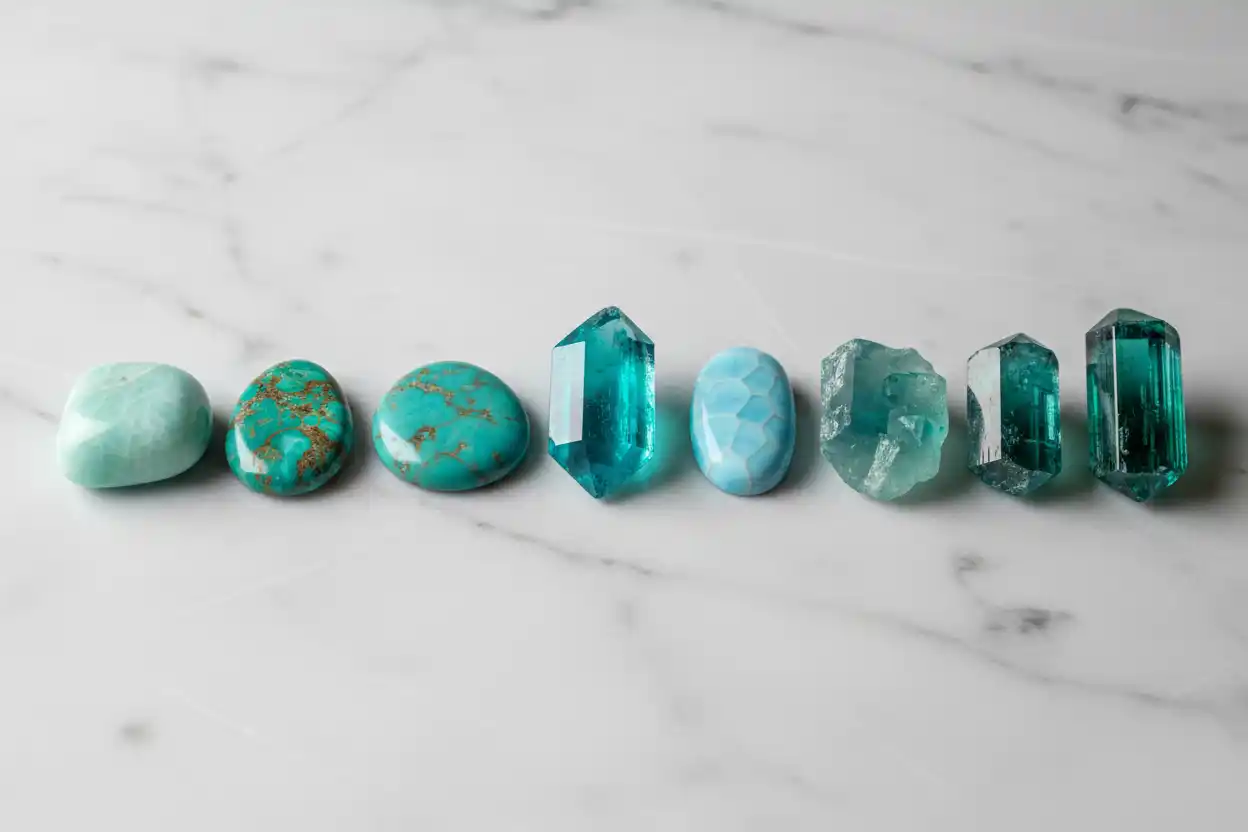

Teal crystals occupy the shifting color range between blue and green. Some appear pale aqua, others lean strongly turquoise, and the deepest examples approach blue-green or greenish navy.
The color does not identify one mineral family. Teal stones include feldspars, phosphates, carbonates, silicates, fluorides, rocks and mixed materials, each with different hardness, treatments and care requirements.
In modern crystal traditions, teal combines blue symbolism associated with communication and reflection with green symbolism associated with growth, balance and compassion. These meanings are cultural interpretations rather than measurable effects of color.
Teal Crystals at a Glance
| Teal crystal | Typical appearance | Common modern symbolism | Main care concern |
|---|---|---|---|
| Amazonite | Opaque pale blue-green | Honest boundaries and calm expression | Cleavage and feldspar softness |
| Turquoise | Opaque sky blue to greenish blue | Protection, wisdom and communication | Porosity, treatment and chemicals |
| Chrysocolla | Blue-green with brown or black matrix | Gentle speech and emotional composure | Variable softness and stabilization |
| Blue-green Apatite | Transparent to translucent teal | Motivation and clear intention | Mohs hardness near 5 |
| Paraíba Tourmaline | Vivid neon blue-green | Visibility and inspired communication | Treatment and high value |
| Indicolite | Deep blue to green-blue Tourmaline | Focused expression and introspection | Dark extinction and inclusions |
| Grandidierite | Blue-green to greenish blue | Perspective and resilience | Rarity and inclusion |
| Larimar | Pale sea blue to blue-green | Calm expression and adaptability | Low hardness and light sensitivity |
| Variscite | Opaque mint to teal green | Patience and emotional steadiness | Softness and porosity |
| Shattuckite | Rich blue-green in matrix | Truthfulness and careful speech | Soft specimen material |
| Smithsonite | Pale blue-green botryoidal forms | Gentleness and emotional ease | Softness and acid sensitivity |
| Green-blue Fluorite | Transparent aqua to teal | Organization and flexible thinking | Mohs 4 and perfect cleavage |
| Blue Kyanite | Blue with greenish zones | Direct communication and alignment | Variable hardness and cleavage |
| Blue Aventurine | Blue-green Quartz aggregate | Calm discipline and steady focus | Dye and trade-name confusion |
| Azurite-Malachite | Blue and green intergrowth | Insight joined with practical change | Copper minerals and acid sensitivity |
| Teal Sapphire | Transparent blue-green Corundum | Loyalty, clarity and durable commitment | Treatment disclosure |
| Blue Zircon | Bright blue to greenish blue | Clarity and renewed direction | Brittleness and heat treatment |
| Aquamarine | Pale green-blue to blue | Calm communication and perspective | Fractures and routine heat treatment |
What Counts as a Teal Crystal?
Teal lies between blue and green, but there is no universal gemological boundary defining where aqua ends, teal begins or turquoise becomes green.
Lighting makes the distinction more complicated. A stone may look blue in daylight, greener under warm indoor light and grayish in a photograph.
Transparency also affects color. A clear green-blue gem can look brighter than an opaque stone with the same basic hue.
For this guide, teal includes natural crystals and polished materials whose dominant appearance combines visible blue and green rather than fitting comfortably into only one category.
The companion teal gemstones guide focuses on gemological identity, jewelry performance and treatment. This page gives greater attention to crystal symbolism, specimens and practical use.
Teal Crystal Meaning
Teal blends two major color traditions.
Blue is associated symbolically with communication, calm reasoning, reflection and truth. Green represents growth, balance, compassion, renewal and connection with nature.
Combined, teal is often interpreted as thoughtful communication: speaking honestly without abandoning empathy.
The color may also represent adaptability. Teal does not belong completely to blue or green, making it a useful symbol for situations that require more than one perspective.
No mineral becomes emotionally or medically active merely because it appears teal. The usefulness of the color comes from the attention, memory and ritual a person builds around it.
1. Amazonite
Amazonite is a blue-green variety of Microcline feldspar. Its color can range from pale mint and aqua to stronger turquoise green, often with white streaks or grid-like patterns.
Modern traditions associate Amazonite with honest communication, balanced boundaries and expressing disagreement calmly.
Its symbolism works well for situations in which a person needs to say no without becoming hostile or explain a concern without over-apologizing.
Amazonite has feldspar cleavage and a Mohs hardness around 6–6.5. It can chip after impact and should be stored away from Quartz and harder gemstones.
Dye, coatings and imitation material occur. The guide to real versus fake Amazonite covers common substitutes, while treated Amazonite addresses enhancement concerns.
2. Turquoise
Turquoise is an opaque hydrated copper-aluminum phosphate that naturally ranges from blue to green.
Its color may be even or crossed by brown, black or tan matrix. Some people prefer a clear “robin’s egg” blue, while others value greenish-blue or matrix-rich material.
Across many cultures, Turquoise has carried protective, ceremonial and status-related meanings. Modern crystal use often emphasizes communication, wisdom and connection between practical experience and personal values.
The stone is relatively soft and porous. Stabilization, impregnation, dye and reconstruction are common, making disclosure essential.
The Turquoise buying guide explains quality and treatment, while the guide to real versus fake Turquoise covers imitations. The guide to types of Turquoise explains color, matrix and locality terminology.
3. Chrysocolla
Chrysocolla is a blue-to-green copper-bearing material commonly found with Quartz, Chalcedony, Malachite and other minerals.
Its composition and physical character can vary, which is why one piece may be soft and earthy while another takes a durable glassy polish.
Modern symbolism connects Chrysocolla with gentle communication, emotional composure and the ability to speak without escalating conflict.
It may serve as a reminder that calm language and firm boundaries are not opposites.
Soft or porous Chrysocolla may be stabilized. Quartz-rich material can be harder, but a commercial name alone does not reveal the exact composition.
The guide to cleansing Chrysocolla prioritizes conservative handling.
4. Blue-Green Apatite
Apatite can occur in vivid aqua, turquoise and green-blue colors that resemble Paraíba Tourmaline.
Modern crystal traditions associate teal Apatite with motivation, clear intention and turning scattered ideas into a defined direction.
Its bright color suits practices related to choosing a priority. A person might write one goal, one immediate step and one distraction to postpone.
Apatite ranks only about 5 on the Mohs scale and has cleavage. It scratches readily and is safer as a specimen, pendant or carefully handled stone than as an exposed daily ring.
The completed Apatite color meaning guide explains the symbolism of blue, green and yellow material. The guide to types of Apatite covers mineral and color varieties.
5. Paraíba Tourmaline
Paraíba Tourmaline is a copper-bearing Tourmaline famous for electric blue, greenish-blue and blue-green colors.
The finest gems can appear almost illuminated from within. This intensity has led to modern symbolism based on visibility, inspiration and speaking with confidence.
Natural copper-bearing material comes from Brazil, Nigeria and Mozambique. Origin and treatment can affect value, but color remains a major commercial factor.
Tourmaline ranks approximately 7–7.5 and suits many jewelry uses. Fractures, heating and high value still require informed care.
The Paraíba Tourmaline buying guide explains quality and origin, while the Paraíba Tourmaline price guide addresses current market factors.
6. Indicolite
Indicolite is blue Tourmaline. Some stones lean green enough to appear deep teal.
Modern traditions associate it with focused communication, introspection and choosing words deliberately.
Dark material may show considerable extinction, so the color can look almost black without strong lighting. A well-cut stone should preserve enough brightness to show its blue-green identity.
Tourmaline’s durability supports jewelry use, though elongated crystals and heavily included gems can fracture.
The guide to types of Tourmaline explains how Indicolite relates to green, pink, multicolored and copper-bearing varieties.
7. Grandidierite
Grandidierite is a rare blue-green borosilicate first described from Madagascar.
Transparent facetable material is uncommon. Many pieces are translucent or included, while fine gems show blue, green and colorless directional hues.
Modern symbolism links Grandidierite with perspective, resilience and remaining composed during uncertainty.
Its rarity makes identification and documentation important. Glass, Apatite and other blue-green gems can imitate its appearance.
The Grandidierite buying guide covers authenticity and quality, while the Grandidierite price guide addresses rarity and value.
8. Larimar
Larimar is blue Pectolite from the Dominican Republic.
Its pale blue, white and occasional greenish areas resemble tropical water, waves or cloud patterns. Modern traditions therefore associate it with calm expression, adaptability and emotional cooling.
Larimar is softer than Quartz and can scratch, chip and lose color after prolonged intense light exposure.
It is commonly cut into cabochons, beads and carvings rather than transparent faceted gems.
The guide to real versus fake Larimar covers resin, glass and dyed imitations. The completed Larimar versus Turquoise comparison separates two frequently confused blue materials.
9. Variscite
Variscite is a hydrated aluminum phosphate that occurs in green, mint, blue-green and teal shades.
It often forms as nodules and veins, sometimes with brown, black or tan matrix. Polished cabochons can resemble Turquoise.
Modern symbolism emphasizes patience, emotional steadiness and choosing a measured response.
Variscite is relatively soft and porous. It may be stabilized or backed for jewelry, and harsh chemicals can damage its surface.
Color alone cannot separate it reliably from Turquoise, Chrysoprase or dyed imitations.
10. Shattuckite
Shattuckite is a copper silicate known for rich blue, cyan and blue-green color.
It commonly occurs with Quartz, Chrysocolla, Malachite, Ajoite and other copper minerals.
Modern crystal traditions associate Shattuckite with truthfulness, thoughtful speech and listening before responding.
Much material is better suited to specimens and cabochons than exposed daily jewelry. Its hardness and durability vary according to matrix and associated minerals.
Avoid acids, prolonged soaking and abrasive cleaning.
11. Smithsonite
Smithsonite is zinc carbonate and often forms smooth botryoidal surfaces.
Its colors include white, pink, yellow, green, blue and blue-green. Teal specimens can look soft, waxy and almost translucent around their edges.
Modern symbolism connects Smithsonite with gentleness, emotional ease and reducing the pressure to resolve everything immediately.
The mineral ranks only about 4–4.5 and reacts with acids. Fine specimens should be handled minimally and stored away from harder crystals.
Most Smithsonite is a collector material rather than an everyday jewelry gem.
12. Green-Blue Fluorite
Green Fluorite can grade toward aqua, sea green and teal, particularly in color-zoned crystals.
Modern traditions associate Fluorite with organization, flexible thinking and separating useful information from mental clutter.
The crystal is attractive but physically delicate. It ranks 4 on the Mohs scale and has perfect cleavage.
Specimens should not be soaked, exposed to thermal shock or stored with harder minerals. Faceted jewelry is best reserved for protected occasional wear.
The guide to types of Fluorite covers blue, green, purple, yellow and multicolored varieties.
13. Blue Kyanite
Blue Kyanite may contain greenish or teal zones, especially where color is uneven.
Modern crystal symbolism connects it with direct communication, internal alignment and expressing a clear decision.
Kyanite has unusual directional hardness. It can be significantly softer in one direction than another and also has cleavage.
Bladed crystals are especially vulnerable to splitting. Rough pieces should be handled as specimens rather than carried loose in a pocket.
The guide to types of Kyanite explains blue, black, green and orange material.
14. Blue Aventurine
Blue Aventurine is a Quartz-based aggregate whose blue or blue-green appearance comes from mineral inclusions.
Modern traditions associate it with calm discipline, focused effort and reducing impulsive reactions.
Unlike transparent teal gems, it usually appears opaque to translucent and may contain subtle glitter.
Quartz gives it useful hardness, although the aggregate structure and inclusions may affect polish and durability.
Dyeing and trade-name confusion occur, so extremely uniform color deserves examination.
15. Azurite-Malachite
Azurite-Malachite combines blue Azurite with green Malachite.
The combined material may produce teal transitions where the colors meet. Each pattern reflects changing copper-mineral chemistry rather than one uniform mineral species.
Modern symbolism treats the pairing as insight joined with practical transformation: recognizing a truth, then acting on it.
Both minerals are relatively soft and sensitive to acids. Dust from cutting copper minerals should not be inhaled.
The completed Malachite versus Azurite comparison explains their individual properties.
16. Teal Sapphire
Sapphire can occur in blue-green, green-blue and teal colors.
These stones may show zoning, pleochroism or a balanced mixture of blue and green. Montana Sapphire is often associated commercially with teal shades, though similar colors can occur elsewhere.
Modern symbolism connects teal Sapphire with loyalty, thoughtful communication and commitments that allow growth.
Corundum’s Mohs hardness of 9 makes it one of the most durable teal gems for jewelry.
Heat treatment is common, while diffusion and laboratory-grown material also exist. The guide to types of Sapphire covers color varieties and terminology.
17. Blue Zircon
Zircon can appear bright blue, greenish blue or teal after heat treatment.
It has strong brilliance and dispersion, but it is brittle and may show abrasion along facet edges.
Modern crystal traditions associate blue Zircon with mental clarity, renewed direction and honest self-assessment.
Most vivid blue Zircon has been heated from brownish starting material. The treatment is common and should be disclosed.
The guide to types of Zircon covers blue, yellow, orange, red, green and colorless material.
18. Aquamarine
Aquamarine is the blue-to-greenish-blue variety of Beryl.
Natural rough often contains more green than the strongly blue stones favored in much of the modern market. Heating commonly reduces the green component.
Modern symbolism connects Aquamarine with calm communication, perspective and the ability to remain clear during emotionally charged conversations.
Its hardness of 7.5–8 supports regular jewelry wear, though fractures and filled stones require care.
The Aquamarine buying guide explains quality and treatment. The guide to types of Aquamarine covers color and trade varieties.
Teal Crystals for Communication
Amazonite, Turquoise, Chrysocolla, Shattuckite and Indicolite are the most common symbolic choices for communication.
Amazonite represents balanced boundaries. Turquoise carries long-standing associations with wisdom and protection, while Chrysocolla emphasizes gentler delivery.
Shattuckite is chosen for truthfulness and careful listening. Indicolite provides a more introspective interpretation suited to choosing words deliberately.
A crystal cannot resolve a communication problem independently. The practice becomes useful when it supports preparation, direct language and attentive listening.
Teal Crystals for Emotional Balance
Larimar, Variscite, Smithsonite and green-blue Fluorite are gentler choices within modern crystal traditions.
Larimar represents cooling an intense reaction. Variscite symbolizes patience, while Smithsonite suits a practice of reducing self-imposed pressure.
Fluorite can serve as a reminder to organize thoughts before responding.
These stones have different physical limits. Smithsonite and Fluorite are too soft for casual pocket carrying with other crystals.
Teal Crystals for Confidence
Paraíba Tourmaline, Apatite, teal Sapphire and blue Zircon provide brighter, more energetic symbolism.
Paraíba Tourmaline represents visibility. Apatite is associated with choosing direction, while Sapphire symbolizes commitment and disciplined action.
Zircon adds a theme of renewed clarity.
Confidence practices should remain behavior-based. The stone can mark the intention, but the person still needs to speak, decide or act.
Teal Chakra Associations
Modern color-based chakra systems often place teal stones between the throat and heart centers.
The throat chakra symbolizes communication and truth, while the heart chakra represents compassion and connection. Teal is therefore interpreted as speaking honestly without abandoning empathy.
These associations are contemporary spiritual frameworks rather than fixed historical rules. Different traditions use different colors and chakra maps.
The planned throat and heart chakra pages will provide fuller context after publication.
How to Choose a Teal Crystal
Begin with the intended use.
For jewelry, teal Sapphire, Aquamarine, Tourmaline and Zircon provide greater durability than Fluorite, Smithsonite or Chrysocolla.
For mineral display, Shattuckite, Fluorite, Smithsonite and Azurite-Malachite offer rich natural structures that should remain protected rather than worn.
For symbolic practice, choose the stone whose meaning supports a specific action. Amazonite may accompany a boundary statement, while Variscite can support patient reflection.
Then verify authenticity and treatment. Teal is easily reproduced through dye, coatings, glass and composites.
Cleansing and Physical Care
No cleansing method suits every teal crystal.
Turquoise, Variscite and Chrysocolla can be porous or stabilized. Fluorite and Smithsonite are soft, while Kyanite and Apatite have cleavage.
Sound, visualization and placement on a clean dry cloth are broadly conservative spiritual methods.
Avoid salt beds, acids, prolonged soaking and direct intense sunlight unless the material and treatment history are known.
The guide to crystals that can go in water explains why mineral identity matters more than color. The guide to crystals that fade in sunlight covers light-sensitive materials and treatments.
Frequently Asked Questions
1. What are teal crystals?
They are natural crystals, rocks and gem materials whose visible color combines blue and green. Teal is a color description rather than a mineral species.
2. Which crystal is the truest teal color?
Paraíba Tourmaline, teal Sapphire, blue-green Apatite and some Turquoise can show especially balanced blue-green color.
3. What do teal crystals symbolize?
Modern traditions associate them with compassionate communication, emotional balance, growth and adapting to change.
4. Which teal crystal is best for communication?
Amazonite, Turquoise, Chrysocolla, Shattuckite and Indicolite are common symbolic choices.
5. Which teal stone is most durable?
Teal Sapphire is the hardest common option. Aquamarine and Tourmaline also provide strong jewelry durability.
6. Which teal crystals are too soft for daily jewelry?
Fluorite, Smithsonite, Variscite and many Chrysocolla-rich materials require considerable protection.
7. Is Paraíba Tourmaline always teal?
No. It can appear blue, green, violet, greenish blue or bluish green. The trade term depends on copper-bearing chemistry, not one exact shade.
8. Is Turquoise naturally teal?
Yes. Natural Turquoise ranges from blue to green and can occupy a teal range, although treatment and dye are common.
9. Is teal Sapphire natural?
Natural blue-green Sapphire exists. Heat, diffusion and laboratory-grown material also occur, so treatment disclosure matters.
10. Can teal crystals go in water?
Some can tolerate brief washing, but many should not be soaked. Turquoise, Chrysocolla, Variscite, Fluorite and matrix-rich specimens need conservative care.
11. Are teal crystals associated with the throat chakra?
Modern color-based systems often connect them with the throat chakra and sometimes the heart chakra. These are spiritual associations rather than anatomical effects.
12. How can I tell whether a teal crystal is dyed?
Look for color concentrated in cracks and drill holes, unnaturally uniform saturation, surface coatings or color that does not continue beneath a chipped area. Professional testing is safest for valuable material.
Teal crystal meanings, chakra associations and healing claims belong to spiritual and cultural traditions and are not scientifically established medical effects. Do not ingest mineral specimens or prepare crystal drinking water with materials of uncertain composition, treatment or matrix.