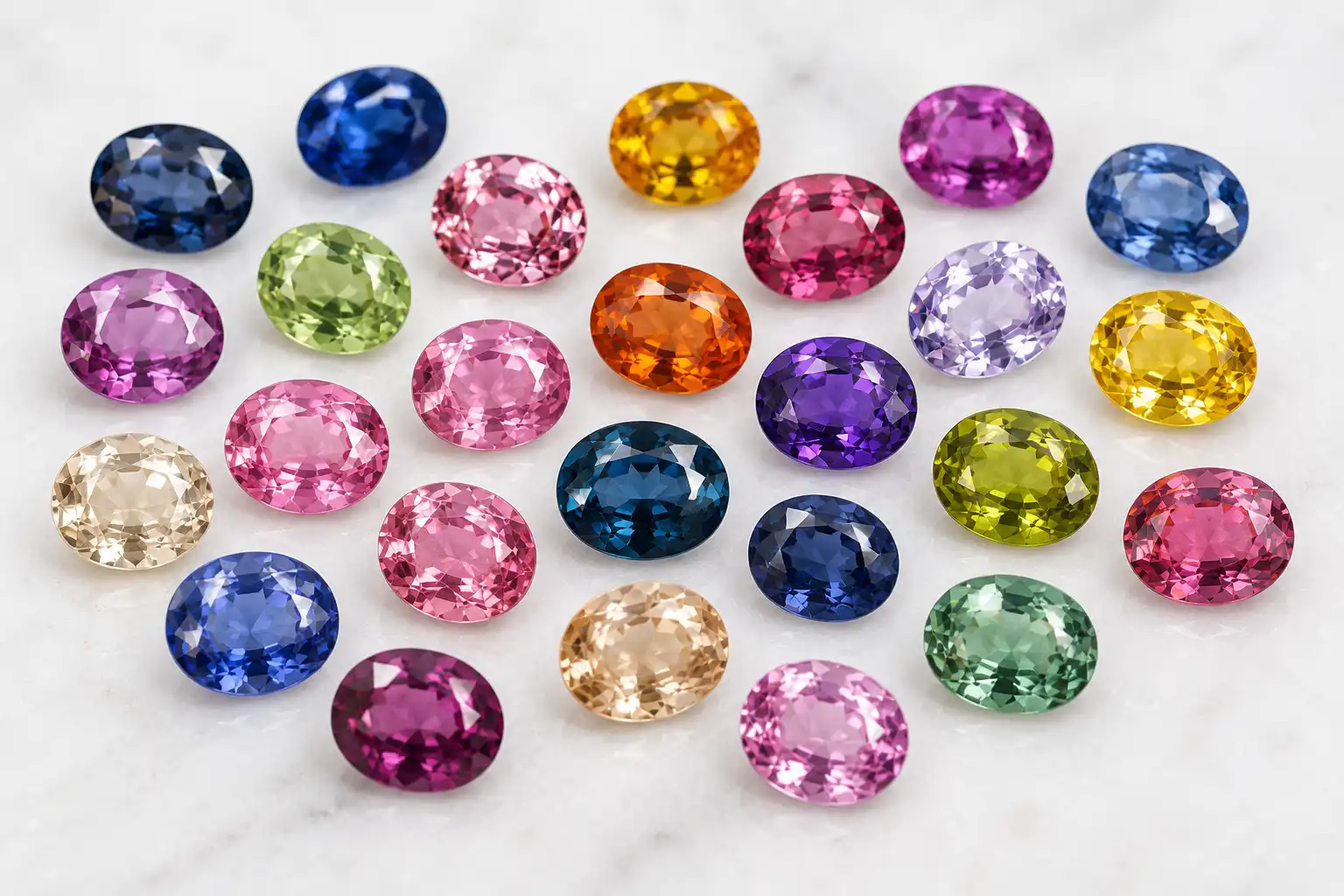
Types of Sapphire: A Complete Guide to the Family
Sapphire is the name given to gem-quality corundum in every color except the red range classified as ruby. Blue is the best-known variety, yet sapphire can also be pink, yellow, orange, green, teal, purple, gray, black, colorless, multicolored, star-bearing, or color-changing.
Its practical types are defined by hue, tone, saturation, trace-element chemistry, locality, transparency, optical effect, treatment, and natural or laboratory growth. The parent sapphire meaning and properties guide covers the mineral broadly, while this page owns sapphire’s color and variety classification.
Sapphire at a Glance
| Property | Sapphire |
|---|---|
| Composition | Aluminum oxide, Al₂O₃, colored by iron, titanium, chromium, vanadium, magnesium, and other trace elements or defects |
| Mineral group | Corundum |
| Main colors | Blue, violet-blue, greenish blue, teal, pink, yellow, orange, padparadscha, green, purple, gray, black, brown, and colorless |
| Crystal system | Trigonal |
| Typical habit | Barrel-shaped, prismatic, tabular, bipyramidal, rounded alluvial crystals, massive material, and cabochons |
| Luster | Vitreous to subadamantine |
| Transparency | Transparent to opaque |
| Mohs hardness | 9 |
| Cleavage | No true cleavage; parting can occur |
| Tenacity | Brittle, though generally durable when structurally sound |
| Common uses | Rings, engagement rings, earrings, necklaces, bracelets, cabochons, watch components, windows, bearings, and optical technology |
| Main care concern | Diffusion treatment, fracture filling, unstable color, surface-reaching fissures, synthetic material, and misleading origin or trade-color claims |
Sapphire and Ruby
Sapphire and ruby are varieties of the same corundum mineral.
Red corundum is ruby. Corundum in blue and every non-red color is sapphire.
The boundary between pink sapphire and pinkish ruby can vary among laboratories and trade traditions. Therefore, a report may be important when classification materially affects value.
The detailed red-corundum families appear in types of ruby.
What Creates Sapphire Colors?
Pure corundum is colorless.
Blue commonly develops through interactions involving iron and titanium. Chromium produces pink and red, while iron can create yellow, green, and brown components.
Vanadium may contribute to violet or color-change behavior. Magnesium, trapped holes, lattice defects, irradiation-related centers, and interactions among multiple trace elements create additional colors.
The same elements can produce different results depending on oxidation state, concentration, crystal growth, heat history, and neighboring defects.
Blue Sapphire
Blue sapphire ranges from pale sky blue and gray-blue to cornflower, royal, navy, violet-blue, and greenish blue.
Fine blue sapphire has strong saturation, medium-to-medium-dark tone, high transparency, and even face-up color. Excessively light stones appear washed out, while overly dark examples lose brilliance.
Color zoning is common. A cutter may orient concentrated blue bands beneath the table, but poor orientation can create patchy color or a dark center.
Blue sapphire is included among the stones compared in the blue gemstones guide, although its hardness and corundum identity distinguish it from topaz, aquamarine, spinel, and kyanite.
Royal Blue Sapphire
Royal blue is a prestigious trade color term for strongly saturated blue sapphire.
No single international colorimetric definition applies across every laboratory. Respected laboratories use master stones and their own criteria involving hue, tone, saturation, transparency, zoning, treatment, and visual performance.
A sapphire does not qualify simply because a seller calls it royal blue. Laboratory wording should support an expensive claim.
The term can apply to sapphires from more than one country. It is a color designation rather than proof of Kashmir, Myanmar, or Sri Lankan origin.
Cornflower Blue Sapphire
Cornflower blue describes a moderately saturated, lively blue that is generally lighter and softer than deep royal blue.
The name is associated historically with Kashmir and Sri Lankan sapphire, but it is now used broadly in retail descriptions.
Like royal blue, cornflower is not governed by one universal trade standard. A well-balanced medium-blue stone can be beautiful without receiving the term.
Kashmir Sapphire
Kashmir sapphire comes from historic deposits in the Himalayan region.
Fine stones are famous for velvety, saturated blue created partly by microscopic inclusions that scatter light without destroying transparency.
Mining production was limited, and verified material is exceptionally scarce. Origin reports, historic provenance, treatment status, and quality all affect value.
“Kashmir color” or “Kashmir blue” should not be used as a substitute for proven geographic origin.
Burmese Sapphire
Myanmar produces blue, colorless, yellow, pink, star, and other sapphires.
Fine Burmese blue sapphire can show rich saturation and strong transparency. Mogok is the best-known historic region, although production occurs elsewhere.
Origin alone does not establish royal-blue quality. Dark, included, or heavily treated Burmese stones may be less valuable than fine material from another country.
Sri Lankan or Ceylon Sapphire
Sri Lanka has produced sapphire for centuries from extensive alluvial deposits.
Colors include blue, yellow, pink, orange, padparadscha, green, purple, colorless, star, and color-change varieties.
Sri Lankan blue sapphire is commonly associated with medium-to-light tone and strong brightness, although dark stones also occur.
The commercial term Ceylon sapphire refers to Sri Lankan origin, not a single shade or quality grade.
Madagascar Sapphire
Madagascar is one of the most important modern sapphire sources.
Deposits produce blue, pink, yellow, orange, green, colorless, star, and padparadscha-like stones in a wide range of qualities.
Some Madagascar sapphires resemble material from Sri Lanka, Myanmar, or Kashmir closely enough that advanced laboratory analysis is required for origin determination.
Australian Sapphire
Australia produces large quantities of basalt-related sapphire.
Material commonly appears dark blue, greenish blue, teal, yellow, green, black, or parti-colored. Higher iron content can produce strong saturation and reduced fluorescence.
Dark commercial stones may appear nearly black in deep cuts, while carefully oriented lighter Australian sapphires can show attractive blue-green or teal color.
Montana Sapphire
Montana sapphires come from several deposits in the United States, including Yogo Gulch, Rock Creek, and Missouri River gravels.
Colors include blue, green, teal, gray, yellow, pink, and parti-color. Many Montana sapphires are relatively small, though larger stones occur.
Yogo sapphires are known for naturally attractive blue-to-violet-blue color and generally do not require the same level of heat treatment as much commercial rough. However, origin claims require documentation.
Modern interest in teal and parti-color stones has increased the visibility of Montana sapphire.
Teal Sapphire
Teal sapphire combines blue and green.
The balance may range from blue-dominant ocean tones to equal blue-green or green-dominant forest teal. Gray and yellow modifiers can also appear.
Australian, Montana, Madagascar, Nigerian, Ethiopian, and other deposits produce teal material.
Teal is a commercial color category rather than a trace-element variety. Fine stones have deliberate-looking color, good brightness, and limited extinction.
Green Sapphire
Green sapphire ranges from pale mint and yellow-green to forest, olive, blue-green, and dark green.
Iron-related absorption commonly contributes to the color. Some green stones consist of very fine alternating blue and yellow zones that visually blend.
Green sapphire is generally less expensive than comparable blue or padparadscha material, although vivid clean stones have a growing designer market.
Pink Sapphire
Pink sapphire ranges from pale blush and rose to hot pink, magenta, and purplish pink.
Chromium creates the color. As chromium concentration and red saturation increase, the material approaches the ruby boundary.
Fine pink sapphire should have even color and strong brightness. Brown or gray modifiers generally reduce value, while vivid hot pink can command significant premiums.
Pink sapphire appears in the broader pink gemstones guide alongside spinel, morganite, tourmaline, and other gems.
Purple and Violet Sapphire
Purple sapphire can appear lavender, lilac, violet, grape, plum, or reddish purple.
Chromium, vanadium, iron, titanium, and color centers may contribute. Some stones shift noticeably between cool and warm light.
Purple sapphire usually sells below fine blue, pink, or padparadscha material, yet clean vivid examples remain attractive and durable.
The broader purple gemstones guide compares its appearance with amethyst, spinel, tanzanite, and iolite.
Yellow Sapphire
Yellow sapphire ranges from pale lemon and straw to canary, golden, honey, and orange-yellow.
Iron and color centers commonly create the color. Heat treatment and irradiation-related processes can modify yellow appearance.
Some yellow sapphires contain an unstable color component that fades or strengthens after light or heat exposure. Reputable laboratories may perform stability testing before finalizing a report.
Yellow sapphire is often confused with citrine, topaz, chrysoberyl, synthetic sapphire, and glass. The dedicated citrine versus yellow sapphire guide owns that comparison.
The Vedic-tradition intent remains with Pukhraj yellow sapphire, rather than this color-classification page.
Orange Sapphire
Orange sapphire ranges from pale apricot and yellow-orange to vivid mandarin and reddish orange.
Iron, chromium, lattice defects, and treatment can contribute. Strong orange material may approach padparadscha if it also contains the required pink component.
Beryllium diffusion has produced vivid orange and yellow-orange sapphire, so treatment analysis matters.
Orange sapphire appears among related materials in the orange gemstones guide.
Padparadscha Sapphire
Padparadscha sapphire is a rare pinkish-orange to orangy-pink sapphire.
The name comes from a Sinhalese word associated with a lotus blossom. Laboratories apply specific boundaries to hue, tone, saturation, uniformity, treatment, and color stability.
Pure orange, pure pink, strongly brown, excessively dark, or certain treated stones may not qualify.
Some sapphires gain or lose an orange component after light exposure. Laboratory stability testing therefore plays an important role.
Sri Lanka has the strongest historic association, while Madagascar and Tanzania also produce qualifying or padparadscha-like material.
The dedicated padparadscha sapphire buying guide owns the complete transaction intent.
Colorless Sapphire
Colorless sapphire is corundum without enough color-producing impurities or defects to create a visible body color.
It may occur naturally, form through laboratory growth, or result from treatment of pale material.
Before diamond simulants such as cubic zirconia became widespread, colorless synthetic sapphire was frequently used as an imitation diamond.
It has high hardness but less brilliance and fire than diamond. Grayness, silk, zoning, and poor cutting can further reduce its brightness.
Gray Sapphire
Gray sapphire ranges from pale silver and smoke to dark charcoal.
It may contain blue, violet, green, or brown modifiers. Dense silk and inclusions can create a soft metallic or misty appearance.
Gray stones have become popular in alternative jewelry, especially when they retain visible brilliance or attractive color zoning.
Black Sapphire
Black sapphire is opaque or nearly opaque dark corundum.
Its appearance may come from dense inclusions, iron-rich color, fractures, or a naturally dark body. Some stones transmit dark blue or green at thin edges.
Black sapphire is used for cabochons, beads, men’s jewelry, and star stones. It should not be confused with black spinel, onyx, tourmaline, or treated black diamond.
Parti-Color Sapphire
Parti-color sapphire contains two or more visibly distinct colors within one stone.
Blue and yellow zones can create blue-green or teal transitions. Green-yellow, blue-clear, pink-yellow, and other combinations also occur.
Australian and Montana sapphires are especially associated with parti-color material, although it occurs elsewhere.
The best cuts use zoning deliberately so the colors remain balanced face-up. Poor orientation can create a distracting pale patch or one dark corner.
Color-Change Sapphire
Color-change sapphire appears different under light sources with different spectral output.
A common change is blue or violet-blue in daylight-equivalent illumination to purple or reddish purple under incandescent light. Green-to-red, gray-to-purple, and other combinations also occur.
The strength of change depends on trace elements, defects, thickness, and lighting. Pleochroism can complicate visual assessment because directional colors may mimic a light-source shift.
Fine color-change sapphire should show a distinct and attractive transformation rather than a minor tonal difference.
Star Sapphire
Star sapphire displays asterism when oriented needle-like inclusions reflect light across a cabochon.
A six-rayed star is most common. Twelve-rayed stars can occur when two inclusion systems intersect at different angles.
Fine star sapphire has an attractive body color, centered star, straight complete rays, smooth movement, and enough translucency to show depth.
Blue, pink, purple, gray, white, yellow, and black star sapphires exist. Synthetic star sapphire is also common.
Black Star Sapphire
Black star sapphire commonly shows a gold, silver, or white star against a dark body.
Some examples contain hematite or ilmenite-related inclusions rather than only rutile. Different inclusion systems can affect ray color and number.
A sharp star does not compensate for a badly cracked or artificially assembled stone.
Trapiche Sapphire
Trapiche sapphire has a fixed six-rayed growth pattern divided by dark sectors or arms.
It differs from star sapphire because its rays are structural and stationary rather than a reflected light phenomenon moving across the surface.
Trapiche patterns may involve carbonaceous material, mineral inclusions, growth sectors, or compositional boundaries.
The rough is cut perpendicular to the crystal axis to display the structure.
Geuda Sapphire
Geuda is a Sri Lankan trade category for pale, cloudy, silky, or low-transparency corundum rough that can respond strongly to heat treatment.
Heating may dissolve rutile silk, improve transparency, and create or strengthen blue color.
The term describes starting material and treatment potential rather than one final sapphire variety.
After heating, the resulting stone should be sold according to its actual color and treatment status rather than relying solely on the word geuda.
Untreated Sapphire
Untreated sapphire shows no detectable evidence of heat or other enhancement.
Fine untreated blue, padparadscha, pink, yellow, and color-change sapphires command premiums because heating is widespread.
Untreated status alone does not guarantee quality. Color, clarity, size, and cut remain decisive.
Heated Sapphire
Heat treatment can improve color, reduce zoning, dissolve silk, increase transparency, and alter included minerals.
Conventional heating is widely accepted when disclosed. Fine heated sapphire remains valuable, particularly when its color and cut are strong.
Low-temperature heating and high-temperature processing can leave different evidence. Laboratory testing is needed because not all treatment signs are visible with a loupe.
Diffusion-Treated Sapphire
Lattice diffusion uses high heat and added elements to change color or create asterism.
Titanium diffusion commonly creates blue near the surface. Beryllium diffusion can produce yellow, orange, pink-orange, and other colors extending deeper into the stone.
Shallow color can be altered during repolishing or recutting. Diffusion-treated sapphire generally sells for less than conventionally heated material of similar appearance.
The dedicated treated sapphire guide owns detailed treatment identification.
Fracture-Filled and Composite Sapphire
Glass, flux, or other materials may fill fractures and cavities.
The filler can improve transparency but reduce heat and chemical resistance. Heavily filled sapphire belongs to a lower value and care category.
Composite stones may combine natural sapphire with synthetic sapphire, glass, or another backing. Layer boundaries can be visible around the girdle or under magnification.
Laboratory-Grown Sapphire
Lab sapphire is synthetic corundum produced by flame fusion, flux, hydrothermal, Czochralski, Kyropoulos, or related growth methods.
Manufacturers can create blue, pink, yellow, orange, green, purple, colorless, color-change, and star material.
Flame-fusion sapphire is abundant and may show curved growth lines and gas bubbles. Flux-grown material can contain natural-looking inclusions.
Synthetic origin should always be disclosed. It is not the same as a glass or cubic-zirconia imitation.
Sapphire Inclusions
Natural sapphire may contain rutile silk, zircon crystals, feldspar, mica, apatite, spinel, negative crystals, fingerprints, color bands, cavities, and healed fissures.
Inclusions can support natural origin and contribute to locality interpretation. However, origin determination relies on multiple observations and chemical data.
Fine silk can create a velvety appearance or star effect. Dense silk reduces transparency.
Zircon inclusions may show stress halos, while heat can alter or partially dissolve several inclusion types.
Sapphire Identification and Lookalikes
Sapphire can resemble spinel, tanzanite, kyanite, topaz, tourmaline, zircon, glass, and synthetic corundum.
The kyanite versus sapphire guide separates two common blue lookalikes. The tanzanite versus sapphire guide covers pleochroism, cleavage, hardness, and color.
The broader sapphire, emerald, and ruby comparison addresses major-jewelry selection.
The real versus fake sapphire guide owns consumer warning signs.
Refractive index, birefringence, pleochroism, spectroscopy, microscopy, fluorescence, trace chemistry, and growth structures provide reliable evidence.
Cutting Behavior
Sapphire rough often contains strong zoning and pleochroism.
Cutters orient blue stones to place the preferred blue direction face-up while avoiding excessive green or gray. They also position color bands to improve apparent saturation.
Ovals and cushions preserve weight from barrel-shaped and water-worn rough. Rounds demand greater loss.
Dark Australian material may require shallow cutting, while pale Sri Lankan material may benefit from deeper proportions. Excessively shallow stones show windows, whereas deep cuts create extinction.
Star and trapiche stones require cabochon or cross-sectional orientation rather than conventional faceting.
Durability and Jewelry Suitability
Sapphire has Mohs hardness 9 and excellent scratch resistance. The gemstone hardness chart places it below diamond but above almost every other mainstream colored gem.
It lacks true cleavage, although parting and fractures can create chips. The distinction appears in the gemstone cleavage guide.
Sound untreated and conventionally heated sapphire is suitable for daily-wear rings, earrings, pendants, necklaces, and bracelets.
Fracture-filled, composite, heavily included, and certain diffusion-treated stones require additional care.
Sapphire Prices in 2026
Sapphire prices vary according to color, treatment, origin, clarity, cut, size, and laboratory documentation.
Commercial blue and fancy-color sapphires commonly range from approximately $50–$500 per carat.
Good-quality heated blue sapphires near one carat often fall around $500–$3,000 per carat. Fine vivid stones, especially above two carats, can reach $3,000–$15,000 per carat.
Exceptional untreated Sri Lankan, Burmese, Madagascar, or other fine-origin blue sapphires may exceed $10,000–$30,000 per carat. Verified historic Kashmir material can command far higher auction prices.
Commercial pink, yellow, green, teal, purple, and parti-color sapphires often range from $100–$2,000 per carat, with vivid, clean, untreated, or unusual examples moving substantially higher.
Fine padparadscha sapphire commonly occupies approximately $2,000–$20,000-plus per carat, depending on color balance, stability, treatment, size, and origin.
Star sapphire may range from $50–$1,500 per carat, while exceptional translucent stones with sharp stars can exceed that range.
Laboratory-grown sapphire is much less expensive, although precision cutting and branded settings add cost.
The dedicated sapphire price guide should retain detailed future pricing.
Buying Guidance
Choose the exact color category before comparing price.
Blue, teal, pink, padparadscha, yellow, star, and parti-color stones have different quality priorities. One universal sapphire grading formula does not work for every type.
Assume heat may be present unless an independent report states otherwise. Ask specifically about diffusion, fracture filling, irradiation, coating, and synthetic origin.
For valuable stones, verify the report number, measurements, treatment statement, and any origin or trade-color terminology.
The complete buying process belongs in the sapphire buying guide. Laboratory-report scope appears in gemstone certification.
Sapphire Jewelry
A sapphire engagement ring offers strong daily-wear durability when the stone and setting are sound.
Sapphire rings include solitaires, halos, three-stone designs, bezels, clusters, and parti-color custom settings.
Sapphire earrings suit matched pairs and protect rare colors from heavy impact.
A sapphire necklace can feature faceted gems, beads, stars, or cabochons, while sapphire bracelets require secure links and protected girdles.
Cleaning and Storage
Warm soapy water is generally safe for untreated and conventionally heated sapphire.
Ultrasonic and steam cleaning may be suitable for many sound stones, but not for fracture-filled, cavity-filled, composite, dyed, or heavily fractured material.
The complete care process belongs in how to clean sapphire jewelry.
Store sapphire separately from diamond and other sapphires because equally hard stones can scratch one another.
Meaning and Symbolism
Sapphire has represented wisdom, loyalty, authority, truth, protection, and spiritual commitment across different cultural traditions.
Blue sapphire is commonly associated with insight and constancy, pink with affection, yellow with optimism, green with renewal, and parti-color stones with complexity or balance.
The detailed symbolic color intent belongs in the sapphire color meaning guide.
Sapphire is the traditional subject of the September birthstone guide.
These meanings arise from history, spiritual practice, and personal interpretation. They are not scientifically demonstrated effects of trace elements within corundum.
Frequently Asked Questions
1. How many sapphire colors exist?
Sapphire occurs in nearly every color except the red range classified as ruby, including blue, pink, yellow, orange, green, teal, purple, gray, black, brown, and colorless.
2. What is the most valuable sapphire type?
Exceptional untreated Kashmir blue sapphire occupies the highest historic market tier. Fine royal-blue, padparadscha, color-change, pink, and star sapphires can also be extremely valuable.
3. Is royal blue a formal scientific color?
No. It is a prestigious trade term assessed through individual laboratory standards rather than one universal international definition.
4. What is cornflower blue sapphire?
It is a commercial description for a lively medium blue, generally lighter and softer than deep royal blue.
5. What makes padparadscha sapphire different?
Padparadscha has a carefully balanced pinkish-orange to orangy-pink color and must meet laboratory criteria involving hue, tone, saturation, treatment, and stability.
6. Is teal sapphire naturally colored?
Yes, natural blue-green and greenish-blue sapphire exists. Heating and other treatment can also modify color, so disclosure remains important.
7. What is parti-color sapphire?
It is a sapphire containing two or more clearly visible color zones, commonly blue and yellow or blue and green.
8. What creates a star sapphire?
Oriented rutile, hematite, or related needle-like inclusions reflect light across a correctly oriented cabochon.
9. Is heated sapphire real?
Yes. It is natural corundum whose color or clarity has been improved through heat treatment.
10. Is white sapphire a diamond?
No. It is colorless corundum with lower brilliance and dispersion than diamond but excellent hardness.
11. Can sapphire change color?
Yes. Color-change sapphire may appear blue or violet in daylight-equivalent light and purple or reddish under incandescent illumination.
12. Is lab-grown sapphire genuine sapphire?
It is synthetic corundum with the same basic composition and structure as natural sapphire, but its laboratory origin must be disclosed.
Sapphire’s types demonstrate the full versatility of corundum. A velvety Kashmir blue, bright Sri Lankan stone, Australian teal, Montana parti-color, delicate padparadscha, purple color-change gem, six-rayed star, and laboratory-grown crystal share the same aluminum-oxide framework, yet their trace chemistry and market identities differ. Related S entries appear in the crystals that start with S directory and the gemstones that start with S guide.