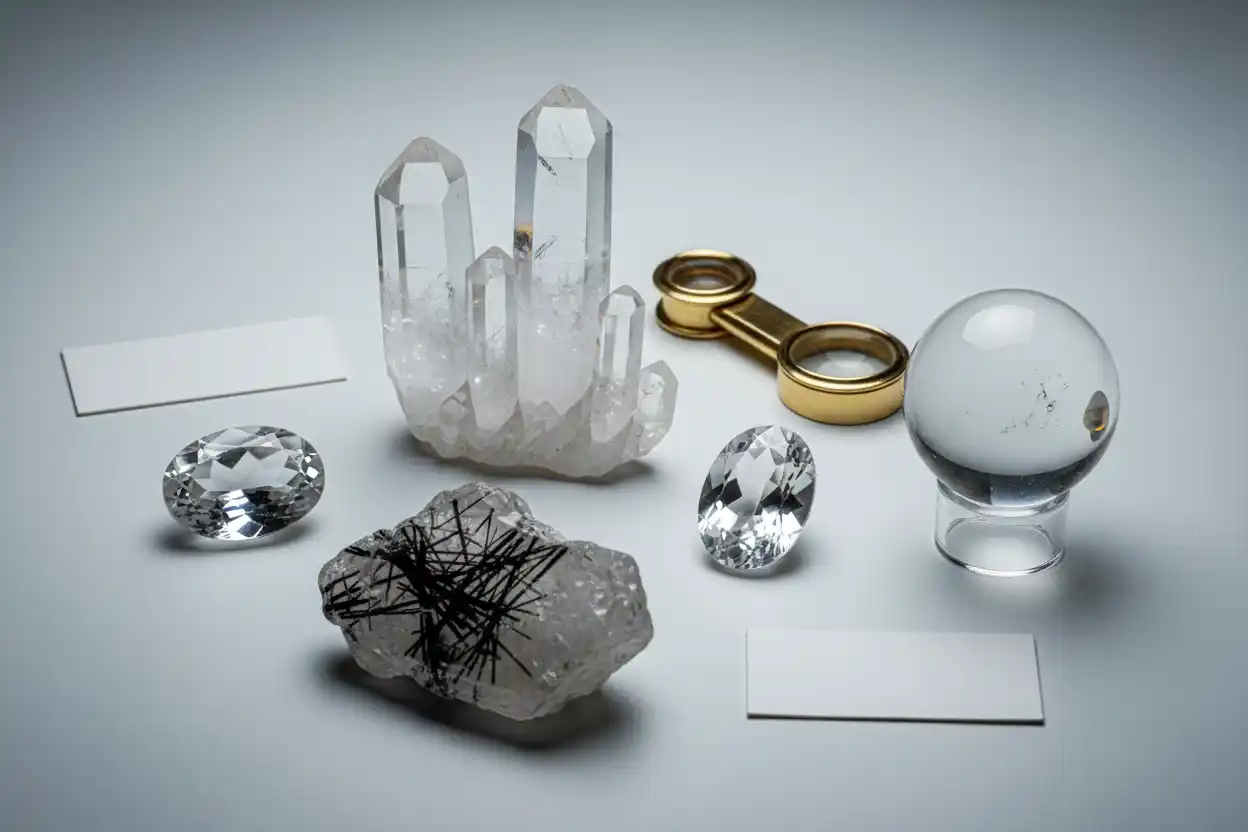
Where to Buy Real Clear Quartz and Avoid Glass or Synthetic Fakes
Clear quartz is abundant, but buying it well is not always simple. The market includes natural rock crystal, hydrothermally grown synthetic quartz, ordinary glass, lead glass, resin, reconstructed clusters, coated quartz, heat-crackled material and natural crystals whose surfaces have been polished or repaired.
Many imitation products look convincing because natural quartz can be remarkably clear, while manufactured glass can contain imperfections. Bubbles do not automatically prove glass, and flawless transparency does not automatically prove synthetic growth.
The best purchase begins with the intended product. A collector buying a natural crystal point needs reliable growth surfaces and locality information. A jewelry buyer needs gemological identity and cutting quality. Someone purchasing a sphere or carved tower needs disclosure of cracks, coatings and assembly.
The clear quartz meaning and properties guide covers the variety’s identity and traditional symbolism. This page focuses on sellers, natural versus synthetic quartz, glass imitations, crystal construction, treatments and value.
Rock Crystal Is the Canonical Clear Quartz Alias
Rock crystal is the traditional mineral and gem name for transparent colorless quartz. Under the tracker’s alias rule, Rock Crystal routes to Clear Quartz rather than requiring a duplicate page.
The two terms can be used together: “natural clear quartz, also called rock crystal.” A seller should not present Rock Crystal as a rarer species or a scientifically stronger grade.
Clear quartz consists of silicon dioxide, SiO2, and crystallizes in the trigonal system. Well-formed crystals commonly develop six-sided prisms capped by rhombohedral faces.
Quartz has Mohs hardness 7, vitreous luster and conchoidal fracture. It lacks the prominent cleavage found in calcite, fluorite and feldspar.
The quartz family guide provides the wider context, while the types of clear quartz guide separates natural habits, inclusions and commercial varieties.
Choose the Product Form Before Shopping
| Clear quartz product | Best source | Main buying concern |
|---|---|---|
| Natural crystal point | Specialist mineral dealer | Natural versus polished faces, repaired termination and locality |
| Cluster | Mineral dealer or mineral show | Glued crystals, reconstructed base and concealed damage |
| Faceting rough | Colored-stone rough dealer | Internal fractures, synthetic quartz and usable yield |
| Faceted gemstone | Gem dealer | Quartz versus glass and synthetic origin |
| Sphere | Lapidary retailer | Glass, resin, internal fractures and coating |
| Carved tower | Experienced crystal retailer | Artificial point, repaired tip and material identity |
| Cabochon | Gem dealer or lapidary | Glass substitution, backing and inclusions |
| Beads | Established bead supplier | Glass, synthetic quartz and drill-hole fractures |
| Included quartz | Specialist dealer | Natural inclusion, artificial insertion and trade-name accuracy |
| Jewelry | Jeweler with treatment disclosure | Assembly, coating, glue and metal quality |
| Optical or educational crystal | Mineralogical supplier | Synthetic industrial quartz versus natural specimen |
| Large display specimen | Dealer with shipping expertise | Structural cracks, repairs and packing risk |
A carved tower can be genuine quartz without being a naturally terminated crystal. The seller should state which feature is natural and which was shaped.
Where to Buy Genuine Clear Quartz
Specialist mineral dealers
A knowledgeable mineral dealer is the best source for natural points, clusters, matrix specimens and documented localities.
Listings should show the base, terminations, side faces and any contact damage. Ask whether the specimen was repaired, acid-cleaned, polished or coated.
A naturally terminated point normally preserves growth faces, fine striations, irregular contacts and a base related to its geological setting. A machine-polished point has smooth, regular facets and a cut base.
Both can be attractive, but their collector value differs.
Gem and mineral shows
Shows allow direct comparison among natural quartz, synthetic crystals and glass.
Under a loupe, look for natural fluid inclusions, mineral inclusions, healed fractures, growth zoning, polishing marks, bubbles and mold seams.
Do not rely on one feature. Natural quartz can contain gas bubbles within fluid inclusions, and manufactured glass can be made with very few bubbles.
The crystal identification guide explains how habit, optical properties and laboratory measurements should work together.
Colored-stone and faceting dealers
A specialist gem dealer is the right source for clean faceted rock crystal, calibrated stones and high-clarity rough.
Ask whether the material is natural or hydrothermal synthetic quartz. Both have the same essential chemical composition and many similar physical properties.
Natural-origin claims should be supported by inclusions, growth features, infrared spectroscopy or a laboratory report when the price justifies testing.
Established online shops
The online gemstone buying guide explains how to assess seller identity, payment protection and returns.
For clear quartz, insist on exact-item photographs for crystal points, clusters, included stones and spheres. Internal fractures and terminations vary too much for one stock image to represent every item.
Request videos against both light and dark backgrounds. A dark background reveals scratches and cloudiness, while a light background makes bubbles and inclusions easier to see.
Independent lapidaries and jewelry makers
A maker who cut the stone may know whether it began as natural or synthetic rough. Ask for pre-cut photographs when purchasing expensive included or unusual quartz.
For closed jewelry settings, request an image of the loose stone before mounting. Cement layers, foil and colored backing can remain hidden after setting.
What Natural Clear Quartz Looks Like
Natural rock crystal ranges from nearly flawless transparency to heavily included, veiled or cloudy material.
Common internal features include fluid inclusions, healed fractures, negative crystals, wispy veils, mineral needles, chlorite, hematite, rutile, tourmaline and numerous other inclusions.
Crystal surfaces may show horizontal striations, growth hillocks, etching, contact faces and small irregularities. Not every natural point is symmetrical or sharply terminated.
A crystal can be natural yet polished. Sellers may polish one face to reveal inclusions, reshape a damaged termination or cut a completely new tower from massive quartz.
Clarity alone does not establish natural origin. Hydrothermal synthetic quartz can be exceptionally clean, but natural crystals can also be eye-clean.
The raw-versus-polished crystal guide explains the practical differences between preserved surfaces and shaped lapidary products.
Natural Quartz Versus Glass
The glass-versus-crystal guide owns the broader comparison. Clear quartz and glass can look similar because both are transparent silicate-rich materials with vitreous luster.
Glass commonly shows round bubbles, flow lines, mold seams and conchoidal fracture. Quartz can contain irregular fluid inclusions and healed cracks, which may include small gas bubbles inside liquid-filled cavities.
A bubble floating alone within a perfectly uniform body supports glass, but it is not definitive. A bubble enclosed within an angular fluid inclusion can occur naturally in quartz.
Quartz is harder than ordinary glass, yet scratching a finished object is not an acceptable buying test. The scratch may damage the piece, test a coating or produce an ambiguous result.
A gemologist can use refractive index, optic character, specific gravity and polarized light to separate most quartz from glass quickly.
Natural Quartz Versus Hydrothermal Synthetic Quartz
Synthetic quartz is grown in laboratories by hydrothermal methods, usually on prepared seed plates. Industrial production became important because quartz has valuable electronic and optical properties.
Synthetic rock crystal has essentially the same chemical composition and crystal structure as natural quartz. It is not glass and should not be called an imitation.
The problem arises when laboratory-grown material is sold as naturally mined rock crystal.
Synthetic crystals can show seed plates, nail-head spicules, breadcrumb-like inclusions, unusual growth zoning or infrared features that differ from natural quartz. However, identification can be difficult when the material is clean and expertly cut.
The completed treated-or-synthetic clear quartz guide owns the detailed synthetic and treatment identification process.
For expensive clean crystals or carvings represented as rare natural material, request an independent laboratory report.
Natural Quartz Versus Resin
Clear resin can be molded into points, pyramids, spheres and decorative objects. It may include glitter, dried plants, metal fragments or quartz chips.
Resin commonly shows mold seams, soft scratches, rounded bubbles and lower density. It can also feel warmer than stone, although temperature perception is unreliable.
Some objects use real quartz fragments inside resin. These should be described as resin composites containing quartz, not as solid quartz crystals.
Lead Glass and “Crystal Glass”
The word crystal is used commercially for high-quality decorative glass, including lead crystal. That usage does not mean the object consists of natural quartz crystal.
Glassware, prisms and chandeliers may be marketed accurately as crystal glass. Problems arise when the same terminology is applied to healing stones, mineral specimens or gemstone jewelry without clarifying the manufactured material.
Ask whether “crystal” refers to natural quartz, synthetic quartz or glass.
Clear Quartz Versus Selenite
Selenite is a transparent or translucent gypsum variety. It is much softer than quartz and has prominent cleavage.
The planned clear quartz versus selenite guide owns the detailed identification boundary.
Clear quartz usually has vitreous luster, conchoidal fracture and greater resistance to scratching. Selenite may show sheet-like cleavage, fibrous texture or tabular crystals.
Do not scratch either material. Refractive index, specific gravity and crystal habit provide safer identification.
Clear Quartz Versus Herkimer Diamond
Herkimer Diamond is a trade and locality name for naturally double-terminated quartz associated with Herkimer County and nearby areas of New York.
It is quartz, not diamond. A double-terminated crystal from another locality should be described as double-terminated quartz rather than genuine Herkimer Diamond.
The future guide to buying real Herkimer Diamond will own locality, drilling, oiling and double-termination claims.
Lemurian Quartz
Lemurian Quartz is a metaphysical trade name commonly applied to quartz points with prominent horizontal growth striations.
The term does not define a separate mineral species. Natural striations can occur on many quartz crystals.
The future guide to buying Lemurian Quartz will address trade-name provenance and artificially engraved lines.
A seller should not claim that ladder-like marks prove an ancient civilization or scientifically measurable energy.
Phantom and Garden Quartz
Phantom Quartz contains visible internal growth outlines created when a crystal paused and later resumed growth.
Garden Quartz, also called Lodolite, contains scenic mineral inclusions that may resemble landscapes, gardens or underwater scenes.
The future phantom-quartz buying guide and garden-quartz buying guide will own artificial inclusion, oiling and trade-name checks.
For clear quartz generally, ask whether internal features are natural mineral inclusions, fractures filled with pigment or objects inserted through drilling.
Rutilated and Tourmalinated Quartz
Rutilated Quartz contains rutile needles, while Tourmalinated Quartz contains tourmaline crystals or needles.
Natural inclusions should pass through the quartz volume and show plausible crystallographic relationships. Surface-mounted wires or artificially inserted fibers may stop at drill channels or resin seams.
High-quality included quartz can carry a substantial premium, making artificial insertion a more realistic concern than it is for plain common rock crystal.
Druzy and Spirit Quartz
Druzy Quartz consists of a surface covered by many small quartz crystals.
Spirit Quartz is a trade name commonly applied to quartz crystals whose main point is coated by numerous smaller secondary crystals.
Coatings, dye and glued fragments may imitate natural crystal coverage. The base and crystal relationships should be inspected carefully.
Snow Quartz
Snow Quartz is a milky to opaque white quartz variety. It is not low-quality clear quartz made opaque through damage in every case; its cloudiness can reflect abundant microscopic inclusions or structural features.
A seller should not use clear quartz and snow quartz interchangeably when transparency affects the purchase.
Common Treatments and Alterations
Polishing and recutting
A damaged natural point can be polished into a new termination. The crystal remains natural quartz, but the current point is manufactured.
Crackling
Natural colorless quartz can be heated and rapidly cooled to create a network of fractures. Crackled quartz may remain colorless or be dyed so pigment enters the new cracks.
Irradiation and heating
Quartz can be irradiated or heated to alter color. These treatments are more relevant to smoky quartz, citrine and other colored varieties than to plain clear quartz, but treatment history may still matter in mixed-color pieces.
Aura coating
A thin metallic coating can create rainbow, blue, gold or iridescent surfaces. Aura quartz is treated natural or synthetic quartz, not a naturally iridescent variety.
Filling
Resin or oil may enter fractures, especially in carvings and included quartz. Filler can reduce fracture visibility and improve apparent clarity.
Assembly
Separate quartz crystals can be glued into clusters, attached to fabricated matrix or cemented to decorative bases.
The gemstone treatments guide explains the distinctions among coating, filling, assembly and synthetic growth.
Glued and Reconstructed Clusters
Natural quartz clusters commonly contain irregular crystals emerging from one matrix. Their growth directions, contacts and bases should be geologically coherent.
Reconstructed clusters may use separate points arranged upright in resin, cement or crushed rock. The individual crystals can be natural even though the cluster is artificial.
Inspect the underside for glue, filler and saw cuts. Look between crystals for a smooth binding material that bridges unrelated bases.
A repaired natural cluster can remain collectible when the seller identifies which crystal was reattached.
How to Evaluate a Natural Point
Termination
Natural terminations can be sharp, incomplete, contacted or slightly damaged. Perfect symmetry is not required.
Machine-polished points often have highly regular planes, sharp identical edges and grinding marks.
Prism faces
Natural prism faces may carry horizontal striations and subtle growth texture. Completely smooth mirror-like faces can indicate polishing, although some natural quartz is exceptionally lustrous.
Base
A natural base may show matrix, broken attachment or irregular growth. A flat sawn base is a preparation feature and should be disclosed.
Internal features
Fluid inclusions, veils and mineral inclusions can support natural origin. Their absence does not prove synthetic growth.
Condition
Inspect for chips, bruises, repaired tips and fractures. A large internal crack can extend after a temperature change or impact.
Locality
Brazil, Madagascar, the United States, the Alps, Pakistan, China and numerous other regions produce rock crystal.
Appearance alone rarely proves a locality. Fine source claims require labels or supplier records.
How to Evaluate Faceting Rough and Loose Gems
Faceting rough should have enough transparent material between fractures. Ask for videos through several directions because one clean window can conceal internal damage elsewhere.
For faceted stones, inspect brilliance, polish, facet junctions and windowing. Rock crystal has modest refractive index, so it will not show diamond-like fire.
Extremely inexpensive flawless faceted stones may be natural quartz, synthetic quartz or glass. Low price alone does not establish composition because all three materials can be produced economically.
A basic gemological test can normally separate glass from quartz. Natural versus synthetic quartz may require more advanced spectroscopy or microscopy.
How to Judge Spheres
A clear quartz sphere should be examined over black and white backgrounds. Rotate it fully to reveal fractures, bubbles, inclusions and polishing distortions.
Natural quartz spheres can be extremely clear, although large flawless spheres require substantial high-quality rough.
A perfectly transparent low-cost sphere with round isolated bubbles or mold-related surface features is likely glass.
Check for filled fractures and glued halves. A straight internal seam can indicate assembly.
How to Judge Towers and Carvings
Most clear quartz towers are carved from rough or massive material. A cut tower is not a natural crystal point.
Look for a level base, sound tip and polish without deep scratches. An artificial point crossing a large internal fracture may break easily.
Carvings should be inspected for resin-filled cavities and repaired sections. Deep recesses can conceal polishing compound or adhesive.
The crystal-points guide explains natural, polished and carved point terminology.
Buying Beads
Quartz beads should have smooth holes and clean polish. Inspect for radial fractures, dye and resin.
Glass beads can be mixed into quartz strands. A seller should disclose whether the strand is natural quartz, synthetic quartz, glass or a mixture.
Perfectly matched clarity does not prove glass because extensive sorting is possible. However, identical bubbles or mold marks across several beads strongly support manufacture.
Buying Clear Quartz Jewelry
Quartz has useful scratch resistance, but thin edges, pointed crystals and existing fractures can still chip.
The gemstone hardness chart places quartz at Mohs 7. The gemstone toughness-versus-hardness guide explains why a hard crystal can remain brittle.
Pendants and earrings work well for natural points. Rings should protect the stone’s girdle and avoid exposing long crystal tips.
Ask whether the stone is drilled, glued or wire-wrapped. Adhesive caps can detach from smooth quartz surfaces if preparation was poor.
Price and Value
Common clear quartz is abundant and affordable. High prices should reflect a specific quality rather than the material name alone.
Value can rise with exceptional transparency, large size, attractive natural termination, rare inclusions, aesthetic cluster form, documented locality, historical provenance or expert carving.
Synthetic quartz and glass may be beautifully made but should not receive a natural-mineral premium.
Large spheres cost more because cutting removes substantial rough and requires careful polishing. Included quartz can also command more when the inclusions are natural, attractive and accurately identified.
Avoid labels such as “AAA master crystal” unless the seller explains measurable criteria.
Questions to Ask the Seller
Ask whether the item is natural quartz, hydrothermal synthetic quartz, glass, resin or a composite.
Determine whether a point is naturally terminated, repolished or fully carved. Request disclosure of coating, crackling, filling, glue, backing and repair.
For clusters, request photographs of the underside and every crystal base. For spheres, ask for full rotation videos over black and white backgrounds.
For included quartz, ask how the inclusion was identified. When locality affects price, request labels or supplier documentation.
Finally, obtain a return policy that permits ordinary gemological inspection.
Professional Identification
A gemologist can separate quartz from most glass using refractive index, optic character, specific gravity and polarized light.
Microscopy can reveal natural fluid inclusions, synthetic growth features, seed plates, glass bubbles, resin and assembly.
Infrared spectroscopy is especially useful for separating some natural and hydrothermal synthetic rock crystal. Raman spectroscopy confirms quartz but may not, by itself, prove natural origin.
Testing should address the seller’s actual claim. A report identifying SiO2 does not distinguish natural quartz from synthetic quartz because both share the same composition.
Ethical Sourcing, Cleaning and Storage
Quartz is mined worldwide through industrial, small-scale and specimen-collecting operations. The ethical crystal sourcing guide provides questions about legal collection, labor and supply-chain transparency.
Sound untreated quartz can generally be cleaned with lukewarm water, mild soap and a soft brush. However, coatings, adhesives, filled fractures and mixed-mineral specimens may require gentler methods.
Ultrasonic cleaning can extend fractures or detach glued components. The planned ultrasonic-cleaner guide explains why construction matters.
Avoid sudden temperature changes. Store crystal points so their terminations cannot strike harder objects or one another.
Frequently Asked Questions
1. Are clear quartz and Rock Crystal the same?
Yes. Rock Crystal is the traditional name for transparent colorless quartz.
2. Is synthetic clear quartz fake?
Synthetic quartz is genuine laboratory-grown quartz with the same essential composition and crystal structure. It becomes deceptive only when sold as naturally mined material.
3. How can I tell quartz from glass?
Refractive index, optic character and microscopy provide reliable separation. Bubbles can support a glass identification but are not definitive by themselves.
4. Do bubbles always mean clear quartz is fake?
No. Natural quartz can contain gas bubbles inside fluid inclusions. Isolated round bubbles in a uniform body are more characteristic of glass.
5. Can a real quartz point be polished?
Yes. A natural crystal may have polished faces or a recut termination. The seller should disclose the alteration.
6. Are perfectly clear quartz crystals always synthetic?
No. Natural rock crystal can be exceptionally clear. Natural versus synthetic origin may require microscopic or infrared testing.
7. Is a carved quartz tower a natural crystal point?
The material may be natural quartz, but the tower shape was manufactured. A natural point grew with its existing crystal faces.
8. Can quartz clusters be glued together?
Yes. Separate crystals can be assembled into artificial clusters, and broken natural clusters can also be repaired. Both should be disclosed.
9. What is crackle quartz?
Crackle quartz is natural or synthetic quartz that has been thermally shocked to create internal fractures, sometimes followed by dyeing.
10. Is clear quartz suitable for everyday jewelry?
Generally, yes. Quartz has Mohs hardness 7, but sharp points, thin edges and internal fractures can still chip.
11. Do ordinary clear quartz pieces need laboratory reports?
Usually not. Testing is most useful for flawless high-value crystals, synthetic-origin disputes, unusual inclusions or expensive locality claims.
12. What is the biggest warning sign in a clear quartz listing?
Be cautious when a flawless “rare natural” crystal has perfectly polished faces, no base photographs, no origin evidence and a seller who cannot distinguish natural quartz from glass or synthetic quartz.
Buy the Origin and Preparation You Can Verify
Clear quartz is common, but a natural point, a polished tower, a synthetic optical crystal and a glass sphere are four different products.
The C crystal directory, C gemstone directory and visual gemstone guide provide wider context. Choose the seller who identifies both the material and the preparation method instead of relying on the word “crystal.”
Safety note: Quartz contains crystalline silica. Intact stones can be handled normally, but cutting, drilling, sanding or grinding can produce hazardous respirable silica dust. Do not dry-work quartz. Use professional wet methods, effective local extraction and appropriate respiratory and eye protection.