

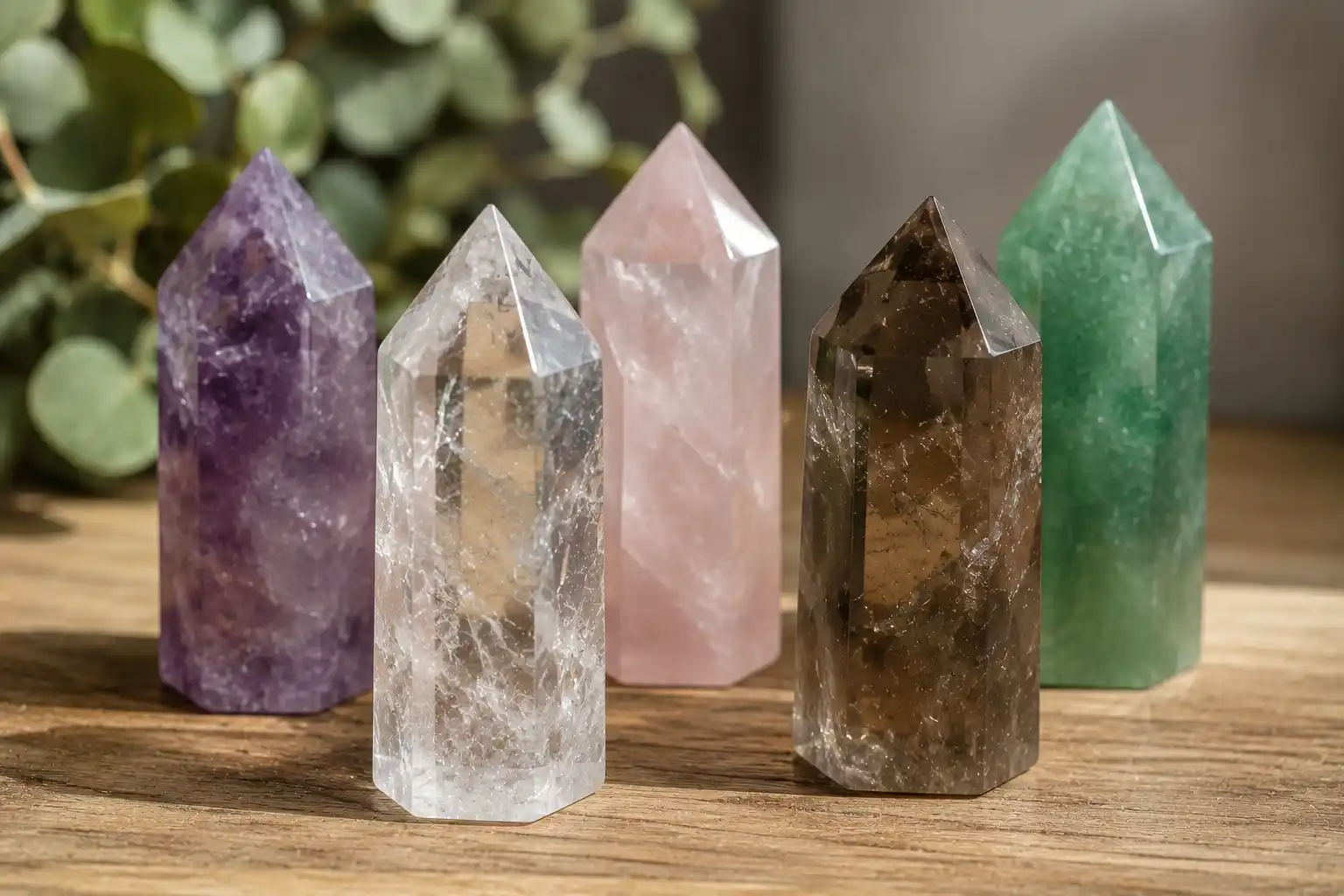

Once you start collecting crystals, you’ll notice they come in many shapes — tumbles, spheres, clusters, and the elegant, pointed wands known as crystal points. Of all the forms, points are among the most popular and the most useful, because their shape is said to direct energy. At Gems Lore, this guide explains what crystal points are, what they mean, and how to use and choose them.
A quick frame first: the meanings below come from tradition and belief, not science. They’re a meaningful way to focus intention rather than literal claims.
What Is a Crystal Point?
A crystal point is a stone cut or grown into a tapered shape with one or both ends coming to a tip (called a “termination”). Some points are natural — many crystals like quartz grow this way — while others are polished into a point from rough stone. The shape matters in crystal tradition because the tip is believed to focus and direct energy like a channel, making points one of the most intentional tools in the kit.
Single vs. Double-Terminated Points
The number of tips changes how a point is traditionally used:
- Single-terminated — one flat base and one point. Energy is said to flow out through the tip (point away to release/send energy, point toward you to draw it in). The most common type.
- Double-terminated — a point at both ends. Energy is said to flow in both directions at once, so these are used for balancing, connecting, and two-way energy work. Herkimer diamonds are a famous example.
What Crystal Points Mean and Do
In tradition, points are tools of focus and direction. They’re used to:
- Direct energy toward a goal, a person, or a part of the body
- Set and amplify intention — pointing the tip in a chosen direction
- Anchor a crystal grid — points are the classic “center” and “way” stones in a grid
- Cleanse and energize a space by directing energy with the tip
The stone the point is made from still carries its own meaning — a clear quartz point amplifies, an amethyst point directs calm, a citrine point focuses abundance. The shape adds direction; the stone adds the quality.
How to Use Crystal Points
- Point in or out. Aim the tip toward yourself to draw energy in, or away to release what you don’t want — a simple, intentional practice.
- Build a crystal grid. Use points around (and at the center of) a grid to direct energy toward a shared intention.
- Set an intention. Hold the point, focus your goal, and direct it through the tip (see how to charge crystals).
- Clear a space. Move a point through the air with the intention of clearing or energizing a room.
- Display one. A standing point is a beautiful, focused presence on a desk or altar.
How to Choose a Crystal Point
- Pick the stone for your intention. Clear quartz for all-purpose amplifying, amethyst for calm, citrine for abundance, black tourmaline for protection — choose by what you need. (See how to choose the right crystal for you.)
- Single or double-terminated? Choose single for directing energy one way, double for balancing and two-way work.
- Natural or polished? Natural points keep the stone’s raw character; polished points are smooth and uniform. Both work — it’s aesthetic preference.
- Trust the draw. As with any crystal, the one you keep coming back to is often the right one.
Caring for Crystal Points
Points are cared for like any crystal — but mind the tips, which can chip if knocked. Store them so the points are protected, and cleanse according to the stone (a quartz point is water-safe; a selenite point must stay dry). See our how to cleanse crystals guide, and check water and sun safety for the specific stone.
Crystal Points vs. Other Shapes
Points are just one form. Briefly, how they compare:
- Points — focus and direct energy
- Spheres — radiate energy evenly in all directions
- Clusters — cleanse and uplift a whole space
- Tumbled stones — gentle, pocket-friendly all-rounders
- Towers — like tall points, for focused energy and display
(We cover these in our wider crystal shapes and their meanings guide.)
Frequently Asked Questions
What are crystal points used for?
Crystal points are used to focus and direct energy — toward a goal, a person, or in a crystal grid — and to set and amplify intention. The tip acts like a channel in crystal tradition. They’re tools for intention, not medical devices.
Which way should a crystal point face?
Point the tip toward you to draw energy in, or away to release or send energy out. In a grid, points are usually aimed toward the central intention.
What’s the difference between single and double-terminated points?
A single-terminated point has one tip and directs energy one way; a double-terminated point has tips at both ends and channels energy in both directions, making it useful for balancing and connecting.
Are natural crystal points better than polished ones?
Neither is “better” — natural points keep the stone’s raw character, while polished points are smooth and uniform. It comes down to personal preference.
Where to Go From Here
Crystal points are the collection’s tool of focus and direction — choose the stone for what you need, point it with intention, and mind those tips. They’re especially powerful as the heart of a crystal grid.
New to crystals? Start with our beginner’s guide to healing crystals and learn to pick your stone in how to choose the right crystal for you. Ready to put points to work? See our how to make a crystal grid guide. Explore more any time here at Gems Lore.
Do you work with crystal points — and which way do you point them? Tell us in the comments.
