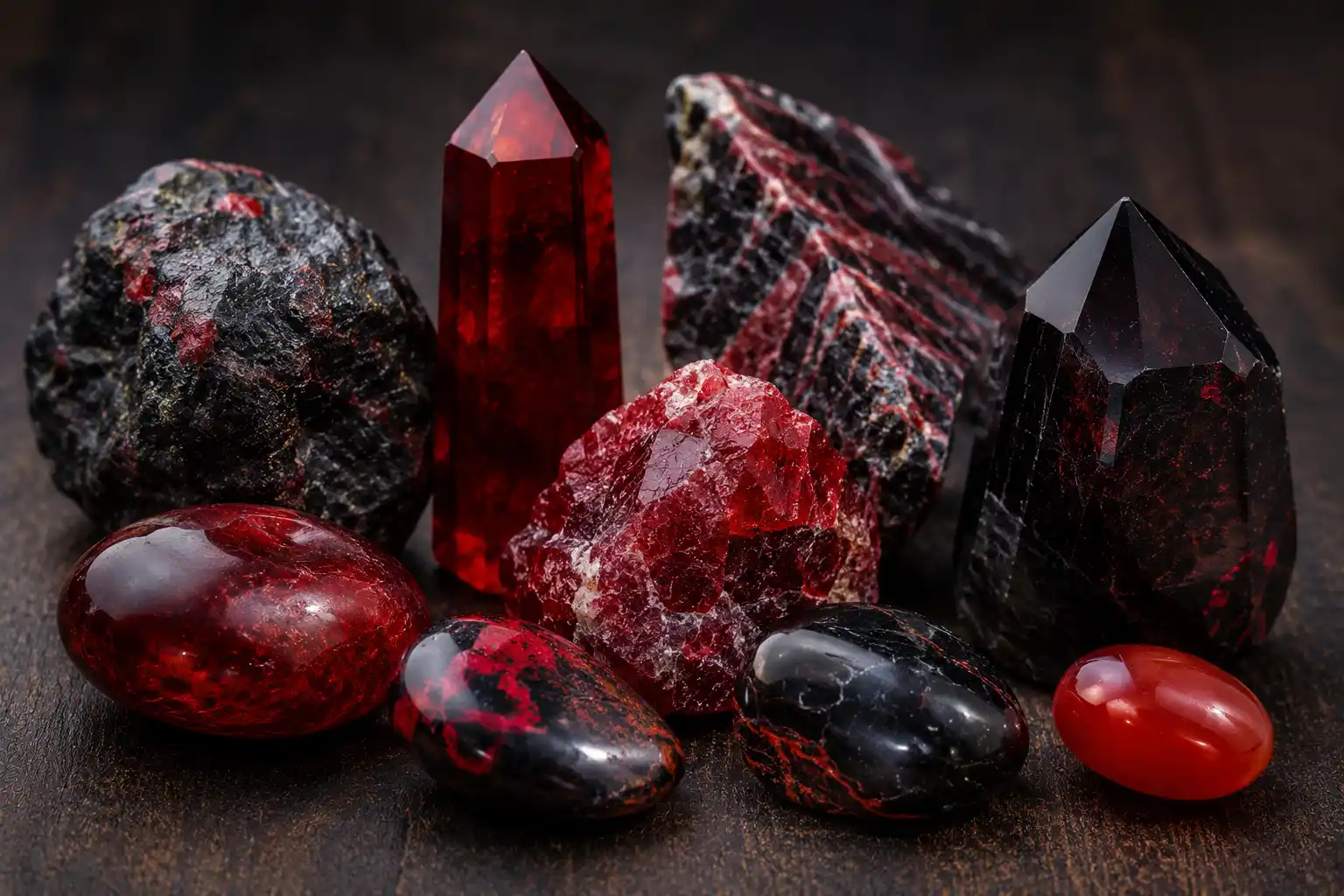
Root Chakra Crystals: 15 Best Stones for Grounding
Root chakra crystals are stones used symbolically in practices involving stability, embodiment, boundaries, home, resources and belonging. Red stones are associated with vitality and physical presence, black stones with protection and containment, and brown or smoky stones with earth and practical grounding.
These categories are based on color symbolism, spiritual traditions and contemporary crystal practice rather than scientifically measured energy effects.
The mineral differences among the stones remain important. Red jasper is durable microcrystalline quartz, hematite is dense iron oxide, obsidian is volcanic glass and black tourmaline is a complex borosilicate. They cannot share one universal cleaning, water or jewelry-care method merely because practitioners assign them to the same chakra.
This page owns the complete root-chakra stone list, selection process, combinations and safe use. The broader root chakra guide owns history, meditation, symbolism and balancing practices.
Best Root Chakra Crystals at a Glance
| Crystal | Traditional root-chakra role | Physical note |
|---|---|---|
| Red jasper | Steadiness, endurance and practical action | Durable quartz-rich material suitable for handling |
| Black tourmaline | Boundaries and protection symbolism | Hard but brittle; raw crystals can have sharp striations |
| Smoky quartz | Releasing tension and returning to practical focus | Quartz hardness; natural and irradiated color occur |
| Hematite | Weight, embodiment and mental organization | Dense iron oxide; many magnetic retail products are imitations |
| Garnet | Commitment, vitality and persistence | Garnet-group properties vary by species |
| Black obsidian | Honest reflection and protective symbolism | Volcanic glass that chips and scratches more easily than quartz |
| Bloodstone | Courage, endurance and grounded service | Green chalcedony with red inclusions |
| Carnelian | Motivation and physical participation | Durable chalcedony; commonly orange-red rather than deep red |
| Red tiger’s eye | Focus and directed action | Quartz aggregate; much red material is heat-treated |
| Mahogany obsidian | Strength through change and integration | Brown-red and black volcanic glass |
| Snowflake obsidian | Balance between difficult and calm periods | Obsidian containing pale cristobalite structures |
| Apache tear | Gentle grounding during grief and transition | Rounded obsidian nodules requiring glass care |
| Black onyx | Discipline, boundaries and consistency | Much commercial black onyx is dyed chalcedony |
| Lava stone | Earth symbolism, resilience and beginnings | Porous volcanic rock that can hold oil or residue |
| Petrified wood | Patience, ancestry and long-term stability | Silicified fossil material; durability varies with preservation |
How Root Chakra Crystals Are Chosen
Root-chakra lists usually rely on color, traditional symbolism and visual character.
Red recalls blood, warmth, survival and physical vitality.
Black suggests boundaries, depth and containment.
Brown resembles soil, wood and stable natural structures.
Dense or heavy stones such as hematite are often described as grounding because their physical weight reinforces the symbolic experience.
A stone does not need to be red to appear in root-chakra practice. The color system is a contemporary framework rather than a rigid mineral law.
The broader crystals-for-grounding guide organizes stones by grounding intention without limiting the list to one chakra.
Red Jasper
Red jasper is one of the most widely recommended root-chakra stones.
Its opaque brick-red body is associated with endurance, steady action and practical courage.
It suits practices involving routines, work, boundaries and completing tasks that require repeated effort.
A polished palm stone can be held during meditation, while a tumbled piece can sit beside a written schedule or budget.
Because red jasper is quartz-rich and comparatively durable, it tolerates regular handling better than soft red calcite or rhodochrosite.
It should still be protected from harder gems and unknown dye or filler.
Black Tourmaline
Black tourmaline is traditionally used for protection and boundaries.
Its natural striated crystal form gives it a strong visual identity. Practitioners often place it near an entrance, workspace or object associated with a boundary.
The stone does not create a measurable shield against danger, radiation or harmful people.
Its most responsible use is as a reminder to take practical protective actions: communicate a limit, secure a space or reduce avoidable exposure.
Raw tourmaline can chip and produce sharp fragments. Keep large specimens on stable surfaces.
Smoky Quartz
Smoky quartz ranges from pale brown-gray to nearly black.
Its transparent or translucent body gives grounding symbolism a lighter visual quality than opaque black stones.
Practitioners use it during reflection on stress, uncertainty and practical decision-making.
Natural smoky color can result from radiation interacting with aluminum-related defects in quartz. Commercial material may also receive irradiation.
The stone works well as a polished palm stone, pendant or desk object.
Its quartz hardness supports regular handling, although internal fractures can still chip.
Hematite
Hematite is dense iron oxide with metallic gray, black or earthy red forms.
Its weight makes embodiment and physical presence particularly noticeable during handling.
In crystal traditions, hematite is associated with organization, focus and returning attention to immediate facts.
Many highly magnetic beads sold as hematite are manufactured ferrite or other imitation material. Natural hematite is not normally strongly magnetic.
The planned hematite healing-properties guide owns broader belief-based use, while how to cleanse hematite retains physically safe care methods.
Garnet
Garnet is the traditional January birthstone and a longstanding symbol of protection, commitment and endurance.
Deep-red almandine and pyrope garnets fit the modern root-chakra color naturally.
The stone may be used when grounding is connected with keeping a promise, returning to a goal or sustaining effort.
Garnet is a mineral group, so exact hardness, density and color vary by species.
The dedicated garnet chakra guide owns the family-wide energy-center discussion.
A garnet ring or bead can serve as a durable symbolic object when its setting and treatment are understood.
Black Obsidian
Black obsidian is natural volcanic glass.
Its dark reflective surface leads to traditions involving protection, truth and confronting what has been avoided.
The completed obsidian healing-properties guide owns the broader metaphysical discussion.
Obsidian should not be treated as an object that forces hidden truths to appear or protects against every external risk.
It can serve as a visual prompt for honest self-assessment.
Because it is glass, it chips and scratches more easily than quartz. Broken edges can become extremely sharp.
Bloodstone
Bloodstone is dark-green chalcedony with red, brown or orange inclusions, commonly associated with iron oxides.
Its red marks inspired historical connections with courage, sacrifice and vitality.
Within root-chakra practice, bloodstone represents acting in service while remaining physically grounded.
The green body also introduces themes of balance and recovery rather than pure intensity.
Bloodstone is durable enough for tumbled stones and many jewelry forms.
Its historical name should not be interpreted as evidence that it changes blood, circulation or wound healing.
Carnelian
Carnelian is translucent orange-red to brown-red chalcedony.
It sits near the symbolic boundary between root and sacral chakra work.
For the root chakra, it represents participation, motivation and moving from planning into action.
Its brighter warm color may suit someone who finds black stones too severe or dark-red stones too heavy.
Carnelian is commonly heated, and dyed chalcedony can imitate fine color.
The stone remains a symbolic aid rather than a treatment for fatigue, reproductive health or circulation.
Red Tiger’s Eye
Red tiger’s eye combines red-brown color with a moving chatoyant band.
It is traditionally associated with directed focus, confidence and action.
Much market material is heated from golden or brown tiger’s eye. The treatment is generally stable but should be understood when natural-red rarity is claimed.
The broader tiger’s eye meaning guide owns the main material and symbolism.
A polished piece can be placed beside one defined task as a reminder to direct attention rather than scatter it.
Mahogany Obsidian
Mahogany obsidian contains black volcanic glass with reddish-brown or mahogany areas caused by iron-related inclusions and oxidation.
Its two-color appearance is associated with integrating difficult and constructive parts of experience.
In root-chakra practice, it can symbolize resilience during change without pretending that change is painless.
It requires the same basic care as other obsidians: protection from drops, hard impacts and abrasive storage.
Its earthy brown-red palette also connects with the wider brown-crystals guide.
Snowflake Obsidian
Snowflake obsidian is black volcanic glass containing pale spherulitic cristobalite structures.
The contrast inspires symbolism involving balance between calm and difficult periods.
It is often chosen when grounding means observing a pattern rather than reacting immediately.
The white “snowflakes” are natural mineral structures, not literal trapped snow or energy points.
Snowflake obsidian is softer than quartz and can chip. It should be stored separately from harder stones.
Apache Tears
Apache tears are rounded obsidian nodules, commonly translucent brown-black when held against strong light.
They are traditionally associated with grief, emotional protection and gentle grounding.
Their cultural name carries specific Indigenous associations and should be used respectfully rather than as generic marketing detached from that history.
A small nodule may be held during remembrance or journaling.
Like all obsidian, it is volcanic glass and should not be dropped or carried loose with harder stones.
Black Onyx
Onyx is traditionally parallel-banded chalcedony, although much commercial black onyx is dyed black chalcedony.
Its symbolism emphasizes discipline, boundaries and consistent choices.
A black onyx bead or ring can represent maintaining a routine after initial motivation fades.
Dyed natural chalcedony is still mineral material, but treatment should be disclosed.
Black glass and resin are also sold as onyx, making accurate identification important.
Onyx’s quartz-rich structure is more durable than obsidian glass for frequent handling.
Lava Stone
Lava stone is a broad commercial term for porous volcanic rock used in beads and carvings.
Its connection with cooled volcanic material inspires themes of beginnings, resilience and transformation from intense conditions.
The porous surface can absorb skin oil, perfume and essential oils.
Applying concentrated essential oils creates a separate skin-safety question and should not be assumed safe merely because a bead is marketed as an aromatherapy stone.
Lava beads vary widely in composition, density and durability.
Their rough texture may abrade softer adjacent gems.
Petrified Wood
Petrified wood forms when mineral material replaces or fills plant tissue over geological time.
Its age and preserved growth patterns inspire associations with patience, ancestry and long-term stability.
Within root-chakra practice, it suits intentions involving home, lineage, land and decisions that unfold slowly.
Petrified wood can contain quartz, chalcedony, opal and other minerals. Durability therefore varies.
Collectors should preserve important fossil or locality specimens rather than using every piece as a pocket stone.
Choosing Between Red, Black and Brown Stones
Red stones emphasize vitality, courage and participation.
Black stones emphasize boundaries, containment and protective symbolism.
Brown or smoky stones emphasize patience, earth and practical stability.
A person who feels inactive may prefer red jasper, carnelian or garnet.
Someone focusing on boundaries may choose black tourmaline, onyx or obsidian.
Smoky quartz, mahogany obsidian and petrified wood suit slower grounding practices.
The complete black-crystals guide and red-crystals guide provide broader color-based lists.
Best Root Chakra Crystal for Grounding
Red jasper is the most balanced general choice.
It is durable, widely available and symbolically associated with practical endurance rather than dramatic promises.
Smoky quartz offers a transparent alternative.
Hematite creates a strong physical sense of weight.
Petrified wood suits long-term patience and connection with place.
There is no objectively strongest stone. The best choice fits the person’s intention, physical handling needs and preferred appearance.
Best Root Chakra Crystal for Protection
Black tourmaline and black obsidian are the most common traditional choices.
Tourmaline symbolizes boundaries and structural protection.
Obsidian symbolizes reflection and confronting hidden concerns.
Onyx represents discipline and maintaining limits.
No stone should be expected to prevent assault, accidents, radiation exposure, theft or harmful behavior.
Practical security measures remain essential.
The comparison in black tourmaline versus obsidian and onyx helps separate their material and symbolic roles.
Best Root Chakra Crystal for Motivation
Carnelian, red tiger’s eye, garnet and red jasper each represent a different kind of action.
Carnelian emphasizes beginning and participation.
Red tiger’s eye emphasizes directing attention.
Garnet emphasizes commitment.
Red jasper emphasizes continuing after the novelty has passed.
Choose according to the exact behavior required rather than the broad word motivation.
Root Chakra Crystal Combinations
Red Jasper and Black Tourmaline
This pairing combines steady action with boundary symbolism.
It suits practical goals that require both persistence and protection from distraction.
Smoky Quartz and Hematite
The transparent brown-gray quartz and dense metallic hematite create strong visual and tactile contrast.
The combination is often used for focused work and present-moment attention.
Garnet and Black Onyx
Garnet represents commitment, while onyx represents discipline.
This pair suits long-term responsibilities and routines.
Carnelian and Red Jasper
Carnelian represents beginning; red jasper represents continuing.
It is a useful symbolic combination for creative or physical projects.
Mahogany Obsidian and Petrified Wood
Both carry brown earth tones and themes of change over time.
They suit reflective practices involving home, history and gradual rebuilding.
Using more stones does not make a practice stronger. One or two clearly chosen objects usually provide a more coherent intention.
How to Meditate With Root Chakra Crystals
Choose one stone and one practical theme.
Sit in a supported position and place the crystal in the hand or on a nearby surface.
Notice weight, texture, color and temperature without trying to produce a supernatural sensation.
Bring attention to the contact between the body and the chair or floor.
Ask what would increase stability slightly today.
Finish by taking one observable action.
The how-to-program-crystals guide explains how to connect a stone with a specific intention.
Where to Place Root Chakra Crystals
A stone can be placed near an entryway as a boundary reminder.
On a desk, it can represent focus and practical follow-through.
Beside financial records, it can accompany budgeting or administrative work.
Near a bed, a safe stable stone can mark a calming routine, although large sharp specimens should not be placed where they can fall.
Crystals should not obstruct exits, create trip hazards or sit where children and pets can swallow them.
Placement is symbolic. It does not create a measurable protective field around the room.
Wearing Root Chakra Crystals
Bracelets and rings keep stones visible during daily activity but expose them to impact and chemical contact.
Pendants and earrings protect softer or more brittle material.
Red jasper, garnet, onyx and many chalcedony stones work well in jewelry.
Obsidian and hematite require more care, while porous lava stone collects residue.
Raw tourmaline points should be set so sharp ridges do not scratch the wearer.
Remove crystal jewelry before exercise, bathing, swimming and household cleaning.
Carrying a Root Chakra Stone
A small tumbled stone can be carried in a dedicated pouch.
Do not place hard garnet or quartz loose beside a phone screen, keys or soft gemstones.
Obsidian can chip against metal objects and create sharp edges.
Hematite may mark or abrade other surfaces.
Check the stone periodically for cracks, loose fragments and damaged polish.
Carrying is most useful when the object is connected with a specific reminder rather than handled compulsively throughout the day.
Cleansing Root Chakra Crystals
Use a method suited to the actual material.
The completed how-to-cleanse-crystals guide covers symbolic options without assuming water is universally safe.
Gentle wiping, sound used at a distance, intention-setting and placement beside an undamaged stable object avoid many risks.
Do not bury valuable polished stones where moisture, soil chemistry or loss can damage them.
Smoke cleansing requires ventilation and sensitivity to respiratory conditions, children, pets and fire alarms.
Water Safety
Do not place an entire root-chakra collection in water.
Quartz-based jasper and smoky quartz tolerate brief washing more readily than porous lava stone, metallic hematite, glued jewelry or treated material.
Pyrite is not a recommended root stone for water because it can oxidize.
The crystal water-safety guide explains mineral-specific precautions.
Direct crystal elixirs are unnecessary. Unknown minerals, treatments, polishing residue and metal components can contaminate water.
Safety and Toxicity
Most polished root-chakra stones are safe for normal handling.
Risk increases when minerals are cut, ground, drilled, crushed or ingested.
Silica-rich jasper, quartz and obsidian produce hazardous dust during lapidary work.
Unknown black minerals may contain sulfides, metals or artificial coatings.
The completed toxic-crystals list provides broader handling guidance.
Wash hands after working with rough unknown material and keep small stones away from children and pets.
Frequently Asked Questions
1. What is the main root chakra crystal?
Red jasper is the most widely recommended general-purpose stone because of its grounding symbolism and practical durability.
2. Which black crystal is best for the root chakra?
Black tourmaline, black obsidian and onyx are common choices with different protection and boundary symbolism.
3. Is smoky quartz a root chakra stone?
Yes. Its brown-to-black color and grounding traditions make it a common root-chakra crystal.
4. Is hematite good for grounding?
It is widely used symbolically because of its density and metallic weight, although it does not create a scientifically established grounding energy.
5. Is garnet connected with the root chakra?
Yes. Deep-red garnets are associated with vitality, commitment and physical presence.
6. Can carnelian be used for the root chakra?
Yes. Its red-orange color places it between root and sacral traditions, especially for motivation and participation.
7. How many root chakra crystals should I use?
One clearly selected stone is enough. Using several does not make a practice inherently stronger.
8. Where should a root chakra crystal be placed?
It can be placed near an entryway, desk, financial records or meditation area as a symbolic reminder.
9. Can root chakra crystals cure anxiety?
No. They may support reflection or ritual, but anxiety disorders require appropriate professional care.
10. Can all root chakra crystals go in water?
No. Material, porosity, treatments, metal settings and chemical stability vary.
11. Do root chakra crystals protect against EMF or physical danger?
No reliable evidence shows that they replace electrical controls, protective equipment, locks, safety planning or medical guidance.
12. How do I choose the right root chakra crystal?
Define the intention first, then select a stone whose symbolism, appearance, durability and care requirements fit the intended use.
Root chakra crystals are most useful when they connect a spiritual theme with a practical action. Red jasper can accompany steady work, black tourmaline can mark a boundary and smoky quartz can support present-focused reflection. The stone provides symbolism; food, rest, safety, planning and human support provide the foundation.
Crystal and chakra associations are spiritual beliefs, not medical claims. Do not ingest minerals, prepare direct elixirs from unknown stones or substitute crystal use for healthcare, safety measures or practical assistance.