

Amethyst is most commonly associated with the crown chakra and third eye chakra in modern crystal and chakra practices. Its violet-to-purple color has led practitioners to connect it symbolically with spiritual awareness, reflection, intuition, mental clarity, and contemplative meditation.
Within this framework, lighter violet Amethyst is often emphasized for crown-chakra work, while deeper purple or indigo-toned pieces are frequently used with the third eye. These correspondences belong to contemporary spiritual practice rather than established mineral science, so Amethyst is best treated as a symbolic meditation tool rather than a medically or energetically proven treatment.
Amethyst Chakra at a Glance
| Aspect | Amethyst Association |
|---|---|
| Primary chakra | Crown chakra |
| Secondary chakra | Third eye chakra |
| Crown chakra location | Top of the head in modern seven-chakra practice |
| Third eye location | Brow/forehead area |
| Crown color association | Violet, white |
| Third eye color association | Indigo, deep violet |
| Traditional symbolic themes | Awareness, reflection, intuition, wisdom |
| Common practices | Meditation, visualization, intention-setting |
| Placement | Nearby, held in the hand, or positioned symbolically near crown/brow |
| Best forms | Tumbled stone, point, cluster, palm stone, jewelry |
| Cleansing options | Moonlight, sound, brief water cleaning, intention |
| Mineral family | Quartz |
| Composition | SiO₂ |
| Mohs hardness | 7 |
| Scientific evidence for chakra effects | None established |
The broader Amethyst meaning guide covers the stone’s symbolism and traditional uses, while this page focuses specifically on its chakra associations and how practitioners incorporate it into chakra-centered routines.
What Chakra Is Amethyst Associated With?
Amethyst is primarily associated with two upper chakras:
the crown chakra, traditionally positioned at the top of the head,
and
the third eye chakra, commonly placed at the center of the forehead or between the eyebrows.
Of the two, Amethyst is most strongly associated with the crown chakra in modern crystal literature because violet is widely mapped to the crown in contemporary seven-chakra systems.
However, its deeper purple tones also overlap visually with the indigo traditionally assigned to the third eye.
For that reason, Amethyst frequently appears in practices involving both chakras rather than being restricted to only one.
Is Amethyst a Crown Chakra Stone?
Yes, within modern crystal-healing traditions, Amethyst is one of the most frequently named crown chakra stones.
The crown chakra is commonly called Sahasrara in chakra terminology and is represented at or above the top of the head in contemporary seven-chakra diagrams.
Practitioners associate it symbolically with themes such as:
spiritual awareness,
meaning,
connection,
reflection,
wisdom,
and expanded perspective.
Amethyst’s violet coloration fits naturally into the modern color correspondence assigned to this chakra.
The site’s Crown Chakra guide explains that chakra separately without turning this Amethyst page into a general chakra overview.
Is Amethyst a Third Eye Chakra Stone?
Yes.
Amethyst is also widely associated with the third eye chakra, particularly when its color leans toward deep violet or bluish purple.
The third eye is often linked symbolically with:
intuition,
self-reflection,
perception,
discernment,
imagination,
and awareness of internal thought patterns.
Consequently, people may place or hold Amethyst during meditation when their intention involves reflection, visualization, or decision-making.
This is a symbolic spiritual association rather than evidence that Amethyst physically alters the brain, nervous system, or perception.
Crown Chakra vs Third Eye Chakra
Although Amethyst appears in both practices, the symbolic intentions are usually different.
| Crown Chakra | Third Eye Chakra |
|---|---|
| Spiritual perspective | Intuition and perception |
| Meaning and purpose | Insight and discernment |
| Connection to something larger | Internal awareness |
| Reflection and transcendence | Visualization |
| Violet/white symbolism | Indigo/deep violet symbolism |
| Positioned at top of head | Positioned at brow |
In practical crystal use, the distinction does not need to be rigid.
Someone might begin a meditation using Amethyst for third-eye reflection and then continue into broader crown-chakra contemplation.
The stone itself does not change mineral properties according to placement; the difference comes from the intention assigned to the ritual.
Why Is Amethyst Connected to the Crown Chakra?
Color is one of the main reasons.
Amethyst is the purple variety of quartz, ranging from pale lilac through reddish purple to very deep violet.
Modern Western chakra systems commonly use violet or white for the crown chakra.
Because Amethyst is one of the best-known naturally purple gemstones, it became an intuitive choice for this association.
Its long-standing cultural connections with sobriety, contemplation, religious ornament, and personal restraint have also contributed to modern interpretations involving spiritual clarity.
However, the specific crystal-to-chakra correspondences familiar today are largely part of modern crystal practice rather than ancient mineralogical doctrine.
Why Is Amethyst Connected to the Third Eye?
The connection again comes partly from color.
The modern third-eye chakra is usually represented by indigo, dark blue, or blue-violet.
Deep Amethyst can sit visually close to that range.
Furthermore, modern metaphysical traditions frequently interpret Amethyst as a stone of reflection, intuition, calm contemplation, and mental awareness.
These themes overlap closely with contemporary descriptions of third-eye practice.
As a result, Amethyst became one of the few crystals commonly assigned to both the crown and third eye.
Does Amethyst Open the Crown Chakra?
Crystal traditions often use language such as “opening,” “activating,” or “balancing” the crown chakra.
These terms should be understood within the spiritual framework in which they are used.
There is no scientific test demonstrating that Amethyst physically opens a chakra or changes a measurable biological energy center.
Practically, someone might use the stone during meditation as a symbolic cue for slowing down, reflecting on values, or considering a situation from a broader perspective.
That kind of intentional use does not require treating spiritual claims as laboratory-established facts.
Does Amethyst Open the Third Eye?
The same distinction applies.
Some practitioners describe Amethyst as activating or opening the third eye.
In practice, this may involve sitting quietly with the stone, concentrating on the brow area, visualizing violet or indigo light, observing thoughts, or reflecting on intuition.
Those exercises can be meaningful within a spiritual practice.
However, Amethyst has not been scientifically demonstrated to unlock psychic perception, produce clairvoyance, or alter a physical structure associated with a “third eye.”
What Does Amethyst Do for the Crown Chakra?
Within chakra practice, Amethyst may symbolically support intentions involving spiritual reflection and perspective.
A practitioner might use it when considering:
what gives life meaning,
whether current actions align with personal values,
how to approach uncertainty,
how to create quiet time for reflection,
or how to feel more connected to a spiritual practice.
The gemstone serves as a physical point of focus.
Its value in the practice comes from ritual, symbolism, attention, and personal interpretation rather than a scientifically measured energy emitted by quartz.
What Does Amethyst Do for the Third Eye Chakra?
Third-eye practices generally emphasize awareness and perception.
Someone might use Amethyst while asking:
What am I overlooking?
Am I reacting emotionally or observing clearly?
What assumptions am I making?
What does my intuition suggest, and what evidence supports it?
Which possibilities have I not considered?
Used this way, Amethyst becomes a visual and tactile reminder to slow down and examine a situation deliberately.
That offers a grounded way to incorporate traditional symbolism without assuming the gemstone provides supernatural information.
Amethyst Chakra Meaning
Amethyst chakra symbolism centers on the relationship between quiet thought and broader awareness.
For the crown, this becomes a theme of perspective.
For the third eye, it becomes a theme of insight.
Together, the two correspondences give Amethyst a modern symbolic identity involving:
reflection before action,
awareness before judgment,
intuition balanced with discernment,
and contemplation without disconnection from practical reality.
These themes also help distinguish chakra intent from the broader wellness claims covered in the site’s Amethyst Healing Properties page.
Amethyst and Spiritual Awareness
Amethyst has a long cultural history of spiritual and ceremonial use.
Purple itself has repeatedly been associated with status, religion, contemplation, and sacred contexts in different cultures.
Modern crystal practices build on that broader symbolism by assigning Amethyst to upper chakras.
Someone might therefore keep an Amethyst near a meditation space, altar, journal, or quiet reading area.
The stone does not have to be treated as a supernatural object to function meaningfully as a personal symbol.
Amethyst and Intuition
Intuition is one of the strongest themes attached to Amethyst’s third-eye correspondence.
However, intuition is most useful when distinguished from certainty.
A person might use Amethyst during reflection to notice an instinctive reaction, then compare that reaction with available facts.
For example, the stone could become a cue to ask:
What is my first impression?
Why do I feel that way?
What evidence supports it?
What evidence challenges it?
This interpretation makes intuitive practice complementary to thoughtful reasoning rather than a replacement for it.
Amethyst and Meditation
Amethyst is especially popular as a meditation crystal.
Its color provides a simple visual focus, while polished stones are comfortable to hold.
Clusters and points also work well as stationary objects positioned nearby.
A basic practice requires no complicated ritual.
Sit comfortably.
Place the Amethyst somewhere secure.
Observe your breathing.
Choose either a crown or third-eye intention.
Then return your attention to that intention whenever the mind wanders.
The gemstone functions as the physical anchor for the exercise.
Crown Chakra Meditation With Amethyst
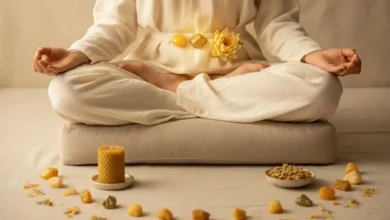
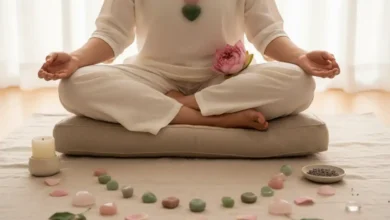
For a crown-focused meditation, place an Amethyst nearby rather than balancing a heavy crystal directly on the head.
Sit or lie comfortably.
Allow your breathing to settle naturally.
Then choose a broad reflective question, such as:
What matters most to me right now?
What am I trying to understand rather than simply control?
Which values should guide my next decision?
Some practitioners visualize violet or white light above the head.
Others simply focus on the Amethyst.
Either approach can be used without claiming that a measurable chakra has physically changed.
Third Eye Meditation With Amethyst
For a third-eye practice, hold a small polished Amethyst or place one safely nearby.
Close your eyes if comfortable.
Direct attention gently toward the brow area without straining the eyes or forehead.
Instead of trying to force visions or unusual experiences, focus on observation.
Notice thoughts as they arise.
Identify which are facts, which are assumptions, and which are emotional responses.
If visualization is part of your spiritual practice, imagine a deep indigo or violet point of light at the brow.
Afterward, write down anything useful rather than treating every thought as a prediction.
Where Should You Place Amethyst for the Crown Chakra?
A stone does not need direct skin contact to be incorporated into the practice.
Safer options include placing Amethyst:
beside a meditation cushion,
on a nearby table,
above the head on a stable surface while lying down,
or in front of you during seated meditation.
Avoid placing large clusters or heavy crystals where they could fall.
Comfort and physical safety matter more than achieving an exact symbolic position.
Where Should You Place Amethyst for the Third Eye?
Small smooth stones are commonly placed briefly on the forehead while someone lies down.
However, direct placement is optional.
Holding the stone or positioning it beside the head can serve the same symbolic purpose.
Do not press pointed crystals against the forehead.
Likewise, avoid oils, adhesives, or elaborate arrangements that irritate the skin.
A spiritual practice should not require uncomfortable physical treatment.
Can You Sleep With Amethyst Near the Crown Chakra?
People sometimes keep Amethyst beside the bed because they associate it with calmness, dreams, or reflection.
A bedside stone is generally straightforward.
However, avoid placing loose crystals in the bed where sharp points could cause discomfort or where small pieces could become lost.
Large clusters should sit on a stable table rather than above the pillow.
Whether Amethyst improves sleep has not been established scientifically.
If a bedside crystal helps create a calming personal routine, that is different from claiming that it treats insomnia.
Can You Put Amethyst Under Your Pillow?
A small smooth stone can physically be placed under a pillow, but it is not always comfortable.
A bedside table usually makes more sense.
Large points, clusters, sharp specimens, or jewelry should not be placed under a pillow because they can create pressure, scratch skin, damage bedding, or break.
From a chakra perspective, distance does not need to invalidate the ritual.
Symbolic practices do not require pressing the mineral against the body.
Amethyst for Crown Chakra Jewelry
Wearing Amethyst is another way people maintain a symbolic connection throughout the day.
Earrings position the stone relatively close to the head.
Necklaces keep it visible and easy to touch during moments of reflection.
Bracelets are convenient when the goal is simply to use Amethyst as an intention reminder.
No specific jewelry position has been scientifically demonstrated to affect a chakra.
Therefore, choose jewelry based on comfort and personal meaning rather than pressure to place the gem at an exact energetic point.
Amethyst Earrings and Chakra Symbolism
Because earrings sit near the head, some practitioners particularly enjoy them for third-eye or crown symbolism.
That association is symbolic rather than anatomical.
From a jewelry perspective, Amethyst works well in earrings because quartz has Mohs hardness 7 and earrings generally experience less abrasion than rings.
The site’s Amethyst Earrings guide covers styles and practical jewelry considerations separately.
Amethyst Necklace and Chakra Symbolism
Amethyst necklaces are often used as spiritual jewelry even though the pendant typically rests closer to the chest than to the crown or brow.
This illustrates why crystal chakra work is fundamentally intention based.
The stone does not need to touch the exact chakra location.
A necklace can function as a reminder of the same reflective goal throughout the day.
The Amethyst Necklace page keeps jewelry-specific selection and styling separate.
Amethyst Bracelet and Chakra Symbolism
Bracelets are convenient for people who use Amethyst as a mindfulness reminder.
A glance at the stone during the day can prompt a brief check-in:
Am I reacting or responding?
Do I need more information?
Am I acting according to my values?
This kind of intentional cue aligns well with the reflection themes commonly assigned to upper chakras.
The Amethyst Bracelet guide handles bracelet construction and buying considerations separately.
Which Amethyst Is Best for the Crown Chakra?
No scientifically established grade or variety performs better for chakra work.
Within symbolic color-based systems, people often choose:
pale lavender Amethyst,
light violet crystals,
or pieces with white quartz.
These colors visually align with the violet-to-white palette commonly assigned to the crown chakra.
However, a dark Amethyst can be used just as meaningfully if it has greater personal significance.
Chakra suitability is not a gemological quality grade.
Which Amethyst Is Best for the Third Eye?
Deep violet, bluish purple, and indigo-leaning Amethyst are often favored.
Again, this comes from color symbolism rather than a difference in scientifically measurable metaphysical energy.
A pale stone can still be used.
Likewise, an included crystal, tumbled stone, cluster, point, or inexpensive specimen is not less effective as a symbolic object simply because it lacks premium gemstone color.
Choose the piece that best supports the ritual.
Chevron Amethyst and the Chakras
Chevron Amethyst combines purple Amethyst with visible white quartz zoning, commonly creating V-shaped or banded patterns.
Because of the contrasting violet and white colors, practitioners often connect it particularly strongly with crown-chakra symbolism.
Some also use its layered appearance as a metaphor for moving through different levels of thought or awareness.
Mineralogically, however, the pattern does not prove stronger chakra effects.
It is still quartz-based material whose distinctive appearance comes from its growth structure and color distribution.
Amethyst Clusters for Chakra Work
Clusters work well as stationary meditation objects.
Instead of placing them on the body, position the cluster where it is visible.
A cluster can define a meditation area and provide a fixed visual anchor.
Its many crystal points also make it visually dramatic, which contributes to symbolic interpretations involving expanded awareness.
However, a cluster does not emit a scientifically demonstrated chakra-balancing field.
Use it because the object helps structure the practice.
Amethyst Points for Chakra Work
A polished or natural Amethyst point is often used in directional crystal rituals.
Some practitioners point the termination toward or away from the body depending on the symbolic goal.
From a mineralogical standpoint, the crystal termination does not create a proven energy beam.
Still, the directional shape can be useful in visualization.
For example, someone might position the point upward during crown meditation as a symbolic representation of perspective or expansion.
Amethyst Geodes and the Crown Chakra
Large geodes are impractical for body placement but excellent as environmental objects.
An Amethyst geode in a meditation room can become part of a consistent ritual setting.
Because ritual environments influence attention and expectation, simply having a familiar object present can help signal that it is time to shift from daily tasks into reflective practice.
The geological beauty of the specimen can also encourage contemplation without any need for supernatural claims.
Amethyst and Clear Quartz for Crown Work
Clear quartz is another crystal frequently associated with crown-chakra practices.
When used with Amethyst, practitioners often interpret clear quartz as representing clarity while Amethyst represents reflection or spiritual awareness.
Both minerals are forms of quartz.
Therefore, the combination is chemically less exotic than metaphysical descriptions sometimes suggest.
Still, combining visually different quartz varieties can create a meaningful symbolic arrangement.
Avoid rubbing polished pieces together because both have approximately Mohs 7 hardness and can abrade one another.
Amethyst and Selenite
Selenite is frequently paired with Amethyst in contemporary crown-chakra layouts.
White selenite visually fits the modern crown-chakra color scheme, while purple Amethyst adds contrast.
Physically, however, selenite is much softer than Amethyst.
Amethyst can scratch it easily.
Therefore, place the stones carefully rather than rubbing them together.
The physical care requirements of a pairing always matter more than metaphysical claims.
Amethyst and Labradorite for Third Eye Work
Labradorite is another stone frequently used in intuition-themed practices.
Its changing flashes make it symbolically associated with perception and hidden possibilities.
Combined with Amethyst, practitioners may use the pair during visualization or reflective journaling.
No scientific evidence shows that the combination enhances psychic ability.
However, two visually distinctive stones can function as effective ritual cues when a person deliberately assigns each one a purpose.
Amethyst and Lapis Lazuli
Lapis lazuli is often associated with the third-eye region because of its deep blue color.
Pairing it with violet Amethyst creates an obvious visual transition from indigo-blue to purple.
Because lapis is a rock composed of several minerals rather than a single quartz variety, its physical care differs from Amethyst.
Avoid assuming every crystal combination tolerates water, cleaners, sunlight, or abrasion in the same way.
Amethyst and Fluorite
Purple fluorite can look surprisingly similar to Amethyst at first glance.
Both appear in spiritual practices involving concentration and reflection.
However, fluorite is much softer at Mohs 4 and has perfect cleavage.
Therefore, do not treat Amethyst and fluorite as physically interchangeable simply because their metaphysical symbolism overlaps.
If arranging them together, protect the softer fluorite from scratches and impact.
How to Use Amethyst for Both Chakras
A simple practice can address both without requiring separate stones.
Begin with a third-eye intention.
Spend several minutes examining a specific question, decision, or pattern in your thinking.
Then broaden the focus toward the crown chakra by asking how the issue relates to your larger values or perspective.
In other words:
third eye: What am I seeing?
crown: What does it mean?
This provides a practical distinction between the two symbolic roles while using the same stone.
Amethyst Chakra Balancing Routine
Start with a clean, comfortable space.
Place one Amethyst in front of you or hold it loosely.
Spend several minutes breathing normally without trying to force a particular experience.
For third-eye focus, consider one question that requires discernment.
Then shift to a broader crown-chakra reflection involving purpose, perspective, or personal values.
Finally, write down one practical action you can take afterward.
This final step keeps the practice connected to everyday life rather than making the ritual an end in itself.
How Long Should You Use Amethyst for Chakra Meditation?
There is no required duration.
Five or ten minutes can be enough for a short reflective session.
Longer meditation is optional.
The idea that a crystal must remain on a chakra for an exact number of minutes has no scientific basis.
Comfort matters more.
If lying still becomes uncomfortable, adjust position.
If concentration becomes strained, end the session.
Consistency generally makes more practical sense than excessively long sessions.
Do You Need to Cleanse Amethyst After Chakra Work?
Not mineralogically.
Within spiritual practices, some people prefer to cleanse their crystal after meditation or after using it in a shared setting.
Others cleanse only occasionally.
If you want to follow that ritual, low-risk methods include moonlight, sound, intention, or appropriate physical cleaning.
The tracker already has a dedicated How to Cleanse and Charge Amethyst guide, so detailed cleansing instructions should remain there rather than being duplicated on this chakra page.
Can Amethyst Go in Water?
Sound natural Amethyst generally tolerates brief cleaning with warm soapy water.
Amethyst is quartz with Mohs hardness 7.
However, long soaking is unnecessary, particularly for jewelry, fracture-filled material, dyed pieces, glued components, or specimens with delicate matrix.
Spiritual chakra work does not require immersion.
A dry meditation practice is completely sufficient.
Should Amethyst Be Put in Sunlight?
Normal daylight is part of ordinary jewelry use, but prolonged intense sunlight or heat is not ideal for Amethyst.
Its color can be affected by prolonged exposure to strong heat or light under certain conditions.
Therefore, avoid leaving an important specimen on a sunny windowsill indefinitely.
If sunlight is part of a symbolic charging ritual, brief gentle exposure is more conservative than extended direct sun.
What Is Amethyst Scientifically?
Amethyst is the purple variety of quartz.
Its chemical formula is SiO₂.
It has a refractive index of approximately 1.544–1.553, birefringence around 0.009, specific gravity around 2.66, and Mohs hardness 7.
Its purple color is related to iron-associated color centers and natural irradiation within the quartz structure.
None of those mineralogical properties demonstrates a chakra mechanism.
That distinction allows both parts of the subject to be discussed accurately: the gemstone has measurable physical properties, while chakra associations belong to spiritual interpretation.
Is the Amethyst Chakra Connection Ancient?
The answer requires nuance.
Chakra concepts have deep roots in South Asian religious and philosophical traditions.
However, the familiar modern system in which seven chakras are assigned a fixed rainbow sequence and matched systematically with particular gemstones reflects later interpretations and modern crystal-healing traditions.
Therefore, it would be misleading to claim that ancient traditions universally prescribed Amethyst as the crown or third-eye crystal in the exact way many modern charts do.
The correspondence is better described as modern chakra-crystal practice.
Can Anyone Use Amethyst for Chakra Meditation?
Yes, if the practice is meaningful to them.
Someone does not need to make supernatural claims to use a symbolic object during meditation.
An Amethyst can function as:
a focus object,
a reminder of an intention,
a visual meditation aid,
or part of a spiritual ritual.
At the same time, chakra practices deserve respectful treatment because their broader concepts have religious and cultural histories beyond modern gemstone marketing.
Can Amethyst Heal a Blocked Chakra?
There is no scientific evidence establishing that Amethyst heals a measurable blocked chakra.
Within spiritual traditions, practitioners may describe emotional or symbolic experiences using the language of balance, openness, or blockage.
If someone finds the practice personally meaningful, Amethyst can be incorporated as a ritual object.
However, persistent physical or psychological symptoms should not be attributed automatically to chakra imbalance or treated solely with crystals.
Amethyst Chakra Affirmations
Affirmations can be useful when they express a realistic intention rather than promise a supernatural result.
For crown-oriented reflection, someone might use:
“I will make choices that reflect my values.”
For third-eye reflection:
“I will observe clearly before I decide.”
Another option is:
“I can consider intuition while still checking the facts.”
The exact words matter less than whether the statement supports useful reflection and action.
Amethyst Chakra Journaling
Amethyst works naturally with journaling because its symbolism already centers on reflection.
Place the stone nearby and answer one or two questions.
For third-eye work:
What am I assuming?
What do I know?
What am I avoiding seeing?
For crown work:
What matters most here?
Which choice aligns with my values?
What would this situation look like from a wider perspective?
The crystal provides continuity between sessions while the journal records actual changes in thinking.
Signs Your Crown Chakra Is “Balanced”
Modern chakra literature commonly describes a balanced crown symbolically through qualities such as perspective, meaning, openness, reflection, and connection.
These descriptions are subjective.
They should not be treated as diagnostic medical criteria.
A practical way to use the concept is to ask whether you feel able to consider a wider viewpoint without losing contact with everyday responsibilities.
Amethyst can serve as a reminder of that intention.
Signs Your Third Eye Chakra Is “Balanced”
Third-eye balance is commonly associated with insight, discernment, imagination, and self-awareness.
Again, these are spiritual descriptions rather than clinical measures.
A grounded interpretation would emphasize the ability to notice patterns while distinguishing intuition from evidence.
If a meditation practice encourages clearer thinking rather than absolute certainty, it is serving a constructive reflective purpose.
Frequently Asked Questions
What chakra does Amethyst belong to?
Amethyst is most commonly associated with the crown chakra and secondarily with the third eye chakra in modern crystal traditions.
Is Amethyst more crown or third eye?
The crown is usually treated as its primary chakra association because violet is the modern crown-chakra color. Deep purple Amethyst is also widely used for third-eye practices.
Where do you put Amethyst for the crown chakra?
You can place it nearby, above the head on a stable surface while lying down, or hold it during meditation. Direct contact is not required.
Where do you put Amethyst for the third eye?
A small smooth stone may be placed briefly near the brow, although holding it or positioning it nearby works just as well symbolically.
What color chakra is Amethyst?
Its violet and purple color connects it primarily with modern violet crown-chakra symbolism and secondarily with indigo-to-purple third-eye symbolism.
Does Amethyst open the third eye?
Some spiritual traditions describe it that way, but there is no scientific evidence showing that Amethyst physically opens a third-eye energy center.
Does Amethyst activate the crown chakra?
It is commonly used symbolically for crown-chakra meditation, although measurable chakra activation by crystals has not been scientifically demonstrated.
Can I meditate with Amethyst every day?
Yes, provided the practice remains comfortable and helpful. There is no mineralogical limit on how often a stone can be used for meditation.
Can I sleep with Amethyst?
You can keep a securely positioned stone near the bed. Claims that it directly improves sleep have not been scientifically established.
Which Amethyst is best for the crown chakra?
Many practitioners prefer pale violet or lavender Amethyst, but no color grade has been scientifically shown to perform better for chakra work.
Which Amethyst is best for the third eye?
Deep violet or bluish-purple stones are commonly chosen because they visually approach the indigo-purple palette associated with the third eye.
Is Chevron Amethyst good for the crown chakra?
It is popular in modern practices because its purple-and-white pattern visually corresponds with crown-chakra colors. Its pattern does not prove stronger metaphysical effects.
Can I use Amethyst with clear quartz?
Yes. Both are quartz varieties and are frequently paired symbolically, although measurable energetic amplification between crystals has not been established.
Should I cleanse Amethyst after meditation?
Only if that ritual is personally meaningful. Amethyst does not physically require energetic cleansing after use.
Does Amethyst have scientifically proven chakra energy?
No. Amethyst has measurable mineralogical properties, but scientific evidence has not established that it opens, balances, or activates chakras.
Final Takeaway
Amethyst is one of the most widely used crystals in modern chakra practice because its purple color overlaps naturally with the symbolic palettes of the crown chakra and third eye chakra.
The crown is its strongest association. Practitioners commonly connect Amethyst with perspective, spiritual reflection, meaning, and awareness.
Its secondary third-eye association emphasizes intuition, discernment, visualization, and self-reflection.
A practical way to distinguish the two is simple:
Third eye asks: What am I perceiving?
Crown asks: What does it mean in the larger picture?
Amethyst can serve as a physical focus during either practice through meditation, visualization, jewelry, journaling, or intention-setting.
Mineralogically, however, it remains purple quartz—SiO₂—with Mohs hardness 7. Scientific research has not established that Amethyst generates a chakra-balancing energy or physically opens spiritual energy centers.
Used with that distinction in mind, Amethyst can remain meaningful as a spiritual and reflective symbol without presenting personal belief as scientific fact.
Disclaimer: Chakra associations and crystal-energy interpretations are spiritual and cultural practices, not scientifically established medical or physiological effects. Crystals should not replace appropriate professional care for physical or mental health concerns.