Selenite Meaning: Properties, Healing Traditions, Uses & Care
Selenite is a transparent to translucent crystalline variety of gypsum, a hydrated calcium sulfate mineral with the formula CaSO₄·2H₂O. The name comes from Selene, the Greek personification of the Moon, and its luminous appearance helped shape selenite meaning around clarity, reflection, peace, symbolic cleansing and creating mental or physical space for a fresh start.
One important distinction changes how the stone should be identified and cared for: most white fibrous towers, wands, hearts and plates sold commercially as “selenite” are actually satin spar, another natural form of gypsum. Both materials are genuine gypsum, but they have different crystal habits and visual textures. That distinction does not prevent someone from using either material within traditional selenite meaning practices, although accurate naming matters for collecting, buying and education.
Selenite meaning belongs to cultural and contemporary spiritual traditions rather than mineral science. Gypsum has measurable properties such as Mohs hardness 2, perfect cleavage and sensitivity to prolonged moisture. It has not been scientifically shown to remove negative energy, treat anxiety, cure illness or charge other stones. A selenite object can still be meaningful as a visual reminder to simplify a space, reflect before acting or mark a deliberate transition.
Selenite at a Glance
| Property | Selenite |
|---|---|
| Mineral species | Gypsum |
| Chemical formula | CaSO₄·2H₂O |
| Mineral class | Sulfate |
| Crystal system | Monoclinic |
| Typical color | Colorless, white, pale gray, cream and occasionally tinted by inclusions |
| Transparency | Transparent to translucent |
| Luster | Vitreous to pearly |
| Mohs hardness | 2 |
| Specific gravity | About 2.3 |
| Cleavage | Perfect in a major direction |
| Tenacity | Brittle; thin crystals may show limited flexibility |
| Related gypsum forms | Satin spar, alabaster and desert rose |
| Common commercial forms | Natural blades, slabs, wands, towers, spheres, hearts and plates |
| Main care concerns | Scratching, cleavage, chipping, prolonged moisture, heat and fibrous damage |
| Common symbolic themes | Clarity, reflection, peace, symbolic cleansing, simplicity and fresh starts |
What Is Selenite?
True mineralogical selenite is a crystalline form of gypsum. It often occurs as transparent or translucent blades, plates and elongated crystals with a glassy to pearly surface.
Gypsum forms where calcium- and sulfate-rich waters become sufficiently concentrated for hydrated calcium sulfate to crystallize. This is especially common in evaporite environments, although gypsum can also develop through groundwater processes, oxidation of sulfide-bearing deposits and alteration of other minerals.
The water in gypsum is structurally incorporated into the mineral itself. That fact sometimes gets mixed into metaphysical descriptions of selenite meaning, but structural water is a chemical property rather than evidence that the crystal stores emotion or energetic information.
Selenite is exceptionally soft. At Mohs 2, it can be scratched by many everyday objects and even by a fingernail under suitable conditions. This softness is one reason it performs better as a protected display mineral than as high-wear jewelry.
Within the broader family of white crystals, selenite stands out because its delicate appearance is matched by equally delicate physical properties.
Selenite vs Satin Spar
The most important identification issue is the difference between selenite and satin spar.
Both are gypsum.
True selenite typically develops clearer, flatter, bladed or tabular crystals. Satin spar is fibrous gypsum. When polished across its parallel fibers, satin spar can show a silky moving band of light that resembles chatoyancy.
Most white “selenite towers” in crystal shops are satin spar. The same applies to many wands, palm stones, hearts and charging plates.
This does not mean those objects are fake.
They are usually genuine natural gypsum sold under a broad commercial use of the word selenite. The problem arises only when a seller claims that satin spar is a different mineral, uses the distinction to manufacture false rarity or represents mass-produced fibrous gypsum as exceptional transparent crystal material.
Selenite meaning is often applied to both forms in contemporary crystal practice. From a symbolic perspective, many people use satin spar for the same themes of clarity, simplicity and ritual cleansing. From a mineralogical perspective, however, the habits should still be described accurately.
Why Satin Spar Has a Moving Silky Band
The luminous stripe on polished satin spar comes from its parallel fibrous structure.
Light interacts with those fibers and creates a concentrated reflection that appears to move as the specimen or light source changes position.
This visual effect is one reason modern selenite meaning often emphasizes light, clarity and movement through difficulty.
The physical explanation remains optical.
A moving band of light does not demonstrate that the stone is circulating energy through a room or removing emotional negativity. It is a result of the material’s internal fiber orientation.
The effect can nevertheless make satin spar visually compelling for meditation or decorative arrangements.
Other Forms of Gypsum
Selenite is only one expression of gypsum.
Satin spar forms fibrous masses. Alabaster is fine-grained massive gypsum historically used for carving and decorative work. Desert rose develops rosette-like aggregates in sedimentary environments, commonly incorporating sand.
All share the same fundamental hydrated calcium sulfate chemistry.
The difference is structure and habit rather than completely different mineral species.
This is important when discussing selenite meaning because crystal-shop terminology sometimes presents every gypsum form as having a completely separate set of guaranteed effects. Symbolic traditions may assign different themes, but the minerals remain closely related.
A desert rose can carry personal symbolism different from a clear blade without requiring a different scientifically measurable energy.
Selenite Meaning and Symbolism
The central selenite meaning is clarity.
Its pale color, translucency and lunar name contribute to associations with clearing distraction, reflecting honestly, simplifying a situation and beginning again with fewer assumptions.
Peace is another major part of selenite meaning. White satin-spar pieces are commonly placed in quiet rooms, meditation areas or bedside spaces because their appearance feels visually restrained.
Symbolic cleansing is perhaps the best-known modern selenite meaning. Contemporary crystal traditions often describe selenite as clearing unwanted energy from people, rooms or other stones.
There is no established scientific evidence that gypsum removes a measurable form of negative energy. A grounded version of the practice treats the object as a cue to perform a real reset: tidy a workspace, close unnecessary browser tabs, write down unresolved tasks, ventilate a room or deliberately end one activity before beginning another.
In that form, selenite meaning becomes connected with behavior rather than supernatural certainty.
Selenite Meaning for Clarity
Clarity within selenite meaning does not need to mean receiving an instant answer.
A more useful interpretation is removing unnecessary complexity.
When facing a difficult decision, place an intact selenite or satin-spar piece near a notebook and divide the issue into three categories: what is known, what is assumed and what still needs to be verified.
That practice reflects selenite meaning without claiming that the stone supplies hidden information.
The visual simplicity of a pale mineral can support the ritual because it creates a consistent association with reducing mental clutter.
Clarity still comes from evidence, attention and reasoning.
Selenite Meaning for a Fresh Start
Fresh starts are another natural extension of selenite meaning.
White and transparent materials are frequently associated with blank space, renewal and transition across different visual traditions.
A new beginning can be practical rather than dramatic.
Someone might use selenite meaning when reorganizing a desk, beginning a new journal, moving into a home, ending an old routine or setting a clearer boundary.
The important step is defining what actually changes.
A stone cannot erase previous consequences or guarantee that a new attempt succeeds. It can represent the decision to begin with a revised approach.
Selenite Meaning for Peace and Quiet
Selenite meaning is often associated with calm spaces.
This symbolism fits the stone aesthetically. Satin spar has soft white tones and subdued reflections that can be less visually demanding than highly saturated crystals.
A selenite object may therefore work well as part of a quiet reading corner, meditation area or uncluttered shelf.
That environmental effect should not be turned into a medical claim.
Selenite has not been scientifically demonstrated to treat anxiety, panic, insomnia or other psychological conditions.
If a person finds a simple visual arrangement calming, that experience can still be genuine. The cause may involve expectation, environment, routine and attention rather than a mineral-specific therapeutic field.
Selenite Meaning for Emotional Reflection
Some traditions describe selenite meaning in terms of clearing emotional blocks or releasing stagnant feelings.
A grounded approach translates that idea into reflection.
Instead of asking the stone to remove an emotion, identify the emotion and what it may be signaling. Is anger pointing toward a crossed boundary? Is sadness connected with a loss that needs acknowledgment? Is uncertainty coming from missing information?
Selenite meaning can represent making enough space to answer those questions without immediately reacting.
The stone does not treat trauma, depression or anxiety disorders. The wider discussion of crystals for emotional healing keeps symbolic practices separate from professional mental-health care.
Severe or persistent distress deserves appropriate qualified support.
Selenite Meaning and Letting Go
“Letting go” appears frequently in selenite meaning, but the phrase can become vague.
A useful interpretation asks exactly what is being released.
It might be a repeated argument that no longer has a productive next step, an unrealistic expectation, physical clutter, resentment that is consuming attention or a plan that evidence no longer supports.
Letting go does not have to mean forgiving immediately, restoring contact or pretending harm never occurred.
The crystals for forgiveness framework makes an important distinction between emotional release and allowing renewed access to someone who remains unsafe.
Selenite meaning can symbolize creating space after a decision. It cannot force emotional closure or another person’s apology.
Selenite Meaning for Boundaries
Selenite is usually described as soft and peaceful rather than protective, yet boundaries fit naturally into selenite meaning when clarity is the central theme.
A clear boundary defines what is acceptable and what action will follow when a limit is crossed.
For example, clearing a workspace might include silencing nonessential notifications during focused time. Creating emotional space might mean ending a conversation after repeated insults.
The stone can represent that decision.
Selenite meaning should not be used to suggest that placing a tower near a doorway creates a physical shield against danger or harmful people.
Real protection comes from appropriate security, communication, distance and professional assistance when necessary.
Selenite Meaning in Meditation
Selenite is widely used as a meditation object because its pale color and luminous texture create a simple visual focal point.
True crystal blades should be placed securely rather than held under pressure, while polished satin spar can sit on a padded surface.
Choose one theme connected with selenite meaning, such as clarity, simplicity or release.
Then choose one question.
What part of this problem is unnecessarily complicated?
What can I stop carrying forward?
Which fact needs to be verified before I act?
The stone does not answer the question. It marks the intention to examine it.
If meditation produces panic, dissociation, traumatic flashbacks or worsening distress, stop the exercise. Discomfort is not evidence that selenite meaning is working more powerfully.
Selenite Meaning in Reiki and Energy-Work Traditions
Selenite appears frequently in contemporary Reiki and energy-work practices.
The crystals for Reiki tradition commonly uses it to symbolize peaceful surroundings, intention-setting and ritual preparation.
In these practices, a selenite piece might be placed nearby before a session or used as part of a visual arrangement.
There is no scientific evidence that selenite increases Reiki, diagnoses energetic imbalance or transfers measurable healing energy.
Consent also matters whenever spiritual objects are used around another person. A practitioner should not assume that someone wants crystals placed on or around their body simply because they agreed to another form of spiritual practice.
Heavy towers, sharp blades and brittle gypsum specimens should remain securely supported rather than placed directly on a person.
Selenite Meaning and Chakra Traditions
Modern chakra traditions often connect selenite meaning with the crown chakra.
The association comes largely from its white or transparent appearance and symbolism involving clarity, contemplation and spiritual reflection.
Some systems also associate selenite with the third-eye chakra or with full-body cleansing rituals.
These assignments vary between traditions.
Chakras are spiritual concepts rather than scientifically established anatomical structures. Selenite does not physically open the crown chakra, improve brain function or diagnose an energetic blockage.
A crown-focused selenite meaning practice can instead ask reflective questions about values, perspective and what deserves attention.
That keeps the practice spiritual without turning it into medical anatomy.
Selenite Meaning for Sleep and Bedside Use
Selenite meaning is often associated with peaceful sleep, quiet thoughts and calming bedroom energy.
There is no established evidence that gypsum treats insomnia or changes sleep architecture.
A selenite object can still be included in a low-stimulation evening environment if its placement is physically safe.
Keep it on a stable bedside surface rather than underneath a pillow or loose in bedding. Thin crystal blades can break, while damaged satin spar may develop rough fibrous edges.
A heavy tower can also become a falling hazard if balanced on an unstable shelf.
The more practical sleep benefit comes from the surrounding routine: lower stimulation, comfortable lighting, consistent timing and appropriate medical evaluation when sleep problems persist.
Selenite Meaning and the Moon
The lunar association in selenite meaning begins with the name itself.
“Selenite” derives from Selene, the Moon figure of ancient Greek tradition. Its pearly, luminous appearance made the association visually intuitive.
Modern crystal practices often extend that connection into moonlight charging, cycles, intuition and reflective rituals.
The cultural symbolism can be personally meaningful, but selenite is not known to absorb a special physical energy from moonlight.
Indirect indoor moonlight is nevertheless one of the safer symbolic practices because it does not require soaking, salt, chemicals or direct handling.
Outdoor overnight exposure is less sensible because of dew, rain, dirt, temperature changes and accidental loss.
Selenite Meaning for Symbolic Cleansing
Symbolic cleansing is probably the most familiar modern selenite meaning.
People may place a selenite slab on a shelf, keep a satin-spar tower near a doorway or place another object beside it as part of a ritual reset.
There is no established evidence that gypsum extracts harmful energy from another stone.
A physically safe interpretation is to use the arrangement as a marker: the object has been cleaned if necessary, inspected for damage and assigned a new personal purpose.
That ritual can have meaning without implying measurable energy transfer.
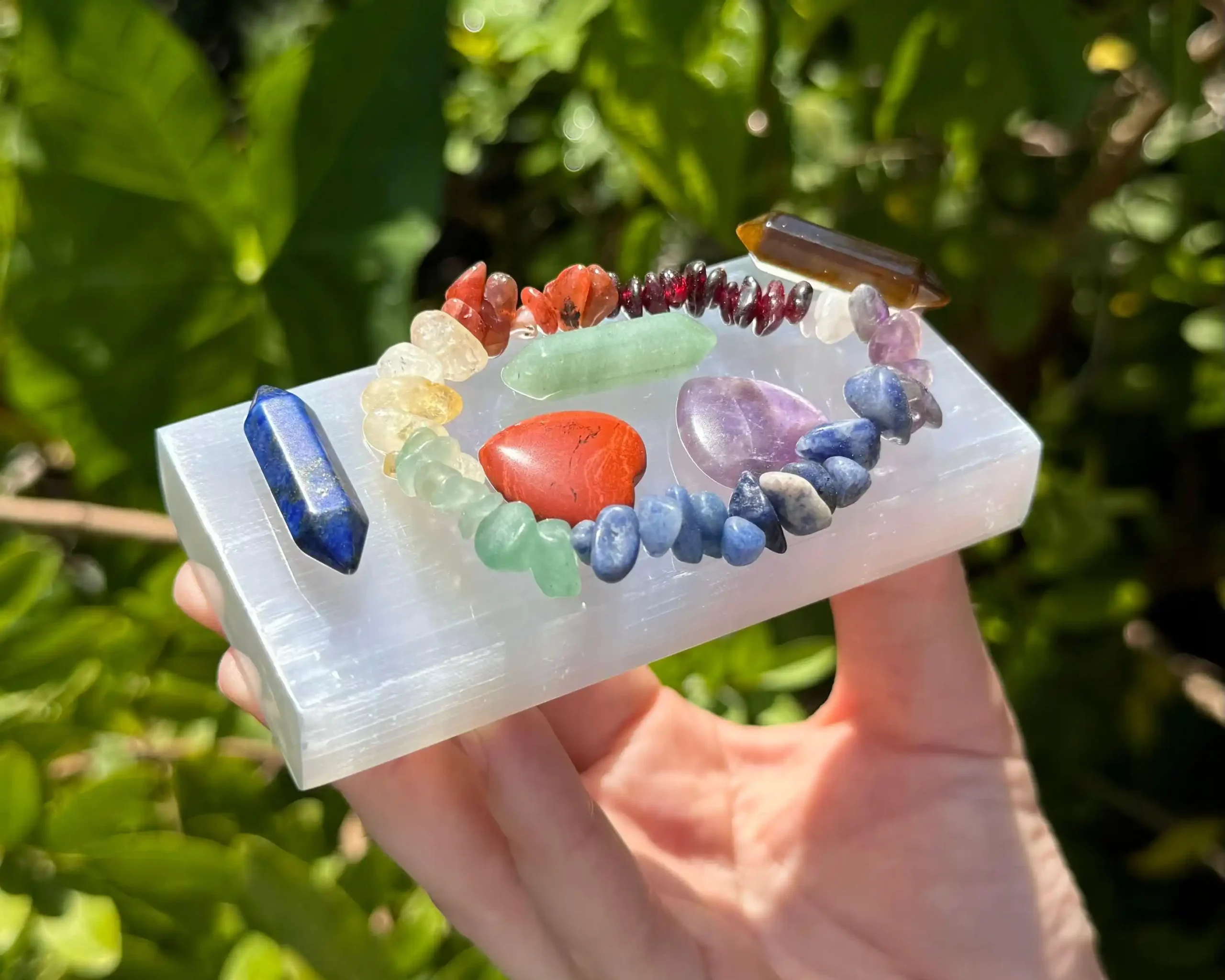
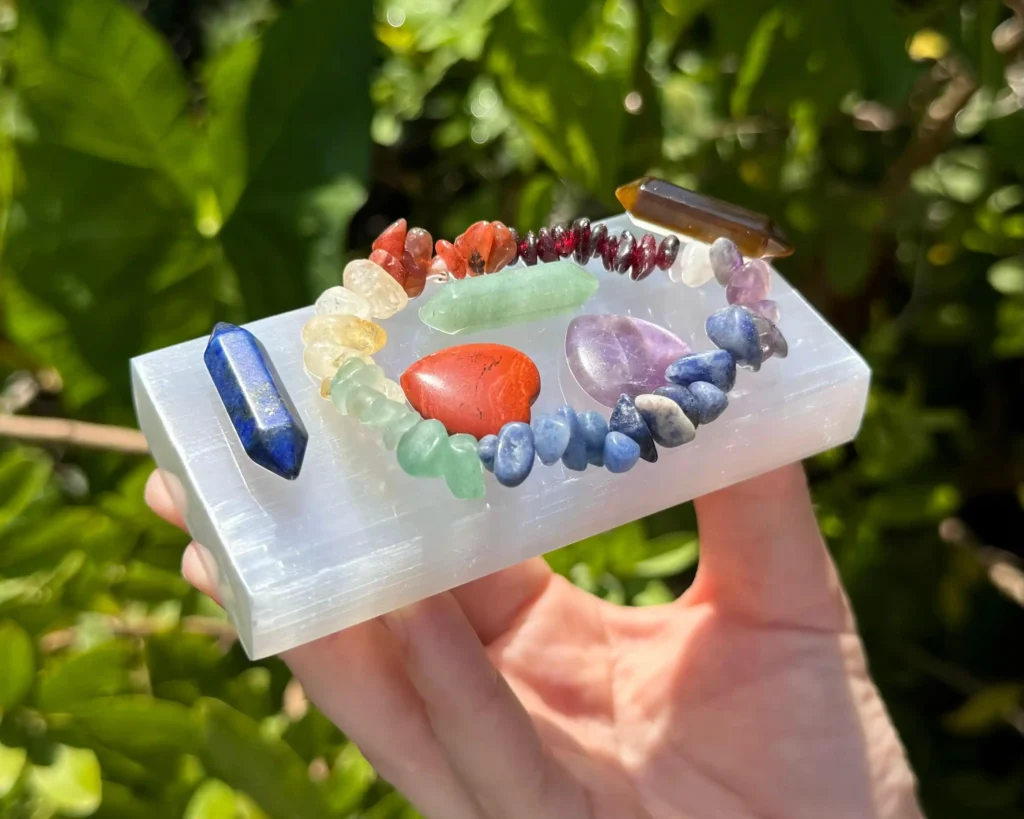
One physical caution is often overlooked: many stones commonly placed on selenite are much harder than gypsum.
Quartz, amethyst, aventurine and many other minerals can scratch a satin-spar plate. Do not rub harder stones across the surface simply because a spiritual tradition describes selenite as a charging material.
Can Selenite Charge Other Crystals?
Within contemporary crystal traditions, many practitioners say yes.
Scientifically, no demonstrated mechanism shows that selenite transfers measurable energy into quartz, amethyst or another gemstone.
The ritual can still be performed symbolically.
Place the objects beside one another rather than assuming direct contact is necessary. A thin soft cloth can prevent harder crystals from scratching gypsum.
This is particularly important because Mohs hardness is relative. Gypsum at 2 is softer than most stones in a typical crystal collection.
Selenite meaning should never become a reason to damage the selenite itself.
Selenite Water Safety
Water is one of the most important practical concerns.
Selenite is gypsum, and gypsum has limited solubility in water. A brief accidental touch does not normally make an entire crystal vanish, but prolonged moisture can dissolve, dull, etch or roughen the surface.
Fibrous satin spar can also trap moisture and become less attractive after repeated wet handling.
For this reason, the broader guide to which crystals can and cannot go in water places selenite among materials that should not be soaked.
Do not use running-water cleansing, saltwater soaking, crystal baths or prolonged immersion.
Selenite meaning does not require water exposure.
Never Use Selenite in Drinking Water
Do not place selenite directly into drinking water or prepare a direct crystal elixir from it.
The issue is larger than gypsum alone.
Commercial specimens may carry polishing compounds, dust, coatings, handling contamination, matrix minerals or residues that are not suitable for ingestion.
A mineral being natural does not make it food-safe.
If a symbolic water ritual is personally meaningful, keep the crystal completely outside a closed drinking-water container.
The stone does not medically alter the water, and direct contact offers no necessary advantage.
Is Selenite Safe in Sunlight?
Ordinary light exposure is not usually the primary damage concern for colorless gypsum.
The greater risks are heat, outdoor moisture, thermal change, dirt and fragile construction.
A specimen does not need hours of strong direct sun to preserve selenite meaning.
For symbolic charging, indirect indoor light is safer and easier to control.
Do not leave selenite outdoors where morning dew, rain or condensation may wet the surface.
Also avoid hot windowsills, radiators and intense heat. Gypsum contains structural water and can change when strongly heated.
Selenite Hardness and Durability
Selenite has Mohs hardness 2, making it one of the softest minerals commonly sold in crystal collections.
The distinction between hardness and other durability properties is important. Gemstone toughness vs hardness explains why scratch resistance does not describe every way a material can fail.
Selenite is both soft and vulnerable to cleavage.
The underlying principle is discussed in gemstone cleavage: crystals with preferred structural splitting directions may break from impacts that do not necessarily scratch the surface first.
Keep selenite away from quartz, metal jewelry, keys, coins and abrasive household dust.
Even gentle repeated rubbing can gradually dull a polished satin-spar surface.
Physical softness has no relationship with the strength of selenite meaning. A symbolic association with clarity does not make the mineral more durable.
Selenite Towers
White towers sold as selenite are usually satin spar.
The crystal towers guide emphasizes that these gypsum carvings should remain dry and protected from harder materials.
The silky vertical effect makes towers visually appealing, and selenite meaning often interprets the upward form as focus, clarity or purposeful direction.
That interpretation belongs to symbolism.
The carved point does not project a measurable beam of energy.
A tall tower should sit on a stable level base where it cannot topple. Damaged tips may splinter, and falls onto tile can create sharp or rough fragments.
Selenite Hearts
Many white fibrous hearts marketed as selenite are polished satin spar.
The crystal hearts guide places these objects among decorative forms that need careful handling because gypsum scratches easily.
A heart shape may add compassion, emotional space or relationship reflection to selenite meaning.
Someone could use the object as a reminder to express care clearly or to distinguish kindness from unlimited access.
The shape does not increase the mineral’s healing ability.
Keep satin-spar hearts away from loose bags, keys and harder stones, and do not give fragile fibrous pieces to young children as toys.
Selenite Eggs
Polished eggs are another common commercial form.
As the crystal eggs guide explains, many “selenite eggs” are satin spar and remain extremely soft despite their smooth polish.
Egg imagery contributes themes of beginnings, development and renewal to selenite meaning.
A stable padded stand is preferable to placing a polished gypsum egg on a hard shelf where it can roll.
A damaged fibrous edge can become rough or splintered.
Is Selenite Good for Jewelry?
True transparent selenite is generally a poor choice for conventional everyday jewelry.
Its Mohs hardness of 2 means abrasion occurs easily, and cleavage adds breakage risk.
Satin-spar pendants and earrings exist, but they require much more protection than ordinary quartz or corundum jewelry.
Rings and bracelets are particularly impractical because they regularly contact desks, doors, clothing and other objects.
Selenite meaning may make a pendant personally attractive, but symbolism should not override durability.
For frequent wear, a harder white or colorless stone may be more practical. The white crystals comparison shows how dramatically durability varies among visually similar pale materials.
Selenite vs Clear Quartz
Colorless selenite and clear quartz can sometimes be confused, particularly in photographs.
Quartz is silicon dioxide and ranks Mohs 7. Selenite is hydrated calcium sulfate and ranks only 2.
Quartz commonly develops hexagonal-looking prisms with pointed terminations, while selenite often forms flatter blades, plates or elongated tabular crystals.
Quartz lacks gypsum’s perfect cleavage.
The enormous hardness difference is one of the most useful professional identification distinctions, although deliberately scratching a finished specimen is unnecessary and destructive.
Their symbolism also overlaps. Both may be associated with clarity in contemporary practice.
Similar symbolic language does not indicate that the minerals are related.
Selenite vs Scolecite
Selenite and scolecite can both appear white, pearly and delicate.
They are different minerals.
Scolecite is a calcium-rich zeolite and commonly forms slender radiating crystals or sprays. Selenite is gypsum and can form blades, plates and transparent crystals, while satin spar develops fibrous masses.
Visual identification becomes difficult in small or damaged specimens.
When certainty matters, mineralogical testing such as Raman spectroscopy or X-ray diffraction is more reliable than trying to identify a specimen through spiritual sensation.
Selenite meaning cannot distinguish gypsum from zeolite.
Selenite vs Calcite
White calcite can resemble some gypsum specimens.
Calcite is calcium carbonate, CaCO₃, while selenite is hydrated calcium sulfate.
Calcite ranks Mohs 3, which is still soft but harder than gypsum. It also displays characteristic rhombohedral cleavage and reacts readily with acid.
Do not use vinegar or another acid as a casual home test because it can damage the specimen.
Some polished white objects sold under loose trade terminology may be calcite rather than gypsum. Seller disclosure and physical identification are more useful than relying on color alone.
How to Recognize Real Selenite
Start with structure and texture.
True selenite may be transparent to translucent and often shows bladed or tabular growth. Satin spar displays aligned fibers and a silky moving optical band when polished.
Real gypsum should be very soft.
However, intentionally scratching a polished object is poor practice. Existing damage at a hidden edge may already reveal the material’s softness.
Check for molding seams, trapped manufacturing bubbles, repeated identical shapes or plastic-like surfaces when evaluating suspicious imitations.
Resin and glass can reproduce a pale appearance, although glass is much harder.
A commercial tower that is fibrous does not become fake simply because it is technically satin spar rather than crystalline selenite.
The important question is whether the material is natural gypsum and whether the seller describes it honestly.
Selenite Treatments and Alterations
Selenite and satin spar may be polished, carved, dyed, coated, glued or repaired.
Colorful commercial “selenite” pieces can sometimes be dyed or coated gypsum rather than naturally vivid material.
Some objects may also combine several sections with adhesive.
Surface coatings can improve shine or protect delicate material temporarily, but they change cleaning requirements.
Dye may collect more strongly along cracks and fibers.
A treated piece can still carry whatever personal selenite meaning the owner assigns to it. Treatment affects physical description and value, not a scientifically measurable spiritual property.
How to Judge Selenite Quality
Quality depends on what type of material is being purchased.
For transparent crystalline selenite, collectors may value clarity, crystal form, intact terminations, unusual growth and documented locality.
For satin spar carvings, visual quality depends more on fiber orientation, strength of the silky band, even polish, symmetry and absence of distracting chips.
A large object is not automatically rare.
Commercial satin spar can be abundant, and much of its retail price reflects carving, shipping and presentation rather than raw mineral rarity.
Claims about unusually strong selenite meaning or “high vibration” do not establish gemological quality.
For collectible specimens, provenance and condition are more meaningful.
Selenite Safety Around Children and Pets
Intact selenite is not a toy.
The main practical hazards are fragility, small broken pieces and rough or fibrous edges.
Children or pets may drop, chew or mouth objects, so delicate gypsum specimens should remain out of reach.
Do not allow pets to lick crystal plates or drink water that has been in contact with minerals.
Large towers should be placed where they cannot fall.
Selenite meaning does not make a fragile object physically protective.
Safe placement is particularly important in homes where decorative crystals are stored on open shelves.
How to Clean Selenite
Dry care is the safest default.
Use a very soft clean brush to remove loose dust. A dry microfiber cloth can work on sturdy polished satin spar, but rub gently because repeated abrasion can scratch the surface.
Avoid soaking.
Do not use vinegar, lemon juice, household cleaners, bleach, alcohol-based products, abrasive powders or ultrasonic equipment.
Steam is also unsuitable because it combines moisture and heat.
A badly soiled collectible crystal may require specialist mineral-conservation advice rather than aggressive home cleaning.
Physical cleaning is different from selenite meaning or symbolic cleansing. One removes dirt; the other is a personal ritual.
How to Cleanse Selenite Symbolically
Because gypsum is moisture-sensitive and extremely soft, low-contact symbolic methods are ideal.
Sound, visualization, prayer, intention-setting or placing the stone in a quiet dry space avoid unnecessary physical risk.
Indirect indoor moonlight can also fit the lunar symbolism behind selenite meaning.
There is no scientifically required cleansing schedule.
The stone does not become physically contaminated with negative energy after a difficult conversation, and it does not require recharging to preserve its mineral properties.
Perform the ritual when it helps mark a transition or renew an intention, not because fear-based claims say the stone becomes dangerous when “full.”
How to Store Selenite
Selenite should be kept dry, padded and separate from harder minerals.
The wider guide to storing crystals safely places gypsum in the very-soft category because nearly every common jewelry stone can scratch it.
Wrap important blades individually in soft acid-free tissue or place them in padded specimen boxes.
Do not stack quartz points directly on satin-spar plates.
Keep long crystals supported along their length rather than balancing them on one fragile end.
Avoid bathrooms, damp basements and areas where condensation or spills are common.
A stable display protects the mineral without changing selenite meaning.
Practical Ways to Use Selenite Meaning
Selenite meaning is most useful when a symbolic theme leads to a real action.
For clarity, separate facts from assumptions.
For symbolic cleansing, physically remove unnecessary clutter or close unfinished tasks.
For peace, create a lower-stimulation environment.
For reflection, write down one question rather than trying to solve everything simultaneously.
For release, identify something specific that no longer needs attention.
For boundaries, state what behavior will trigger a particular response.
For a fresh start, define what will be done differently this time.
The selenite object becomes a marker for the practice rather than the cause of the outcome.
How Selenite Meaning Fits With the Real Mineral
Selenite meaning is unusually easy to connect with the appearance of the real material.
Its translucency naturally suggests clarity. Its pale color supports symbolism involving simplicity and blank space. Its lunar name creates an association with reflection. Satin spar’s moving band of light can symbolize changing perspective.
At the same time, its physical softness provides an unexpectedly useful counterpoint.
Something associated with clarity still requires careful handling.
That can become a metaphor in itself: clearer decisions do not eliminate vulnerability, and peaceful boundaries still need protection.
At Gems Lore, selenite meaning is best understood as this symbolic layer around a genuine gypsum mineral. The spiritual traditions can be respected without presenting them as scientific medicine or measurable energy physics.
Gypsum’s real properties determine identification, care and safety. Personal practice determines what the object represents.
Frequently Asked Questions
What is the main selenite meaning?
The main selenite meaning centers on clarity, reflection, peace, symbolic cleansing, simplicity and fresh starts. These associations come from cultural and contemporary spiritual practices rather than scientifically established healing effects.
What is selenite made of?
Selenite is crystalline gypsum with the chemical formula CaSO₄·2H₂O. It is hydrated calcium sulfate and belongs to the monoclinic crystal system.
Is satin spar the same as selenite?
Both are gypsum, but their crystal habits differ. True selenite is typically transparent to translucent and bladed or tabular, while satin spar is fibrous. Many commercial objects sold as selenite are actually satin spar gypsum.
Is satin spar fake selenite?
Usually no. Satin spar is genuine natural gypsum. The issue is terminology rather than authenticity when it is broadly marketed as selenite.
What are selenite healing properties?
Selenite healing properties are traditional or contemporary spiritual interpretations involving clarity, peace and energetic cleansing. They are not scientifically established medical effects.
Can selenite treat anxiety?
No reliable evidence shows that selenite treats anxiety or another mental-health condition. A stone may be used as a calming visual object during reflection, but persistent anxiety requires appropriate professional support.
Does selenite remove negative energy?
There is no established evidence that gypsum removes a measurable form of negative energy. Within selenite meaning traditions, the stone can instead symbolize resetting a space, releasing an unwanted association or reinforcing a boundary.
Can selenite cleanse other crystals?
Using selenite to cleanse other stones is a contemporary spiritual practice. No scientifically demonstrated energy transfer has been established. If the ritual is meaningful, keep harder stones from rubbing against the very soft gypsum surface.
Does selenite need to be cleansed?
There is no scientific need to cleanse selenite energetically. Symbolic cleansing can be performed whenever it helps renew a personal intention. Dry, low-contact methods are safest.
What chakra is selenite associated with?
Selenite meaning is most commonly associated with the crown chakra, although some traditions also connect it with the third eye. Chakra assignments are spiritual frameworks rather than anatomical facts.
Why is selenite associated with the Moon?
The name selenite is derived from Selene, the Moon figure in Greek tradition. Its pale, luminous appearance reinforced lunar symbolism.
Can selenite go in water?
Selenite should not be soaked. Gypsum has limited water solubility, and prolonged moisture can dull, dissolve or damage the surface. Keep selenite dry whenever practical.
Does selenite dissolve instantly in water?
No. A brief accidental touch generally does not make a crystal instantly disappear. The concern is progressive surface damage and dissolution with unnecessary or prolonged exposure.
Can I make selenite water or a crystal elixir?
Do not place selenite directly into drinking water. Minerals may carry dust, treatments, polishing residues or other contaminants, and direct crystal elixirs provide no established medical benefit.
Can selenite sit in sunlight?
Normal light is not usually the primary issue for colorless gypsum, but strong heat, outdoor moisture and environmental exposure add unnecessary risk. Indirect indoor light is safer for display or symbolic charging.
Is selenite hard or fragile?
Selenite is very soft, ranking only 2 on the Mohs scale, and it has pronounced cleavage. It scratches easily and can chip or split after impact.
Is selenite good for jewelry?
It is generally unsuitable for high-wear jewelry because of its softness and cleavage. Protected pendants or earrings can be worn cautiously, while everyday rings and bracelets are poor choices.
How can I tell selenite from clear quartz?
Selenite is gypsum with Mohs hardness 2 and pronounced cleavage. Quartz is silicon dioxide with hardness 7 and no comparable easy cleavage. Crystal habit also differs. Avoid destructive scratch tests on finished specimens.
Is selenite the same as calcite?
No. Selenite is hydrated calcium sulfate, while calcite is calcium carbonate. Calcite is harder at Mohs 3 and has different cleavage and chemical behavior.
Is selenite the same as scolecite?
No. Selenite is gypsum, whereas scolecite is a calcium-rich zeolite. Both can be pale and delicate, but their composition, structure and typical crystal habits differ.
What are selenite towers actually made from?
Most white fibrous towers sold as selenite are carved from satin spar gypsum. They are usually natural gypsum even though the mineral habit is more accurately called satin spar.
Why does my selenite have a moving white line?
A moving silky band is typical of polished satin spar. Parallel gypsum fibers interact with light to produce the optical effect as the viewing angle changes.
How should selenite be cleaned?
Use dry, gentle methods such as a soft brush or careful microfiber cloth. Avoid soaking, strong cleaners, acids, abrasives, steam and ultrasonic equipment.
How should selenite be stored?
Keep it dry, individually padded and separated from harder minerals. Avoid damp locations and support long or thin crystals so they cannot fall or bend under pressure.
Selenite combines simple chemistry with an unusually strong visual identity. It is gypsum—a soft, water-sensitive hydrated sulfate—but its transparent blades and luminous satin-spar forms have inspired selenite meaning involving clarity, reflection, peace and ritual renewal.
The most useful interpretation does not require treating the mineral as a medical device or invisible-energy machine. Selenite meaning can represent the decision to clear unnecessary clutter, examine a situation more carefully, establish a quieter environment or leave behind something that no longer deserves attention.
Its physical fragility also adds an important lesson. Selenite meaning may emphasize clarity and peace, yet the material itself requires boundaries: keep it dry, protect it from harder stones and handle it deliberately. Respecting both the symbolism and the mineral produces a more complete understanding of what selenite actually is.
Selenite meaning, chakra associations, energy-cleansing traditions, emotional-healing practices and Reiki uses are cultural, spiritual or personal interpretations rather than scientifically established medical effects. Selenite should not replace medical or mental-health care, cannot guarantee protection or remove a measurable form of negative energy, and should not be ingested or placed directly in drinking water. Gypsum is extremely soft and moisture-sensitive, so keep selenite and satin spar dry, protected from abrasion and safely stored away from children or pets that may mouth or damage the material.