Pink Tourmaline Meaning, Properties and Healing Uses
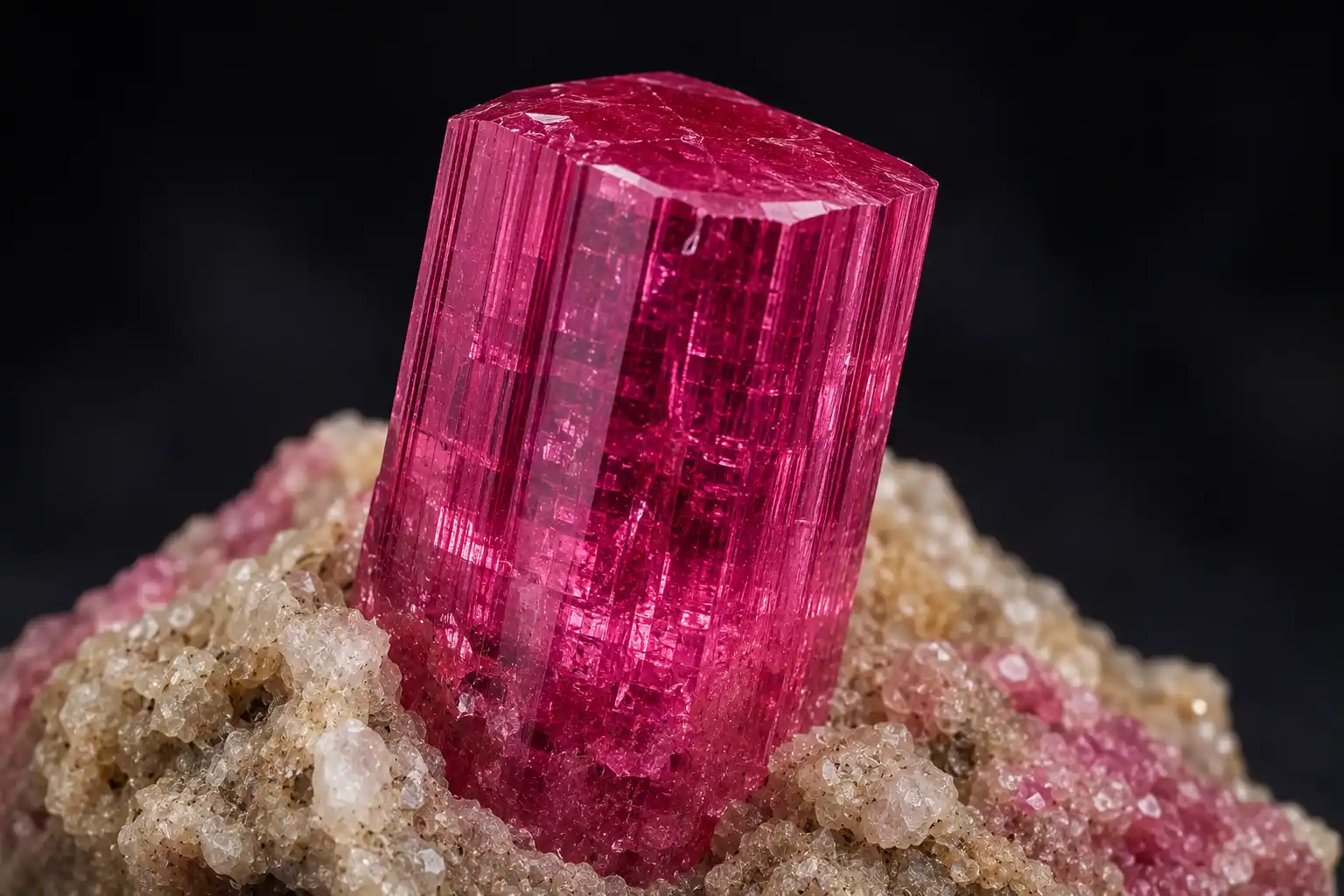
Pink tourmaline is a pale blush to saturated rose, magenta or purplish-pink member of the tourmaline group. Most transparent gem-quality pink material belongs to elbaite, a lithium-bearing tourmaline species associated with granitic pegmatites.
Its color commonly relates to manganese and to changes in manganese’s oxidation state. Natural zoning may produce pale cores, darker rims, red-pink sections or transitions into green, creating bicolor and watermelon crystals.
Historically and in contemporary crystal practice, pink tourmaline represents emotional openness, compassion, resilience and the courage to communicate honestly. These meanings remain cultural or personal beliefs rather than scientifically demonstrated healing effects.
Pink Tourmaline at a Glance
| Property | Pink tourmaline |
|---|---|
| Mineral group | Tourmaline |
| Common gem species | Elbaite |
| Mineral class | Complex borosilicate |
| Typical color | Pale pink, rose, magenta, purplish pink or red-pink |
| Main color influence | Commonly manganese-related |
| Crystal system | Trigonal |
| Common crystal habit | Elongated prismatic crystals with vertical striations |
| Transparency | Transparent to translucent |
| Luster | Vitreous |
| Mohs hardness | Approximately 7–7.5 |
| Toughness | Fair |
| Cleavage | Indistinct or poor |
| Optical character | Doubly refractive and strongly pleochroic in some stones |
| Common inclusions | Tubes, thread-like cavities, healed fractures and fluid inclusions |
| Common cuts | Oval, cushion, emerald, pear, round and cabochon |
| Common treatments | Heating, irradiation and occasional fracture filling |
| Main care concern | Impact, inclusions, thermal shock and high heat |
| Birthstone association | October |
The tourmaline meaning guide owns the family-level mineralogy, history and full color range. Pink tourmaline should not repeat every property of black, blue, green or copper-bearing tourmaline.
What Is Pink Tourmaline?
Tourmaline is not one mineral with a simple fixed composition. It is a group of related borosilicate minerals that share a crystal structure while varying chemically.
Many gem-quality pink tourmalines belong to elbaite, a sodium–lithium–aluminum tourmaline species capable of producing pink, red, green, blue and color-zoned crystals.
The trade name “pink tourmaline” describes color rather than a separate mineral species. Two pink stones may have slightly different chemistry while still being sold under the same color description.
The types of tourmaline guide explains how mineral species, color varieties and trade names overlap without being identical systems.
How Pink Tourmaline Forms
Pink tourmaline commonly forms in granitic pegmatites. Pegmatites crystallize from late-stage, volatile-rich magmatic fluids that can concentrate lithium, boron, manganese and other elements not easily incorporated into earlier-forming minerals.
These chemically evolved environments can produce large crystals alongside quartz, feldspar, mica, lepidolite, spodumene and other pegmatite minerals.
Color may change during growth as the chemical composition and oxidation conditions of the fluid shift. Consequently, one crystal may begin nearly colorless, become pink, deepen toward red or transition into green.
Fractures and fluid inclusions are common because tourmaline crystals grow in environments rich in liquids and gases. Later tectonic pressure and mining can add further fractures.
Pink Tourmaline Sources
Brazil has produced substantial quantities of pink and multicolored tourmaline, particularly from Minas Gerais. Brazilian material ranges from pale crystals to rich pink-red gems and strongly zoned specimens.
Afghanistan and Pakistan are known for pegmatite tourmalines with delicate pink, mint-green and bicolor combinations. Fine crystals may display attractive terminations and collectible matrix associations.
Madagascar produces a wide range of tourmaline colors, including pink, red, bicolor and polychrome material. Mozambique and Nigeria have also supplied significant gem-quality stones.
California and Maine became historically important American tourmaline sources. Pink crystals from Southern California helped establish tourmaline as a notable American gem during the late nineteenth and early twentieth centuries.
Origin can add collecting interest, but visual appearance alone does not establish locality. A seller’s geographic claim should be supported when it materially affects price.
Pink Tourmaline Color
Pink tourmaline may be nearly colorless blush, pastel pink, rose, hot pink, magenta, purplish pink or red-pink. Brown, orange, gray or violet modifiers may also appear.
Color is usually the most important quality factor. Fine stones combine attractive hue, sufficient saturation and enough brightness to remain lively outside intense display lighting.
A dark stone may retain weight but show broad extinction. A pale stone may look attractive in photographs yet disappear against skin or a light setting.
The planned tourmaline color-meaning guide retains the cross-color symbolism framework. This page remains focused on the pink variety’s identity and uses.
Pleochroism and Cutting Orientation
Tourmaline can show different colors or color strengths along different crystal directions. This pleochroism affects how a cutter orients the rough.
Long prismatic crystals often encourage elongated emerald, oval, rectangular and pear shapes. However, the table direction may be chosen to lighten a dark crystal or intensify pale material.
If the stone is cut too shallow, the center may appear transparent or windowed. Excessive depth can preserve carat weight while reducing visible size and creating dark areas.
The strongest cut distributes color across the face and uses the pleochroism constructively rather than producing one bright end and one dead end.
Pink Tourmaline Clarity
Pink and red tourmalines commonly show more visible inclusions than green and blue varieties. The market may accept inclusions when color remains vivid and the stone retains sufficient transparency.
Typical features include thread-like growth tubes, fluid-filled cavities, healed fractures and reflective fissures. Some inclusions run parallel to the crystal’s length.
A few inclusions may give the gem character without materially weakening it. Surface-reaching fractures near corners, girdles or prongs deserve closer attention because they can affect setting and long-term durability.
Included material with strong color may be cut as a cabochon, bead or carving. Parallel tubes can occasionally produce a cat’s-eye effect when oriented correctly.
Pink Tourmaline Versus Rubellite
Rubellite is a trade term rather than a separate mineral species. It generally describes saturated pink, red, purplish-red or orangy-red tourmaline.
Some dealers reserve rubellite for stones that remain rich red or pink in daylight, incandescent light and other common lighting. Others use the term for almost any strong pink-red tourmaline.
Pale pink tourmaline normally falls outside the rubellite category. The transition is gradual, so no universal color boundary separates every stone.
Buyers comparing important material should use the rubellite buying guide and rubellite price guide rather than assuming the trade name alone proves quality.
Pink Tourmaline Versus Watermelon Tourmaline
Watermelon tourmaline shows pink or red centers surrounded by green zones, often with a lighter intermediate band.
The pink section may share similar manganese-related coloration with ordinary pink tourmaline, but the defining search intent is the multicolored zoning pattern.
Slices are commonly cut across a crystal to display a pink core and green rim. Elongated gems may instead show color changes along their length.
A solid pink stone should not be marketed as watermelon tourmaline simply because it came from a crystal that once had green sections.
Pink Tourmaline Versus Paraiba and Indicolite
Paraiba tourmaline is a copper-bearing trade variety associated with vivid blue, green or violetish-blue color. Its chemistry, market premiums and origin testing create a distinct buying category.
Indicolite refers to blue or greenish-blue tourmaline. It occupies another separate color intent.
A crystal can theoretically show complex zoning that includes pink and blue or pink and copper-bearing sections, but those unusual examples require laboratory evaluation before strong trade claims are made.
Pink tourmaline should be valued for its own hue, saturation and transparency rather than described as “pink Paraiba.”
Pink Tourmaline Treatments
Heating may alter some tourmaline colors, while irradiation can increase pink or red saturation. These treatments can be difficult or impossible to detect in some stones.
Fracture filling with oils or resins also occurs, especially in valuable stones with surface-reaching fissures. Filling can improve apparent clarity but may introduce special-care requirements.
The gemstone treatments guide owns the complete treatment taxonomy.
A treated natural tourmaline remains natural tourmaline. The problem arises when the treatment is concealed or when untreated status is claimed without evidence.
Pink Tourmaline Hardness and Durability
Pink tourmaline measures approximately 7–7.5 on the gemstone hardness chart. It resists ordinary light scratching but can be abraded by sapphire, diamond and other harder materials.
Tourmaline’s toughness is considered fair. The gemstone toughness-versus-hardness guide explains why a respectable Mohs number does not protect a fractured stone from impact.
High heat can alter color or damage inclusions. Sudden temperature change may cause thermal shock and fracturing.
Earrings and pendants are comparatively safe uses. Rings and bracelets require secure settings and careful habits.
Buying Pink Tourmaline
Color should lead the assessment. Compare stones under diffused daylight, neutral indoor light and warm evening light.
Strong saturation is desirable only when the stone remains bright. A dark magenta tourmaline that becomes black around the edges may be less attractive than a lighter rose gem with even brilliance.
Clarity expectations should reflect the material. A moderately included vivid stone may be preferable to an eye-clean pale stone, but durability-threatening fractures should reduce value.
The general tourmaline buying guide owns the complete purchase workflow, while the tourmaline price guide retains current market ranges and size premiums.
Laboratory Reports
Routine commercial pink tourmaline may not need a laboratory report. Documentation becomes more useful for high-value rubellite, major untreated claims, unusual origin stories, suspected treatment or stones represented as rare species.
The gemstone certification guide explains report types and laboratory limitations. Use how to read a gem lab report to determine whether a document identifies the mineral species, describes treatment or merely supplies an appraisal value.
A report cannot determine whether the stone’s color is personally attractive or whether the setting is well constructed.
Pink Tourmaline Jewelry
A tourmaline bracelet exposes stones to frequent wrist contact and needs secure links, protected edges and a reliable clasp.
Tourmaline earrings allow matched pink stones to frame the face with comparatively low impact risk.
A tourmaline necklace can focus on one strong center stone or use color-zoned beads and stations.
A tourmaline ring requires the greatest care. Bezel settings, protective halos and substantial prongs are preferable for included gems.
White metals make cool pinks appear crisp. Yellow and rose gold emphasize warmth and may blend naturally with peach-pink stones.
Pink Tourmaline Meaning
Pink tourmaline commonly symbolizes emotional openness, compassion, tenderness and the courage to communicate.
Its meaning differs subtly from rose quartz. Rose quartz is often associated with comfort and gentle self-regard, while pink tourmaline is more frequently framed as active emotional expression and resilience after disappointment.
The pink gemstones guide places it among other pink materials, while the pink crystals guide owns the color-based spiritual roundup.
These meanings remain interpretive rather than scientifically measurable.
Emotional Healing Beliefs
Contemporary crystal practitioners use pink tourmaline as a symbol for acknowledging feelings without allowing them to control every action.
A grounded intention might involve stating a need clearly, listening before becoming defensive or accepting that vulnerability and boundaries can coexist.
The stone cannot treat trauma, depression or anxiety. It may function as a reminder to use an established coping strategy or seek appropriate support.
Pink Tourmaline and Self-Love
Self-love symbolism should not be reduced to admiration or constant positivity. It can include resting, maintaining boundaries, asking for fair treatment and accepting responsibility without humiliation.
Pink tourmaline may be worn as a reminder to speak internally with the same accuracy and fairness offered to another person.
Its value as a symbol does not depend on carat weight, origin or market price.
Pink Tourmaline and Relationships
Pink tourmaline is associated with affection, emotional honesty and reciprocal care.
It cannot attract a specific person, guarantee fidelity or repair a relationship without participation from the people involved.
A useful relationship intention focuses on controllable behavior: communicate directly, notice reciprocity, respect consent and recognize when distance is safer than repeated repair attempts.
Pink Tourmaline and the Heart Chakra
Modern crystal traditions often assign pink tourmaline to the heart chakra because of its color and emotional symbolism.
Within that system, it may represent receiving affection, expressing vulnerability and balancing compassion with self-respect.
Chakras are spiritual concepts rather than anatomical structures. A “blocked heart chakra” should not be used to diagnose chest pain, breathing problems or cardiovascular symptoms.
Pink Tourmaline Meditation
Hold a smooth stone or place a crystal on a stable surface. Notice its color zoning, temperature and texture without assigning every observation a supernatural message.
Choose one specific theme, such as communicating honestly or reducing defensive reactions.
After the meditation, identify one action that supports the intention. The usefulness comes from reflection and behavior, not a proven field emitted by the stone.
Pink Tourmaline as an October Birthstone
Tourmaline is one of October’s recognized birthstones, together with opal. The October birthstone guide covers the month-level tradition.
Pink tourmaline is a popular October choice because it combines recognizable color with broad jewelry availability. The October birthstone jewelry guide owns gifting formats and coordinated designs.
Birthstone status does not identify treatment or quality. A pink stone still requires accurate gemological disclosure.
Cleaning Pink Tourmaline
Warm water, mild soap and a soft brush are the safest routine. Avoid prolonged soaking when fracture filling, adhesives or complex settings may be present.
Steam and ultrasonic cleaning are not recommended. Heat, vibration and inclusions can create damage risk.
The complete procedure appears in how to clean tourmaline jewelry safely.
Store the gemstone away from diamonds and sapphires. Included or crystal specimens should also be protected from pressure on their terminations.
Frequently Asked Questions
1. What does pink tourmaline symbolize?
It commonly symbolizes compassion, emotional openness, self-respect, resilience and honest communication.
2. Is pink tourmaline a type of elbaite?
Many gem-quality pink tourmalines are elbaite, although tourmaline is a chemically complex mineral group and color names do not always identify species by themselves.
3. What causes pink tourmaline’s color?
Manganese commonly contributes to pink and red coloration, with oxidation state and growth conditions affecting the final shade.
4. Is pink tourmaline the same as rubellite?
Not exactly. Rubellite is a trade term usually reserved for strongly saturated pink-to-red tourmaline, while pink tourmaline includes lighter shades.
5. Is pink tourmaline rare?
Fine saturated, transparent and well-cut material can be scarce. Pale, included and commercial-grade pink tourmaline is more widely available.
6. Is pink tourmaline commonly treated?
Heating and irradiation can alter tourmaline color, while some fractured stones may be filled. Treatment can be difficult to detect.
7. Can pink tourmaline be worn every day?
Earrings and pendants can be worn regularly. Daily rings and bracelets require protective settings and removal during impact-prone activities.
8. Is pink tourmaline suitable for an engagement ring?
It can be used with care, although sapphire, spinel and diamond are more resistant to demanding wear. A protective bezel or halo improves security.
9. Why are pink tourmalines often included?
They commonly grow in fluid-rich pegmatite environments, where tubes, cavities and healed fractures may become trapped during crystal growth.
10. Does pink tourmaline fade in sunlight?
Tourmaline is generally stable to ordinary light, although treated color and prolonged extreme exposure create uncertainty. High heat is the more important concern.
11. Can pink tourmaline go in an ultrasonic cleaner?
It should not. Vibration may affect included, fractured or filled stones, and warm soapy water is safer.
12. How can I tell pink tourmaline from glass?
Glass may show bubbles, different optical behavior and lower hardness, but no single home observation is conclusive. Valuable stones should be tested professionally.
Pink tourmaline’s appeal lies in the combination of color and structure. Growth zoning records changes inside a pegmatite, inclusions preserve traces of a fluid-rich environment, and cutting determines whether pale blush or saturated magenta remains lively from the face-up view. Its emotional symbolism can add personal meaning, but the stone’s lasting value depends on accurate identity, treatment disclosure and a setting suited to its real durability.
Pink tourmaline appears in Gemstones That Start With P, Crystals That Start With P and Gemstones That Start With T.
Pink tourmaline healing, chakra and emotional-energy claims are cultural or contemporary spiritual beliefs, not medical facts. The gemstone does not diagnose, prevent or cure physical or mental-health conditions and cannot control another person’s feelings or behavior.