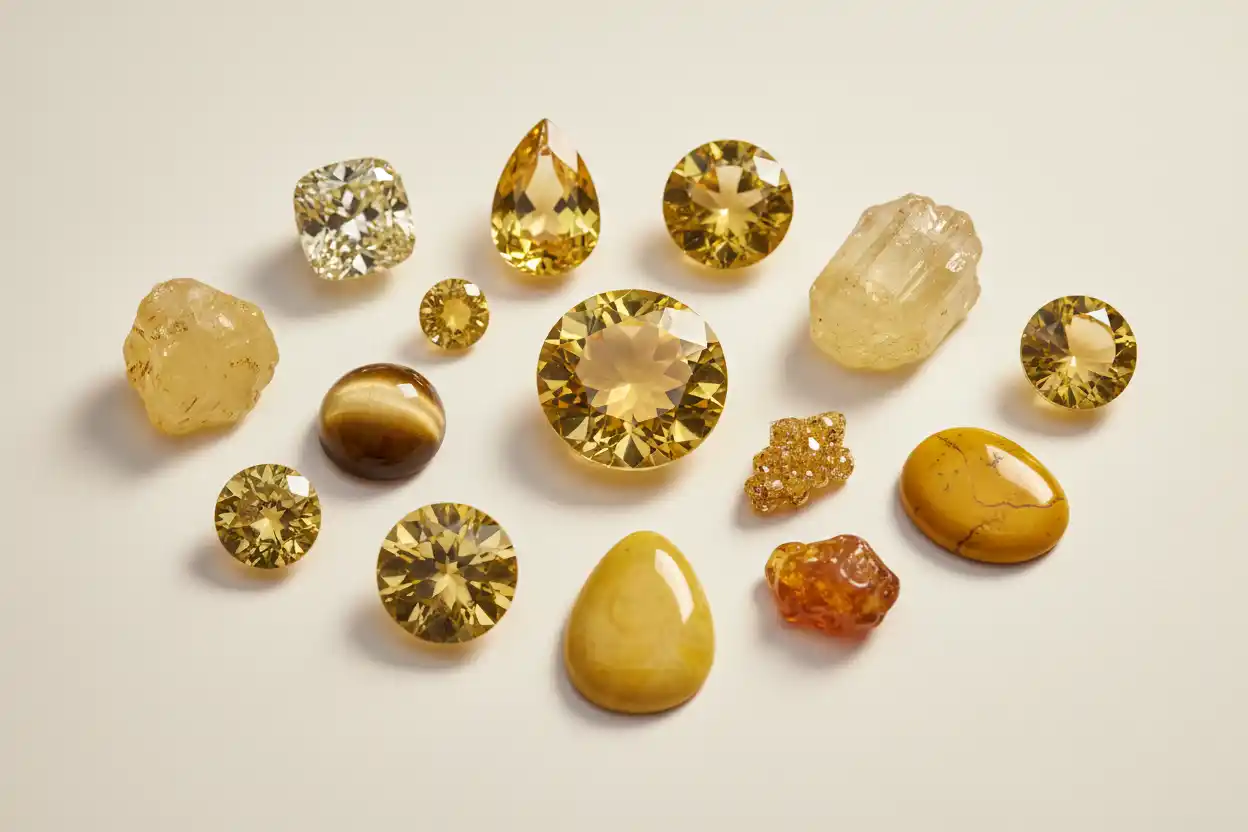
Yellow Gemstones: Names, Meanings, Properties and Uses
Yellow gemstones include transparent faceted gems, opaque ornamental rocks, phenomenal Feldspars, organic materials and natural glasses. Their colors range from pale straw and lemon to canary, gold, honey, mustard and orange-yellow.
These stones do not share one chemical composition or durability level. Yellow Diamond consists of carbon, Yellow Sapphire is Corundum, Citrine is Quartz, Heliodor is Beryl and Amber is fossilized resin.
Within symbolic traditions, yellow gemstones commonly represent optimism, confidence, intellectual clarity, creativity, prosperity and purposeful action. Those interpretations vary among cultures and remain personal or spiritual meanings rather than scientifically demonstrated health effects.
The completed yellow crystals guide provides the broader crystal-shop list, including soft collector minerals and metallic specimens. The yellow engagement-ring stones guide compares the strongest yellow center stones for daily rings.
Yellow Gemstones at a Glance
| Yellow gemstone | Material identity | Typical yellow range | Traditional association | Common use |
|---|---|---|---|---|
| Yellow Diamond | Crystalline carbon | Pale yellow to Fancy Vivid canary | Commitment and confident expression | Fine jewelry and engagement rings |
| Yellow Sapphire | Yellow Corundum | Straw, lemon, canary and golden | Wisdom and disciplined prosperity | Rings, earrings and pendants |
| Citrine | Yellow-to-orange Quartz | Pale yellow to reddish orange | Motivation and generosity | Faceted jewelry and carvings |
| Yellow Topaz | Yellow Topaz | Lemon, honey, sherry and gold | Intention and honest communication | Large faceted jewelry |
| Imperial Topaz | Premium orange-pink-to-yellow Topaz trade category | Golden, orange, peach and reddish | Leadership and purposeful action | Fine jewelry and collecting |
| Heliodor | Yellow Beryl | Pale yellow to golden green-yellow | Direction and personal purpose | Faceted jewelry |
| Chrysoberyl | Beryllium aluminum oxide | Lemon, yellow-green and honey | Resilience and practical judgment | Durable fine jewelry |
| Yellow Zircon | Natural zirconium silicate | Yellow, gold and orange-yellow | Wisdom and renewal | Brilliant faceted jewelry |
| Yellow Tourmaline | Tourmaline-group mineral | Lemon to brown-yellow | Creativity and flexible thinking | Collector gems and jewelry |
| Yellow Garnet | Several Garnet varieties | Lemon, honey and yellow-orange | Energy and perseverance | Fine and collector jewelry |
| Yellow Spinel | Spinel | Yellow to orange-yellow | Renewal and endurance | Fine jewelry |
| Yellow Sunstone | Feldspar | Yellow, peach and orange with possible sparkle | Independence and enthusiasm | Cabochons and faceted gems |
| Yellow Opal | Hydrated silica mineraloid | Cream, lemon and honey | Imagination and adaptability | Cabochons and pendants |
| Yellow Jasper | Opaque silica-rich material | Mustard, ochre and tan | Endurance and grounded optimism | Beads, carvings and cabochons |
| Yellow Fluorite | Calcium fluoride | Pale lemon to golden | Organization and discernment | Collector stones and occasional jewelry |
| Yellow Calcite | Calcium carbonate | Butter, lemon and gold | Perspective and release | Carvings and display |
| Amber | Fossilized plant resin | Lemon, honey and orange | Warmth and memory | Beads, carvings and jewelry |
| Libyan Desert Glass | Natural silica-rich glass | Pale yellow to golden | Transformation and resilience | Specimens and pendants |
| Golden Healer Quartz | Iron-stained or included Quartz | Golden films and clouds | Renewal and integration | Crystals, cabochons and carvings |
| Pyrite | Iron sulfide | Metallic brassy yellow | Resourcefulness and boundaries | Specimens and ornamental pieces |
The category includes materials that are not mineral crystals. Amber is organic, Opal is a mineraloid, Libyan Desert Glass is natural glass and Yellow Jasper can represent a rock or opaque silica-rich aggregate.
Yellow Diamond
Yellow Diamond is the most valuable and durable mainstream yellow gemstone category.
Nitrogen-related defects within the Diamond lattice absorb blue light, allowing yellow to dominate. Greater color saturation usually moves the stone into Fancy-color grades.
Yellow Diamond can be described through grades such as:
- Fancy Light
- Fancy
- Fancy Intense
- Fancy Vivid
- Fancy Deep
- Fancy Dark
Exact terminology belongs to laboratory grading rather than seller opinion.
Traditional symbolism combines Diamond’s association with commitment and endurance with yellow themes of confidence, visibility and active joy.
Natural, laboratory-grown and color-treated yellow Diamonds all exist. A significant purchase requires an independent colored-Diamond report.
The Diamond buying guide owns full report and quality-factor guidance.
Yellow Sapphire
Yellow Sapphire is yellow Corundum with Mohs hardness 9.
It offers pale straw, lemon, canary, golden and orange-yellow colors.
Traditional meanings emphasize wisdom, disciplined confidence, prosperity and turning knowledge into practical decisions.
Yellow Sapphire works well in rings because of its excellent scratch resistance and generally useful toughness.
However, the market includes natural, heated, diffusion-treated and synthetic stones. Some Yellow Sapphires can also show unstable color behavior under particular lighting or testing conditions.
The Pukhraj guide explains the gem’s role in Vedic tradition without treating spiritual prescription as universal or medically established.
Citrine
Citrine is yellow-to-orange crystalline Quartz.
Colors range from pale lemon and brownish yellow to golden orange and reddish orange.
Traditional symbolism emphasizes confidence, motivation, generosity, commerce and approaching opportunities actively.
Citrine’s hardness of 7 makes it suitable for pendants, earrings, bracelets and carefully worn rings.
Natural Citrine is relatively uncommon. Most market material results from heating Amethyst, while some yellow-green Quartz develops through other treatment combinations.
Treatment is accepted and generally stable, but naturally colored material should not be claimed without evidence.
The November birthstone guide covers Citrine’s birthstone role alongside Topaz.
Yellow Quartz and Lemon Quartz
Yellow Quartz is a broad category that can include Citrine, treated Quartz, iron-stained Quartz and inclusion-colored material.
Lemon Quartz is generally transparent yellow-to-yellow-green Quartz and is often treatment-related.
Traditional meanings emphasize clear priorities, curiosity and approaching work with fresh energy.
The names should not be used to imply distinct mineral species.
When purchasing, ask whether color:
- Lies within the Quartz lattice
- Follows fractures
- Comes from iron-oxide films
- Results from irradiation
- Results from heat
- Comes from coating
- Is natural or treated
- Remains stable during normal wear
Quartz-family durability supports jewelry, but treatment and fractures still matter.
Yellow Topaz
Yellow Topaz includes pale yellow, honey, golden and brownish-yellow Topaz.
Traditional symbolism connects it with intention, honest communication and following through on commitments.
Topaz has Mohs hardness 8 but perfect cleavage. Therefore, it resists many scratches while remaining vulnerable to splitting after impact.
Large transparent stones are available, making Yellow Topaz useful for pendants, statement rings and earrings.
It can be confused with Citrine, Heliodor and Yellow Sapphire. Refractive properties and crystal structure separate them.
Names such as Topaz Quartz or Smoky Topaz should be avoided when the material is Quartz rather than Topaz.
Imperial Topaz
Imperial Topaz is a prestigious trade category applied to selected yellow-orange, orange-pink, peach, pinkish and reddish Topaz.
Definitions vary among dealers. Some require a visible red or pink pleochroic component, while others use the name more broadly.
Traditional meanings emphasize purposeful leadership, responsibility and confidence.
The finest material is strongly associated with Ouro Preto, Brazil, although geographic origin alone does not guarantee Imperial quality.
An Imperial premium requires attractive color, good cutting, credible identity and treatment disclosure.
A plain pale-yellow Topaz should not receive the name simply to increase price.
Heliodor
Heliodor is the yellow-to-greenish-yellow variety of Beryl.
Its colors commonly appear lemon, straw, golden yellow and yellow-green.
Traditional associations include direction, personal purpose and maintaining confidence while accepting responsibility.
Heliodor is reasonably durable for jewelry, with hardness approximately 7.5 to 8.
Large transparent stones can be cut, although poor proportions may create central windows.
Golden Beryl and Heliodor are overlapping trade descriptions rather than consistently separate mineral varieties.
The Heliodor price guide explains how color, clarity, cutting and size influence value.
Chrysoberyl
Chrysoberyl is not a Beryl variety despite the similar name.
It is a beryllium aluminum oxide mineral with Mohs hardness 8.5 and good practical durability.
Transparent stones can appear yellow, yellow-green, greenish yellow, honey or brownish yellow.
Traditional meanings emphasize resilience, practical judgment and preserving attention under pressure.
Ordinary Chrysoberyl is distinct from Alexandrite and cat’s-eye Chrysoberyl.
Fine transparent yellow material can make excellent rings and earrings, although it remains less familiar to general jewelry buyers than Sapphire.
A laboratory report helps distinguish it from Beryl, Sapphire, Zircon and synthetic materials.
Yellow Zircon
Zircon is a natural zirconium silicate known for high brilliance and strong dispersion.
Yellow Zircon may appear lemon, golden, orange-yellow or brownish yellow.
Traditional symbolism includes wisdom, renewal and protecting attention from distraction.
Zircon should not be confused with Cubic Zirconia, a manufactured zirconium oxide simulant.
Natural Zircon can show strong double refraction, making rear facet edges appear doubled.
Heat treatment can change Zircon color and structural condition. Although attractive in jewelry, brittle behavior and facet-edge abrasion make it less durable than Sapphire or Diamond.
The types of Zircon guide covers color varieties and structural differences.
Yellow Tourmaline
Yellow Tourmaline occurs across several Tourmaline compositions.
Colors include pale lemon, greenish yellow, golden, brown-yellow and orange-yellow.
Traditional meanings emphasize creativity, flexible thinking and responding constructively when plans change.
Tourmaline is pleochroic, so one crystal can show different color strengths from different directions.
Correct cutting orientation can emphasize yellow while reducing unwanted brown or green modifiers.
Inclusions are common and can create fracture risks. Heat or irradiation may alter selected Tourmaline colors.
The types of Tourmaline guide explains the broader mineral family.
Yellow Garnet
Yellow Garnet can include Grossular, Andradite, Spessartine and mixed Garnet compositions.
Some Mali Garnets appear yellow-green to golden and can show lively brilliance. Topazolite is a yellow-to-brown Andradite variety, while other Garnets may appear honey or orange-yellow.
Traditional symbolism emphasizes energy, perseverance and using available resources effectively.
Garnet generally has no easy cleavage and offers moderate-to-good durability, though hardness and toughness vary among species.
A seller should identify the Garnet variety through gemological properties rather than color alone.
The types of Garnet guide provides the necessary family context.
Yellow Spinel
Yellow Spinel is less common in the market than red, pink or blue Spinel.
Natural colors range from pale yellow to orange-yellow and brownish yellow.
Traditional associations include renewal, persistence and restoring enthusiasm after setbacks.
Spinel has Mohs hardness 8 and generally good toughness, supporting rings and everyday jewelry.
Synthetic Spinel is widely available and can be exceptionally clean.
A natural-origin premium requires independent testing. Yellow Spinel should not be identified from refractive appearance or lack of inclusions alone.
Sunstone
Sunstone is a Feldspar variety that can appear yellow, peach, orange, red, green or colorless.
Some material shows aventurescence from reflective inclusions, while transparent stones may have no obvious glitter.
Traditional meanings emphasize independence, enthusiasm and taking initiative.
Feldspar cleavage and moderate hardness require more protection than Quartz, Chrysoberyl or Sapphire.
Oregon Sunstone can contain copper and may show red, green, bicolor or color-change effects. The Oregon Sunstone guide owns that locality-specific material.
Goldstone and aventurine glass can imitate strong sparkle.
Yellow Opal
Yellow Opal has a yellow, cream, lemon, honey or golden body.
Precious material displays play-of-color, while common Yellow Opal has body color without spectral flashes.
Traditional meanings emphasize imagination, adaptability and allowing ideas to change during development.
Opal is hydrated silica with lower hardness and stability than Quartz or Sapphire.
Heat, dehydration, sudden temperature changes and impact can cause damage.
Doublets and triplets contain assembled layers, while dyed common Opal and glass can imitate attractive yellow color.
Yellow Opal works best in pendants, earrings and protected occasional-wear rings.
Yellow Jasper
Yellow Jasper is an opaque yellow, mustard, ochre, tan or brownish silica-rich material.
Traditional meanings emphasize endurance, grounded optimism and making steady progress.
The Jasper trade category includes multiple opaque rocks and silica-rich aggregates.
Natural patterns can include veins, spots, bands, brecciation and iron-rich areas.
Bright uniform lemon color deserves treatment scrutiny because dye can enter porous or fractured material.
Sound Yellow Jasper is practical for beads, cabochons, carvings, worry stones and everyday jewelry.
Yellow Fluorite
Yellow Fluorite ranges from pale lemon to golden and honey-brown.
It may form cubes, octahedra, complex crystals and massive banded material.
Traditional meanings emphasize organization, discernment and sorting useful ideas from distracting ones.
Fluorite has Mohs hardness 4 and perfect cleavage, making it primarily a collector stone.
Occasional pendants and earrings are possible with careful protection, but rings and bracelets are likely to scratch or chip.
Some colors can change through prolonged light or heat exposure.
Glass, Calcite and Quartz can imitate polished yellow Fluorite.
Yellow Calcite and Honey Calcite
Yellow Calcite and Honey Calcite occupy overlapping commercial color ranges.
Yellow Calcite commonly implies pale lemon or butter-yellow material, while Honey Calcite suggests deeper golden, amber and caramel tones.
Both are calcium carbonate with Mohs hardness 3 and perfect cleavage.
Traditional meanings connect them with perspective, persistence and confidence developed through experience.
They are best suited to carvings, display pieces and carefully handled palm stones.
Acids cause permanent etching, and water can enter fractures or disturb resin and coatings.
Amber
Amber is fossilized plant resin.
Natural colors include lemon yellow, honey, orange, red, brown, greenish and nearly black.
Traditional symbolism emphasizes warmth, memory, continuity and connection with the natural past.
Amber is lightweight, soft and sensitive to heat, alcohol, perfume and household chemicals.
Commercial products may be natural, heat-treated, clarified, pressed, reconstructed, Copal, plastic or resin.
Its low density and warm appearance make it popular for necklaces and earrings.
Amber rings require protection because exposed surfaces scratch easily.
Golden Healer Quartz
Golden Healer Quartz is commonly Clear or Milky Quartz containing yellow-to-orange iron-oxide films, staining or inclusions.
Traditional meanings emphasize renewal, integration and symbolic cleansing.
The color may follow fractures, coat the exterior or form internal clouds.
It differs from transparent Citrine because much of its yellow appearance can come from separate iron-rich material rather than uniform Quartz body color.
Coatings, artificial staining and acid cleaning can alter its appearance.
The material is used for points, spheres, cabochons and carvings rather than high-brilliance faceted jewelry.
Libyan Desert Glass
Libyan Desert Glass is natural silica-rich glass found in the Great Sand Sea.
Its colors range from pale straw to rich golden yellow, sometimes with greenish or brownish areas.
Traditional interpretations emphasize transformation, resilience and adaptation after disruptive change.
Provenance is central because bottle glass, slag and resin can resemble it.
Natural pieces may have frosted, pitted or partly polished surfaces. Faceting removes much of that geological context.
It should not be sold automatically as a meteorite because the material formed mainly from terrestrial silica during an extreme impact-related event.
Pyrite and Metallic Yellow Stones
Pyrite is iron sulfide with brassy metallic color.
It differs visually from transparent yellow gems but is commonly included in yellow and gold crystal collections.
Traditional meanings emphasize resourcefulness, boundaries and recognizing practical value.
Pyrite is brittle and may oxidize in damp conditions.
Chalcopyrite and other metallic minerals can look similar but have different hardness, tarnish and chemistry.
Metallic sulfides should not be soaked, ingested or used in drinking-water preparations.
Choosing Yellow Gemstones for Jewelry
Diamond, Sapphire, Chrysoberyl and Spinel provide the strongest daily-wear durability.
Heliodor, Tourmaline, Citrine and Garnet work well in many jewelry forms when their settings protect vulnerable areas.
Topaz requires protection from cleavage-related impact. Zircon needs protection from abrasion and brittleness.
Sunstone and Opal are better for careful or occasional rings.
Calcite and Fluorite work mainly in pendants, earrings and low-impact pieces, while Pyrite is best treated as an ornamental mineral rather than conventional ring material.
The correct choice follows how the jewelry will actually be worn.
Yellow Gemstone Treatments
Yellow color can be natural, heat-induced, irradiated, diffused, dyed or coated.
Important examples include:
- Heated Citrine
- Heat-treated Yellow Sapphire
- Beryllium-diffused Sapphire
- Treated yellow Diamond
- Heated Zircon
- Irradiated Lemon Quartz
- Coated Beryl or Topaz
- Dyed Opal
- Dyed Jasper
- Resin-filled fractures
- Clarified or pressed Amber
- Artificially tarnished Chalcopyrite
The gemstone treatments guide explains how treatment affects disclosure, care and value.
Treatment does not automatically make a gemstone undesirable. Undisclosed treatment and inappropriate pricing create the problem.
Durability and Care
The gemstone hardness chart provides the starting point for scratch resistance, but each yellow material needs its own care plan.
Diamond and Sapphire tolerate more regular use than Calcite, Fluorite or Opal.
Topaz has cleavage despite relatively high hardness. Zircon can abrade despite strong brilliance.
Amber and Opal need protection from heat, while Pyrite needs protection from moisture.
When identity or treatment is uncertain, use a soft dry cloth and consult a qualified jeweler before using steam, ultrasonic equipment, chemicals or soaking.
Traditional Meanings and Practical Use
Yellow gemstones are often used symbolically for optimism, confidence, creativity and purposeful action.
A Citrine ring may remind someone to approach an opportunity actively. Yellow Sapphire can symbolize long-term judgment, while Yellow Jasper may represent patience during gradual progress.
These meanings can support personal ritual or storytelling.
However, a stone does not create success, cure low mood or replace planning, skill development and professional care.
The strongest symbolic use connects the gemstone to a realistic action rather than passive expectation.
Frequently Asked Questions
1. What is the most valuable yellow gemstone?
Fine natural Fancy yellow Diamond usually has the strongest established market, although exceptional Sapphire, Chrysoberyl and rare collector gems can also be valuable.
2. What is the most durable yellow gemstone?
Diamond is the most scratch-resistant, followed by Yellow Sapphire and Chrysoberyl among major natural yellow gems.
3. What is the most affordable transparent yellow gemstone?
Citrine, Yellow Topaz and some Heliodor stones are widely available at accessible prices.
4. Is Citrine always naturally yellow?
No. Most commercial Citrine is produced by heating Amethyst or other Quartz.
5. Is Yellow Sapphire commonly treated?
Yes. Heat treatment is common, while diffusion-treated and synthetic Yellow Sapphire also occur.
6. Is Yellow Topaz the same as Citrine?
No. Topaz and Quartz have different compositions, optical properties, hardness and cleavage.
7. Is Yellow Zircon the same as Cubic Zirconia?
No. Zircon is a natural mineral, while Cubic Zirconia is a laboratory-created simulant.
8. Is Amber a gemstone?
Amber is an organic gem material rather than a mineral, but it has a long history of jewelry use.
9. Which yellow gemstone has the strongest fire?
Fancy yellow Diamond and Zircon can show strong dispersion, while manufactured yellow Moissanite can produce especially intense rainbow fire.
10. Can yellow gemstones fade?
Some Fluorite, treated Quartz, Sapphire color centers, Amber and organic or coated materials may change under prolonged light, heat or chemical exposure.
11. What do yellow gemstones traditionally symbolize?
They commonly symbolize confidence, optimism, prosperity, creativity and purposeful action, although meanings vary.
12. What should I ask before buying a yellow gemstone?
Ask for exact identity, natural or laboratory origin, treatments, durability, report, setting suitability and return terms.
Choose the Yellow Effect That Belongs to the Stone
Yellow gemstones can sparkle, glow, flash, shimmer or remain quietly opaque. Diamond and Zircon create fire, Sapphire offers durable color, Sunstone glitters, Opal flashes and Amber carries a warm organic luster.
The Y gemstone directory and Y crystal directory organize names alphabetically. Choose the stone whose real optical effect, durability and treatment history fit its intended use.
Wellness note: Gemstone meanings are cultural and spiritual traditions rather than scientifically proven health effects. Do not ingest stones, prepare gemstone water or use jewelry as a substitute for professional medical or mental-health care.