Ammolite Price: Quality & Value, Authenticity, Rarity & Size
Ammolite price can range from relatively accessible commercial jewelry to substantial collector-level values because this gem does not follow a simple price-per-carat model. Ammolite is iridescent fossil ammonite shell composed mainly of aragonite, and its value depends heavily on the brilliance and range of its colors, chromatic shift, pattern, usable surface area, construction, treatment, condition, provenance, and whether the piece is jewelry material or an important fossil specimen. GIA identifies red and green as relatively common ammolite colors, while blue and violet are less common and typically more valuable.
Size matters, but it needs careful interpretation. A large ammolite cabochon may consist of a very thin iridescent shell layer backed or capped with other materials, while a complete iridescent ammonite fossil can derive enormous value from its completeness, geological significance, preservation, provenance, and display quality. Carat weight therefore tells far less about ammolite value than it does for many transparent gemstones. The strongest valuation approach begins by identifying exactly what is being priced, then evaluates color, construction, rarity, condition, and market category.
Ammolite Price at a Glance
| Value Factor | Typical Influence on Ammolite Price |
|---|---|
| Color brightness | Strong, vivid iridescence generally raises desirability |
| Number of colors | Several distinct attractive colors can add value |
| Blue and violet | Less common than red and green and often command stronger premiums |
| Chromatic shift | Color that remains attractive over a wider range of viewing angles is generally more desirable |
| Pattern | Attractive dragon-skin, sheet, cobblestone, moonglow, or other patterns can increase collector appeal |
| Surface area | Large uninterrupted areas of strong color often matter more than total weight |
| Construction | Solid, stabilized solid, doublet, and triplet material belong to different market categories |
| Treatment | Polymer stabilization is common and should be considered in price comparisons |
| Condition | Chips, scratches, delamination, cracks, repairs, or damaged caps can reduce value |
| Provenance | Documented Alberta or Bearpaw Formation material can add confidence and collector appeal |
| Full fossil preservation | Complete or large iridescent ammonites can enter a high-value natural-history market |
| Jewelry craftsmanship | Gold, diamonds, setting quality, and maker reputation can exceed the value of the ammolite itself |
| Market venue | Retail, wholesale, fossil auction, and private resale values can differ substantially |
Ammolite is therefore best valued as a highly visual, structurally delicate fossil gem rather than through a universal commodity-style rate.
What Actually Creates Ammolite Value?
Ammolite’s most important visible characteristic is its iridescence. The effect develops because light interacts with extremely fine layered structures within the fossil shell. Modern GIA research describes iridescent ammonite as consisting mostly of aragonite platelets arranged in structures comparable with nacre in modern shells. The exact colors depend on the thickness and spacing of those layers, which is why one piece may appear predominantly red and green while another shows blues, violets, golds, and complex shifting combinations.
This optical structure makes value highly appearance-dependent. Two pieces from the same deposit and of similar dimensions may look radically different because one has broad, vivid, multicolored iridescence while the other shows narrow or muted patches. Unlike many transparent gemstones, ammolite is not primarily judged through clarity and faceting. Buyers respond instead to brightness, color range, color shift, pattern, surface coverage, construction, and how the material performs as it moves.
Color Usually Has the Greatest Visual Influence on Price
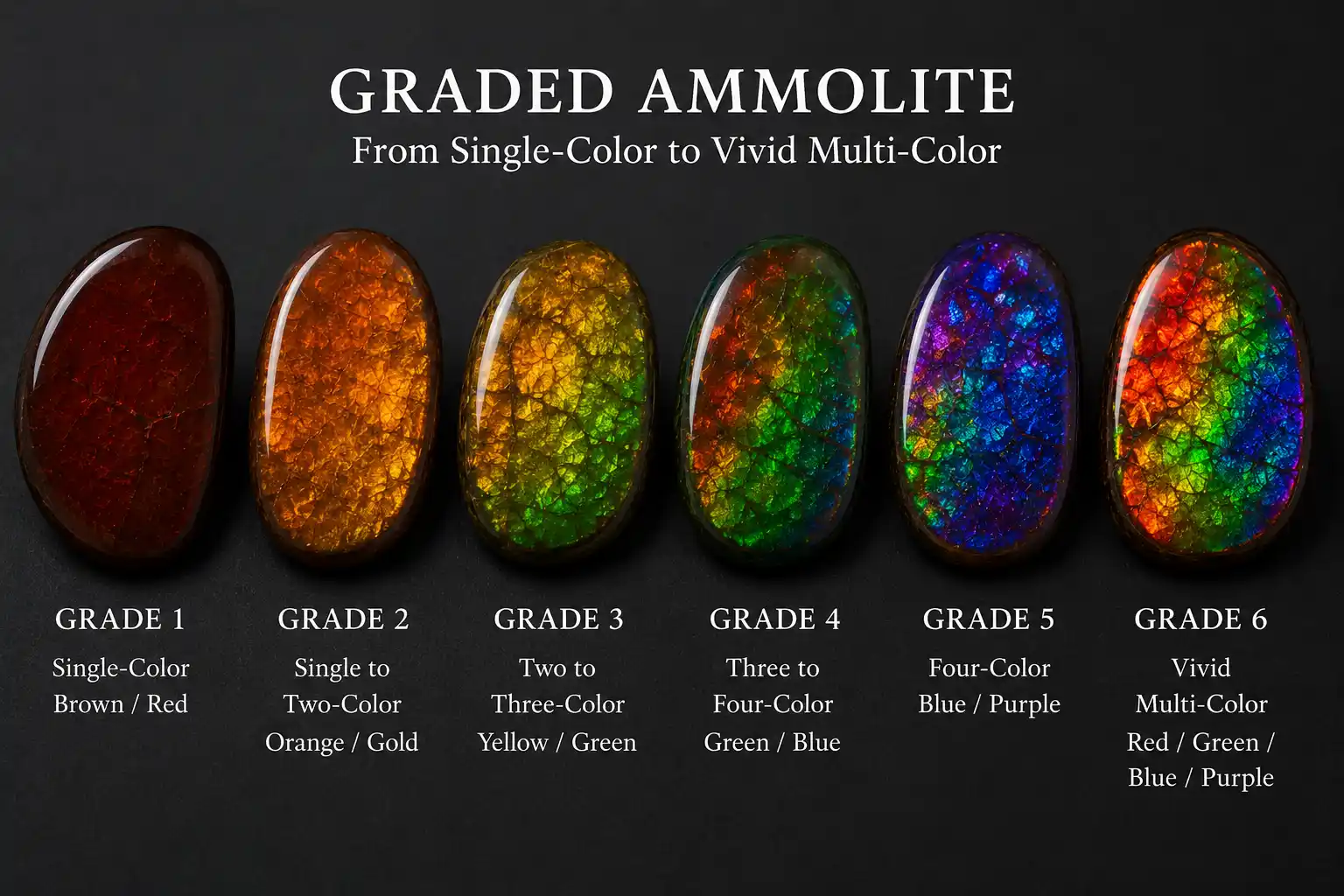
Color is one of the clearest drivers of ammolite price. GIA notes that red and green are relatively common in commercial ammolite, while blue and violet are less common and generally more valuable. A piece displaying vivid red, orange, yellow, green, blue, and violet may therefore command stronger interest than one showing only a narrow red-green range, provided those colors are bright and clearly visible.
The number of colors should not be treated mechanically. A five-color stone with dull, weak iridescence may be less attractive than a brilliant two-color piece with intense green and red across most of its face. Brightness, saturation, continuity, and viewing-angle performance can outweigh simple color counting.
For that reason, seller descriptions such as “seven-color rainbow ammolite” should be treated as a starting point rather than a complete quality grade. The actual stone needs to be viewed under neutral lighting, ideally in motion.
Blue and Violet Can Add a Strong Premium
Blue and violet are especially prized because they occur less frequently than red and green in classic Alberta material. GIA specifically states that blue and violet ammolite are more unusual and typically more valuable. This rarity can create a meaningful premium when those colors occupy a substantial part of the gem and remain visible across practical viewing angles.
A tiny blue flash does not automatically transform an ordinary stone into top-tier material. The premium depends on how much of the color appears, how intense it is, how consistently it remains visible, and how it interacts with the rest of the pattern.
The same caution applies to violet. Broad vivid violet can be exceptional, while a faint purple hint visible only under one studio light may have much less practical impact.
Brightness Can Matter More Than Color Count
Ammolite should appear lively rather than merely colorful. Strong iridescence creates an almost illuminated quality as the viewing angle changes. GIA’s recent work on phenomenal gemstones emphasizes that the visual impact of iridescence comes from changing color and intensity as light interacts with layered structures.
This is why two nominally “rainbow” pieces can command very different prices. One may glow strongly under ordinary light, while another may need intense directional illumination to reveal its full color range.
When comparing ammolite price, ask whether the strong colors remain visible under realistic indoor and daylight-type conditions. The stone that performs consistently often offers better value than the stone with the most dramatic single photograph.
Chromatic Shift Influences Quality
Ammolite changes color as the viewing angle changes, and this chromatic shift is an important quality consideration. GIA’s detailed technical study incorporated directional color performance into ammolite quality evaluation, while high-end auction descriptions also emphasize how strongly color shifts in hue and intensity as the fossil is viewed from different directions.
A piece that maintains vivid color over a relatively broad range of viewing angles is often more satisfying in jewelry because normal movement does not cause the entire surface to disappear into darkness.
Highly directional material can still be beautiful, especially in a display specimen positioned for optimal viewing. Its value simply belongs to a different practical category from a gem that remains brilliant through a wider range of orientations.
Historical Ammolite Grades Should Be Used Carefully
One of the most important facts about ammolite grading is that no single internationally accepted grading system has governed the entire market. GIA’s major technical study explicitly noted the absence of an internationally accepted grading system and documented a producer-specific in-house classification using categories such as Extra Fine, Fine, Good, Fair, Poor, and Commercial.
That historical system considered factors such as color number, brilliance, dark areas, directional dependence, fracture pattern, and the rarity of blue or purple. It remains useful for understanding how professionals think about quality, but it should not be mistaken for a modern universal laboratory grade.
Seller labels such as AA, AAA, AAAA, premium, collector grade, or investment grade may therefore mean different things at different companies. Before paying a major premium, ask exactly what the grade measures.
Extra-Fine-Type Characteristics Explain Premium Pricing
The historical top category described by GIA’s source material emphasized three or more sharp, brilliant colors, minimal dark areas, color visible without strong dependence on orientation, attractive narrow fracture patterns, and especially desirable rare colors such as blue and purple. Those characteristics remain useful as a conceptual description of high-end ammolite even though the labels themselves are not universal.
A stone with vivid multicolor iridescence, little dead area, strong viewing-angle performance, attractive patterning, and good surface condition will naturally command more interest than a dull or heavily directional piece.
The important point is to buy the characteristics rather than the label. “AAA” has little value if the seller cannot show why the stone deserves that description.
Pattern Can Raise or Lower Ammolite Value
Ammolite can occur as broad sheet material or as fractured material with stained-glass-like divisions. GIA describes sheet ammolite as continuous color and fractured ammolite as mosaic-like material, with commercial names such as dragon skin, cobblestone, moonglow, and paint brush used to describe different visual patterns.
Some collectors prefer broad uninterrupted sheet color because it creates a cleaner visual field. Others seek complex dragon-skin or cobblestone patterns because each piece becomes visually distinctive.
Pattern only adds value when it complements the iridescence. Heavy dark fractures that dominate the surface can reduce color coverage, while narrow, attractive lines may enhance the design. The best pattern depends partly on personal taste and partly on how much strong color remains visible.
Uninterrupted Color Fields Can Be Especially Desirable
Large continuous swaths of vivid color can create exceptional visual impact. Current high-end auction descriptions of iridescent ammonite specimens specifically emphasize broad lustrous rainbow-like color areas as an important quality characteristic.
This feature becomes especially important in collector fossils, where uninterrupted mineralization across large areas is much harder to preserve than a small jewelry cabochon cut from one favorable section.
For finished gems, a broad clean sheet of color can also justify stronger pricing because the cutter had a larger high-quality area to work with.
Surface Area Is Often More Important Than Carat Weight
Ammolite value is poorly represented by carat weight alone because the prized iridescent shell layer is commonly very thin. GIA’s technical study explains that the fragile color-bearing layer is often fashioned into assembled stones for practical use. A triplet may therefore contain natural ammolite plus backing, adhesive, and a transparent protective cap, all contributing to total weight.
A buyer should pay close attention to face-up dimensions. A 25 x 15 mm ammolite cabochon provides a very different visual presence from a 12 x 8 mm stone even if construction makes their total weights difficult to compare meaningfully.
This is why many useful ammolite comparisons focus on visible surface quality, dimensions, pattern, and color rather than relying on weight as the dominant value factor.
Large Size Does Not Automatically Mean High Quality
Ammolite can cover substantial areas of fossil shell, but large dimensions alone do not guarantee strong value. A large piece with weak red-green patches and large gray or dark areas may be less desirable than a smaller stone with vivid rainbow iridescence and excellent viewing-angle performance.
Size becomes valuable when quality survives across the larger surface. A broad gem displaying intense blue, violet, green, gold, and red without major dead areas is far harder to replace than a large piece dominated by low-grade color.
The same principle applies to whole ammonite fossils. A large fossil earns premium pricing when it combines size with completeness, strong iridescent mineralization, good preparation, attractive matrix, provenance, and condition.
Full Iridescent Ammonite Fossils Can Reach a Completely Different Market
Collector fossils should not be priced using jewelry-cabochon assumptions. Sotheby’s has offered large Bearpaw Formation ammonites with extensive ammolite mineralization at estimates reaching tens of thousands of US dollars, including one large iridescent specimen estimated at US$50,000–80,000. Another large wall-mounted iridescent ammonite carried a US$30,000–50,000 estimate.
These figures do not mean ordinary ammolite jewelry should be valued in the same range. The auction pieces were large natural-history specimens with substantial preservation, provenance, display quality, and broad iridescent coverage.
They illustrate an important market distinction: a polished gem and a major fossil specimen may contain the same type of iridescent shell material while deriving value from very different attributes.
Fossil Completeness Can Add Enormous Value
An intact or substantially complete iridescent ammonite preserves biological form, geological context, and gemstone color simultaneously. This combination is much rarer than obtaining small sections suitable for jewelry.
A complete spiral shell with broad rainbow mineralization may appeal to fossil collectors, gem collectors, museums, interior designers, and natural-history buyers at the same time. That wider demand can lift value far beyond what would be expected from the equivalent surface area divided into cabochons.
Condition still matters. Restoration, missing sections, heavy reconstruction, matrix repair, and surface loss should all be considered before applying prices from exceptional auction specimens.
Rarity Needs Careful Definition
Ammolite is genuinely unusual, but claims such as “found only in Alberta” now require nuance. Alberta’s government describes the gemstone as found almost exclusively in southern Alberta and officially designated it the provincial gemstone. However, recent GIA research notes that iridescent ammonite also occurs in Madagascar, Russia, and other localities, while stating that the brightest and best-known gem-quality material comes from the Bearpaw Formation of southern Alberta.
This distinction matters for value. Alberta material remains the reference point for the commercial market, but “ammolite” should not be treated as proof of Canadian origin by itself.
If a seller charges a provenance premium for Alberta or Bearpaw Formation origin, ask what evidence supports that specific claim.
Bearpaw Formation Material Remains the Benchmark
Southern Alberta’s Bearpaw Formation has exceptional importance because it produced the classic material that established ammolite as a gemstone. GIA’s foundational study describes iridescent fossil ammonite from Late Cretaceous Bearpaw Formation horizons and identifies the historic commercial material with specific ammonite species such as Placenticeras meeki and P. intercalare.
Recent GIA research continues to identify the Bearpaw Formation as the source of the brightest high-quality iridescent ammonite material, even while recognizing comparable material in much smaller quantities elsewhere.
Documented Bearpaw provenance can therefore matter, particularly for collector pieces, but visual quality still needs to justify the price.
Authentication Comes Before Valuation
Ammolite price only makes sense after establishing that the object actually contains natural iridescent ammonite shell. Colored foil, painted material, plastic, resin, and other decorative products can imitate the general appearance.
Assemblies need additional care because a genuine ammolite triplet contains natural material but also includes other components. Authentication should therefore answer two separate questions: is the iridescent layer genuine ammolite, and how is the finished gem constructed?
The previous Gems Lore guide to buy ammolite covers construction, provenance, treatments, inspection, and return terms in greater depth. For valuation purposes, those facts establish the correct comparison category.
Solid, Doublet, and Triplet Prices Should Not Be Compared Directly
Ammolite is commonly sold as stabilized solids, doublets, or triplets. GIA notes that sheet material is often polymer-impregnated and that assembled stones may use shale, black onyx, or glass backing, with quartz or synthetic spinel caps used in triplets.
A solid may carry stronger collector appeal because more of the finished object consists directly of natural fossil shell. A doublet sacrifices some purity of construction for structural support. A triplet provides even greater protection through a transparent cap.
These are different products rather than simply different “grades.” Price should be evaluated within the construction category before comparing color quality.
A Triplet Can Offer Strong Practical Value
A triplet may cost less than an equivalent minimally assembled solid in some collector markets, but it can provide better everyday durability. The cap protects the fragile iridescent layer from scratching and direct impact, which can make a triplet a sensible choice for a ring or frequently worn pendant.
Value should therefore be judged according to purpose. A collector seeking a minimally assembled specimen may pay more for a solid, while a jewelry buyer may prefer a protective triplet even if the material category is less rare.
Practical value and collector rarity are not always the same thing.
Stabilization Does Not Automatically Make Ammolite Low Value
Polymer stabilization is common because ammolite’s color-bearing layer is fragile. GIA specifically describes polymer impregnation as a typical method for strengthening sheet material.
Treatment therefore needs context. In a gem where stabilization is widespread and often necessary for practical jewelry use, treated status does not automatically push a piece into a low-value category.
The important question is whether treatment was disclosed and whether the comparison stone received similar treatment. Undisclosed stabilization becomes a transparency problem; disclosed stabilization is simply part of the product description.
Condition Can Significantly Affect Ammolite Price
Ammolite itself is relatively soft. GIA gives it about 3.5 on the Mohs hardness scale and warns that it can scratch easily. Surface abrasion, edge chips, layer separation, cap scratches, clouded adhesive, and delamination can all reduce appearance and resale value.
Condition becomes especially important in older doublets and triplets. The natural iridescent layer may remain beautiful while the protective cap has become scratched or the adhesive has begun to fail.
Whole fossil specimens have another set of condition concerns, including repaired breaks, reconstructed sections, matrix damage, missing shell, or restoration. Those factors should be disclosed when comparing auction-level values.
Cap Material Can Influence Durability but Not Natural Rarity
Triplets commonly use quartz or synthetic spinel over the natural ammolite layer. These materials protect the surface and may improve practical jewelry durability.
The cap itself does not make the underlying ammolite rarer. A perfectly polished synthetic-spinel cap can improve wearability, but the value of the natural layer still depends on its color, pattern, size, and provenance.
Buyers should therefore avoid paying a large rarity premium simply because a triplet has a durable cap. The premium should correspond to the entire jewel’s quality and construction.
Pattern Names Do Not Create an Automatic Premium
Dragon skin, cobblestone, moonglow, and paint brush are descriptive market terms recorded by GIA for different ammolite appearances. They can help buyers communicate preferences, but they are not standardized value grades.
One dragon-skin stone may have vivid blue-green-red iridescence and elegant narrow fractures, while another may contain heavy dark lines that overpower the color. Their prices should not be identical merely because both use the same pattern name.
A pattern premium makes sense when the actual pattern is visually attractive and difficult to replace.
Whole Fossil Size and Gem Size Are Different Concepts
Ammolite jewelry size normally refers to the polished face-up gem dimensions. Fossil size refers to the physical shell and matrix, which may weigh kilograms rather than carats.
Sotheby’s recent large Bearpaw Formation specimen measured roughly 19 x 16 inches and weighed about 10 kilograms, with extensive iridescent mineralization on both faces. Its estimate reflected far more than raw ammolite area.
Using that fossil’s price to calculate a per-carat or per-square-centimeter jewelry value would therefore be meaningless.
Jewelry Setting Can Become a Major Part of Price
Ammolite is often set in gold or silver and may be combined with diamonds or other gemstones. In a finished piece, craftsmanship, protective engineering, precious metal, accent gems, maker reputation, and retail margin can equal or exceed the cost of the ammolite component.
This explains why two similar-looking cabochons can appear in finished jewelry at dramatically different retail prices. One may be mounted in a simple sterling-silver pendant, while another sits in a handcrafted high-karat gold setting with diamonds.
Always separate gem value from jewelry-object value when comparing prices.
Ring Prices Often Include a Durability Premium in the Setting
Ammolite rings require more structural protection than pendants because hands encounter far more impact and abrasion. Bezel settings, recessed designs, protective caps, and substantial metalwork can add manufacturing cost.
That additional cost may be worthwhile because GIA warns that ammolite is soft and vulnerable to scratches, heat, acids, perfume, and hairspray.
A higher-priced ring may therefore contain an ordinary ammolite triplet but superior protective engineering. That can represent good practical value even when the raw gem itself is not collector grade.
Pendant and Earring Material Can Prioritize Color Over Protection
Pendants, earrings, and brooches generally experience less impact than rings, allowing designers to use larger or more exposed ammolite surfaces. GIA identifies these among the material’s common jewelry applications.
This means jewelry form can change what quality factors matter most. A pendant buyer may prioritize broad color coverage and size, while a ring buyer may place more value on triplet construction and protective setting.
Comparing ammolite jewelry without accounting for intended wear can therefore create misleading price judgments.
A Complete Rainbow Does Not Automatically Mean Top Value
Full-spectrum material has strong market appeal, but quality involves more than the presence of every color. A complete rainbow that appears dim, fragmented, or only from one narrow angle may be less desirable than a brilliant green-blue-violet piece visible through a broader range of motion.
High-end auction descriptions emphasize not only the number of primary colors but also chromatic shift and magnitude of iridescence.
The strongest stones combine several favorable characteristics rather than winning on one checklist item.
Directional Color Can Lower Practical Appeal
Some ammolite shows bright color only when viewed from one specific direction. Historical grading criteria documented by GIA treated excessive directional dependence as a lower-quality characteristic.
This matters because jewelry is rarely held at a fixed angle. A ring or pendant moves constantly, and a highly directional gem may appear dark through much of normal wear.
For display specimens, directional material can still work well if positioned carefully under controlled lighting. Context again determines whether a characteristic materially affects value.
Dark Areas Can Reduce Price
Large gray, brown, or black areas interrupting the iridescent field generally reduce visual impact. The historical grading framework cited by GIA explicitly considered dark areas when separating finer material from lower commercial categories.
Some dark matrix or fracture lines can enhance contrast and create attractive patterning. The problem arises when non-iridescent material occupies so much of the surface that the gemstone loses brightness and color coverage.
A fair price should reflect the percentage and placement of usable color rather than just the external dimensions.
Ammolite Availability Is Limited but Not Vanishing Overnight
Scarcity claims are common in gemstone marketing, and ammolite’s concentrated historic source makes dramatic wording tempting. Alberta remains the dominant commercial source of fine material, and high-quality broad-spectrum stones are genuinely selective.
However, statements that no ammolite remains or that every piece will inevitably soar in price should be treated cautiously. GIA’s recent research recognizes additional iridescent ammonite occurrences outside Canada, even though production is much smaller and southern Alberta remains the benchmark for the finest material.
Rarity supports value, but it does not create guaranteed appreciation.
Does Ammolite Become More Expensive as Mining Becomes Harder?
Reduced access to high-quality deposits can affect supply, especially for broad uninterrupted sheets and rare blue-violet material. Yet retail price is influenced by more than mining output. Demand, existing dealer inventory, fashion, cutting technology, jewelry manufacturing, exchange rates, and collector interest also matter.
Ammolite may therefore become more expensive in certain quality tiers without every commercial piece rising at the same rate.
The highest-quality stones are likely to respond differently from ordinary stabilized triplets because replacement difficulty differs substantially.
Authenticity Influences Price More Than Marketing Grade
An authentic natural ammolite layer with strong color is fundamentally more important than an impressive-sounding AAAA label. The market also includes imitations made from colored or reflective materials that can resemble the stained-glass appearance from a distance.
Before applying natural ammolite price expectations, confirm whether the object contains genuine fossil shell and whether it is solid, stabilized, doubled, tripled, or otherwise assembled.
A seller-created grade only becomes meaningful after that foundation is established.
Laboratory Identification Can Be Worthwhile for Expensive Material
Most ordinary commercial ammolite jewelry does not require elaborate laboratory documentation. The economics change when a buyer considers a high-value solid, unusual provenance claim, exceptional collector cabochon, or important fossil specimen.
Professional examination can help clarify material identity, treatment, assembly, and construction. A natural-history expert may also be needed for full-fossil questions involving species, restoration, preparation, or provenance.
Gemological identification and fossil appraisal serve different purposes, so high-end specimens sometimes require more than one kind of expertise.
Documentation Becomes More Valuable as Claims Become More Specific
A simple commercial pendant may need little more than an accurate invoice. A piece sold as untreated solid Alberta Bearpaw ammolite of exceptional grade justifies far more detailed documentation.
Useful records can include construction, stabilization, dimensions, provenance, species where relevant, repairs, and seller guarantees. For complete fossils, preparation and restoration records can also matter.
Documentation does not create quality, but it reduces uncertainty and can make future insurance or resale easier.
Retail Price and Resale Price Are Different
Retail ammolite price includes sourcing, cutting, assembly, stabilization, metalwork, labor, marketing, inventory, and seller margin. A private owner entering the resale market generally cannot expect to recover all of those costs immediately.
A dealer purchasing secondhand jewelry must account for authentication, cleaning, possible repair, new marketing, holding time, and future profit. Resale offers can therefore be considerably lower than original retail.
Collector fossils may behave differently when they have exceptional preservation, provenance, or exhibition quality, but auction fees and buyer demand still affect final outcomes.
Auction Estimates Should Not Be Used as Retail Jewelry Guides
Large iridescent ammonites at major auction houses can reach estimates in the tens of thousands of dollars. Sotheby’s current natural-history offerings include exceptional Alberta specimens with estimates of US$30,000–50,000 and US$50,000–80,000.
These are not ordinary cabochons. They are substantial fossil specimens with broad mineralization, geological context, display preparation, and collector appeal.
Auction evidence helps demonstrate the upper collector market but should never be divided by weight or surface area to estimate a pendant or ring.
Rarity Is Strongest When Several Qualities Occur Together
The most valuable ammolite is not simply blue, large, Canadian, or multicolored. Strong premiums appear when several favorable characteristics coincide: bright iridescence, broad color range, blue or violet, wide chromatic shift, attractive pattern, large usable area, excellent condition, high-quality construction, and credible provenance.
Each individual factor narrows supply. Their combination can make a particular stone difficult to replace.
This interaction explains why two superficially similar pieces can have dramatically different asking prices.
Low-Grade Ammolite Can Still Be Genuine
Muted color, narrow viewing angle, heavy fractures, or dominant dark areas do not make a piece fake. They simply place genuine material in a lower commercial tier.
The historical grading model documented by GIA included fair, poor, and commercial categories characterized by weaker color, increased directional dependence, distracting fractures, brown overtone, or poor brilliance.
An inexpensive genuine piece can therefore be completely legitimate. The buyer simply should not pay high-grade pricing for low-grade visual performance.
Price per Carat Has Limited Use for Ammolite
Carat-based calculations can be particularly confusing because assemblies incorporate backing and caps, while face-up area drives visual impact. A heavier triplet does not necessarily contain more ammolite than a lighter solid.
For that reason, the forthcoming Gems Lore page on ammolite price per carat should be treated as a specialized comparison topic rather than a universal valuation formula.
For the broader ammolite price question, dimensions, color, construction, pattern, condition, and provenance are usually more useful than weight.
How to Compare Two Ammolite Prices Correctly
First confirm that both products belong to the same category. Compare solid with solid, doublet with doublet, or triplet with triplet where possible. Next compare face-up dimensions, color range, brightness, chromatic shift, pattern, and condition.
Then examine treatment, cap and backing quality, provenance, setting, precious metal, and maker. Only after those factors are aligned should direct price comparison begin.
A cheaper stone may simply contain weaker iridescence, while a more expensive one may justify the premium through blue-violet color, broader viewing angles, larger usable surface, better condition, or superior construction.
Practical Ammolite Value Checklist
Before accepting an ammolite price, review the major variables:
Confirm that the iridescent material is genuine natural ammolite.
Determine whether the finished gem is solid, stabilized solid, doublet, or triplet.
Check whether polymer stabilization or another treatment has been disclosed.
Evaluate color brightness before simply counting colors.
Look at how much blue or violet is actually visible.
Check whether the colors remain visible as the piece moves.
Compare the amount of iridescent surface with dark or non-color areas.
Judge pattern quality at normal viewing distance.
Inspect the edges for chips, cracks, lifting, or delamination.
Examine triplet caps for scratches, cloudiness, or adhesive problems.
Compare face-up millimeter dimensions rather than relying only on carat weight.
Verify Alberta or Bearpaw provenance when it materially affects price.
Treat AAA, AAAA, and investment-grade labels as seller-defined unless criteria are published.
Separate gem value from gold, diamonds, setting, and maker value.
Compare full fossil specimens only with other comparable fossil specimens.
Consider independent expertise for high-value collector material.
This framework gives far more useful information than a generic price table alone.
Is Ammolite Expensive?
Ammolite can be inexpensive, moderately priced, or very expensive depending on what form is being purchased. Small commercial triplets in ordinary jewelry occupy a completely different category from broad multicolor solids, precision-selected collector cabochons, and complete iridescent ammonites.
The existence of extremely valuable fossil specimens does not mean that every ammolite ring is rare enough to justify a luxury price. Similarly, inexpensive commercial jewelry does not prove that exceptional ammolite lacks rarity.
The market is broad because product categories differ so dramatically.
What Makes Ammolite Cheap?
Lower-cost material may show only one or two common colors, weak brightness, limited chromatic shift, large dark areas, distracting fractures, small dimensions, or extensive assembly.
Mass-produced silver jewelry can also keep the final price relatively low, especially when the gem is a small triplet. None of those characteristics automatically means the ammolite is fraudulent.
The critical question is whether the price matches what the buyer receives.
What Makes Ammolite Expensive?
High-value ammolite usually combines bright iridescence, several strong colors, desirable blue or violet, broad chromatic shift, attractive pattern, large usable surface, excellent condition, and strong provenance.
Collector fossils add further variables such as shell completeness, species, matrix, preparation, restoration, geological context, size, and display quality.
Luxury jewelry may add gold, diamonds, custom metalwork, designer reputation, and brand prestige on top of the gemstone itself.
Is Blue Ammolite More Expensive?
Often, yes. GIA identifies blue and violet as less common than the dominant red and green colors and notes that they are typically more valuable.
The premium should still correspond to quality. Strong broad blue visible over many angles is more significant than a small dim blue flash.
A brilliant red-green stone can therefore be worth more than a poor-quality blue-bearing stone.
Is Rainbow Ammolite More Expensive?
A broad spectrum can add value because several distinct colors increase visual complexity and rarity. Historical grading descriptions placed multicolor stones with strong brilliance near the top of the quality range.
Rainbow appearance only deserves a premium when the colors are attractive, strong, and practically visible.
A seller should not charge top-tier pricing simply because six colors can be found under magnification or at carefully selected angles.
Is Sheet Ammolite More Valuable Than Fractured Ammolite?
Sheet material can be valuable because it provides continuous color across a broader area, while attractive fractured material can produce distinctive stained-glass patterns. GIA recognizes both categories without establishing one as universally superior.
Fine sheet material may command strong interest when it combines broad uninterrupted iridescence with rare colors. High-quality dragon-skin or cobblestone material can be equally desirable to buyers who prefer patterned stones.
Value depends on the individual piece rather than the category name alone.
Is Solid Ammolite More Valuable Than a Triplet?
A minimally assembled solid can carry stronger collector appeal because more of the finished gem consists of natural fossil shell. However, a triplet can be more practical and durable for jewelry because of its protective cap.
A mediocre solid is not automatically worth more than an exceptional triplet with outstanding color.
Compare construction, visual quality, condition, rarity, and intended use together.
Does Stabilization Lower Ammolite Value?
Stabilization can affect collector preference, but polymer treatment is common and often necessary to make fragile shell suitable for jewelry. GIA describes polymer impregnation as a typical stabilization method.
The market therefore does not treat all stabilized ammolite as low value. Instead, disclosure, visual quality, construction, and rarity determine the outcome.
A truly minimally treated collector specimen may attract a premium, but untreated status alone does not guarantee superior appearance.
Does Alberta Origin Increase Value?
Documented Alberta provenance can strengthen collector confidence because southern Alberta remains the historic and most important source of high-quality ammolite. Alberta officially recognizes ammolite as its provincial gemstone, and GIA identifies the Bearpaw Formation as the benchmark source for the finest iridescence.
The origin label does not replace quality. Weak Alberta material can still be less valuable than exceptional iridescent ammonite from another locality.
A provenance premium makes the most sense when it accompanies strong visual quality and credible documentation.
Is Ammolite Really Rare?
High-quality ammolite is rare in a meaningful sense because bright, durable, broad-spectrum iridescence requires a particular combination of shell preservation, mineral structure, geological history, and usable surface. Southern Alberta has produced the market’s benchmark material.
The word rare should still be used precisely. Commercial stabilized ammolite jewelry is widely available, while exceptional blue-violet material, large unbroken sheets, and complete richly iridescent fossils are much harder to replace.
Rarity therefore increases sharply with quality rather than applying equally to every piece.
Does Larger Ammolite Always Cost More?
Larger face-up size usually raises total price when visual quality remains similar, but size alone cannot rescue poor color or condition.
A smaller stone with vivid blue, violet, green, and red may command more than a much larger piece with dull yellow-green patches and heavy dark areas.
Whole fossils follow a different scale entirely because completeness and iridescent coverage become major collector factors.
Is Ammolite a Good Investment?
Ammolite can be collectible, particularly when a piece combines strong color, rarity, provenance, unusual pattern, large usable surface, or exceptional fossil preservation. That does not make future appreciation guaranteed.
Dealer margins, market demand, fashion, mining supply, condition, auction fees, authenticity, and provenance all affect resale performance.
Ammolite is better purchased for its geological history, visual beauty, jewelry appeal, or collector significance than on a promise of guaranteed financial return.
How Care Affects Long-Term Value
Poor care can quickly reduce the value of a delicate gem. GIA recommends cleaning ammolite only with a damp, soft, non-abrasive cloth and warns that heat, acid, perfume, and hairspray can cause damage.
Deep scratches, edge chips, cracked caps, lifting layers, and adhesive failure all diminish visual appeal. Valuable pieces should be stored separately from harder gemstones and protected from chemical exposure.
Preserving condition is particularly important because every natural color pattern is effectively unique. Damage cannot always be hidden by replacing the stone with an identical match.
Conclusion
Ammolite price depends on a combination of color, brightness, chromatic shift, pattern, usable surface area, construction, treatment, condition, provenance, size, and market category. Red and green are comparatively common, while blue and violet are less common and typically command stronger premiums. GIA’s technical work also shows that broad bright color, minimal dark areas, attractive fractures, and color visible over useful viewing angles are characteristics historically associated with finer-quality material.
Rarity must be understood carefully. Southern Alberta’s Bearpaw Formation remains the benchmark source for the finest commercial material, but modern research confirms that iridescent ammonite also occurs elsewhere in smaller quantities. Large complete Alberta fossils with extensive ammolite mineralization can reach major natural-history auction estimates, while ordinary stabilized jewelry remains far more accessible.
The most reliable valuation therefore starts by establishing authenticity and construction before looking at price. A solid, doublet, triplet, jewelry cabochon, and complete fossil should never be compared as though they were interchangeable. Once the product category is clear, color performance, condition, provenance, rarity, and craftsmanship explain the price far better than carat weight or an unsupported AAA label.
Frequently Asked Questions About Ammolite Price
How much is ammolite worth?
Ammolite value spans a very wide range because commercial jewelry, collector cabochons, solids, doublets, triplets, and complete fossils belong to different markets. Exceptional full ammonite specimens with extensive iridescent mineralization have received auction estimates in the tens of thousands of US dollars, while ordinary jewelry pieces can be far more affordable.
What determines ammolite price the most?
Brightness, color range, blue or violet presence, chromatic shift, pattern, usable surface area, construction, condition, and provenance are major factors. Carat weight has limited value unless the construction and visible surface are also considered.
What colors of ammolite are most valuable?
Blue and violet are generally less common and more valuable than the widespread red and green colors. GIA specifically identifies blue and violet ammolite as more unusual. Strong brightness and wide color visibility still matter.
Is rainbow ammolite expensive?
Fine rainbow ammolite can command a premium when several colors are bright, well distributed, and visible across practical viewing angles. A weak multicolor stone may still be worth less than a brilliant gem with fewer colors.
Is blue ammolite rare?
Blue is less common than red and green in classic Alberta ammolite and can add value when it is strong and extensive. A small faint blue flash should not be valued the same as broad vivid blue.
Is violet ammolite more valuable?
Violet is among the less common colors and can contribute to premium pricing. Its impact depends on intensity, area, brightness, chromatic shift, and the overall quality of the gem.
Does the number of colors determine ammolite value?
It is one factor, but not the only one. Historical grading documented by GIA considered color number together with brilliance, dark areas, viewing-angle dependence, fracture pattern, and rare colors.
What is chromatic shift in ammolite?
Chromatic shift describes how the gem’s colors change in hue and intensity as the viewing angle changes. Strong color visible over a broader range of angles generally makes jewelry more visually effective.
Is sheet ammolite more expensive?
Sheet material can command strong prices when it offers broad uninterrupted color. Fractured material can also be valuable when it produces attractive patterns such as dragon skin or cobblestone. GIA recognizes both forms.
What is dragon-skin ammolite worth?
There is no fixed dragon-skin price because the term describes pattern rather than a standardized grade. Brightness, color range, size, fracture width, construction, condition, and provenance still determine value.
Does ammolite have an official grading system?
No single internationally accepted grading system governs the entire market. GIA’s technical study documented a producer-specific system and explicitly noted the lack of an internationally accepted grading system.
What does AAA ammolite mean?
AAA is generally a commercial seller grade. Its meaning depends on the company using it. Ask whether the grade measures color count, brilliance, chromatic shift, pattern, condition, or another combination.
Is AAAA ammolite an official grade?
No. AAAA is not a universal GIA grade. Buyers should compare the actual gem characteristics rather than assuming seller grades are equivalent across companies.
Is solid ammolite worth more than a doublet?
It can carry stronger collector appeal because it contains less supporting material, but value still depends on color quality, size, condition, stabilization, and provenance. A poor solid can be worth less than a beautiful doublet.
Is a triplet ammolite valuable?
Yes. A triplet contains genuine ammolite protected by backing and a transparent cap. It can be an excellent jewelry product, especially for wearability. GIA recognizes triplets as a common form of ammolite assembly.
Is an ammolite triplet fake?
No, provided genuine ammolite forms the iridescent layer and the assembly is disclosed accurately. It is an assembled gem, not automatically an imitation.
Does stabilization reduce ammolite value?
Not automatically. Polymer stabilization is common because the natural shell layer is thin and fragile. Collector preference may favor minimally treated material, but stabilized high-quality ammolite can still be valuable.
Why is ammolite often backed?
The natural iridescent layer is fragile and commonly requires support. GIA documents backing materials such as shale, black onyx, or glass in doublets.
Why is ammolite capped?
Triplets use a transparent cap, often quartz or synthetic spinel, to protect the delicate ammolite layer from abrasion. This improves practical jewelry durability.
Is Canadian ammolite more valuable?
Southern Alberta remains the benchmark source for high-quality commercial material, and documented Alberta provenance can support collector appeal. Actual value still depends strongly on visual quality and condition.
Is all ammolite Canadian?
No. Modern GIA research reports iridescent ammonite from Canada, Russia, Madagascar, and other localities, although the brightest and best-known material comes from southern Alberta.
Is Alberta the only source of gem-quality ammolite?
Southern Alberta remains the historic and dominant benchmark source, but recent GIA research notes comparable-quality Russian iridescent ammonite in much smaller quantities. Absolute “only source” claims should therefore be treated carefully.
Why is the Bearpaw Formation important?
The Bearpaw Formation in southern Alberta produced the classic commercial ammolite that established the gemstone market. GIA’s foundational research links high-quality material to specific Late Cretaceous ammonite horizons in this formation.
Is ammolite rare?
High-quality ammolite is genuinely uncommon, particularly material with blue or violet, broad-spectrum color, wide chromatic shift, large uninterrupted areas, and excellent condition. Commercial ammolite jewelry itself is widely available, so rarity increases sharply with quality.
Are whole ammolite fossils valuable?
They can be exceptionally valuable when large, complete, richly iridescent, well prepared, and well documented. Sotheby’s has offered major Alberta specimens with estimates reaching US$50,000–80,000.
Does a bigger ammolite always cost more?
No. Size helps only when color and condition remain strong. A smaller vivid blue-violet multicolor stone can be worth more than a much larger dull piece.
Is ammolite priced by carat?
It can be quoted by weight, but carat price is often less useful than face-up dimensions because the natural iridescent layer is thin and many finished stones include backing or caps.
Should I compare ammolite by millimeter size?
Yes. Face-up length and width provide useful information about the visible colored area, especially when comparing doublets and triplets whose total weights include multiple materials.
What makes ammolite expensive?
Strong iridescence, multiple bright colors, blue or violet, wide chromatic shift, attractive pattern, large usable surface, excellent condition, solid or collectible construction, strong provenance, and exceptional fossil preservation can all raise price.
What makes ammolite inexpensive?
Weak brightness, limited color range, strong directional dependence, large dark areas, poor fracture pattern, small size, damaged surfaces, mass-produced assembly, or low-cost settings can keep prices modest.
Does authenticity affect ammolite price?
Yes. Natural fossil-shell ammolite belongs to a different category from painted, plastic, foil-based, or other imitative products. Construction should also be disclosed because genuine ammolite may be sold as a solid, doublet, or triplet.
Does pattern affect value?
Yes. Pattern can increase visual and collector appeal when it complements the color. GIA documents sheet, fractured, dragon-skin, cobblestone, moonglow, and paint-brush appearances.
Does condition affect ammolite value?
Strongly. Ammolite is only about 3.5 on the Mohs scale and scratches relatively easily. Chips, delamination, cap scratches, cracks, or damaged adhesive can reduce both beauty and resale appeal.
How should valuable ammolite be cleaned?
GIA recommends only a damp, soft, non-abrasive cloth and warns against heat, acid, perfume, and hairspray. Gentle care helps preserve condition and value.
Does jewelry setting affect ammolite price?
Yes. Gold, platinum, diamonds, craftsmanship, bezel protection, brand reputation, and designer work can add considerably to the price beyond the gem itself.
Is an ammolite ring worth more than a pendant?
Not automatically. Rings may require stronger protective construction and settings, while pendants can prioritize larger surface area and color. The finished price depends on both gem and jewelry quality.
Does a laboratory report make ammolite more valuable?
A report can reduce uncertainty for significant purchases, but it does not create better color or rarity. Documentation is most useful when authenticity, construction, treatment, or provenance materially affects value.
Is ammolite a good investment?
Ammolite can be collectible, particularly in exceptional quality or major fossil specimens, but appreciation is not guaranteed. Buy it primarily for its beauty, geological significance, jewelry appeal, or collector value rather than relying on promises of financial returns.
Why do ammolite prices vary so much?
The market includes inexpensive triplet jewelry, large natural cabochons, solids, designer pieces, and museum-scale iridescent fossils. Those categories have different value drivers, so price differences can be enormous even though all contain ammolite.
What is the biggest mistake when estimating ammolite price?
The biggest mistake is relying on carat weight or an AAA label before identifying what the piece actually is. Construction, authenticity, color performance, pattern, condition, dimensions, provenance, and market category need to be understood first. Only then does an ammolite price comparison become meaningful.