
Moonstone Meaning: Properties, Healing Traditions, Uses & Care

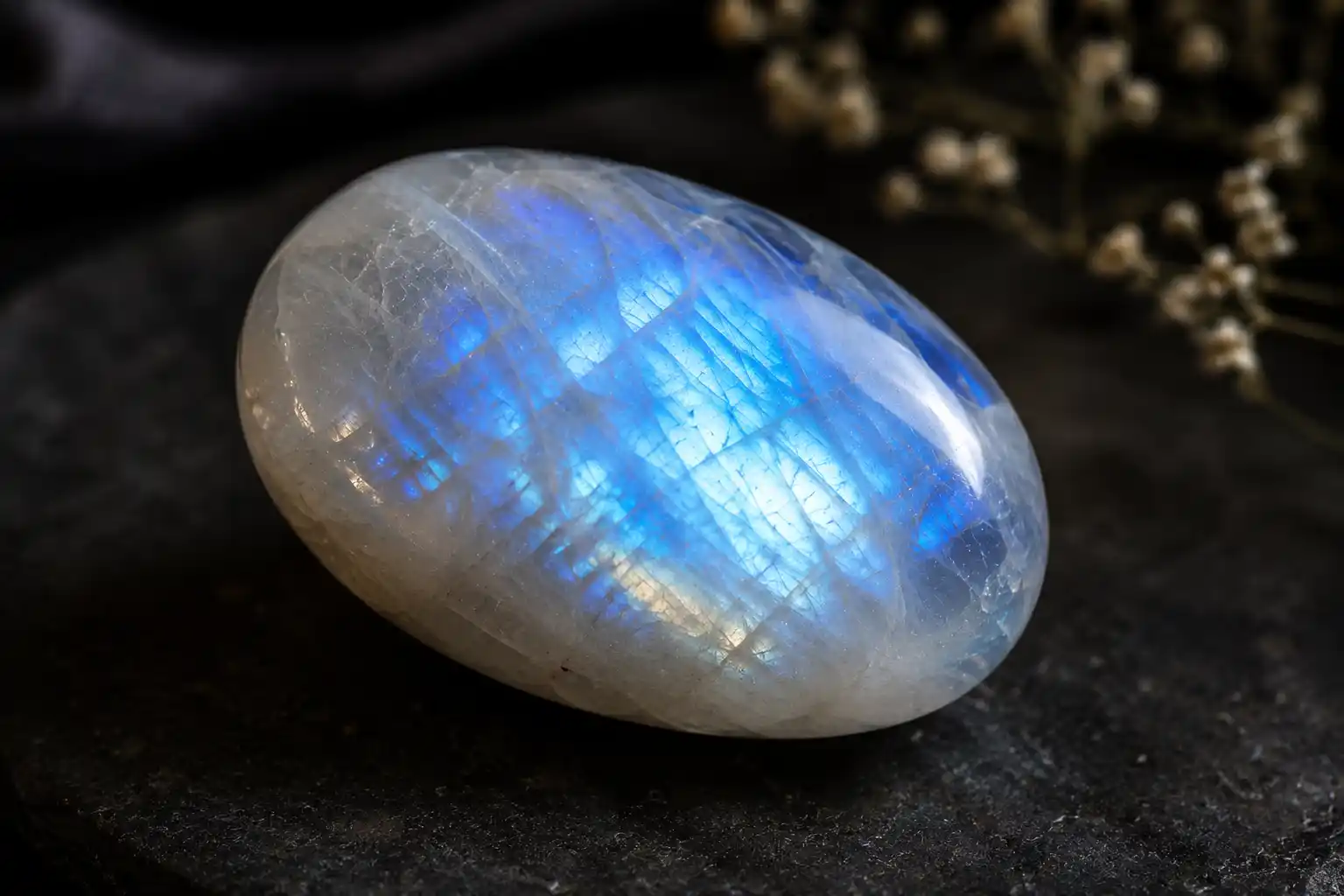
Moonstone is a feldspar gemstone prized for adularescence, the soft internal glow that seems to move beneath its surface as the stone turns. Fine examples can show vivid blue light over a nearly colorless body, while other moonstones appear white, gray, peach, brown, green or dark. Moonstone meaning developed around this shifting appearance, with lunar imagery, changing cycles, intuition, transition and reflection becoming recurring themes in historical lore and contemporary spiritual practice.
The optical effect itself has a geological explanation. Microscopic feldspar layers interact with incoming light and create the floating sheen for which moonstone is famous. Moonstone meaning belongs to a different layer of the gem’s identity: cultural symbolism and personal interpretation rather than a scientifically demonstrated force.
That distinction makes it possible to appreciate both sides of the stone. Moonstone meaning can provide a symbolic framework for reflection, new beginnings or changing circumstances, while mineralogy explains its glow, durability, identification, value and care requirements.
Moonstone at a Glance
| Property | Moonstone |
|---|---|
| Mineral family | Feldspar |
| Traditional gem identity | Adularescent alkali feldspar, commonly associated with orthoclase and albite intergrowths |
| Common formula | KAlSi₃O₈ for the orthoclase end-member |
| Crystal system | Monoclinic for orthoclase |
| Defining optical effect | Adularescence |
| Common body colors | Colorless, white, cream, gray, peach, brown, green and dark gray |
| Common sheen colors | Blue, silver and white |
| Transparency | Transparent to translucent; some material appears nearly opaque |
| Luster | Vitreous to pearly |
| Mohs hardness | About 6–6.5 |
| Toughness | Poor to fair depending on fractures and orientation |
| Cleavage | Two prominent directions |
| Common cuts | Cabochons, beads, carvings, rose cuts and faceted stones |
| Main quality factor | Strong, mobile and well-centered adularescence |
| Main jewelry concern | Cleavage, impact and scratching |
| Common symbolic themes | Cycles, intuition, reflection, transition, new beginnings and lunar imagery |
What Is Moonstone?
Moonstone belongs to the large feldspar family, which also includes gem materials such as labradorite, sunstone and amazonite. Traditional moonstone is generally associated with alkali feldspar containing microscopic intergrowths of different feldspar compositions.
As the mineral cools, sodium-rich and potassium-rich components can separate into extremely thin layers. Light entering the gemstone interacts with those layers and produces adularescence.
This internal glow is the physical feature that inspired much of moonstone meaning. The light can appear hidden until the stone moves into the right position, then sweep across the cabochon before fading again. That changing appearance provides an intuitive metaphor for cycles, shifting perspectives and things that become visible gradually.
The metaphor should not be confused with the mechanism. Feldspar structure creates the optical phenomenon; it does not demonstrate that the gemstone controls emotions, hormones, intuition or future events.
How Adularescence Creates Moonstone’s Glow
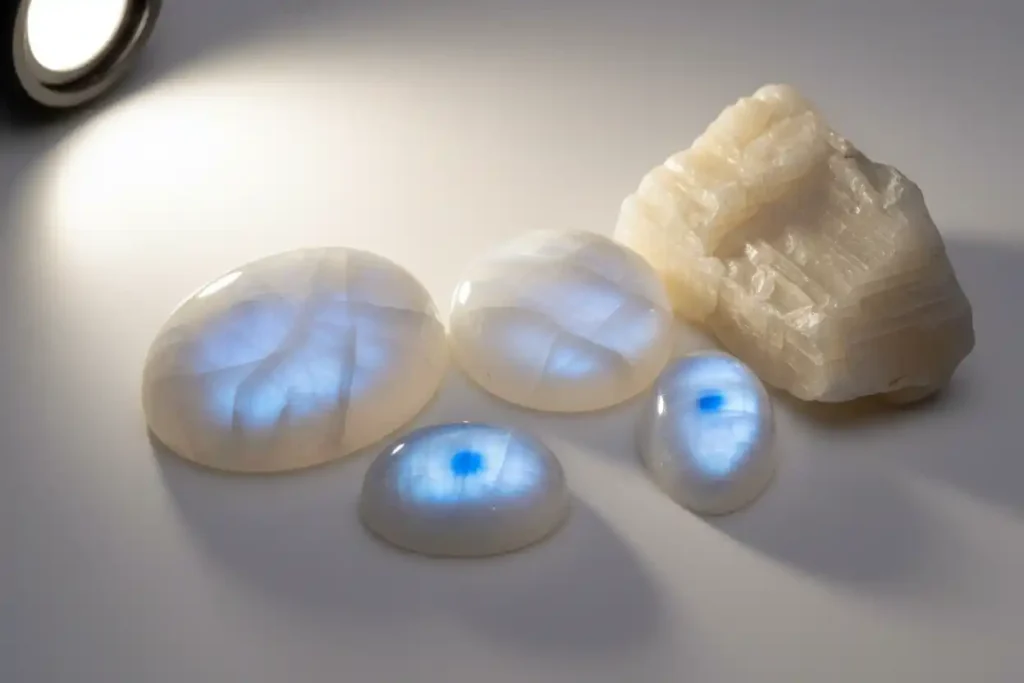
Adularescence occurs inside the gemstone rather than as simple surface reflection. Microscopic internal layers have slightly different optical properties. As light encounters their boundaries, scattering and interference produce the characteristic white, silver or blue glow.
Fine moonstone often displays sheen that moves smoothly across a broad portion of the stone as it tilts. A bright effect visible from only one extreme angle may be less attractive in jewelry because normal movement rarely presents that exact viewing position.
Thin, regular internal layers can favor stronger blue light, whereas different structures may create a broader white or silver appearance.
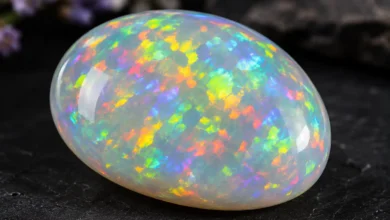
This phenomenon is different from the colorful labradorescence of labradorite and the play-of-color found in opal. The labradorite vs moonstone comparison separates related feldspar effects, while moonstone vs opal explains why two luminous-looking gems can have completely different structures.
Moonstone meaning grew around the gem’s visual resemblance to moonlight, but adularescence is produced by mineral structure rather than by exposure to the Moon.
Moonstone Meaning and Symbolism
At its broadest, moonstone meaning centers on cycles, transition, intuition, reflection and new beginnings. Lunar imagery naturally contributed to these associations because the Moon itself appears to change through repeating phases.
Historical and modern traditions have also connected moonstone with affection, travel, hope, dreams, femininity and emotional awareness. These themes vary by culture and period, so moonstone meaning should not be treated as one universal ancient doctrine.
A grounded interpretation uses the stone as a symbol rather than an authority. Someone entering a new stage of life might associate moonstone meaning with being willing to adjust while preserving important values. Another person may use the gem as a reminder to slow down before making an emotional decision.
Neither practice requires assuming that the gemstone predicts what will happen next. The useful part of moonstone meaning can lie in the intention a person deliberately attaches to it.
Moonstone Meaning for New Beginnings
New beginnings are among the strongest themes in modern moonstone meaning. The association works particularly well because a new beginning rarely means erasing everything that came before. Lunar cycles repeat while still marking change, making the imagery suitable for graduation, relocation, a new job, creative work or another intentional transition.
A practical way to use moonstone meaning during change is to identify what is actually beginning. Instead of asking the gemstone to produce a desired outcome, define the decision, habit or responsibility that accompanies the transition.
For example, someone starting a new role might use moonstone as a visual reminder to review priorities each morning. Someone moving to a new city could connect moonstone meaning with remaining curious while building unfamiliar routines.
The stone does not guarantee that a transition will be comfortable or successful. Its symbolism can simply provide a consistent cue to approach change deliberately.
Moonstone Meaning for Cycles and Change
The language of cycles appears repeatedly in moonstone meaning because of the gem’s lunar name and changing sheen. Contemporary spiritual practices often connect it with accepting that energy, motivation, relationships and circumstances do not remain identical every day.
That idea can be useful without claiming that moonstone synchronizes the body with lunar phases. Human biological rhythms involve complex physiological processes, and moonstone has not been shown to regulate them.
A more grounded interpretation of moonstone meaning is that cycles can be observed. A journal can reveal when concentration is strongest, which situations repeatedly create stress, or when a habit tends to fail. Once a pattern becomes visible, practical changes become easier to test.
The gemstone can represent awareness of those patterns, while the actual evidence comes from experience, records and observable behavior.
Moonstone Meaning for Intuition and Decision-Making
Intuition is another major theme within moonstone meaning. In spiritual traditions, the stone is often described as encouraging inner awareness or intuitive understanding.
Intuition itself is real as a psychological phenomenon: people can form rapid judgments from prior experience, pattern recognition and subtle cues. However, there is no evidence that moonstone transmits hidden information or gives someone supernatural knowledge.
A responsible way to apply moonstone meaning is therefore to treat intuition as a prompt for examination rather than proof. If a situation feels wrong, the feeling may deserve attention, but it should be followed by questions: What behavior triggered the concern? What evidence supports it? Is there another explanation? What information is missing?
In this sense, moonstone meaning can represent listening carefully to an internal reaction while still checking it against facts.
Moonstone Meaning for Emotional Reflection
Moonstone meaning is commonly connected with calm, emotional balance and self-reflection. Crystal traditions sometimes go further and describe moonstone as regulating emotions. That claim has not been scientifically demonstrated.
The symbolic version is more practical. Holding or looking at a familiar stone may become part of a pause before responding to an emotionally charged situation. The value comes from the pause, attention and chosen behavior rather than a measurable force emitted by the mineral.
Someone using moonstone meaning for reflection might ask: What exactly am I feeling? What happened immediately before the feeling changed? What do I need to communicate? Am I reacting to the current situation or to an older pattern?
This approach keeps emotional work grounded. Persistent anxiety, depression, trauma symptoms, panic, severe sleep disruption or other significant mental-health concerns should not be explained as crystal imbalance or treated with gemstones instead of appropriate professional care.
Moonstone Meaning in Love and Relationships
Love and romance have long contributed to moonstone meaning. Its soft glow and lunar imagery have made it a popular symbolic gift, while later traditions attached themes of affection, reconciliation and emotional openness to the stone.
Moonstone cannot establish compatibility, reveal whether someone is faithful, force reconciliation or guarantee that a relationship will last. It also cannot identify a destined partner.
A useful relationship interpretation of moonstone meaning focuses instead on changing perspectives. During disagreement, the stone might symbolize the question, “What am I not seeing from the other person’s position?” In a new relationship, it may represent allowing trust to develop from consistent behavior rather than fantasy.
Moonstone meaning can also accompany boundary-setting. Emotional sensitivity does not require tolerating manipulation, intimidation, coercion or repeated disrespect. Reflection should help clarify boundaries rather than remove them.
Moonstone Meaning, Sleep and Dream Traditions
Because moonstone is linked visually and symbolically with nighttime, moonstone meaning frequently appears in traditions involving sleep and dreams. Some people keep a polished stone near the bed, use it during evening meditation or record dreams beside it.
These practices can function as personal rituals, but moonstone has not been shown to treat insomnia, regulate circadian rhythms or medically improve sleep quality.
A safer way to incorporate moonstone meaning into an evening routine is to associate the stone with behaviors already known to support a consistent wind-down period: lowering stimulation, writing down unfinished thoughts or keeping a regular bedtime.
Dream journaling can also be used as reflective writing rather than prediction. Dreams do not become reliable forecasts because moonstone is present, and disturbing or persistent sleep problems deserve appropriate medical assessment.
Moonstone Meaning and Fertility Symbolism
Fertility symbolism appears in some historical and contemporary discussions of moonstone meaning, largely because lunar cycles, femininity, motherhood and reproductive symbolism became culturally connected over time.
This area requires a clear boundary between symbolism and health claims. Moonstone has not been shown to improve fertility, increase the likelihood of pregnancy, regulate menstrual cycles, alter reproductive hormones, prevent miscarriage or make childbirth safer.
Someone may still wear moonstone because its traditional imagery feels meaningful during a personal life transition. In that context, moonstone meaning should remain symbolic and emotional rather than medical.
Pregnancy planning, fertility concerns, menstrual problems and reproductive-health questions require qualified healthcare guidance. A gemstone should never determine whether someone delays testing, treatment or medical advice.
Moonstone and Chakra Traditions
Modern spiritual systems commonly connect moonstone with the crown and third-eye chakras, while some practices also associate particular varieties with the sacral chakra.
Within these traditions, moonstone meaning may represent introspection, intuition, receptivity, imagination or awareness of emotional cycles. Chakra assignments vary between teachers and systems, so there is no single mineralogical rule determining which chakra “belongs” to moonstone.
Chakras are spiritual concepts rather than scientifically established anatomical structures. Moonstone does not physically open a chakra or diagnose an energy blockage.
A chakra meditation can still function as a reflective ritual. For example, someone might hold a polished stone, focus on breathing and choose one question to consider without expecting the mineral to produce an answer.
Moonstone Meaning for Travel and Protection
Protection and travel appear in older moonstone lore, and the gem has sometimes been described symbolically as a traveler’s stone.
Modern moonstone meaning can preserve that historical association without interpreting it as physical protection. Carrying a stone does not reduce road hazards, prevent accidents, guarantee safe flights or substitute for travel planning.
A more practical ritual is to let the stone represent preparation: checking documents, sharing an itinerary, securing valuables, respecting weather warnings or avoiding impaired driving.
This keeps the traditional protective theme while placing actual safety where it belongs—in decisions, equipment and situational awareness.
Moonstone Colors and Varieties
The types of moonstone include colorless, white, peach, gray, dark and phenomenal material. Color descriptions affect appearance and market classification, while different symbolic interpretations are largely products of contemporary practice.
White moonstone commonly has a white, milky or nearly colorless body with white, silver or blue sheen. In modern moonstone meaning, white varieties are often associated with clarity, reflection and fresh starts.
Peach moonstone ranges through cream, apricot, pink-orange and warm brownish tones. Contemporary symbolism sometimes associates it with warmth, creativity and emotional gentleness.
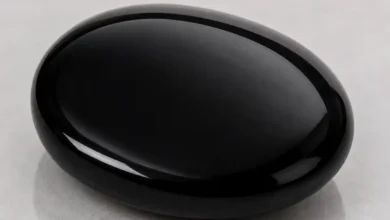
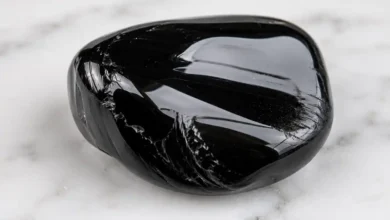
Black moonstone is a trade description for darker feldspar that may display pale sheen, zoning or contrasting internal patterns. Dark color has encouraged modern boundary and protection symbolism, but black material is not scientifically more protective than lighter moonstone.
These color-specific interpretations can personalize moonstone meaning, yet they should not be confused with mineral identification or grading.
Rainbow Moonstone Is a Special Trade Case
Rainbow moonstone deserves separate attention because the trade name can cause confusion. Material sold under this name is generally transparent to translucent labradorite, a plagioclase feldspar, rather than classic orthoclase-rich moonstone.
It may display brilliant blue, green, yellow, violet or multicolored flash. That appearance makes it highly desirable, but accurate labeling still matters.
Rainbow moonstone meaning is often associated with creativity, openness and intuition in modern spiritual traditions. Those interpretations do not change the underlying gemological distinction.
A buyer can enjoy the accepted trade name while still asking whether the material is traditional moonstone or labradorite sold as rainbow moonstone.
Moonstone as a June Birthstone
Moonstone is one of the recognized June birthstones, alongside pearl and alexandrite.
This status gives moonstone meaning an additional personal dimension for June birthdays. A gemstone may matter because it marks a date or relationship even when the owner does not follow crystal traditions.
The three June gems also differ significantly in durability. Moonstone is harder than pearl but has important cleavage concerns, while alexandrite is considerably more durable.
For a gift, lifestyle should therefore matter as much as symbolism. Someone who works frequently with their hands may be better served by moonstone earrings or a pendant than an exposed ring.
Physical Properties and Durability
Moonstone measures about 6–6.5 on the Mohs scale. The gemstone hardness chart places that in a moderate range: harder than many decorative minerals but still vulnerable to quartz, topaz, sapphire, diamond and other harder materials.
Hardness does not tell the whole durability story. Moonstone has prominent cleavage directions, so a concentrated impact can chip or split the gem. The distinction between surface hardness and breakage resistance is explained in gemstone toughness vs hardness.
This practical weakness has no relationship to moonstone meaning. A stone associated symbolically with resilience can still be physically fragile.
Earrings, pendants and brooches generally present lower impact risk. Rings and bracelets need more thoughtful settings and wearing habits.
Moonstone Jewelry
Moonstone’s moving sheen works especially well in jewelry because normal body movement continuously changes the viewing angle. Jewelry can express moonstone meaning personally, but the setting should protect the feldspar rather than expose it unnecessarily.
A moonstone necklace or pendant can display a relatively large cabochon while keeping it away from many of the impacts experienced by hand jewelry. Moonstone earrings are similarly practical, although matched pairs should be compared for body color, transparency and direction of sheen.
A moonstone ring requires greater care. A low bezel, halo or recessed construction can protect the perimeter better than a high, exposed setting.
A moonstone bracelet receives frequent movement but can strike desks, door frames and hard surfaces. Larger beads and cabochons should therefore be worn with realistic expectations about abrasion and impact.
Moonstone meaning may influence why someone chooses the jewelry, but physical construction determines how well that jewelry survives.
How to Judge Moonstone Quality
The strongest value factor is usually adularescence. A desirable stone should show a bright internal glow that moves as the gem turns and remains visible through a useful viewing range.
Body color and transparency also matter. Transparent or nearly colorless material with strong blue sheen has traditionally commanded high demand because the contrast makes the optical effect particularly clear.
Cut orientation can dramatically change value. A beautiful piece of rough can become a weak finished gem if the strongest sheen is left near the side instead of centered on the visible face.
Clarity should be judged in context. Small internal features may be acceptable if they do not distract from the glow or weaken the stone. Surface-reaching fractures, chips near the girdle and serious cleavage damage deserve more concern.
The moonstone buying guide covers these evaluation factors in greater detail, while the moonstone price guide provides separate value context. Moonstone meaning itself is not a quality factor; claims that one gem carries stronger spiritual energy do not establish greater rarity or monetary value.
Treatments, Imitations and Disclosure
Many natural moonstones are sold without major color treatment, but coatings, backing, fillers, resin and assembled constructions can occur.
Backing may make blue sheen appear stronger. Surface coatings can produce artificial color or iridescence. Resin may reduce the visibility of cracks, while glass and other manufactured materials can imitate moonstone’s pale appearance.
Opalite is a common source of confusion. It is manufactured glass rather than natural moonstone.
The detailed real vs fake moonstone guide explains consumer-level identification clues and the limits of home testing.
Moonstone meaning should never be used as an authenticity test. A stone cannot be confirmed as natural because it feels cold, seems energetic, produces a particular emotional response or was sold for spiritual purposes.
How to Recognize Real Moonstone
Natural adularescence usually appears to originate inside the gem and move as the viewing angle changes. The body may contain small inclusions, cleavage features or natural variations rather than appearing perfectly uniform.
However, visual inspection alone is not always conclusive. Other feldspars, coated stones, glass and assembled materials can be convincing.
Avoid destructive scratch, flame, chemical and impact tests. A test that damages a genuine gemstone is not a sensible authentication method.
For higher-value material, independent gemological testing can provide stronger evidence about identity and treatment than home experiments.
Moonstone meaning is therefore best kept separate from authenticity. Symbolism is subjective; gem identification relies on physical properties.
Meditation and Reflective Uses
A simple reflective practice can use moonstone meaning without making supernatural claims. Place an intact polished stone somewhere comfortable, notice how the sheen changes as it moves and choose one question that relates to a real decision.
For example: What has changed in this situation? Which assumption am I still carrying from an earlier stage? What evidence would change my opinion? Which next action is within my control?
The stone’s changing light becomes a metaphor for viewing a problem from another angle.
Moonstone meaning can also be incorporated into journaling, quiet breathing or personal rituals around a new month or life transition. The useful outcome should come from attention, reflection and action rather than the expectation that the gemstone will predict an answer.
Spiritual Cleansing and Moonstone Care Are Different
Some owners perform symbolic cleansing because it forms part of their spiritual practice. The safest approach respects moonstone’s actual mineral properties.
The guide to cleansing and charging moonstone covers low-risk approaches. Non-contact rituals are particularly useful when a stone contains fractures, backing, glue or an uncertain treatment.
Physical cleaning serves another purpose entirely: removing dirt, oil and residue. Neither procedure changes the scientifically measurable validity of moonstone meaning.
Keeping the two concepts separate prevents a symbolic ritual from becoming a reason to expose a fragile gemstone to salt, heat, prolonged soaking or other unnecessary risks.
How to Clean and Store Moonstone
For routine cleaning, use lukewarm water, mild soap and a soft cloth or very soft brush. Keep contact brief, particularly when treatment, backing or adhesives are uncertain.
Avoid steam and ultrasonic cleaners. Heat, vibration and sudden temperature changes can aggravate existing fractures or exploit cleavage.
The step-by-step moonstone jewelry cleaning guide provides a conservative care method.
Store moonstone separately from harder gemstones and metal edges. A padded compartment or soft pouch helps protect the polish and reduces accidental impact.
Care requirements come from feldspar structure, not moonstone meaning. Even a stone worn as a symbol of protection needs physical protection of its own.
How Moonstone Meaning Fits With the Real Gem
Moonstone meaning becomes more useful when symbolism and mineral science are allowed to answer different questions.
Mineralogy explains what the gemstone is, how its internal layers form, why light appears to move inside it, how easily it can break and how it can be identified. Cultural traditions explain why generations of people have associated that unusual appearance with the Moon, cycles, love, intuition and transition.
Personal interpretation adds another layer. A June birthday, inherited pendant, major life change or private ritual may give one moonstone meaning that cannot be measured in a laboratory but remains personally significant.
At Gems Lore, moonstone meaning is most useful when it supports reflection without turning symbolic language into promises about health, fertility, relationships or future events.
The distinction also preserves what makes moonstone interesting. Its physical glow does not need a supernatural explanation to be remarkable, and its symbolism does not need to become a medical claim to hold personal value.
The crystals that start with M directory places moonstone alongside other M-named stones for readers comparing mineral identities and traditional meanings.
Frequently Asked Questions
What is the main moonstone meaning?
The central moonstone meaning is usually connected with cycles, intuition, emotional reflection, transition and new beginnings. Love, travel, dreams and lunar symbolism also appear in historical and contemporary traditions. These interpretations are symbolic rather than scientifically demonstrated properties.
Why is moonstone associated with the Moon?
Its name comes from its moonlike internal glow. Adularescence can resemble light floating beneath the surface, so historical and modern traditions naturally connected the gemstone with lunar imagery. The optical phenomenon itself is caused by microscopic feldspar structures.
Does moonstone have healing properties?
Moonstone healing properties belong to crystal-healing and spiritual traditions. There is no established evidence that the gemstone treats physical or psychological illness, regulates hormones or produces medical healing.
Can moonstone improve fertility?
No scientific evidence shows that moonstone improves fertility, increases the chance of pregnancy or regulates reproductive hormones. Fertility themes in moonstone meaning are cultural and spiritual symbolism rather than medical effects.
Is moonstone good for sleep?
Some people include moonstone in a calming bedtime ritual because of its nighttime symbolism, but the gemstone has not been shown to treat insomnia or regulate sleep cycles. Persistent sleep problems should receive appropriate medical attention.
What chakra is moonstone associated with?
Contemporary spiritual practices commonly associate moonstone with the crown or third-eye chakra, while some traditions connect certain varieties with the sacral chakra. These assignments vary and represent spiritual frameworks rather than anatomical properties.
Does moonstone protect travelers?
Protection during travel is part of traditional moonstone meaning, but the gemstone cannot prevent accidents or other hazards. It can instead serve symbolically as a reminder to plan carefully and use appropriate real-world safety measures.
Is rainbow moonstone real moonstone?
Rainbow moonstone is generally natural transparent or translucent labradorite sold under an accepted trade name. It belongs to the feldspar family but is not the same mineral material as traditional orthoclase-associated moonstone.
What is the most valuable type of moonstone?
Fine transparent traditional moonstone with strong, centered and mobile blue adularescence generally receives the greatest market demand. Size, clarity, body color, cut orientation, condition and provenance can also influence value.
Can moonstone be worn every day?
It can be worn regularly with care, but moonstone is not ideal for every high-impact situation. Its hardness is moderate and its cleavage makes it vulnerable to sharp blows. Earrings and pendants are usually safer than exposed rings and bracelets.
How can I tell whether moonstone is real?
Look for an internal optical effect that moves naturally as the stone turns, along with realistic inclusions and structural variation. These clues are not conclusive by themselves. High-value stones may require professional gemological testing, and destructive home tests should be avoided.
How should moonstone be cleaned?
Use lukewarm water, mild soap and a soft cloth or brush for brief cleaning. Avoid steam, ultrasonic equipment, abrasive products and sudden temperature changes. Store the gemstone separately from harder materials.
Moonstone combines an unusual feldspar structure with a body of symbolism shaped by its luminous appearance. Its adularescence is a real optical phenomenon, while moonstone meaning belongs to history, culture and personal practice. Keeping those categories distinct allows the gemstone to be appreciated without exaggerating what it can do.
For someone drawn to moonstone meaning, the most grounded interpretation is not that the stone controls life’s cycles, but that it can symbolize the willingness to notice them. Its moving light can represent changing perspective, its lunar imagery can mark a transition, and a piece of jewelry can carry a personal reminder long after the original occasion has passed. The symbolism remains meaningful while decisions, health, safety and relationships continue to depend on evidence, communication and real-world action.
Moonstone meaning, chakra associations, dream practices, emotional-healing traditions, fertility symbolism and protective beliefs are cultural, spiritual or personal interpretations rather than scientifically established effects. Moonstone should not be used to diagnose or treat medical or mental-health conditions, regulate hormones, improve fertility, protect pregnancy or replace qualified professional care.