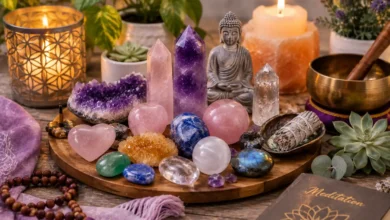

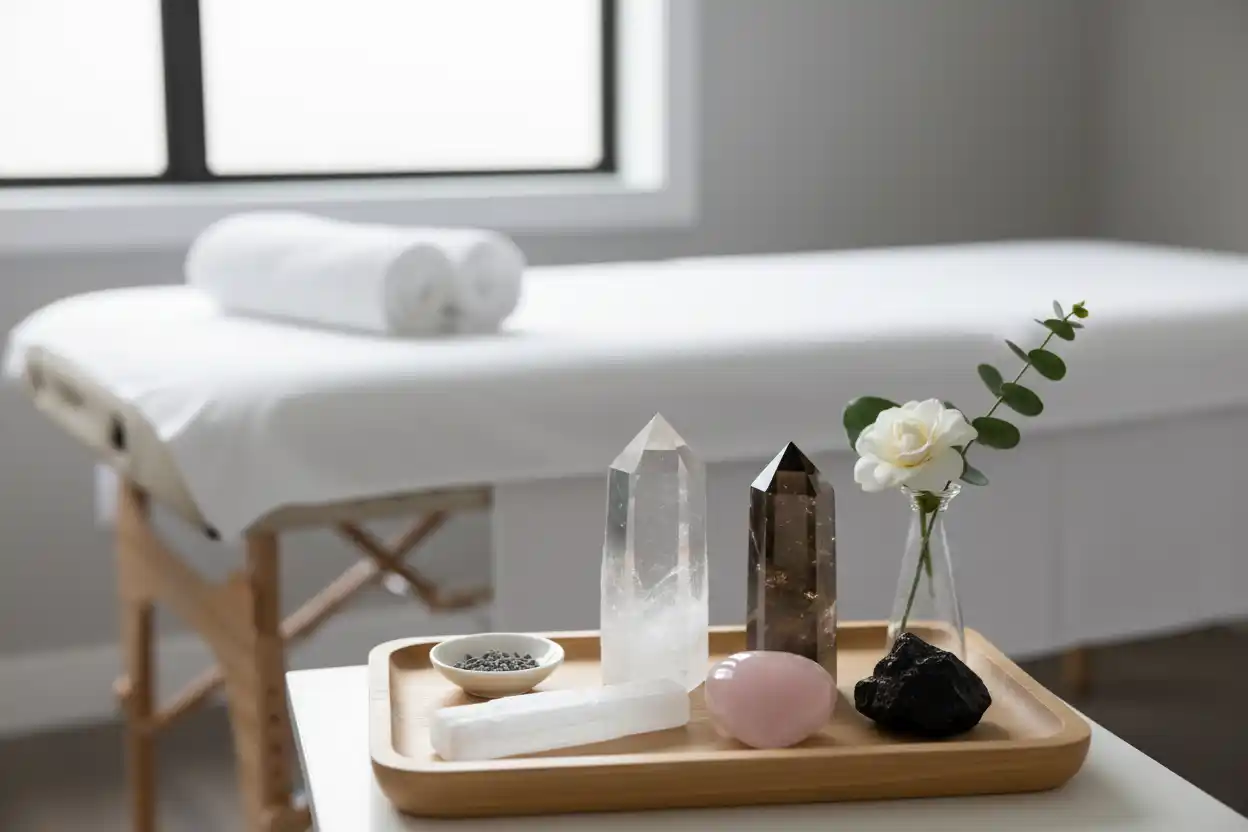

Crystals for Reiki are traditionally used as visual focal points, intention markers and symbolic companions during energy-work sessions. They do not increase Reiki scientifically, diagnose energetic imbalances or treat medical conditions, but they may help practitioners structure preparation, meditation and post-session reflection.
Clear quartz is the most adaptable Reiki crystal, while selenite suits a quiet treatment space and smoky quartz supports grounding. Rose quartz emphasizes compassion, black tourmaline reinforces boundaries and chevron amethyst provides a contemplative focal point.
Top 10 Reiki Crystals at a Glance
| Rank | Crystal | Traditional Reiki theme | Most suitable symbolic use |
|---|---|---|---|
| 1 | Clear quartz | Clarity, intention and symbolic amplification | Defining the purpose of a session |
| 2 | Selenite | Peace, clarity and purification symbolism | Marking a quiet treatment space |
| 3 | Smoky quartz | Grounding and practical perspective | Preparing before and decompressing after sessions |
| 4 | Rose quartz | Compassion and emotional gentleness | Supporting a respectful, nonjudgmental approach |
| 5 | Black tourmaline | Boundaries and symbolic protection | Separating practitioner and client responsibilities |
| 6 | Chevron amethyst | Reflection and spiritual awareness | Meditation before energy work |
| 7 | Carnelian | Initiative and embodied action | Transitioning from reflection into practical follow-up |
| 8 | Sodalite | Truth and organized communication | Discussing intentions and observations clearly |
| 9 | Moonstone | Cycles and emotional awareness | Reflecting on changing needs without forcing outcomes |
| 10 | Labradorite | Perspective and transformation symbolism | Practitioner reflection and adaptable session planning |
How Crystals Fit into Reiki Practice
Reiki is commonly practiced as a complementary spiritual or relaxation method involving light touch or hands held near the body. Some practitioners incorporate crystals because their colors, shapes and traditional meanings provide an additional focus.
The crystal does not become a diagnostic device. A practitioner cannot determine a disease, trauma history or psychological condition by sensing the stone or interpreting an energy center.
Instead, a crystal may help organize the session. Clear quartz can represent the stated intention, smoky quartz may mark the grounding period and rose quartz can remind the practitioner to maintain compassion without making assumptions.
Crystals should remain optional. A client who does not want stones included should receive the same respect and attention without them.
1. Clear Quartz for Session Intention
Clear quartz is the most versatile Reiki crystal because modern spiritual traditions associate it with clarity, intention and amplification.
Before the session, define the purpose in language that does not promise a medical result. Suitable intentions may include relaxation, quiet reflection or creating time for personal awareness.
Avoid intentions such as curing an illness, removing trauma or guaranteeing emotional release. Those claims exceed what Reiki or a crystal can responsibly promise.
Clear quartz can remain on a nearby table or in a grid. It does not need to touch the client’s body to function as a symbolic focal point.
2. Selenite for a Quiet Treatment Space
Selenite is traditionally associated with clarity, peaceful environments and symbolic purification. Its pale translucent appearance makes it popular in Reiki rooms.
Place a stable selenite piece near the practitioner’s preparation area rather than on the edge of the treatment table. It can mark the transition from ordinary activity into a quieter session.
Selenite does not sterilize a room, remove pathogens or replace cleaning procedures. Surfaces, linens and equipment still require appropriate physical hygiene.
Because selenite is soft and water-sensitive, it should remain dry and protected from repeated handling, sprays and disinfectants that may damage it.
3. Smoky Quartz for Grounding
Smoky quartz is traditionally linked with grounding, release and practical perspective. It is especially useful before and after energy work.
Before a session, notice the stone’s weight, temperature and visible details. Then identify the present environment and the professional responsibilities that apply.
Afterward, smoky quartz can mark the end of the session. Complete any agreed notes, clean the space and return attention to ordinary tasks.
Grounding should not be framed as transferring a client’s illness or emotional burden into the stone. The practitioner remains responsible for boundaries, hygiene and appropriate referral.
4. Rose Quartz for Compassionate Practice
Rose quartz is traditionally associated with compassion, affection and emotional gentleness.
Within Reiki, it may symbolize creating a respectful environment where a client is not pressured to disclose personal information or report a particular sensation.
Compassion also requires accurate limits. A practitioner should not imply that a client’s condition reflects weak belief, blocked love or failure to release an emotion.
Rose quartz can remain near the consultation area as a reminder to listen carefully and use neutral, nonjudgmental language.
5. Black Tourmaline for Practitioner Boundaries
Black tourmaline is traditionally associated with grounding and symbolic protection. Its most responsible Reiki use involves professional and emotional boundaries.
A practitioner can care about the client without assuming responsibility for controlling the outcome. Black tourmaline may represent remaining within training, avoiding medical claims and ending the session at the agreed time.
It can also symbolize not carrying confidential stories into unrelated parts of life. Appropriate supervision, rest and professional standards create this boundary in practice.
Raw tourmaline may have brittle edges or loose fragments. A polished or securely displayed piece is safer in a frequently used room.
6. Chevron Amethyst for Preparation and Reflection
Chevron amethyst combines purple amethyst and white quartz in visible bands. It is traditionally connected with contemplation, spiritual awareness and reflection.
Use it during a brief preparation meditation. Identify the session intention, acknowledge personal expectations and release the need to produce a dramatic experience.
After the session, the stone may accompany reflective notes about communication, room setup and professional practice.
Reflection should focus on the practitioner’s behavior rather than speculative claims about what happened inside the client’s body or mind.
Amethyst can fade after prolonged exposure to strong sunlight, so protected indoor storage is preferable.
7. Carnelian for Practical Follow-Through
Carnelian is traditionally associated with initiative, courage and action. It provides useful balance when energy work becomes entirely abstract.
A Reiki session may leave a client with practical ideas, such as taking a break, discussing a concern with a professional or adjusting a daily routine. Carnelian can symbolize moving from reflection into an appropriate action.
The practitioner should not prescribe medical, psychological or nutritional changes outside their qualifications.
Carnelian may also support the business side of practice, including completing records, maintaining the room and communicating policies clearly.
8. Sodalite for Clear Communication
Sodalite is traditionally linked with truth, logic and coherent expression. It suits the consultation and feedback stages of Reiki.
Before beginning, clarify what the client expects and what the session can realistically provide. Explain touch, positioning, duration and privacy before consent is given.
Afterward, describe observations cautiously. Statements about room temperature, breathing pace or the practitioner’s own experience should not become diagnoses.
Sodalite can symbolize keeping facts, interpretations and spiritual beliefs clearly separated.
9. Moonstone for Changing Needs
Moonstone is traditionally associated with cycles, transition and emotional awareness.
A client’s response to Reiki may differ between sessions. Someone may feel relaxed one day and restless during another. Neither response proves that the session succeeded or failed.
Moonstone can remind the practitioner to observe without forcing consistency. Expectations, health, sleep and current stress may all affect the experience.
Because moonstone can chip along cleavage planes, it should remain on a stable surface or in a protective setting.
10. Labradorite for Perspective and Adaptability
Labradorite carries modern associations with transformation, intuition and changing perspective.
Its shifting optical color makes it a suitable symbol for adapting a session when the client’s comfort or preferences change. The practitioner may reduce conversation, avoid touch or remove crystals entirely.
Labradorite can also support reflective supervision. Ask what was observed, which assumptions appeared and what should be handled differently next time.
It should not be used to claim psychic access to a client’s memories, relationships or future.
Choosing Reiki Crystals by Purpose
| Session purpose | Suggested crystals | Grounded application |
|---|---|---|
| Set a clear intention | Clear quartz | Define a nonmedical session goal |
| Prepare the room | Selenite | Create a clean, quiet and uncluttered space |
| Ground before a session | Smoky quartz | Use present-moment sensory awareness |
| Maintain compassion | Rose quartz | Listen without pressure or assumptions |
| Protect professional limits | Black tourmaline | Remain within scope and agreed time |
| Reflect before practice | Chevron amethyst | Notice expectations and personal state |
| Encourage practical follow-up | Carnelian | Identify one appropriate action |
| Communicate clearly | Sodalite | Explain consent, process and limitations |
| Work with changing responses | Moonstone | Avoid forcing a particular experience |
| Adapt the session | Labradorite | Respond to comfort and feedback |
Reiki Crystals Versus Chakra Crystals
Reiki and chakra practices often overlap, but they are not identical. Reiki is a distinct energy-work system, while chakra traditions organize spiritual symbolism around energy centers.
The completed guide to crystals for chakras covers stones selected by chakra color and theme. A Reiki practitioner may use those correspondences, but they should not be presented as anatomical diagnoses.
A red stone placed near the lower body does not prove a root-chakra disorder. Likewise, a blue stone near the throat cannot diagnose communication problems or thyroid disease.
Crystals may provide symbolic structure while medical concerns remain within qualified healthcare.
Reiki Crystals Versus Meditation Crystals
Reiki sessions may include quiet breathing or meditation, but meditation can also be practiced independently.
The completed guide to crystals for meditation focuses on attention, breath awareness and contemplative methods. Reiki places greater emphasis on the practitioner-client session and the traditions associated with Reiki practice.
A crystal used in both settings should have a clearly defined role. Clear quartz might mark intention during Reiki and breath focus during meditation.
Consent Before Crystal Placement
Consent should be specific and easy to withdraw. Explain whether crystals will be placed near the client, held by the client or used only as room decoration.
Do not assume that someone who agreed to Reiki also agreed to physical crystal placement. Some clients may dislike particular textures, spiritual associations or objects near their body.
Avoid placing stones on the chest, abdomen, face, throat or injured areas. Heavy and pointed crystals should remain off the body entirely.
When consent changes, remove the stone without questioning the client’s reason.
Hygiene Between Reiki Sessions
Crystals handled by different clients can collect oils, residue and microorganisms. Physical cleanliness must remain separate from symbolic cleansing.
Whenever repeated client contact is expected, choose smooth, nonporous objects that can be managed according to appropriate hygiene procedures. Fragile and water-sensitive stones are better kept as display pieces.
The completed guide to cleansing crystals safely explains spiritual methods, but sound or visualization does not disinfect a contaminated surface.
Follow applicable professional and local hygiene requirements.
Programming a Reiki Crystal
Programming refers to assigning a personal symbolic intention to a stone.
The completed guide to programming crystals for intentions provides a broader method. Within Reiki, the intention should remain clear, ethical and limited.
For example, “This clear quartz reminds me to listen without assumptions” is more responsible than “This crystal will heal every condition in the room.”
Reset the intention when the stone changes purpose or moves to a different part of the practice.
Reiki Crystal Grids
A crystal grid may provide a visual structure in a Reiki room. Clear quartz can occupy the center, with grounding, compassion and boundary stones positioned around it.
The completed crystal grid guide explains how to assign each stone a distinct role.
The geometry does not create a proven therapeutic field. Keep the grid away from walkways, treatment-table edges and locations where clients may knock it over.
A simple arrangement is easier to clean and maintain than a dense collection of small stones.
Crystals in Distance Reiki
Some practitioners use a photograph, written name or crystal as a symbolic focus during distance Reiki.
The practice should not imply that the practitioner can monitor the recipient’s health or thoughts remotely. Consent remains important even when no physical contact occurs.
A crystal can represent the agreed intention, but it does not transmit a scientifically established healing signal.
Distance work should never delay emergency help or replace direct medical and psychological care.
Reiki and Medical Treatment
Reiki and crystals should be described as optional complementary spiritual or relaxation practices rather than medical treatments.
Do not advise clients to stop medication, cancel an appointment or avoid a recommended procedure. Likewise, do not claim that discomfort during a session proves detoxification or energetic release.
New, severe or worsening symptoms require appropriate professional assessment.
A practitioner should know when referral lies outside the scope of Reiki practice.
Building a Three-Crystal Reiki Set
A balanced starter set can include one stone for intention, one for grounding and one for compassion.
Clear quartz, smoky quartz and rose quartz form a versatile combination. Their roles remain easy to explain and remember.
A practitioner-focused set may instead use selenite for the room, black tourmaline for boundaries and sodalite for communication.
More crystals do not automatically make a session stronger. Simplicity often improves consent, hygiene and practical organization.
Storing Reiki Crystals
Store crystals in a clean, dry area protected from damage. Soft selenite and moonstone should not be placed loosely beside harder quartz pieces.
Keep client-handled stones separate from decorative specimens until physical cleaning is complete.
Avoid open bowls of small crystals where children, pets or visitors may handle or swallow them.
Labels can help the practitioner remember which stones are display-only and which are suitable for repeated handling.
Conclusion
The best crystals for Reiki provide structure without promising treatment. Clear quartz defines the intention, selenite marks a quiet space and smoky quartz supports grounding. Rose quartz represents compassion, black tourmaline reinforces boundaries and sodalite encourages clear communication.
Crystals remain optional symbolic tools. Consent, hygiene, professional limits and appropriate medical referral matter more than any specific stone or energetic interpretation.
Frequently Asked Questions
1. What is the best overall crystal for Reiki?
Clear quartz is the most adaptable choice because it can represent a clearly defined session intention. Smoky quartz may be more useful when grounding is the main need.
2. Does Reiki require crystals?
No. Crystals are optional and are not required for Reiki practice.
3. Can crystals make Reiki stronger?
There is no reliable evidence that crystals increase Reiki’s therapeutic effect. They may provide symbolic focus for the practitioner or client.
4. Which crystal is best for grounding after Reiki?
Smoky quartz and black tourmaline are popular grounding choices. A practical transition routine remains more important than the stone.
5. Can Reiki crystals be placed directly on a client?
Only with specific consent and when placement is physically safe. Heavy, pointed and fragile stones should remain off the body.
6. Should Reiki crystals be cleaned between clients?
Yes, any object handled by multiple clients requires appropriate physical hygiene. Spiritual cleansing alone does not disinfect it.
7. Which Reiki crystal is associated with compassion?
Rose quartz is the most common compassion stone. It may remind the practitioner to listen without judgment or pressure.
8. Can several Reiki crystals be used together?
Yes. Two or three stones with distinct purposes are usually sufficient, such as clear quartz, smoky quartz and rose quartz.
9. Can Reiki crystals diagnose blocked chakras?
No. Crystals cannot diagnose chakra imbalances, medical conditions or psychological problems.
10. Can Reiki crystals be used during distance sessions?
They may be used as personal symbolic focal points, but they do not provide verified remote diagnosis or treatment.
11. Can Reiki replace medical treatment?
No. Reiki and crystals cannot replace medication, therapy, surgery, diagnosis or emergency care.
12. When should a Reiki practitioner refer someone to healthcare?
Referral is appropriate whenever symptoms are new, severe, worsening or outside the practitioner’s professional qualifications.
Disclaimer: Reiki and crystal energy work are complementary spiritual practices, not medical or psychological treatments. They cannot diagnose disease, replace healthcare or guarantee healing. Obtain consent before crystal placement, maintain physical hygiene and refer health concerns to qualified professionals.