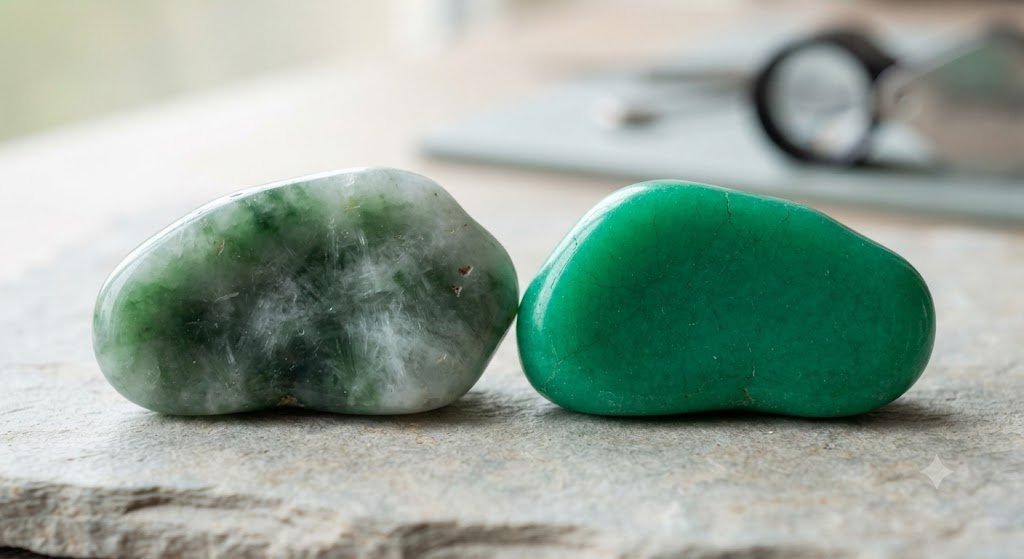
Real vs Fake Jade: 9 Essential Tests for Authentic Healing Stones
Real vs fake jade identification is unusually complicated because jade is not one simple mineral species. Gemologists traditionally use the name jade mainly for jadeite jade and nephrite jade, two distinct stones with different chemistry and physical properties but similarly exceptional toughness. Modern gemological usage also recognizes some green omphacite-rich jade. At the same time, serpentine, quartz, aventurine, calcite, glass, dyed stones, polymers, and other substitutes are frequently sold under jade-like trade names.
Treatment makes the subject even more complicated. Natural jadeite may be waxed, dyed, acid bleached, polymer impregnated, or treated through combinations of those processes. GIA’s commonly used trade classification describes A jade as natural jadeite or jadeite polished with wax only, B jade as acid-bleached and polymer-impregnated jadeite, and C jade as dyed jadeite.
Healing claims add no authentication value. A stone that feels calming, protective, lucky, cool, or “energetically strong” may be jadeite, nephrite, serpentine, glass, or another substance. Real vs fake jade identification depends on structure, optical properties, density, treatment evidence, and professional testing rather than spiritual sensation.
9 Real vs Fake Jade Tests at a Glance
- First determine whether the stone is jadeite or nephrite.
- Examine texture rather than judging green color by itself.
- Measure refractive properties with appropriate gemological instruments.
- Compare density carefully on loose stones when practical.
- Inspect color concentrations that may indicate artificial dye.
- Look for polymer impregnation and treatment under magnification.
- Never rely on scratch, sound, temperature, or hair tests alone.
- Treat bargain-priced vivid translucent jadeite with healthy skepticism.
- Request independent laboratory testing for valuable jade purchases.
Jade Means More Than One Gem
Jadeite and nephrite earned the shared name jade because both have long histories as carving stones and both possess exceptional toughness.
Their mineral identities are different.
Jadeite is a pyroxene with the idealized formula NaAlSi₂O₆. Nephrite consists mainly of tightly interlocking amphibole minerals in the tremolite-actinolite series. GIA also notes that some green omphacite-rich rocks can fall within modern jade terminology.
| Feature | Jadeite Jade | Nephrite Jade |
|---|---|---|
| Main mineral identity | Jadeite-rich pyroxene rock | Tremolite-actinolite amphibole rock |
| Idealized chemistry | NaAlSi₂O₆ | Ca₂(Mg,Fe)₅Si₈O₂₂(OH)₂ |
| Mohs hardness | About 6.5 to 7 | About 6 to 6.5 |
| Specific gravity | Around 3.34 | Around 2.95 |
| Typical RI range | About 1.666 to 1.680 | About 1.606 to 1.632 |
| Structure | Interlocking granular crystals | Interlocking fibrous crystals |
| Typical colors | Green, white, lavender, orange, yellow, black and others | White, cream, green, brown, gray, black |
| Toughness | Exceptional | Exceptional |
| Major treatment issue | Bleaching, polymer impregnation, dye, wax | Dye, wax and other treatments can occur |
These differences mean no single density, hardness, or refractive-index number describes every genuine jade object.
The first question is which type of jade is being examined.
1. Identify Jadeite Versus Nephrite Before Calling a Stone Fake
A genuine nephrite bangle will not test exactly like genuine jadeite.
That sounds obvious, yet many internet tests assume all jade must have one density, one shade of green, or one internal texture.
GIA lists specific gravity around 3.34 for jadeite and around 2.95 for nephrite. Refractive properties likewise differ substantially.
If someone expects a nephrite carving to behave like jadeite, they may incorrectly label an authentic piece fake.
The correct identification process begins by asking whether the stone’s properties fit jadeite, nephrite, or another jade-category rock before evaluating treatment or imitation.
2. Natural Jade Texture Is More Useful Than Green Color
Green is strongly associated with jade, but genuine jade occurs in many other colors.
Jadeite can be green, white, lavender, orange, yellow, gray, black, brown, or combinations of these colors. Nephrite commonly ranges through white, cream, gray, green, brown, and black.
Texture is more informative than hue.
Jadeite is composed of interlocking crystals, while nephrite develops an exceptionally tough interlocking fibrous structure. Under magnification, the surface and internal appearance may show a granular, fibrous, felted, or uneven texture unlike ordinary glass.
Glass may reveal bubbles or flow structures.
Dyed quartz or serpentine may show textures inconsistent with either jadeite or nephrite.
A bright green color by itself proves almost nothing.
3. Refractive Testing Can Separate Jade From Many Substitutes
Refractive-index measurement is one of the strongest routine gemological tools for polished jade.
GIA lists jadeite around 1.666 to 1.680 and nephrite around 1.606 to 1.632, although aggregate structure means readings can behave differently from those of conventional transparent faceted gems.
Quartz, glass, serpentine, calcite, feldspar, and other common substitutes generally have different optical properties.
An experienced gemologist can combine refractive readings with magnification, density, spectroscopy, and other observations to narrow identification quickly.
Home visual inspection cannot provide this level of certainty.
4. Density Is Useful When Interpreted Correctly
Jadeite usually feels relatively substantial because its specific gravity is around 3.34, while nephrite is somewhat lighter near 2.95.
A hydrostatic measurement can therefore help distinguish certain substitutes.
The common internet advice to toss a jade object in the hand and decide whether it “feels heavy enough” is much weaker.
Size, carving thickness, hollow areas, metal fittings, and human expectation make hand-weight judgments unreliable.
Mounted jewelry cannot be measured accurately without accounting for its setting.
Density is valuable when measured, not merely guessed.
5. Dye Often Collects Where the Stone Accepts It Most Easily
Vivid green jadeite commands strong prices, which creates a powerful incentive to improve pale or uneven stone artificially.
Dyed jadeite is often called C jade within the familiar A, B, C treatment terminology.
Magnification may reveal unusually concentrated color along fractures, grain boundaries, pores, or surface-reaching features.
The color may also appear unnaturally uniform compared with the stone’s underlying texture.
These observations can raise suspicion, but sophisticated dyes may be difficult to identify visually.
Spectroscopic testing is much stronger.
A buyer should never assume that brilliant green means fake because top-quality untreated jadeite can naturally show exceptionally vivid green.
The issue is whether the color belongs naturally to that specimen.
6. B Jade Can Be Genuine Jadeite and Still Be Heavily Treated
This is one of the most important distinctions in real vs fake jade identification.
B jade begins as genuine jadeite.
It is treated with acid to remove unwanted staining or impurities, then impregnated with polymer resin to fill spaces created or exposed during the bleaching process. GIA explains that bleaching can make jadeite more porous or vulnerable, so polymer impregnation is used to improve appearance and structural integrity.
The stone is therefore not glass.
It is treated jadeite.
However, its commercial value and durability may differ substantially from untreated A jade.
Advanced infrared spectroscopy is particularly useful for detecting polymer impregnation.
This is why asking only “Is it real jade?” is incomplete.
A serious buyer should ask whether the jade is jadeite or nephrite and whether treatment is present.
7. Common Home Jade Tests Are Far Less Reliable Than They Sound
Many popular jade tests are based on sound, scratching, temperature, hair burning, tapping bangles together, or holding the stone against the skin.
None provides a complete identification.
Jadeite and nephrite are tough, but other stones can also resist breakage.
Several substitutes feel cool initially.
Many stones produce ringing sounds when shaped as bangles.
Hair placed against a stone tells nothing about mineral identity.
Scratch testing is especially poor practice because jade can be damaged and because hardness overlaps with other substances.
Jadeite is about Mohs 6.5 to 7, while nephrite is about 6 to 6.5.
Professional optical and spectroscopic tests provide much stronger evidence without unnecessary damage.
8. Price Can Reveal When a Claim Is Implausible
Top-quality translucent vivid green jadeite can command extraordinary prices.
An unusually large, translucent, richly colored jadeite bangle sold for the price of ordinary decorative stone therefore deserves skepticism.
That does not mean inexpensive jade is automatically fake.
Nephrite can be affordable.
Commercial jadeite in white, gray, mottled green, or lower transparency may also be inexpensive.
The factors behind jade price differ greatly according to whether the object is jadeite or nephrite, color, translucency, texture, treatment, size, carving, provenance, and market demand.
Price is a plausibility check.
It is not an identification instrument.
9. Laboratory Testing Is the Best Protection for Valuable Jade
Fine jade can be difficult enough to identify that significant purchases deserve independent testing.
GIA advises obtaining a report from a recognized gemological laboratory for important jadeite purchases because visual inspection alone may not disclose bleaching, polymer impregnation, dye, or exact identity reliably.
Laboratories can use infrared spectroscopy, refractive testing, microscopy, Raman analysis, UV-Vis spectroscopy, and other methods depending on the stone.
The resulting report can distinguish jadeite from nephrite or imitation and identify many detectable treatments.
When buying a valuable bangle, carving, cabochon, or bead strand, documentation can prevent a mistake worth far more than the cost of testing.
A Jade, B Jade, and C Jade Explained Properly
The A, B, and C terms apply primarily to jadeite treatment categories rather than to quality grades.
A jade refers to jadeite that has not undergone significant chemical treatment, although traditional surface waxing after polishing may be acceptable within the category.
B jade has been acid bleached and polymer impregnated.
C jade has been dyed.
Some stones receive combinations of B and C treatment.
GIA explicitly describes these categories and notes that treated jade requires different commercial consideration from untreated jadeite.
An “A” label therefore does not mean top quality.
It refers to treatment condition.
A low-quality untreated jadeite can still be A jade, while a beautiful vivid treated stone may be B or C jade.
Jadeite Versus Nephrite
Jadeite and nephrite share exceptional toughness but differ strongly in mineralogy.
Jadeite’s granular interlocking crystal structure can produce remarkable translucency and vivid colors, including the highly prized intense green variety commonly called imperial jade.
Nephrite’s fibrous structure creates exceptional toughness and has historically made it valuable for tools, weapons, ritual objects, carvings, and jewelry.
GIA notes that both stones are exceptionally resistant to breaking or chipping despite their moderate Mohs hardness.
This is a useful reminder that hardness and toughness are different properties.
A gemstone can resist impact exceptionally well without ranking near diamond in scratch resistance.
Jade Versus Serpentine
Serpentine is one of the best-known jade substitutes and has sometimes been marketed under names that include the word jade.
It can occur in attractive green colors and can be carved easily.
Its mineral properties, however, differ from jadeite and nephrite.
Serpentine is generally softer and has different density, refractive behavior, and microscopic texture.
An experienced gemologist can separate the stones readily.
Trade names should therefore be treated carefully.
A product called “new jade,” “Korean jade,” or another commercial jade-like name may not necessarily be gemological jade.
The mineral identity should be stated explicitly.
Jade Versus Dyed Quartz and Aventurine
Quartz and quartz-rich rocks can also resemble jade when they occur in green or are dyed.
Quartz has Mohs hardness 7 and specific gravity around 2.65, placing it within a range that may seem plausible to someone using only a crude scratch or weight test.
Its crystal structure and optical properties differ from both jadeite and nephrite.
Green aventurine may show tiny reflective inclusions that create aventurescence, while dyed quartz can display color concentrations or textures inconsistent with jade.
Color alone cannot resolve the distinction.
Glass Imitations Can Be Visually Convincing
Green glass can imitate polished jade surprisingly well, especially in beads, cabochons, decorative carvings, and inexpensive bangles.
Rounded gas bubbles, flow lines, mold marks, and overly uniform internal appearance may reveal some examples.
Better glass may contain few obvious bubbles.
Density, refractive properties, microscopy, and spectroscopy provide more reliable separation.
A heavy green glass bangle should not be assumed genuine merely because it feels substantial.
Likewise, a translucent glow under backlighting is not exclusive to jadeite.
GIA notes that jadeite’s interlocking structure can scatter and transmit light attractively, which is part of its appeal, but imitations can reproduce the visual effect superficially.
Fluorescence Can Suggest Treatment but Does Not Decide the Case
UV fluorescence sometimes provides clues in jade testing.
Certain polymer-impregnated or wax-treated stones may show bluish fluorescence, and GIA has documented strong fluorescence in treated B jade.
Still, fluorescence varies with treatment substance, natural composition, wavelength, and concentration.
Some untreated stones can fluoresce.
Some treated stones may react weakly.
UV light therefore belongs within a group of tests rather than functioning as a definitive authentication tool.
Why Jade Toughness Is Not an Authenticity Test
Jade’s exceptional toughness has encouraged internet demonstrations involving hitting stones together or attempting to break them.
This is unnecessary.
Nephrite and jadeite are indeed extremely tough because their interlocking microstructures resist crack propagation, but another tough stone can survive impact too.
A genuine jade object may also contain fractures or weakened carved sections that can break.
Destroying a bangle to prove it is jade defeats the purpose of authentication.
Toughness is a known physical property.
It does not need to be demonstrated through damage.
Buying Jade Requires More Than Asking Whether It Is Real
When preparing to buy jade, ask what kind of jade it is.
Is it jadeite?
Is it nephrite?
Has it been dyed?
Has it been bleached and polymer impregnated?
Is the color natural?
Is a laboratory report available?
These questions are more useful than asking whether the stone is “real.”
A treated jadeite bangle can still contain real jadeite but occupy a very different market position from untreated A jade.
A nephrite carving can be completely genuine even though it does not have the translucency or price associated with fine imperial jadeite.
Spiritual or Healing Sensations Cannot Prove Jade Authenticity
The beliefs discussed under jade healing properties include traditions involving protection, prosperity, harmony, emotional balance, and wellbeing.
These interpretations may carry personal or cultural significance, but they cannot identify a stone.
Glass can feel cool.
Serpentine can feel smooth.
Dyed quartz can be used in meditation.
A treated jadeite bangle can hold family meaning.
None of those experiences establishes mineral identity.
“Authentic healing stone” should therefore be understood as search language rather than a scientific test of either healing power or geological origin.
Jade Care Depends on Treatment
Untreated jadeite and nephrite are remarkably tough and generally stable during ordinary jewelry use.
GIA recommends warm soapy water as a universally conservative cleaning choice because treated jade may contain dye, polymer impregnation, coatings, wax, or other enhancements that respond poorly to aggressive cleaning.
Untreated jade can tolerate more than many gemstones, but treatment history may be unknown.
High heat can damage jade, while warm acids can affect it.
Gentle cleaning preserves both the stone and any treatments present.
Conclusion
Real vs fake jade identification starts by recognizing that jade includes jadeite and nephrite rather than one uniform mineral. Genuine jade can also be untreated, dyed, bleached, polymer impregnated, waxed, or otherwise enhanced, so “real” and “untreated” are not interchangeable terms.
Color, texture, refractive properties, density, treatment indicators, magnification, and price plausibility provide useful evidence. Home tests based on sound, temperature, scratching, hair, or perceived energy are too unreliable for serious purchases. When valuable jadeite or nephrite is involved, independent laboratory testing provides the strongest protection against imitation and undisclosed treatment.
FAQs
What is the easiest way to tell if jade might be real?
Begin with the stone’s texture and have its optical properties measured. Jadeite and nephrite have characteristic refractive and density ranges that distinguish them from many common substitutes. Visual green color alone is not enough.
Are jadeite and nephrite both real jade?
Yes. Gemologists have traditionally recognized both jadeite and nephrite as jade, even though they have different chemistry and crystal structures. Some green omphacite-rich jade is also recognized in modern gemological usage.
What does A jade mean?
A jade generally refers to jadeite that has not been chemically bleached or polymer impregnated, although traditional surface waxing after polishing may be acceptable. The term describes treatment status rather than quality.
What is B jade?
B jade is genuine jadeite that has been acid bleached and then impregnated with polymer resin. It should not be sold as untreated A jade.
What is C jade?
C jade is jadeite whose color has been artificially altered with dye. Some stones may receive both polymer impregnation and dye treatment.
Does real jade always feel cold?
No. Jade may initially feel cool because of ordinary thermal behavior, but glass, quartz, and other stones can produce a similar sensation. Temperature is not a reliable authentication test.
Can fake jade scratch glass?
Some jade substitutes can scratch glass, and jade itself should not be tested destructively this way. Scratch tests cannot reliably separate jadeite, nephrite, quartz, and several other stones.
Does fluorescence prove B jade?
No. Some treated jade shows distinctive fluorescence, but UV reaction alone is not definitive. Spectroscopy and other professional tests provide stronger treatment identification.
What is the best way to authenticate expensive jade?
Obtain an independent laboratory report that identifies whether the object is jadeite, nephrite, or another stone and checks for detectable treatments such as dye or polymer impregnation. GIA recommends independent reporting for significant jadeite purchases.
Disclaimer: Spiritual, emotional, prosperity, protective, energetic, chakra, and healing interpretations associated with jade reflect cultural traditions, beliefs, and personal practices rather than established medical or psychological effects. Perceived energy cannot authenticate jade and should not replace professional gemological identification.