Ametrine Price: Cost Guide, Market Demand, Grade & Origin
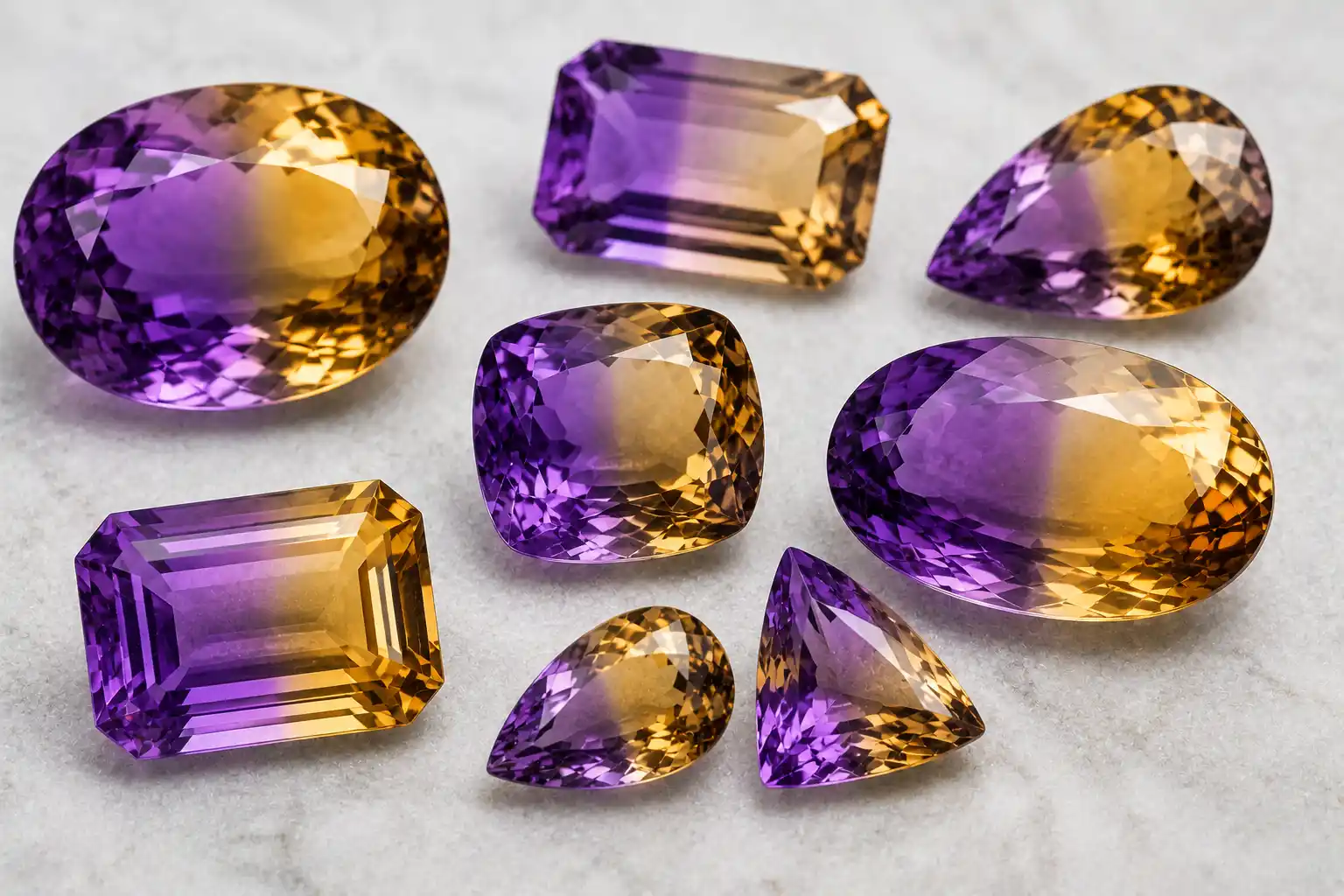
Ametrine price depends much more on the quality of its two colors, their distribution, cutting, clarity, natural or laboratory-grown origin, size, provenance, and craftsmanship than on carat weight by itself. Ametrine is a bicolored variety of quartz containing both amethyst-purple and citrine-yellow to orange areas within the same crystal. GIA identifies Bolivia as the only commercial source of natural ametrine and describes fine material as showing medium-dark to moderately strong orange together with vivid to strong purple or violetish purple. These characteristics make natural ametrine visually distinctive, but they do not create a simple universal price per carat.
The market contains relatively affordable commercial stones, large transparent gems, precision-cut collector pieces, laboratory-grown ametrine, rough crystals, carvings, and finished designer jewelry. Each category follows a different pricing logic. A large stone can remain reasonably accessible because quartz occurs in substantial crystals, while a smaller precision-cut gem with superior saturation and an artfully positioned color boundary may command a much stronger premium. Historical auction offerings reinforce this point: very large ametrines have appeared at estimates measured in the low thousands rather than the extraordinary per-carat levels associated with fine ruby, alexandrite, or emerald.
Ametrine Price at a Glance
| Value Factor | Typical Effect on Ametrine Price |
|---|---|
| Natural vs laboratory-grown | Natural geological origin generally carries the stronger rarity premium |
| Purple color | Strong, vivid purple or violetish purple generally supports higher value |
| Citrine color | Attractive orange to orangy yellow is preferred over weak grayish or muddy areas |
| Color balance | A visually pleasing contribution from both colors generally improves desirability |
| Color boundary | A distinct central division is prized in traditional bicolor cuts |
| Clarity | Eye-clean appearance is expected in much faceted ametrine |
| Cut | Strong brilliance, symmetry, polish, and effective color orientation add value |
| Designer cutting | Precision, concave, fantasy, or artistic cutting can add substantial craftsmanship premiums |
| Carat weight | Larger stones can show stronger colors, but weight alone does not establish rarity |
| Treatment | Filling, dyeing, or other enhancement can affect price and care expectations |
| Origin | Natural commercial material is associated with Bolivia’s Anahí deposit |
| Provenance | Traceable mine-to-market documentation can strengthen collector appeal |
| Grade terminology | AAA and similar labels are seller-defined rather than universal standards |
| Documentation | Independent identification becomes more useful as financial value rises |
| Jewelry setting | Gold, platinum, diamonds, workmanship, and brand can exceed the value of the loose ametrine |
| Market venue | Retail, auction, wholesale, and private resale values can differ significantly |
A useful ametrine valuation therefore begins with material identity, followed by visible quality. Only after those characteristics are understood does a price comparison become meaningful.
Why Ametrine Has a Distinct Market
Ametrine occupies an interesting position within the colored-gem market because it combines a concentrated natural source with the relatively accessible economics of quartz. GIA describes the Anahí mine in southeastern Bolivia as the world’s only commercial source of natural ametrine, although small non-commercial deposits have been identified elsewhere. That supply concentration gives natural ametrine a stronger provenance story than ordinary amethyst or citrine, but it does not make every stone exceptionally expensive.
Quartz can form large clean crystals, and ametrine is available in substantial faceted sizes. GIA illustrates fine examples weighing dozens of carats and notes that larger stones, commonly above five carats, can display the richest purple and orange colors. The result is a market where increased size can improve appearance without necessarily producing the extreme nonlinear pricing seen in much scarcer gem species.
Demand is also closely connected with design. GIA notes that connoisseurs prize imaginative cuts that use ametrine’s two colors in blended or contrasting patterns. Buyers are therefore often paying for the cutter’s ability to exploit natural zoning, not merely for the weight of quartz.
There Is No Universal Ametrine Price per Carat
A single ametrine price per carat can be misleading because two stones of equal weight may differ substantially in color, balance, cut, origin status, and craftsmanship. A 10-carat natural gem containing weak purple and pale yellow can occupy a lower tier than a 7-carat stone with vivid violetish purple, saturated orange, clean separation, and excellent brilliance.
GIA does not publish a standardized commercial ametrine price chart, nor does it assign universal A, AA, or AAA quality grades. Instead, it identifies color, cut, clarity, and carat weight as the principal quality factors and explicitly states that no standardized quality-grading scale exists for ametrine.
Price-per-carat comparisons become useful only when the stones being compared belong to approximately the same category. Natural should be compared with natural, commercial cutting with comparable commercial cutting, and precision-cut stones with pieces offering similar craftsmanship. Without that alignment, a numerical per-carat comparison creates more confidence than accuracy.
Broad Market Benchmarks Show Why Weight Alone Fails
Historical auction material provides useful context for how accessible large ametrine can remain. Bonhams offered a 127.7-carat Bolivian ametrine described as rich in color and high in clarity at an estimate of US$1,500–2,000. Another Bonhams offering featured a 587.5-carat Bolivian ametrine crystal specimen with violet and golden zones at an estimate of US$700–900.
Those examples should not be converted mechanically into modern retail price-per-carat tables. They involve different formats, sale conditions, dates, quality levels, and collector audiences. Their value lies in demonstrating a structural feature of the ametrine market: substantial size can exist without the astronomical price escalation associated with certain rare transparent gemstones.
Finished jewelry can move into a completely different range. Sotheby’s once estimated a high-karat gold necklace made with multiple ametrine briolettes at US$5,000–7,000, while Christie’s documented ametrine in signed Mauboussin jewelry and carved works by recognized lapidary artists. In such pieces, gold, design, maker, craftsmanship, and collectibility can influence value as strongly as the ametrine itself.
Color Is the Core Ametrine Value Factor
The defining appeal of ametrine lies in the interaction between two colors. GIA describes fine material as combining medium-dark to moderately strong orange with vivid to strong purple or violetish purple. A gem that shows both colors clearly and attractively generally occupies a stronger quality tier than material with one impressive zone and one weak, grayish, or muddy area.
Each side deserves separate evaluation. The purple should display enough saturation to read clearly as amethyst without becoming nearly black. The yellow-orange portion should retain brightness and warmth rather than appearing washed out or brown. Strong contrast can enhance the bicolor effect, but contrast between two unattractive colors does not create fine quality.
Photographs can distort both saturation and tone. Camera processing may strengthen purple, push yellow toward orange, or increase the apparent sharpness of the division. Serious comparisons are best made with the exact stone viewed under neutral conditions rather than with seller descriptions alone.
Color Balance Can Add Substantial Appeal
Traditional ametrine cutting frequently aims to give both colors a meaningful role in the finished gemstone. GIA notes that dealers commonly seek an attractive half-and-half distribution with a sharp division at the center. A balanced rectangular stone can therefore command more interest than another stone of identical weight where almost the entire face is one color and only a small corner shows the second.
A literal 50/50 ratio is not required for beauty. Natural crystals do not form according to a retail grading template, and cutters sometimes choose asymmetric designs that intentionally emphasize one color. The strongest pieces make that distribution feel deliberate.
A 60/40 or diagonal division can be more attractive than a technically even but poorly saturated stone. For valuation, balance means visual success rather than mathematical equality.
A Sharp Boundary Helps Traditional Cuts
A distinct separation between purple and yellow-orange enhances the identity of classic bicolor ametrine. GIA specifically mentions a sharp boundary near the center as a characteristic dealers seek and explains that rectangular step cuts display ametrine’s bicolor character particularly well.
A clean boundary can increase visual impact because the viewer immediately recognizes the two color regions. That feature is especially effective in emerald-style, rectangular, and elongated designs where the division can be aligned with the stone’s geometry.
The boundary should not be valued in isolation. A poorly cut gemstone with a perfectly straight division may still look dull, while a precision-cut piece with a less conventional boundary may produce much stronger brilliance and artistic interest.
Blended Color Can Also Be Valuable
Designer cutting changes the traditional rules because internal reflections can visually move one color into the other side of the stone. GIA notes that brilliant, mixed, fantasy, and free-form cuts can deliberately mingle amethyst and citrine colors, producing effects very different from a simple half-and-half step cut.
In such stones, a sharp central boundary may become less important than the overall optical composition. The cutter may use pavilion facets to create alternating purple and gold flashes across the crown, or concave facets to generate repeating patterns.
Pricing these gems requires separating material value from artistic value. A mass-produced commercial ametrine and a one-of-a-kind precision cut can contain similar quartz yet command very different prices because the second stone reflects far more labor, design skill, and rough loss.
Designer Cutting Can Become a Major Price Driver
Ametrine is especially well suited to creative lapidary work because two natural colors allow cutters to construct complex visual patterns. GIA highlights designer examples weighing 48.50 carats and larger, showing how cutters exploit the material’s zoning rather than merely shaping it into standardized commercial forms.
Precision cutting can add value through symmetry, polish, facet design, brightness, and controlled color placement. Concave cutting or fantasy faceting can involve additional equipment and considerable labor. A cutter may also sacrifice more rough to create an ideal pattern instead of maximizing saleable weight.
The resulting premium should therefore not be dismissed simply because quartz itself is relatively available. Buyers of artistic gems are purchasing both natural material and skilled transformation.
Large Size Can Strengthen Color
Ametrine is unusual because larger stones can sometimes display stronger and more satisfying color than smaller ones. GIA states that the best intense purple and orange colors are often found in gems above approximately five carats. Larger rough gives the cutter enough volume to preserve both color regions while maintaining useful saturation.
This creates a legitimate reason for some larger stones to command higher prices beyond the simple addition of weight. A small ametrine may contain two color zones but show them weakly because each occupies too little volume to appear saturated.
The effect is not automatic. A 30-carat pale stone does not become fine merely because it is large. Size supports value when it carries stronger color, good clarity, attractive proportions, and a compelling bicolor pattern.
Size Does Not Create an Extreme Rarity Premium
Very large ametrine is available. GIA documents fashioned stones weighing 48.50 and 87.66 carats, while auction houses have offered stones well above 100 carats. This availability limits the degree to which carat weight alone can drive per-carat value upward.
A 100-carat ametrine is visually impressive, but buyers should still inspect saturation, cut, clarity, face-up spread, and color balance. Quartz can retain large dimensions without entering the extreme scarcity range of fine ruby, emerald, alexandrite, or certain sapphire categories.
This makes ametrine appealing for collectors who enjoy substantial gemstones. Large visual presence can be achieved without automatically reaching the price levels associated with much scarcer gem species.
Face-Up Size Matters More Than Hidden Weight
Carat weight measures mass, not visible spread. Two 15-carat ametrines can look very different from the top if one is cut efficiently and the other carries excessive depth beneath the girdle.
A deep pavilion may sometimes be necessary to preserve color or create a specific optical pattern, especially in fantasy cutting. It becomes less desirable when the additional depth merely retains weight without improving brilliance or color.
Compare length, width, and depth alongside carat weight. The strongest value occurs when the weight contributes either to visible size, stronger saturation, better cutting, or an intentional design feature rather than existing mainly beneath the setting.
Clarity Usually Needs to Be High
GIA states that much of the faceted ametrine in the market is eye-clean, meaning it lacks inclusions visible without magnification. This creates a relatively high baseline expectation for transparency.
Ordinary commercial stones with obvious fractures, dark crystals, cloudy regions, or distracting inclusions should therefore be discounted unless some other feature compensates strongly. A minor inclusion near the edge may have little impact, while a surface-reaching fracture under the table can affect both appearance and durability.
Collector specimens follow different rules. Natural crystal surfaces, internal growth features, and inclusions may add geological interest to rough material even when they would reduce the value of a conventional faceted gem.
Eye-Clean Does Not Mean Exceptional
Because clean material is common, sellers should not treat basic eye-clean transparency as a rare luxury characteristic. It is better understood as a normal expectation for much faceted ametrine.
Premium pricing needs stronger justification through fine color, superior balance, outstanding cut, unusual size combined with quality, traceable natural origin, or artistic workmanship.
A perfectly clean but pale commercial stone can therefore be worth less than a slightly included gem with substantially stronger color and a more compelling design.
Natural and Laboratory-Grown Ametrine Need Separate Price Categories
Synthetic ametrine exists and can look highly convincing because it is laboratory-grown quartz rather than merely colored glass. GIA’s research resources specifically address techniques for separating natural from synthetic ametrine and note that commercially produced synthetic material has entered the gem market.
Laboratory growth makes attractive, clean bicolored quartz more reproducible, so synthetic material does not carry the same geological scarcity component as mined ametrine. Natural stones should therefore receive a different market comparison when geological origin matters.
This does not make laboratory-grown ametrine undesirable. A buyer primarily interested in color and cutting may find synthetic material attractive. The economic issue is disclosure: synthetic material should be priced and represented as laboratory-grown rather than natural Bolivian ametrine.
Appearance Alone Cannot Prove Natural Origin
Natural and synthetic quartz share closely similar fundamental properties, which makes separation more complex than simply checking hardness or color. GIA research identifies twinning, zoning orientation, optical behavior, chemical information, and spectroscopy among the evidence that can help distinguish natural from laboratory-grown ametrine.
A straight boundary does not automatically prove synthetic origin, and visible inclusions do not automatically prove natural origin. Simplified online rules can therefore create false confidence.
For ordinary inexpensive stones, trusted seller disclosure may be sufficient. For an unusually expensive ametrine sold with a significant natural-origin premium, independent gemological identification becomes more defensible.
Bolivia Is Central to Natural Ametrine Value
GIA consistently identifies Bolivia as the only commercial source of natural ametrine, specifically the Anahí mine in southeastern Bolivia near the Brazilian border. This gives Bolivian provenance unusual importance compared with a gem such as amethyst, where many commercial sources exist.
The locality provides historical and collector context, but it should not be confused with a conventional origin premium of the kind sometimes attached to fine ruby or sapphire. Nearly all commercial natural ametrine already traces back to the same broad source, so merely attaching “Bolivian” to an ordinary stone does not automatically make it exceptional.
Quality still determines where a stone sits within the natural market. A weakly colored natural Bolivian stone can remain inexpensive compared with a fine precision-cut example from the same deposit.
The Anahí Mine Shapes Availability
GIA reports that the Anahí mine has produced substantial amounts of amethyst, citrine, and ametrine for the gem market and has maintained commercial operations for decades. The existence of a consistent source helps explain why natural ametrine can remain accessible despite having only one commercial locality.
Supply concentration and scarcity are not identical concepts. One commercial source sounds extremely rare, but if that source produces substantial quantities of usable quartz, the market can still have enough material to support commercial jewelry, large gems, and designer cutting.
This distinction is essential when interpreting seller claims. “Only one commercial source” is factually meaningful; “therefore every ametrine is extremely rare and expensive” does not follow automatically.
Mine-to-Market Provenance Can Add Collector Interest
GIA has documented efforts at the Anahí operation to maintain tighter control over mining, cutting, manufacturing, and distribution, creating a clearer mine-to-market chain for some material. Traceability can appeal to collectors and buyers who value documented sourcing.
A credible provenance package may therefore justify some premium when it identifies the exact supply chain more clearly than an ordinary commercial listing. The value comes from documentation and transparency rather than from a different mineral identity.
A seller’s unsupported statement that a stone is “direct from Anahí” should not receive the same weight as records that actually document the chain of custody.
“Brazilian Ametrine” Needs Context
Listings sometimes use Brazilian wording because Bolivia’s principal ametrine source lies close to the Brazilian border and regional cutting and trading networks have historically handled the material. GIA nevertheless identifies Bolivia as the only commercial source of natural ametrine.
When a seller calls a stone Brazilian ametrine, ask whether the claim refers to mining, cutting, trading, or the seller’s location. A stone mined in Bolivia and cut in Brazil is still Bolivian in geological origin.
Historical auction catalogues sometimes contain locality descriptions that do not align perfectly with modern GIA sourcing guidance, which is another reason not to treat every commercial location label as laboratory-established provenance. Geological origin should be separated from where a gemstone was cut or sold.
Ametrine “Grades” Are Not Universal
AAA, AAAA, premium, royal, investment grade, collector grade, and similar terms frequently appear in online listings, but GIA explicitly states that no standardized quality-grading scale exists for ametrine.
One seller may define AAA as strong color and eye-clean clarity, while another may use the same label for most of its natural stones. Without common criteria, these grades cannot be compared reliably across businesses.
A stronger valuation description states what the stone actually shows: vivid violetish purple, moderately strong orange, approximately even color distribution, eye-clean clarity, precision cutting, weight, dimensions, natural or synthetic status, treatment disclosure, and provenance.
How to Evaluate an Ametrine Grade Without Relying on AAA
Begin with the two colors. Determine whether both are attractive and sufficiently saturated. Next evaluate how those colors interact: are they balanced, sharply separated, artfully blended, or awkwardly distributed? Then examine clarity, cut, brightness, symmetry, and polish.
After appearance comes material status. Confirm whether the stone is natural or laboratory-grown, whether treatment has been disclosed, and whether the provenance claim is credible. Size should be considered after quality rather than before it.
This approach may take longer than reading “AAA,” but it produces a description that can be compared meaningfully across sellers.
Cut Quality Can Strongly Affect Ametrine Price
Cut controls both brilliance and color presentation. Ametrine requires thoughtful orientation because the cutter must decide how purple and yellow-orange regions will face the viewer. GIA notes that rectangular step cuts are popular because they clearly display the bicolor effect, while brilliant and mixed cuts can use internal reflections to intermingle the colors.
A large window through the center can make both colors look pale and lifeless. Excessive extinction can hide saturation inside large black areas. Poor symmetry or polish can further weaken an otherwise attractive stone.
When rough is sufficiently available, a premium-priced ametrine should generally show a reason for its cutting premium rather than merely retaining maximum carat weight.
Windowing Reduces Effective Beauty
Windowing occurs when light travels through an overly shallow portion of the pavilion instead of returning toward the observer. The central area then becomes transparent-looking, often revealing the background behind the gemstone.
In ametrine, windowing can weaken the contrast that gives the gem its identity. A sharp purple-orange boundary may exist structurally yet appear washed out through a broad transparent center.
A small amount of transparency near the edge may not matter, but a large central window should usually affect price unless the stone has some exceptional compensating characteristic.
Extinction Can Hide Fine Color
Extinction appears as dark, inactive areas in a faceted gemstone. Rich ametrine naturally contains darker zones, but excessive extinction can make purple appear nearly black and orange appear brown or dull.
This issue can be difficult to judge from one professional photograph because the photographer can choose an angle that activates the most attractive facets.
Slow video of the exact stone gives a better sense of whether the colors remain visible as the gemstone moves. Fine cutting should create changing patterns of light rather than leaving most of the face permanently dark.
Treatments Are Uncommon but Still Relevant
GIA characterizes ametrine as rarely treated but notes that filled fractures can occur. The rarity of treatment means buyers should not assume every stone has undergone enhancement, but it also means the claim “ametrine is never treated” is too absolute.
Treatment matters because it can affect value and care. A filled fracture improves apparent clarity but changes the stone’s condition and may require gentler cleaning.
Higher-value natural pieces justify stronger treatment disclosure than inexpensive commercial jewelry because even a relatively small difference in value can outweigh the cost of professional verification.
Treatment Does Not Change Natural Versus Synthetic Origin
Natural origin and treatment are separate questions. A mined ametrine can be fracture-filled after recovery, while a laboratory-grown ametrine may be completely untreated after growth.
A seller should therefore answer both questions independently: Is the stone natural or laboratory-grown? Has it received any detectable or disclosed treatment?
Descriptions that use “natural” as though it automatically means untreated can create unnecessary confusion. Geological formation tells you where the quartz originated; treatment history tells you what happened afterward.
Clarity Enhancement Can Influence Price
When surface-reaching fractures are filled, their visibility may decrease, making the gemstone appear cleaner. The resulting stone can still be attractive, but its price should reflect the modification when compared with an otherwise similar untreated example.
Treatment severity also matters. A tiny filled fracture near the girdle is different from extensive filling through the center of a gemstone.
Because eye-clean untreated ametrine is relatively available, buyers of conventional faceted stones have little reason to pay a strong untreated-quality price for heavily filled material unless some unusual design or historical factor justifies it.
Market Demand Is Driven by Appearance and Design
Ametrine does not have the broad global luxury-market profile of diamond, ruby, sapphire, or emerald. Its demand is more specialized, centered on buyers attracted to bicolor gems, quartz collectors, distinctive jewelry, and creative lapidary work. GIA’s quality guidance specifically notes that connoisseurs prize imaginative designer cuts.
That demand structure helps explain why craftsmanship can have such a large influence on price. Ordinary rectangular stones compete heavily on color and value, while a distinctive precision-cut gem can appeal to collectors who care about individual design.
Demand also benefits from immediate visual recognizability. Even buyers unfamiliar with detailed gemology can appreciate the purple-gold contrast, giving ametrine a clear aesthetic identity within the quartz family.
Market Demand Does Not Make Every Stone Rare
Seller language sometimes combines the one-source fact with words such as “ultra rare,” “investment quality,” or “almost impossible to find.” Such descriptions need context. GIA confirms one commercial natural source, but it also illustrates large fashioned ametrines and describes continued commercial supply.
Fine quality is more selective than ordinary material. Strong saturation in both colors, clean separation, excellent clarity, and precision cutting create a narrower supply tier.
The defensible rarity claim therefore concerns exceptional combinations of attributes, not the mere existence of any natural ametrine.
Commercial Ametrine and Collector Ametrine Occupy Different Tiers
Commercial ametrine typically prioritizes attractive bicolor appearance, eye-clean clarity, standard shapes, and accessible pricing. Collector pieces may add unusually strong colors, large size, documented provenance, precision cutting, exceptional crystal form, or historical interest.
These markets overlap but should not be valued identically. A 20-carat calibrated commercial step cut and a 20-carat award-winning fantasy cut may begin with similar rough yet end with radically different prices.
Collectors often value difficulty of replacement. A standardized commercial oval can usually be replaced with another similar stone, while an individual precision cut or exceptional rough crystal may be unique.
Rough Ametrine Follows Different Value Rules
Rough crystals appeal to mineral collectors, cutters, and buyers interested in natural growth structure. Their value depends on visible zoning, crystal form, termination quality, translucency or transparency, damage, aesthetics, matrix association, and provenance rather than faceted brilliance.
Bonhams previously estimated a 587.5-carat Bolivian ametrine crystal with violet and golden zones at US$700–900. That auction example illustrates how a large natural crystal specimen can remain within a relatively accessible collector range.
A rough crystal intended for cutting should be evaluated differently again. Internal fractures, orientation, color saturation, and expected yield determine how much finished gem material a cutter can realistically recover.
Faceted Ametrine and Crystal Specimens Should Not Share One Price Formula
The cost of a faceted stone includes cutting labor and yield loss, while a natural crystal specimen may gain value from an intact termination that would actually disappear during faceting. What increases one category’s value can reduce another’s.
A pristine terminated crystal might be more desirable untouched than sawn into gemstones. Conversely, fractured rough with no specimen aesthetics can still have value if clean sections will produce fine faceted material.
Always determine whether the object is being sold primarily as a gem, a mineral specimen, or lapidary rough before applying market comparisons.
Finished Jewelry Adds Costs Beyond the Ametrine
An ametrine ring or pendant can cost far more than a similar loose stone because jewelry pricing includes precious metal, design, labor, setting, side stones, brand margin, and retailer overhead.
Signed pieces can create another level of value. Christie’s has catalogued ametrine in jewelry by Mauboussin and in fine carved work by Wallace Chan, showing how the material can become part of objects whose value depends heavily on authorship and artistry.
A finished jewelry price should therefore never be divided mechanically by the ametrine’s carat weight to create a loose-gem benchmark.
Brand and Maker Can Matter More Than Raw Gem Cost
A recognized jewelry house or lapidary artist can transform relatively accessible quartz into a high-value collectible object. Buyers may pay for design history, rarity of the model, signature, craftsmanship, provenance, and secondary-market demand.
The gem remains an important visual component, but raw material economics become only one part of the transaction.
This distinction matters particularly when comparing online loose stones with auction jewelry. A branded ring may be expensive even if replacing its center ametrine with another visually similar stone would cost much less.
Retail and Resale Prices Differ
A retail seller must cover sourcing, inventory, cutting, photography, grading, customer service, returns, advertising, rent, transaction fees, and profit. A private seller entering the secondary market does not automatically recover those costs.
Dealers purchasing used jewelry also need enough margin to verify, clean, repair, hold, and resell the piece. An offer to a private owner can therefore be substantially lower than the original retail purchase price.
Signed designer jewelry or unusually fine collector pieces may perform differently because their secondary-market demand depends on more than generic ametrine availability.
Auction Estimates Are Not Retail Price Guides
Historical auction estimates provide real market context, but they represent specific objects under specific conditions. A 127.7-carat loose ametrine offered at US$1,500–2,000 does not mean every stone of that weight should sell at the same level.
Color, cut, clarity, provenance, auction venue, buyer competition, and market conditions all vary. Buyer’s premiums and taxes can further separate the final cost from the published estimate.
Use auction evidence to understand market structure, not as a universal appraisal formula.
Why Online Ametrine Price Charts Often Disagree
Online pricing tables may group stones by carat weight while defining quality differently or not defining it at all. One chart may assume weak commercial color, while another may use fine natural material. Synthetic stones can also become mixed into search results, making apparently low benchmarks misleading.
Undefined AAA grades add another layer of inconsistency because each seller may use a different internal system. GIA’s explicit statement that no standardized ametrine grading scale exists explains why cross-store labels do not always align.
A useful price chart would need to specify natural or synthetic origin, color quality, distribution, clarity, cut, size, treatment, and market level. Without those details, its numbers should be treated only as rough orientation.
How Natural Ametrine Compares with Amethyst Pricing
Ametrine and amethyst are both quartz, but they have different market structures. Amethyst comes from many sources and is widely available across an enormous size range. Natural ametrine has a much more concentrated commercial origin and adds the visual requirement of two attractive color regions.
The Gems Lore guide to amethyst price explains why fine purple color drives amethyst value even though large stones remain relatively accessible. Ametrine inherits that purple-quality consideration while adding the quality of its yellow-orange zone and the relationship between the two.
Ametrine should not simply be valued by adding hypothetical amethyst and citrine prices together. The bicolor crystal is its own visual and commercial category.
Natural Ametrine Versus Synthetic Ametrine Price
Synthetic material can provide strong color, eye-clean transparency, and large size without depending on mining supply. That reproducibility generally limits the scarcity premium compared with natural ametrine.
The difference does not need to be framed as good versus bad. A disclosed laboratory-grown gem may offer excellent value to someone who prioritizes appearance and cutting. A natural stone may be preferable to someone who values geological formation and Bolivian provenance.
The critical pricing rule is to compare within the correct category. A laboratory-grown stone should not be valued using natural Anahí market assumptions simply because both look similar.
How Much Should Provenance Affect Price?
A credible provenance statement can strengthen value when a buyer cares about natural origin, traceability, or collection history. Because Bolivia is the sole commercial source of natural ametrine, basic Bolivian origin is expected rather than extraordinarily rare.
More detailed mine-to-market records may add collector interest, particularly when they document the stone from rough through cutting and sale. GIA has reported on efforts at Anahí to establish a more controlled chain of custody.
The premium should correspond to the strength of the evidence. A marketing card stating “Bolivian” is not equivalent to traceable documentation that identifies the actual supply chain.
Does Anahí Mine Origin Create a Premium?
Anahí is the recognized commercial source, so the mine name can carry historical and collector appeal. Its importance is factual rather than merely promotional. GIA identifies the deposit directly in its ametrine reference material.
However, most commercial natural ametrine already relates to that source. The mine name alone should therefore not transform an ordinary stone into a premium specimen.
Fine color, cut, clarity, size, provenance documentation, and artistry still determine whether a particular Anahí ametrine sits near the top of the market.
Documentation Is Usually Reserved for More Significant Stones
GIA offers Colored Stone Identification Reports for ametrine but notes that such reports are not commonly requested because report costs may be high relative to the value of most ametrine. Reports are more logical for gems of significant value.
This creates a practical threshold rather than a quality rule. An inexpensive natural ametrine from a reputable dealer may be perfectly reasonable without laboratory documentation. A costly collector stone sold as exceptional natural material deserves more scrutiny.
Documentation becomes particularly useful when natural versus synthetic origin materially changes the price.
A Laboratory Report Does Not Set Market Value
Identification and valuation are separate tasks. A gemological report can establish important characteristics of the material, but it does not automatically determine whether the seller’s asking price is fair.
The same natural ametrine could receive different values in wholesale, retail, insurance, auction, or resale contexts. Cutting quality and personal appeal also require visual judgment beyond material identification.
Independent appraisal may therefore be appropriate for unusually valuable finished jewelry even when a laboratory report already exists.
Seller Certificates Are Not Universal Quality Proof
A retailer-created certificate may document the seller’s description, which can be useful. It is not automatically equivalent to an independent gemological laboratory report.
Look at who issued the document, what tests were performed, whether natural or synthetic origin is clearly stated, whether treatment is addressed, and whether the measurements or photograph correspond to the exact gem.
The word certificate alone does not turn an AAA label into a standardized grade.
Condition Matters in Secondhand Ametrine
Ametrine has Mohs hardness 7 and is durable enough for many jewelry applications, but repeated wear can create scratches, facet-edge abrasion, chips, or setting damage over time. GIA states that ametrine is durable enough for most jewelry and may need repolishing eventually.
Secondhand stones should be inspected around facet junctions and exposed corners. Rectangular cuts can be particularly vulnerable at corners if the setting provides little protection.
Minor wear may have limited effect on inexpensive jewelry, while visible chips or substantial repolishing needs can influence collector or resale value more strongly.
Ametrine Is Durable but Not Indestructible
Quartz hardness makes ametrine practical for rings, earrings, pendants, bracelets, and other jewelry, but hardness refers primarily to resistance to scratching. Strong blows can still chip the gem, and long-term wear may abrade exposed facet edges.
A secure setting becomes especially important with large stones because additional size creates more surface area that can strike surrounding objects.
The durability profile supports ametrine’s commercial appeal because substantial gems can be worn rather than confined to display, provided ordinary gemstone precautions are followed.
Care Can Help Preserve Value
Warm soapy water is the safest general cleaning choice for ametrine, according to GIA. Gentle care helps preserve polish and prevents unnecessary stress on a stone or its setting.
Treatment status should influence cleaning. Filled fractures require more caution than intact untreated quartz because aggressive cleaning may affect the filler or worsen existing structural weaknesses.
Periodic inspection of prongs or bezels also protects value because a lost stone represents a far greater problem than ordinary surface dirt.
Market Availability Keeps Commercial Ametrine Accessible
Natural commercial supply is concentrated geographically but not necessarily tiny in volume. GIA reports that the Anahí mine has produced significant quantities of amethyst, citrine, and ametrine and has maintained consistent commercial production.
This helps explain why consumers can find natural ametrine across commercial jewelry and loose-gem markets despite the one-source distinction.
Fine material remains more selective. Strong dual saturation, clean color balance, eye-clean clarity, and excellent cutting represent a smaller portion of supply than ordinary natural ametrine.
Is Ametrine Rare?
Natural ametrine is geologically unusual because commercial production comes from one Bolivian source, but “rare” needs qualification. GIA confirms the single commercial source while also documenting large finished gems and continuing production.
Ordinary natural ametrine is not so scarce that every small stone deserves an exceptional rarity premium. Fine ametrine is harder to replace because both color zones need to reach an attractive quality while the stone also maintains clarity and good cutting.
The most accurate description is that ametrine has unusual geological occurrence, accessible commercial material, and a narrower high-quality tier.
What Makes Fine Ametrine Expensive?
Fine material combines several favorable characteristics at once. The purple is vivid, the yellow-orange is sufficiently saturated, both colors contribute strongly, the distribution looks deliberate, clarity is high, and the cut returns light effectively.
Larger size can increase desirability when it strengthens the colors, while precision cutting can add substantial labor and artistic value. Natural origin and credible provenance further distinguish the stone from laboratory-grown alternatives.
Price rises when these qualities reinforce one another rather than when only one characteristic is exceptional.
What Makes Ametrine Inexpensive?
Commercial material may be inexpensive because the colors are pale, one zone dominates heavily, the boundary is awkward, the cut is windowed, or the gem comes from laboratory production.
Large size alone may not add an enormous premium because large quartz is available. Standardized mass-produced cutting also keeps labor costs lower than one-of-a-kind precision work.
A low price therefore does not automatically indicate fake material. It may simply reflect ordinary natural quality or a lower-cost synthetic category.
Can Ametrine Be an Investment?
Ametrine can be collectible, especially as fine natural material, designer cutting, documented Anahí provenance, unusual rough, or significant jewelry. That does not make ordinary ametrine a guaranteed financial investment.
Future resale depends on buyer demand, documentation, cutting, condition, venue, dealer margin, transaction costs, and the uniqueness of the particular stone.
Any seller promising guaranteed appreciation is making a financial claim that cannot be supported simply by the gemstone’s one-source origin.
Large Designer Ametrine Can Be Collectible Without Being an Investment
An exceptional precision-cut ametrine may become difficult to replace because the combination of natural zoning and one-off lapidary design is unique. Collector appeal can therefore exist even when the underlying quartz is not extraordinarily expensive per carat.
That collectibility is aesthetic and craftsmanship-driven. Future financial performance remains uncertain.
The strongest reason to purchase such a stone is that its color pattern and cutting genuinely appeal to you, with potential resale treated as secondary.
How to Compare Two Ametrine Prices Properly
Begin by confirming natural versus laboratory-grown origin. Next compare purple saturation, yellow-orange saturation, color balance, boundary style, clarity, cut quality, size, dimensions, and treatment.
Then determine whether one gemstone carries additional value through precision cutting or documented provenance. Compare loose stones with loose stones rather than using finished jewelry prices.
Finally, compare sellers at the same market level. A wholesale trade quote, online retail listing, designer-jewelry price, and auction estimate answer different economic questions.
A Practical Ametrine Valuation Checklist
Before deciding whether an ametrine price is justified, review the main variables:
- Confirm whether the stone is natural, laboratory-grown, or an imitation.
- Evaluate the purple and yellow-orange zones independently.
- Check whether both colors are sufficiently saturated and attractive.
- Examine whether the color balance appears intentional.
- Look for a sharp division when evaluating a traditional bicolor cut.
- Judge artistic blending rather than strict separation in fantasy or precision cuts.
- Check for eye-visible inclusions, fractures, chips, or cloudiness.
- Inspect the gem for windowing and excessive extinction.
- Compare face-up dimensions with carat weight.
- Ask about filled fractures, dyeing, or other known treatment.
- Treat AAA, AAAA, premium, and investment-grade terminology as seller-defined.
- Verify natural Bolivian or Anahí claims when provenance materially affects the price.
- Distinguish ordinary commercial cutting from precision or artist cutting.
- Separate the value of the stone from metal, diamonds, brand, and workmanship in finished jewelry.
- Consider independent identification when natural-versus-synthetic status materially changes the financial risk.
- Compare asking prices only with genuinely similar stones.
This process produces a far more defensible valuation than relying on a single generic per-carat number.
How Buying Quality Connects with Price
Price analysis becomes easier when the basic purchase checks have already been completed. The Gems Lore guide to buy ametrine covers identity, provenance, treatments, photography, seller questions, documentation, and return terms in greater detail.
A price that appears low may make complete sense after identifying weak saturation or commercial cutting. A higher quote may become understandable when the stone shows precision workmanship and documented natural provenance.
The purpose of valuation is not to find the cheapest ametrine. It is to understand what qualities the price is actually buying.
How Ametrine Relates to Amethyst Value
The purple portion of ametrine shares the mineral identity of amethyst, so some of the same color principles apply. Strong, attractive purple tends to command more interest than weak grayish material. The Gems Lore amethyst price guide explores those purple-quartz value factors separately.
Ametrine adds the citrine-colored region and the challenge of presenting both colors effectively. Its value therefore depends not simply on the quality of the purple zone but on the interaction of both halves.
This makes the stone more complex to judge visually even though it remains within the quartz mineral family.
Should You Pay More for a 50/50 Ametrine?
An attractive near-even division can justify a premium when a traditional bicolor appearance is the goal. GIA notes that dealers commonly favor an attractive half-and-half distribution with a distinct central boundary.
Exact equality should not become an obsession. A 55/45 gemstone with richer color and superior cutting may be much more desirable than a perfectly divided stone with weak saturation.
The premium belongs to visual success, not arithmetic.
Should You Pay More for an Unusually Large Ametrine?
Only when the additional size contributes to quality or desirability. Larger ametrines can show more saturated colors, and GIA specifically notes stronger hues in stones above about five carats.
Beyond that point, however, large dimensions do not automatically create extreme rarity. Auction records show natural ametrines exceeding 100 carats at estimates far below the values expected for equivalent weights of many scarcer colored gemstones.
Pay more for a large ametrine when the stone remains beautifully colored, clean, well cut, and visually impressive rather than simply heavy.
Should You Pay More for Bolivian Origin?
Natural commercial ametrine is already fundamentally a Bolivian gem in the current market because GIA identifies Bolivia as the sole commercial source. A basic Bolivian label therefore confirms expected provenance rather than automatically creating a luxury premium.
More detailed mine-to-market documentation can have additional collector value. Anahí-specific traceability or records linking a stone to a known parcel may distinguish one piece from generic commercial inventory.
The premium should be proportional to the documentation rather than to the geographic name alone.
Should You Pay More for Untreated Ametrine?
Untreated status can appeal to collectors, but treatments are already uncommon according to GIA. That means untreated material is not necessarily an exceptional rarity in the way untreated status can be for some heavily treated gem markets.
Color and cutting usually remain more visible determinants of commercial desirability. A weak untreated stone can be less attractive than a beautiful treated stone that is fully and accurately disclosed.
Treatment should be included in valuation without becoming the only factor.
Should You Pay More for a Laboratory Report?
A report can be worthwhile when it resolves a question that materially affects value, particularly natural versus synthetic origin. GIA itself notes that ametrine reports are generally reserved for gems of significant value because the testing cost may be high relative to the value of ordinary material.
The report does not make the gemstone more beautiful, but it reduces uncertainty. That confidence can be valuable when a substantial natural-origin premium is involved.
For modest commercial jewelry, the cost of testing may provide little economic benefit.
Conclusion
Ametrine price is shaped by the interaction of two colors rather than by carat weight alone. Fine natural stones combine vivid to strong purple or violetish purple with attractive orange to orangy yellow, good clarity, intentional color distribution, and effective cutting. GIA also notes that larger stones can show stronger saturation and that designer cuts are particularly prized for the way they blend or contrast ametrine’s colors.
Natural commercial material comes from Bolivia’s Anahí deposit, but one-source geology does not make every ametrine extremely expensive. Commercial supply includes large transparent stones, while historical auction examples show that even ametrines above 100 carats can remain far more accessible than similarly sized examples of scarcer gem species. Fine color, precision cutting, natural origin, provenance, and craftsmanship create the strongest premiums.
Buyers should also ignore unsupported assumptions created by AAA or investment-grade labels because GIA confirms that no standardized ametrine grading system exists. The most useful valuation starts with material identity, then evaluates color, balance, clarity, cut, size, treatment, provenance, and market context. A stone priced according to those observable characteristics is easier to understand than one whose value rests mainly on a large carat number or dramatic rarity claim.
Frequently Asked Questions About Ametrine Price
How much is ametrine worth?
Ametrine can range from accessible commercial quartz to considerably more expensive precision-cut, collector, or designer material. There is no universal authoritative price per carat because color quality, balance, clarity, cutting, natural or laboratory-grown origin, size, provenance, treatment, and market venue all affect value. Historical auction examples show that very large natural ametrines can still trade within relatively accessible collector ranges compared with scarcer colored gems.
Why is ametrine sometimes inexpensive even though it has one commercial source?
One commercial source does not necessarily mean tiny production volume. GIA documents continuing production from Bolivia’s Anahí mine and shows that large fashioned ametrines are available. Quartz also forms large crystals, so substantial stones do not automatically carry extreme scarcity premiums.
What is the most valuable ametrine color?
GIA describes fine ametrine as showing medium-dark to moderately strong orange together with vivid to strong purple or violetish purple. Strong color on both sides is usually more desirable than one rich color paired with a weak or muddy second zone.
Is a 50/50 ametrine more valuable?
A visually balanced half-and-half distribution is traditionally desirable, and GIA notes that dealers commonly favor this arrangement with a sharp central boundary. Exact mathematical equality is not required, however. Color quality and cutting can matter more than a perfect 50/50 split.
Does a sharp color boundary increase ametrine value?
It can, especially in traditional rectangular and step-cut stones where a crisp division emphasizes the bicolor effect. GIA specifically identifies a sharp central boundary as desirable in conventional ametrine cutting. Fantasy and designer cuts may intentionally blend the colors instead.
Is blended ametrine less valuable than sharply divided ametrine?
Not necessarily. GIA notes that imaginative designer cuts are prized and can use internal reflections to mingle purple and yellow-orange colors creatively. A beautifully executed blended design can command more than a routine sharply divided commercial cut.
Does carat weight strongly affect ametrine price?
Carat weight increases total value when quality remains comparable, but ametrine is available in large sizes. Larger stones can show richer saturation, particularly above about five carats, yet weight alone does not create an extreme rarity premium.
Why can a smaller ametrine cost more than a larger one?
A smaller stone may have stronger colors, better balance, a cleaner boundary, better brilliance, superior precision cutting, or stronger natural-origin documentation. A larger stone with pale colors or poor cutting can remain less desirable despite its additional weight.
Are 100-carat ametrines rare?
They are impressive, but large ametrines do exist in the market. GIA documents very large fashioned examples, and Bonhams has offered natural ametrines exceeding 100 carats. Quality determines whether a large stone deserves a substantial premium.
What does AAA ametrine mean?
AAA is generally a commercial seller grade rather than an internationally standardized gemological classification. GIA states that no standardized quality-grading scale exists for ametrine. Buyers should ask what the seller’s grade actually measures.
Is AAAA ametrine an official grade?
No universal GIA AAAA grade exists for ametrine. AAAA, premium, royal, investment grade, and similar terms are seller-defined unless accompanied by a transparent grading methodology. Evaluate the actual color, clarity, cut, size, origin status, and treatment instead.
Does GIA grade ametrine?
GIA provides information about ametrine quality factors and offers Colored Stone Identification Reports, but it does not use a standardized A, AA, AAA, or AAAA quality scale for the gem.
Is natural ametrine worth more than laboratory-grown ametrine?
Natural material generally carries a stronger rarity premium because it formed geologically and commercial supply comes from a single Bolivian source. Synthetic ametrine can still be genuine laboratory-grown quartz with attractive color, but it belongs to a different market category.
Can synthetic ametrine look as good as natural ametrine?
Yes. Laboratory-grown quartz can be transparent and strongly colored, making appearance alone unreliable for proving natural origin. GIA research specifically addresses methods used to separate natural and synthetic ametrine.
Can I identify natural ametrine by the color boundary?
Not reliably from a simple visual rule. Gemologists can use zoning orientation, twinning, optical behavior, and other evidence to help separate natural and synthetic material, but interpretation requires proper techniques. A straight or diagonal boundary alone is not definitive proof.
Where does natural ametrine come from?
GIA identifies Bolivia as the only commercial source of natural ametrine, with the Anahí mine in southeastern Bolivia being the principal deposit. Small non-commercial occurrences have been reported elsewhere.
Is Bolivian ametrine more valuable?
Commercial natural ametrine is already associated with Bolivia, so the country name alone does not create an exceptional premium. Quality remains crucial. More detailed and credible mine-to-market provenance can add collector interest when it is documented.
Is Anahí ametrine more valuable?
Anahí provenance can be desirable because GIA identifies the mine as the commercial source of natural ametrine. A premium makes more sense when the provenance is documented and the stone itself has fine color and cutting rather than when the mine name is simply used as marketing language.
Is Brazilian ametrine genuine?
A gem sold in or cut in Brazil can still be genuine ametrine, but GIA identifies Bolivia as the only commercial natural source. If a seller says “Brazilian ametrine,” ask whether the statement refers to geological origin, cutting location, or trade route.
Does ametrine origin matter as much as ruby or sapphire origin?
Generally not in the same way. Almost all commercial natural ametrine already comes from one Bolivian source, so variation within the natural market depends heavily on color, cut, clarity, size, and provenance quality. Geographic origin is more useful for establishing natural supply context than for creating multiple competing origin tiers.
Is ametrine usually treated?
GIA states that ametrine is rarely treated, although filled fractures can occur. Buyers should still ask for treatment disclosure because treatment can affect value and care requirements.
Does untreated ametrine cost more?
Untreated material can appeal to collectors, but treatment is already relatively uncommon. Fine color and cutting may have a stronger effect on ordinary market value. A treatment premium or discount should be evaluated in context rather than applied as a fixed percentage.
Does fracture filling lower ametrine price?
It can. Filling modifies a natural fracture and may influence durability, care, and collector preference. The effect on price depends on the extent and location of the fracture, the quality of the overall stone, and whether treatment was disclosed.
How clear should valuable ametrine be?
Most faceted ametrine is eye-clean, according to GIA. Obvious fractures, dark inclusions, or significant cloudiness can therefore reduce value in conventional transparent stones unless exceptional color or design compensates for them.
Is eye-clean ametrine rare?
Not particularly. GIA states that much faceted ametrine lacks eye-visible inclusions. Premium pricing should generally require more than basic eye-clean clarity.
Does cut affect ametrine price?
Yes. Cut controls brilliance, face-up size, and how the purple and yellow-orange regions interact. Rectangular step cuts can emphasize a sharp bicolor division, while fantasy and brilliant cuts may blend the colors through internal reflections. Precision or artistic cutting can create substantial premiums.
Are fantasy-cut ametrines more expensive?
They can be because design, cutting time, yield loss, precision, and the reputation of the lapidary artist add value beyond the quartz itself. GIA specifically notes that connoisseurs prize imaginative designer cuts.
What is windowing, and does it affect ametrine value?
Windowing is a transparent-looking region caused by pavilion proportions that fail to return enough light toward the viewer. A large window can weaken color and brilliance, reducing the visual impact of both color zones. Premium stones should generally avoid distracting central windowing.
Does extinction affect ametrine value?
Yes. Excessive dark areas can hide the colors that make ametrine desirable. A strongly saturated purple zone may look almost black if cutting creates too much extinction. Stones should be inspected while moving rather than judged from one ideal photograph.
Does documentation increase ametrine price?
Documentation can increase buyer confidence and help support a natural-origin premium, but it does not automatically make the stone higher quality. GIA notes that identification reports are generally requested only for ametrines of significant value because the cost can be high relative to ordinary material.
Do all valuable ametrines need a GIA report?
No. Many legitimate natural ametrines are worth less than the cost-benefit threshold for extensive laboratory documentation. A report becomes more useful when natural versus synthetic origin materially affects a substantial purchase.
Can a seller’s certificate establish ametrine value?
A seller certificate records the seller’s description but is not automatically independent evidence. It also does not establish a universal quality grade. Evaluate who issued the document and what conclusions it actually supports.
Why can ametrine jewelry cost far more than a loose stone?
Finished jewelry includes metal, design, labor, setting, side stones, brand value, and retailer overhead. Signed pieces can also carry significant collectibility. Christie’s has catalogued ametrine in pieces by major jewelry and lapidary names, illustrating how maker and artistry can become major parts of the value.
Can an ametrine necklace be worth thousands of dollars?
Yes. Sotheby’s has estimated a high-karat gold ametrine bead necklace at US$5,000–7,000. That figure reflects the complete necklace, including gold construction, design, workmanship, and maker attribution, rather than creating a general loose-ametrine price benchmark.
Are auction prices good guides for ametrine?
They provide useful market evidence but should be used carefully. Auction objects vary by size, quality, design, provenance, maker, condition, and sale environment. Historical auction estimates should therefore provide context rather than serve as a fixed per-carat formula.
Is rough ametrine valuable?
It can be. Rough value depends on natural crystal form, color zoning, transparency, damage, termination quality, provenance, and cutting potential. A terminated collector crystal follows different pricing rules from rough material purchased primarily for faceting.
Are ametrine crystals worth more than faceted stones?
Neither category is automatically worth more. A fine natural crystal may command a specimen premium because cutting it would destroy its natural form. A precision-cut gem may command more because of brilliance and craftsmanship. The intended collector market determines which features matter.
Why are some huge ametrines surprisingly affordable?
Quartz forms large crystals, and natural ametrine is available in substantial sizes. Historical auction examples include a 127.7-carat Bolivian faceted ametrine estimated at US$1,500–2,000. Large weight therefore does not automatically produce an extreme rarity premium.
Does stronger color always mean higher value?
Usually stronger attractive saturation helps, but the gemstone still needs brightness, balance, and good cutting. An excessively dark purple zone or muddy orange zone can reduce appeal even when the colors are technically intense.
Which matters more for ametrine price: color or size?
Color quality generally deserves priority. Size becomes especially helpful when it allows stronger saturation and a more visible bicolor pattern. GIA notes that stones above about five carats often show the strongest colors, but a large weak-colored stone remains lower quality.
What makes an ametrine expensive?
Fine dual-color saturation, attractive balance, a well-presented boundary, eye-clean clarity, excellent cutting, large size with maintained quality, natural origin, credible provenance, and precision lapidary work can all raise value. Signed jewelry or an important maker can add a separate premium.
What makes ametrine inexpensive?
Pale colors, poor balance, commercial cutting, windowing, excessive extinction, laboratory-grown origin, distracting inclusions, weak provenance, or mass-produced jewelry can reduce price. Large size alone does not compensate for those limitations.
Does ametrine hold its value?
Ametrine can retain collectible or jewelry value, but resale is not guaranteed to match original retail price. Dealer margins, market demand, documentation, condition, cutting, and transaction costs affect secondary-market outcomes.
Is ametrine a good investment?
Ametrine should not be purchased on the assumption of guaranteed appreciation. Exceptional natural stones, documented provenance, important designer cuts, or signed jewelry can have collector markets, but future financial performance remains uncertain.
What is the biggest mistake when estimating ametrine price?
The biggest mistake is treating carat weight, an AAA label, or the fact that Bolivia is the sole commercial source as sufficient proof of high value. Ametrine price makes sense only after natural or synthetic origin, color quality, balance, clarity, cut, size, treatment, provenance, and market context have been evaluated together.