
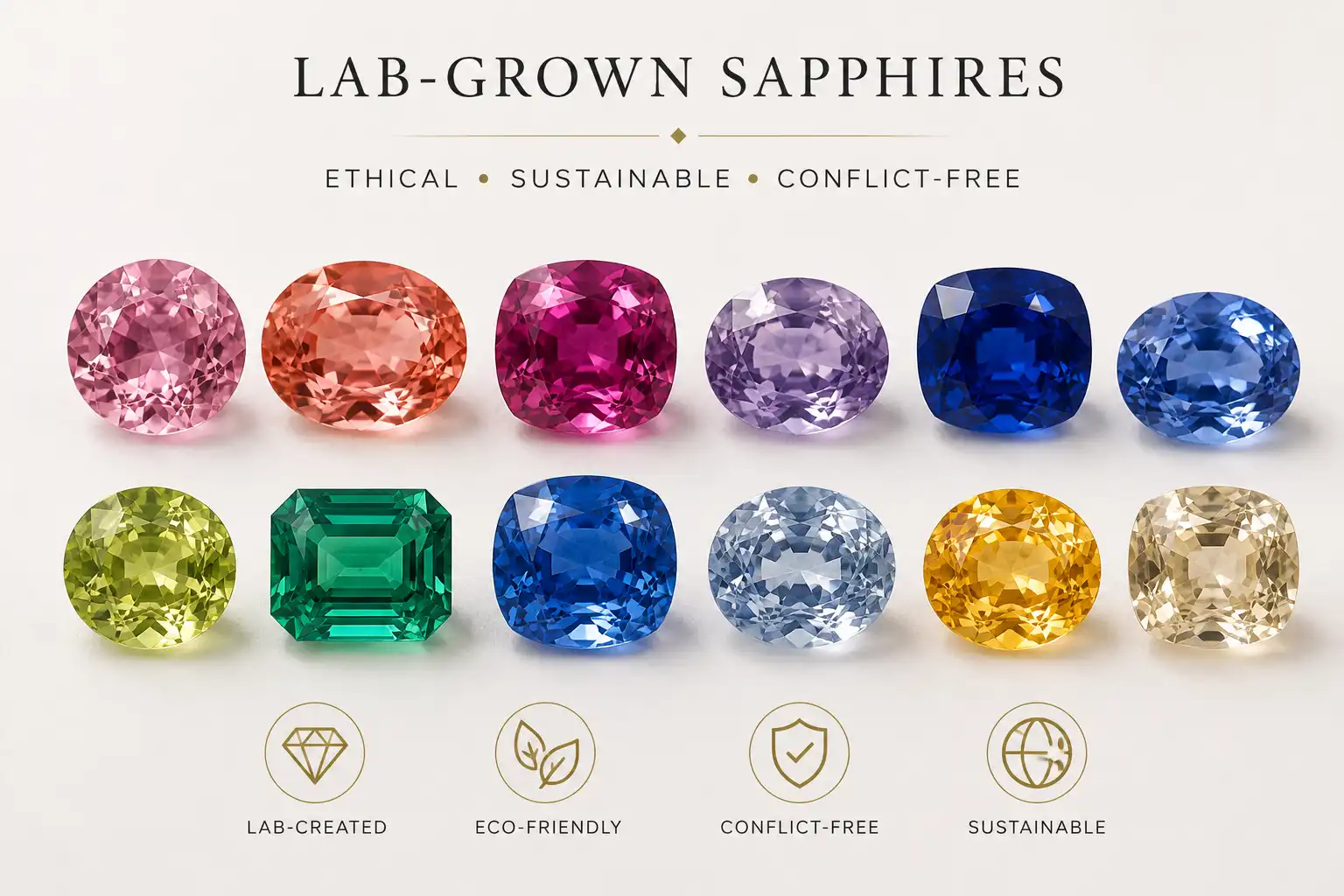

Lab-grown sapphire is real sapphire. Same mineral, same aluminum oxide, same hardness 9, same lack of cleavage, same colors, same optical properties. A gemologist can only distinguish it by hunting for tiny growth features under magnification — not because it’s a different substance, but because it grew in weeks rather than millions of years. It’s been made since 1902, making it the first commercially synthesized gemstone in history. It isn’t fake, and the only real issue is disclosure.
This guide covers lab sapphire from every angle. You’ll learn how it’s made, the crucial difference between synthetic and simulant, why it’s so cheap, and where it genuinely makes sense. At Gems Lore, we share gem lore honestly.
Lab Sapphire at a Glance
- It is sapphire. Identical chemistry and hardness 9.
- Since 1902. The first synthetic gemstone.
- Synthetic ≠ simulant. A crucial distinction.
- Must be disclosed. That’s the only genuine issue.
Synthetic Is Not Simulant
This is the single most important distinction on this page, and confusing the two causes most of the misunderstanding around lab stones.
A synthetic (lab-grown) sapphire IS sapphire. Corundum, aluminum oxide, hardness 9, refractive index 1.76 to 1.77, no cleavage. Chemically and physically identical to a mined stone. It just has a different origin story.
A simulant is NOT sapphire. It’s a different material pretending to look like one — cubic zirconia, glass, blue spinel, blue topaz. Different chemistry, different hardness, different everything. Our real vs. fake sapphire guide covers simulants.
Why this matters practically: “lab-created sapphire,” “synthetic sapphire,” and “lab-grown sapphire” all mean the same thing — actual sapphire, grown in a factory. “Sapphire-like,” “created stone,” “faux sapphire,” or “simulated sapphire” usually mean it isn’t sapphire at all.
Read the words carefully. “Simulated” is the one that isn’t the real mineral.
How It’s Made
Several methods, and they matter because they leave different fingerprints.
Verneuil flame fusion (1902). Powdered alumina is dropped through an oxyhydrogen flame onto a rotating pedestal, building a carrot-shaped boule. Developed by Auguste Verneuil, it was the first commercially viable gem synthesis in history and it remains the cheapest. It produces stones with characteristic curved growth lines — nature grows corundum in straight, angular zones, never curves.
Czochralski (pulled). A seed crystal is pulled slowly from molten alumina. Cleaner than flame fusion, more expensive.
Flux growth. Corundum crystallizes slowly out of a molten flux over months. Produces stones with inclusions that closely mimic natural ones — this is the method that genuinely challenges laboratories.
Hydrothermal. Grown in hot water under pressure, mimicking natural conditions. Also produces convincingly natural-looking inclusions.
The pattern: cheap methods are easy to detect; expensive methods are hard. Flame-fusion material costs almost nothing and gives itself away. Flux and hydrothermal stones are pricier and genuinely require a lab.
The Industrial Story
Worth knowing, because it explains why lab sapphire is so abundant.
Most synthetic sapphire isn’t made for jewelry at all. It’s an industrial material, produced in enormous quantities because hardness 9 and chemical stability are extremely useful:
- Watch crystals. Almost every quality watch face is synthetic sapphire.
- Smartphone components. Camera lens covers and sensor windows.
- LED substrates. A major use by volume.
- Optical windows for scientific and defense equipment.
- Bearings in precision instruments.
Gem-quality lab sapphire is, in a sense, a byproduct of an industrial supply chain. That’s a large part of why it costs what it does.
Why It’s So Cheap
Three reasons stack.
It’s fast. Weeks or months, versus geological time.
It’s controllable. Color is dialed in by adjusting trace elements. No prospecting, no waste, no sorting through tons of unusable rough.
The infrastructure already exists for industrial production at scale.
The result: flame-fusion lab sapphire costs very little per carat, and it’s available in large, flawless, perfectly colored stones that would be extraordinary in nature. Our lab sapphire price guide covers the tiers.
That abundance is exactly the point — and it’s also why lab sapphire has essentially no resale value. You can’t be scarce on demand.
What It’s Identical In
Being specific, because this is where people are misinformed.
Hardness: 9. Identical. Our gemstone hardness chart shows the scale. Cleavage: none. Identical. Chemistry: Al₂O₃ with the same trace elements. Identical. Refractive index, density, dispersion: identical. Durability in wear: identical. A lab sapphire ring will survive fifty years exactly as a mined one would. Color range: every sapphire color, including padparadscha-like pink-orange. Star sapphire: synthetic stars exist too, and they’re often suspiciously perfect — razor-sharp and dead-centered, where natural stars are usually slightly uneven.
Our sapphire meaning guide covers the species properties.
What It Isn’t Identical In
Rarity. This is the whole difference. A mined sapphire is a finite geological accident. A lab sapphire can be made again tomorrow.
Price. A fraction.
Resale. Essentially none. Our best gemstones for investment guide covers why that matters less than people think — mined stones are usually poor investments too.
Provenance. No Kashmir, no Ceylon, no origin story.
Growth features. Curved striae in flame fusion, characteristic flux residue, gas bubbles — the fingerprints labs look for.
The Disclosure Rule
The only genuine ethical issue in this entire subject.
Lab sapphire must be disclosed. Selling it as natural is fraud, full stop. Consumer protection rules in most markets require clear disclosure of laboratory origin.
Selling lab sapphire as lab sapphire is completely legitimate, and it’s a good product at a fair price.
The scam isn’t the stone. It’s the silence. Our lab-grown vs. natural gemstones guide covers this across gems, and our buy lab sapphire guide covers buying.
The Ethics Question
Worth addressing honestly, without overselling.
In favor of lab: no mining, no tailings, no land disturbance, no supply chains running through regions with governance problems, and traceability by definition.
The fair counterpoint: gemstone mining supports real livelihoods, particularly artisanal miners in Sri Lanka, Madagascar, and Tanzania. “Lab is always more ethical” is too simple — for some communities, the trade is the economy.
And the honest caveat: growing corundum requires sustained high temperatures, which is energy-intensive. Lab stones aren’t free of footprint.
The reasonable position: lab sapphire is a legitimate ethical choice, not an automatically superior one.
Where Lab Sapphire Genuinely Makes Sense
Concrete cases, rather than a general endorsement.
Large stones on a budget. A 5-carat vivid blue mined sapphire is a serious purchase. A lab one isn’t.
Matched multi-stone pieces. This is the strongest case. Matching thirty stones for a tennis bracelet is nearly impossible in nature and trivial in a lab.
Rare colors affordably. Padparadscha-like pink-orange at a fraction of the contested-name premium.
Travel and daily-risk pieces. Something you won’t grieve losing.
Where you simply don’t care about geology. A perfectly respectable position.
Frequently Asked Questions
Is lab-grown sapphire real sapphire?
Yes, completely. It’s corundum — the same aluminum oxide, hardness 9, no cleavage, same refractive index, same colors, same durability. The only differences are rarity, price, and microscopic growth features. It’s been made since 1902, making it the first commercially synthesized gemstone.
What’s the difference between synthetic and simulated sapphire?
Synthetic sapphire is real sapphire grown in a lab. A simulant is a different material imitating the look — cubic zirconia, glass, or blue spinel — with different chemistry and hardness. Read labels carefully: “simulated” is the word that means it isn’t actually sapphire.
How is lab sapphire made?
Most commonly by Verneuil flame fusion, developed in 1902, where powdered alumina drops through a flame onto a rotating pedestal to build a boule. Other methods include Czochralski pulling, flux growth, and hydrothermal growth. Cheaper methods leave detectable curved growth lines; flux and hydrothermal are harder to identify.
Why is lab sapphire so cheap?
Because it grows in weeks rather than geological time, color is dialed in by controlling trace elements with no waste or prospecting, and enormous industrial infrastructure already exists — most synthetic sapphire is made for watch crystals, phone components, and LED substrates rather than jewelry.
Is lab sapphire as durable as natural?
Identically so. Same hardness 9, same absence of cleavage, same chemical stability. A lab sapphire ring worn daily for fifty years will look exactly as a mined one would. There is no durability argument for choosing natural over lab.
Is lab sapphire more ethical?
It’s a legitimate choice, not an automatically superior one. There’s no mining impact and traceability is inherent, but gemstone mining supports real livelihoods, particularly for artisanal miners in Sri Lanka, Madagascar, and Tanzania. Growing corundum is also energy-intensive.
Where to Go From Here
Lab sapphire is a genuinely good product carrying a bad reputation it doesn’t deserve. It’s real sapphire, identical in every way you can see or feel, at a small fraction of the price — and it’s been around since 1902. Buy it knowingly, insist it’s disclosed, and it will outlast you exactly as a mined stone would.
Learn the species in our sapphire meaning guide, linked above, see values in our lab sapphire price guide, or compare in our types of sapphire guide.
Considering lab sapphire? Tell us in the comments.
This guide is for general educational purposes and is not appraisal advice.