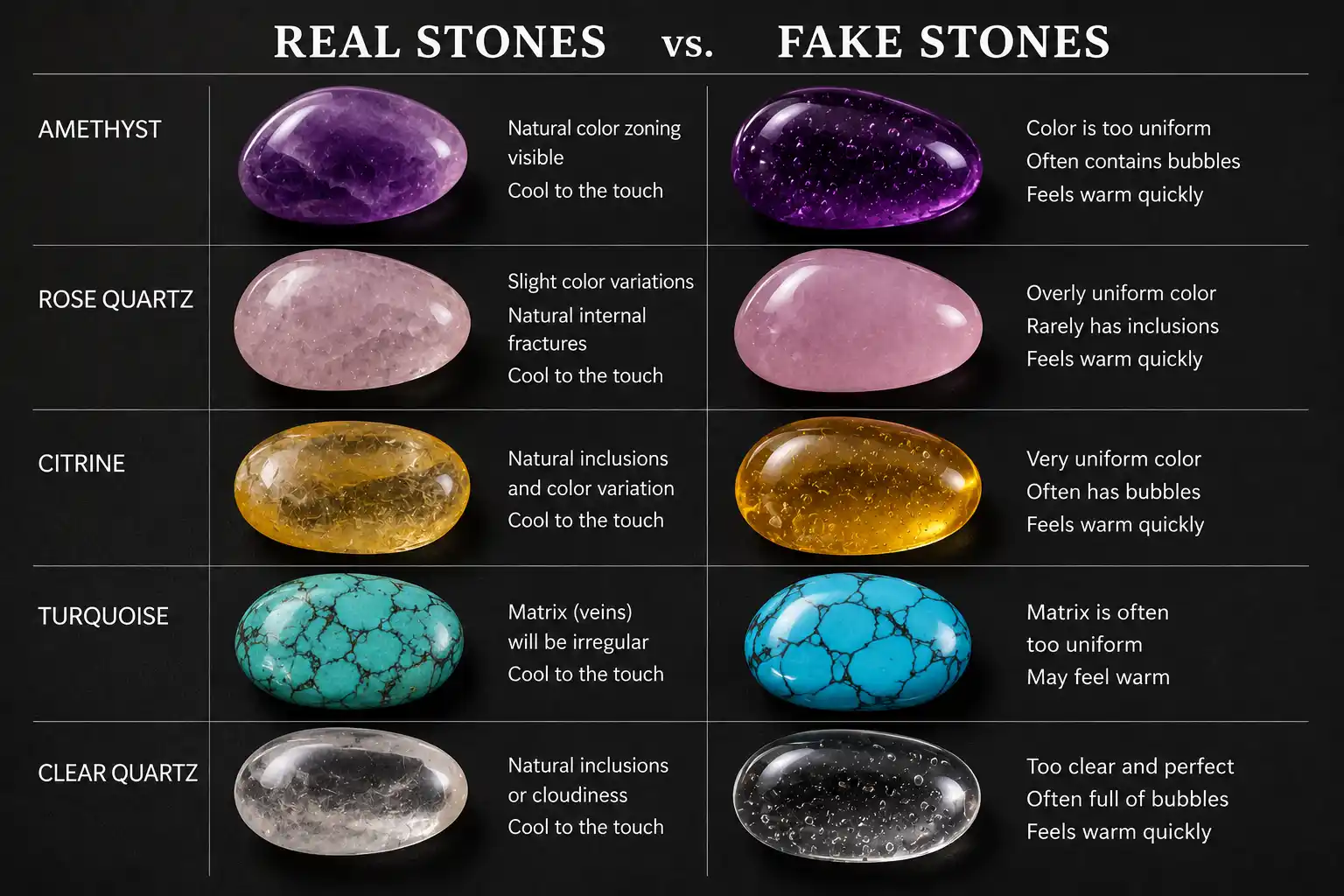
How to Spot Fake Crystals: A Buyer’s Guide
“Fake crystal” is a broad consumer phrase rather than a precise gemological category. It can describe glass sold as quartz, dyed howlite sold as turquoise, laboratory-grown ruby represented as mined ruby, a composite sold as one solid gem, or a natural stone promoted with an invented origin or variety name.
Some manufactured materials are legitimate products. Goldstone, opalite, cubic zirconia, laboratory-grown sapphire, and glass beads are not deceptive when sellers identify them correctly. Misrepresentation—not human manufacture alone—is what turns an attractive product into a buyer problem.
The safest buying method combines accurate naming, treatment disclosure, realistic pricing, magnified inspection, seller verification, and professional testing when the stone’s value depends on its identity.
Fake-crystal categories at a glance
| Product or claim | What it may actually be | Why buyers become misled |
|---|---|---|
| Glass sold as quartz or gemstone | Artificial colored or colorless glass | Different composition and lower replacement cost |
| Dyed stone sold as natural color | Agate, quartz, howlite, magnesite, jade, or another treated material | Color origin affects value and care |
| Undisclosed laboratory-grown gem | Synthetic ruby, sapphire, emerald, quartz, alexandrite, or diamond | Crystal is real, but growth origin is misrepresented |
| Composite sold as one stone | Doublet, triplet, filled material, or bonded fragments | Visible face may not represent the entire object |
| Reconstructed product sold as solid rough | Powder or fragments bonded with resin, glass, or cement | Structure and durability differ from one natural piece |
| Coated or filled material sold as untreated | Surface layer or foreign filler alters appearance | Treatment can affect value, repair, and cleaning |
| Trade name used as mineral identity | Opalite, goldstone, “aura” products, or ambiguous branded names | Buyer may assume natural geological formation |
| Natural but mislabeled mineral | Sodalite sold as lapis, calcite as jade, glass as obsidian | Identity and properties differ |
| False locality or rarity claim | Common material assigned to a famous mine or source | Provenance premium lacks evidence |
| Heavily edited listing | Saturation, lighting, and contrast hide the true appearance | Delivered item differs materially from photographs |
Begin by defining “real”
A product can be real in one sense and misrepresented in another.
Natural untreated gemstone
The material formed without human-controlled growth and has not received a reportable enhancement.
Natural treated gemstone
The material formed naturally but was heated, irradiated, dyed, filled, impregnated, coated, diffused, or otherwise modified.
Laboratory-grown gemstone
The material was grown through a controlled process and has essentially the same core composition and crystal structure as its named natural counterpart.
Imitation or simulant
The product looks like another gem but has different composition or structure. Glass resembling emerald is an imitation emerald.
Composite
The object combines two or more materials, such as an opal triplet, garnet-and-glass doublet, or ruby fragments held in glass filler.
Reconstructed material
Small fragments or powder are bonded into a larger product, often with resin, glass, cement, pressure, or heat.
None of these categories is automatically fraudulent. The product description must accurately state which one applies.
Lab-Grown vs Natural Gemstones explains growth origin, while Gemstone Treatments Explained covers post-growth enhancement.
Step 1: Read the exact product name
Do not evaluate only the photograph. Read the title, specification table, invoice language, and fine print.
Watch for vague descriptions such as:
- Genuine crystal
- Natural-style gemstone
- Created stone
- Simulated crystal
- Quartz-like
- Turquoise color
- Moonstone effect
- Emerald green crystal
- Healing stone
- Premium aura stone
- Laboratory gemstone
- Authentic energy crystal
These phrases may avoid stating the actual material.
A useful listing should identify:
- Mineral, rock, glass, organic gem, or artificial product
- Natural or laboratory-grown origin
- Known treatment
- Composite or reconstructed construction
- Weight and dimensions
- Whether the images show the exact item
- Country or mine claim, if any
- Return policy
Step 2: Check whether the name is a mineral or a trade term
Some names describe manufactured or treated products rather than naturally occurring mineral varieties.
Opalite
Commercial opalite is usually manufactured glass with a milky blue appearance and warm transmitted color. It is legitimate decorative material but not natural opal or moonstone.
The exact material is covered in Opalite: What It Is, Meaning & Uses.
Goldstone
Goldstone is manufactured glass containing reflective metallic crystals. It should not be sold as natural aventurine or sunstone.
Aura quartz
Aura quartz normally consists of natural or laboratory-grown quartz coated with a thin metallic film. The quartz may be real, but the iridescent surface is treated.
Crackle quartz
Crackle quartz is heated and rapidly cooled to create fractures. It may remain colorless or receive dye.
Reconstituted turquoise or lapis
Fragments or powder may be bonded with resin and colored. The product can be durable enough for jewelry but must not be represented as one untreated natural stone.
Trade names are useful only when the underlying material and treatment remain clear.
Step 3: Compare price with the claim
Price alone cannot prove authenticity. Sellers may overcharge for imitations or discount legitimate inventory.
Nevertheless, a large contradiction between price and claim is a warning sign.
Examples include:
- A large transparent “natural ruby” for a few dollars
- A flawless multi-carat “emerald” without treatment disclosure
- A vivid pink “natural diamond” sold without a laboratory report
- Dozens of large “moldavite” pieces at low identical prices
- Perfectly clear large “natural citrine” in an improbable dark orange color
- Premium jadeite sold with no treatment information
Exceptional natural stones are difficult to replace. Their pricing normally reflects rarity, testing, inventory risk, and market demand.
An unusually low price should prompt better verification rather than immediate purchase.
Step 4: Compare several seller photographs
Strong listings show:
- Front and back
- Side profile
- Drill holes
- Close-up magnification
- Neutral background
- Scale reference
- Natural and indoor lighting
- Chips or inclusions
- The exact piece being sold
Warning signs include:
- One stock photograph for hundreds of unique natural stones
- Extreme saturation
- Crushed shadows hiding inclusions
- Backlighting that exaggerates transparency
- No side or back image
- Refusal to provide an unedited phone photograph
- Different stones across the listing
- AI-generated or digitally altered crystal formations
- Perfectly floating jewelry with inconsistent prongs or reflections
Natural material varies. Stock photographs may be acceptable for inexpensive calibrated products, but the seller should state that the delivered piece will differ.
Step 5: Look for repeated patterns
Inspect several pieces in a batch.
Mass-produced imitations may show:
- Identical color swirls
- Repeated internal glitter patterns
- Matching “inclusions”
- Uniform mold marks
- Exact tower dimensions
- Repeated fracture networks
- Identical matrix
- The same surface texture
Calibrated faceted gemstones can legitimately match in size and color. The stronger concern is repetition in internal features that should be unique.
Step 6: Use a 10× loupe
Magnification can expose:
- Round gas bubbles
- Curved glass flow lines
- Mold seams
- Dye in fractures
- Surface coating wear
- Adhesive layers
- Composite boundaries
- Metallic particles in glass
- Granular reconstructed texture
- Unnatural crack networks
- Curved synthetic growth
- Flux inclusions
- Filling flashes
- Chipped surface layers
How to Identify Crystals provides the complete progressive testing workflow. Glass vs. Crystal owns the detailed glass comparison.
One observation rarely settles the identification. A gas bubble can suggest glass, but natural fluid inclusions may also contain a bubble. Structure, refractive properties, density, and other features must agree.
Step 7: Inspect drill holes and chipped edges
Drill holes often expose the untreated or uncoated material.
Look for:
- Pale interior beneath strong surface color
- Dye concentration around the hole
- Resin or cement
- Granular powder texture
- Flaking coating
- Glassy chips
- Metallic foil
- A visible join
- Artificial matrix
Worn bead edges may reveal a different base color. Likewise, the bottom of a carving may show mold texture or surface paint hidden from the main view.
How to Spot Dyed Crystals explains dye-specific clues without treating every bright stone as artificial.
Step 8: Distinguish glass from natural glass
Artificial glass frequently imitates quartz, tourmaline, emerald, sapphire, jade, amber, and other gems.
Possible signs include:
- Simple round gas bubbles
- Curved flow lines
- Mold seams
- Conchoidal chips
- Soft worn facet edges
- Fused layers
- Metallic particles
- Repeated swirls
- A refractive index inconsistent with the claim
However, obsidian, tektites, and moldavite are natural glasses. Their amorphous structure does not make them fake.
A seller should therefore distinguish:
- Natural obsidian
- Natural tektite
- Natural moldavite
- Artificial glass imitation
The material-specific Real vs Fake Moldavite guide will own the detailed comparison for moldavite.
Step 9: Understand laboratory-grown crystals
Laboratory-grown ruby, sapphire, emerald, quartz, alexandrite, spinel, and diamond are crystalline materials. They are not ordinary glass imitations.
They become deceptive when sold without clear growth-origin disclosure.
Possible synthetic clues vary by growth method and may include:
- Curved color banding
- Gas bubbles
- Flux inclusions
- Metallic platelets
- Seed plates
- Hydrothermal growth features
- Unusual fluorescence
- Extremely uniform color
- Growth structures inconsistent with natural formation
Some laboratory-grown gems closely resemble natural material. Professional instrumentation may be necessary.
The broader difference is explained in Lab-Grown vs Natural Gemstones.
Step 10: Check for coatings
A coating alters the surface rather than the entire material.
Signs may include:
- Color concentrated at facet edges
- Scratches through a colored film
- Iridescence limited to the surface
- Uneven coverage near drill holes
- Peeling or flaking
- Different color on the pavilion and crown
- Colorless material visible at chips
- A coating protected beneath prongs
Coated quartz, topaz, tanzanite, diamonds, beads, and decorative pieces all occur.
Do not perform abrasion or solvent tests on jewelry. Professional microscopy and spectroscopy provide safer evidence.
Step 11: Check for composites and reconstructed products
A composite may look convincing from the top because only a thin natural layer is visible.
Possible constructions include:
- Opal doublets and triplets
- Garnet-topped glass
- Ruby fragments in lead glass
- A transparent cap over colored cement
- Turquoise fragments in resin
- Jade powder bonded into carvings
- Thin gem slices bonded to backing
- Glass-filled cavities
Look at the side for a straight boundary. Use transmitted light to identify layers, bubbles in adhesive, differing luster, or color trapped along the join.
The complete structure guide is Gemstone Doublets and Triplets.
Common fake-crystal examples
Clear quartz
Clear glass may be molded into quartz towers or spheres. Bubble-free glass can be difficult to identify by eye, while natural quartz can be remarkably clean.
The planned Real vs Fake Clear Quartz guide will own quartz-specific tests.
Amethyst
Purple glass, synthetic amethyst, dyed quartz, and coated stones can imitate natural amethyst.
Real vs Fake Amethyst will distinguish those categories without replacing the broad buyer-screening process here.
Citrine
Much commercial citrine is heat-treated amethyst, which remains quartz and can be legitimate when disclosed. Glass, dyed quartz, coated quartz, and laboratory-grown material also occur.
Real vs Fake Citrine owns the natural-color, heated-amethyst, and imitation distinctions.
Jade
Jadeite and nephrite face imitations from glass, serpentine, quartz, calcite, polymer, reconstructed material, dyed stones, and impregnated jadeite.
Real vs Fake Jade covers the species and treatment classification.
Opal
Opal may be natural solid, synthetic, treated, doublet, triplet, glass, or resin imitation.
Real vs Fake Opal owns pattern, layering, synthetic structure, and treatment indicators.
Ruby and sapphire
Red and blue glass, synthetic corundum, filled material, composites, diffusion-treated stones, and other natural gems can imitate ruby or sapphire.
Use Real vs Fake Ruby and Real vs Fake Sapphire for material-specific testing.
Turquoise
Dyed howlite, magnesite, glass, plastic, ceramic, reconstructed material, dyed turquoise, and impregnated turquoise can all enter the market.
Real vs Fake Turquoise owns the detailed separation.
Natural inclusions are not a universal authenticity certificate
Sellers sometimes claim that any inclusion proves a crystal is natural. That is incorrect.
Laboratory-grown gemstones may contain:
- Flux
- Gas bubbles
- Metallic particles
- Seed remnants
- Growth zoning
- Internal strain
- Fingerprint-like features
Artificial glass may contain bubbles, metallic crystals, flow bands, or intentionally added particles.
Conversely, natural gemstones can be eye clean. Inclusion interpretation requires knowledge of the specific material and growth method.
Do not rely on “too perfect to be real”
Perfection is not a scientific test.
A natural quartz crystal can be clear and symmetrical. A synthetic ruby may contain obvious bubbles. Glass can be filled with artificial inclusions to appear natural.
Better questions include:
- Are the observed properties consistent with the claimed material?
- Does the growth structure support natural or laboratory origin?
- Are treatments visible?
- Does the price match the quality?
- Is the description precise?
- Can a qualified laboratory confirm the important claims?
Avoid destructive online tests
Do not use:
- Flame
- Hot needles
- Boiling water
- Acids
- Bleach
- Acetone on unknown material
- Uncontrolled scratching
- Hammer tests
- Dropping tests
- Freezing and heating cycles
- Prolonged soaking
- Tapping stones together
These methods can damage both genuine and artificial products while producing ambiguous results.
Seller red flags
Exercise caution when a seller:
- Refuses to name the material precisely
- Uses “natural” only in hashtags
- Calls laboratory-grown material mined
- Uses a gemstone name for glass without qualification
- Claims every inclusion proves natural origin
- Guarantees a famous mine without documents
- Calls common material investment grade
- Uses one certificate for an entire unrelated inventory
- Does not show report numbers
- Hides treatments in fine print
- Offers no return period
- Uses only edited stock photographs
- Cannot explain care requirements
- Pressures the buyer to pay outside a protected platform
- Claims a home test proves laboratory authentication
The transaction protections in How to Buy Gemstones Online Without Getting Scammed address payment, seller identity, return terms, report verification, and shipping.
What a laboratory report can establish
Depending on the service and material, a laboratory report may state:
- Gem species or variety
- Natural or laboratory-grown origin
- Detectable treatments
- Composite construction
- Measurements and weight
- Color
- Photograph
- Geographic origin opinion for selected gemstones
A report does not guarantee:
- Retail value
- Investment performance
- Ethical sourcing
- Seller honesty in unrelated claims
- That a mounted stone has not been switched after testing
Verify the report directly with the issuing laboratory and match its details to the object.
Gemstone Certification Labs Compared explains service differences, while How to Read a Gem Lab Report covers comments, limitations, and matching.
Buying inexpensive crystals without over-testing
A laboratory report may cost more than an ordinary $10 or $30 stone. Buyers can still reduce risk by requiring:
- An exact material description
- Treatment disclosure
- Natural or laboratory-grown origin
- Dimensions and weight
- Unedited photographs
- A return period
- Protected payment
- Seller history
- Realistic claims
- Care instructions
The objective is proportional verification. An inexpensive piece does not require a major laboratory report, but it still deserves honest naming.
Final fake-crystal checklist
Before buying:
- Identify whether the name is mineralogical or commercial.
- Ask whether the item is natural, treated, laboratory-grown, reconstructed, composite, or artificial.
- Read the complete description.
- Compare price with the rarity claim.
- Request images of the exact item.
- Inspect the side, back, drill holes, and chips.
- Use a 10× loupe.
- Look for bubbles, flow lines, dye, coatings, seams, and adhesive.
- Compare several pieces for repeated patterns.
- Treat unusual perfection and dramatic inclusions cautiously.
- Avoid destructive home tests.
- Verify laboratory reports independently.
- Confirm that report measurements match the stone.
- Use protected payment and a meaningful return period.
- Buy manufactured materials confidently only when they are represented accurately.
Frequently Asked Questions
1. What is the easiest way to spot a fake crystal?
Start with the exact product description, price, seller evidence, and magnified inspection. No single visual test works for every material.
2. Do air bubbles mean a crystal is fake?
Simple round gas bubbles often indicate glass, but natural fluid inclusions and synthetic gemstones can also contain bubble-like features.
3. Are laboratory-grown crystals fake?
No. They can have essentially the same crystal structure and composition as natural counterparts, but their laboratory origin must be disclosed.
4. Is dyed stone fake?
The host stone may be natural. The product becomes misleading when the introduced color is not disclosed or when it is sold as a different gem.
5. Is opalite a real crystal?
Commercial opalite is usually manufactured glass. It is a legitimate decorative product but not natural opal, moonstone, or quartz.
6. Is goldstone natural?
No. Goldstone is manufactured glass containing reflective metallic crystals.
7. Are perfectly clear crystals always artificial?
No. Some natural gems are exceptionally clean. Clarity alone cannot determine origin.
8. Can a fake crystal feel cold?
Yes. Glass, stone, ceramic, and many manufactured products can all feel cool at room temperature.
9. Can hardness prove a crystal is genuine?
No. Hardness can narrow material identity but cannot establish natural origin or treatment.
10. Are cheap crystals always fake?
No. Quartz, agate, calcite, jasper, and many other natural materials can be inexpensive because supply is abundant.
11. Can an online photograph prove authenticity?
No. Photographs can reveal useful clues but may be edited, backlit, or taken from a different item.
12. When should I pay for professional testing?
Consider testing when the claimed identity, treatment, natural origin, locality, insurance value, or resale price creates a substantial financial difference.
Conclusion
Spotting fake crystals begins with precise language. Artificial glass, laboratory-grown gemstones, dyed natural stones, composites, reconstructed products, and trade-name materials are different categories that require different disclosures.
A seller does not need to offer only untreated natural crystals to be trustworthy. The reliable seller is the one who names the material accurately, discloses growth and treatment, supports exceptional claims, and gives the buyer enough information to make an informed choice.