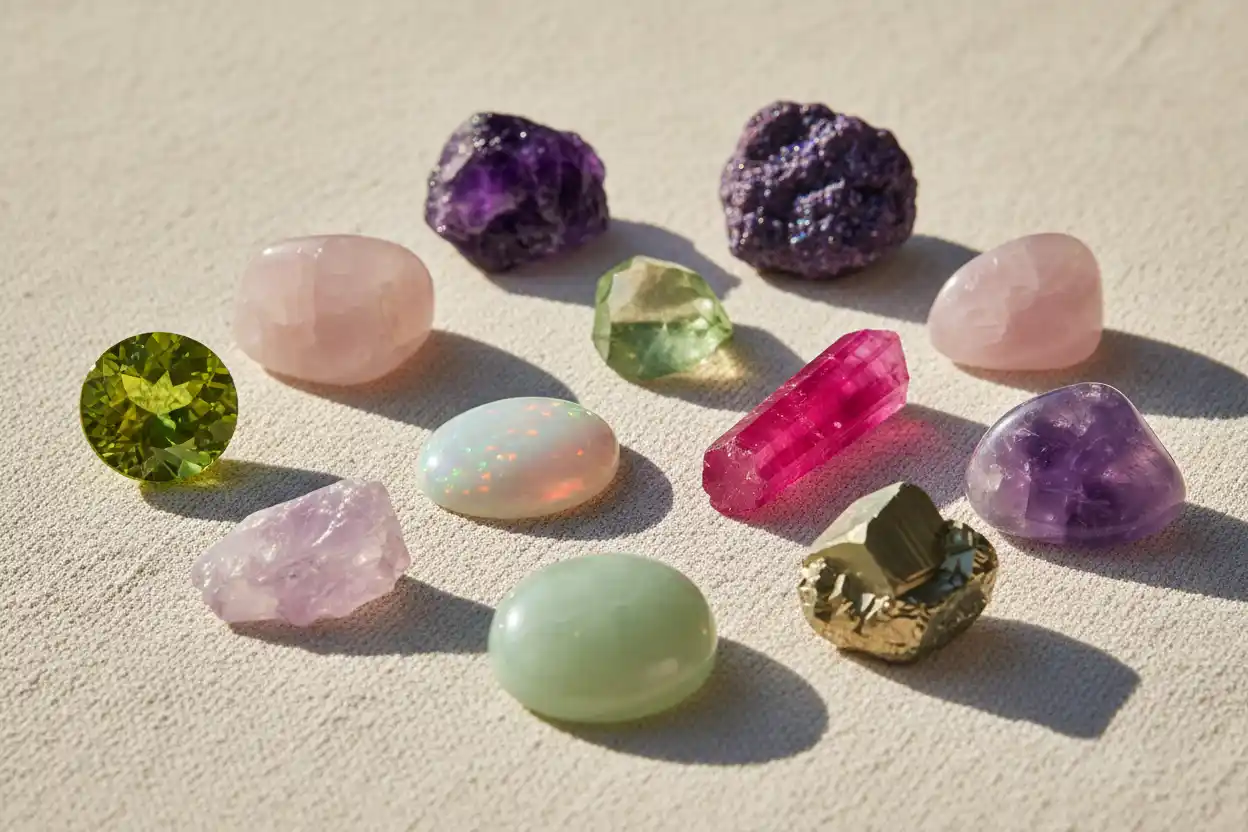
Crystals That Start With P: Names and Meanings
Crystals and gem materials that start with P include padparadscha sapphire, painite, Paraíba tourmaline, peach moonstone, pearl, peridot, petalite, petrified wood, phantom quartz, phenakite, Picasso jasper, picture jasper, pietersite, pink opal, pink tourmaline, prasiolite, prehnite, proustite, purple fluorite, purpurite, pyrite and pyrope garnet.
This varied group includes rare gemstones, quartz and feldspar varieties, organic gems, fossilized material, metallic minerals and patterned lapidary stones.
The meanings below reflect traditional symbolism rather than scientifically established medical effects.
Continue from Crystals That Start With O.
P Crystals at a Glance
| Crystal or material | Typical appearance | Common symbolic meaning |
|---|---|---|
| Padparadscha Sapphire | Pink-orange to orange-pink sapphire | Joy and balanced passion |
| Painite | Brown, red-brown or orange crystals | Persistence and individuality |
| Paraíba Tourmaline | Electric blue to green tourmaline | Expression and confidence |
| Peach Moonstone | Peach, cream or orange feldspar | New beginnings and emotional warmth |
| Pearl | White, cream, pink, gold or dark organic gem | Wisdom and composure |
| Peridot | Yellow-green to olive-green gemstone | Renewal and optimism |
| Petalite | Colorless, white, pink or gray crystals | Clarity and calm |
| Petrified Wood | Stone preserving wood grain and rings | Patience and stability |
| Phantom Quartz | Quartz with internal growth outlines | Progress and reflection |
| Phenakite | Colorless, white or pale crystals | Focus and independent thought |
| Picasso Jasper | Gray, black and cream abstract patterns | Creativity and connection |
| Picture Jasper | Brown, tan and cream landscape patterns | Grounding and perspective |
| Pietersite | Blue, gold, red or brown fibrous swirls | Change and decisive action |
| Pink Opal | Pale to vivid pink common opal | Compassion and emotional renewal |
| Pink Tourmaline | Pale pink to deep reddish-pink tourmaline | Affection and openness |
| Prasiolite | Pale green quartz | Growth and clear intention |
| Prehnite | Pale green, yellow or white translucent stone | Preparation and calm |
| Proustite | Deep red to scarlet metallic crystals | Awareness and transformation |
| Purple Fluorite | Lavender to deep violet fluorite | Focus and mental organization |
| Purpurite | Purple to reddish-violet phosphate mineral | Confidence and self-expression |
| Pyrite | Brass-yellow metallic cubes or masses | Motivation and practical confidence |
| Pyrope Garnet | Deep red to purplish-red garnet | Courage and commitment |
Padparadscha Sapphire
Padparadscha sapphire is a rare pink-orange to orange-pink variety of corundum.
Its color is often compared with lotus blossoms, sunsets or salmon tones, but laboratory grading and trade usage can vary.
It is traditionally associated with:
- Joy.
- Balanced passion.
- Creativity.
- Affection.
- Confident self-expression.
The padparadscha color guide explores how pink and orange balance within the stone.
As a sapphire, it belongs to the corundum family. Treatment disclosure is especially important because heat, diffusion and other processes can affect color and value.
Painite
Painite is a rare borate mineral usually found in brown, reddish-brown, orange-brown or deep red crystals.
It is traditionally linked with:
- Persistence.
- Individuality.
- Resilience.
- Patience.
- Recognizing uncommon opportunities.
Transparent facetable material remains unusual, while included crystals are valued by collectors.
Color, size, transparency, certification and provenance influence cost. The painite price guide explains these factors in more detail.
Paraíba Tourmaline
Paraíba tourmaline is a copper-bearing tourmaline known for vivid blue, green-blue and green colors that may appear neon or electric.
It is associated with:
- Confident expression.
- Creativity.
- Emotional openness.
- Individuality.
- Willingness to be seen clearly.
The name originated with material from Brazil and is also used in the trade for copper-bearing tourmaline from other sources when properly disclosed.
Explore its mineral family in the tourmaline guide.
Origin, copper content, color and clarity strongly affect the figures discussed in the Paraíba tourmaline price guide.
Peach Moonstone
Peach moonstone is a warm peach, cream or orange feldspar that may display a soft floating glow.
It is traditionally associated with:
- New beginnings.
- Emotional warmth.
- Intuition.
- Creativity.
- Gentle confidence.
The color may be uneven, and some material contains visible inclusions or fractures. Protect it from hard impacts and harsh professional cleaning.
Explore related varieties and optical effects in the moonstone guide.
Pearl
Pearl is an organic gem formed inside certain mollusks rather than a mineral crystal.
Pearls occur in:
- White.
- Cream.
- Pink.
- Gold.
- Silver.
- Gray.
- Green.
- Dark tones.
They are traditionally associated with:
- Wisdom.
- Composure.
- Sincerity.
- Patience.
- Mature emotional expression.
Pearls are soft and sensitive to acids, perfume, hairspray and dehydration. Put them on after cosmetics and wipe them gently after wear.
Size, luster, surface quality, shape and origin influence the values described in the pearl price guide.
Peridot
Peridot is the gem-quality variety of olivine and ranges from yellow-green to rich olive or grass green.
It is traditionally associated with:
- Renewal.
- Optimism.
- Generosity.
- Confidence.
- Releasing resentment.
Peridot can resemble emerald, green tourmaline and prasiolite.
Peridot vs. Emerald compares their color, hardness, inclusions and value.
Avoid acids, rapid temperature changes and hard impacts.
Petalite
Petalite is a lithium aluminum silicate mineral that may appear:
- Colorless.
- White.
- Gray.
- Pink.
- Pale yellow.
It is traditionally linked with:
- Clarity.
- Calm.
- Simplicity.
- Emotional balance.
- Thoughtful decision-making.
Transparent material may be faceted, while massive petalite is used for polished stones and specimens.
Petalite has cleavage and can fracture when struck, so jewelry benefits from protected settings.
Petrified Wood
Petrified wood forms when minerals gradually replace or fill ancient wood while preserving grain, rings and cellular patterns.
Its colors may include:
- Brown.
- Cream.
- Red.
- Yellow.
- Black.
- Gray.
- Green.
It is associated with:
- Patience.
- Stability.
- History.
- Gradual growth.
- Appreciation of long-term processes.
Petrified wood is fossilized material rather than living wood or one mineral species. Porosity and fractures vary between specimens.
Phantom Quartz
Phantom quartz contains internal outlines that record pauses and restarts during crystal growth.
The phantoms may appear green, white, red, gray or dark depending on the included minerals.
It is traditionally associated with:
- Progress.
- Reflection.
- Learning from previous stages.
- Patience.
- Recognizing how growth occurs over time.
Its host mineral belongs to the quartz family. Internal fractures or exposed inclusions may require more careful handling than clear solid quartz.
Phenakite
Phenakite is a beryllium silicate mineral that commonly forms colorless, white, pale yellow or pinkish crystals.
It is traditionally associated with:
- Focus.
- Independent thought.
- Clarity.
- Precision.
- Setting clear priorities.
Clear phenakite can resemble quartz or topaz. Professional identification may be needed for valuable faceted stones.
Although reasonably hard, it can be brittle and should be protected from sharp blows.
Picasso Jasper
Picasso jasper is a commercial name for gray, black, cream and brown patterned stone with abstract lines or fractured-looking designs.
It is associated with:
- Creativity.
- Relationships.
- Adaptability.
- Perspective.
- Seeing familiar situations from a new angle.
The material is frequently used in beads, cabochons and carvings. Open fractures and matrix areas can affect polishing.
Explore related patterned stones in the jasper guide.
Picture Jasper
Picture jasper is an opaque silica-rich material with brown, tan, cream and reddish patterns resembling landscapes or desert scenes.
It is traditionally linked with:
- Grounding.
- Perspective.
- Stability.
- Patience.
- Connection with place.
The images are natural mineral patterns rather than painted scenes. Color enhancement or composite material should still be disclosed when present.
Pietersite
Pietersite is a brecciated, fibrous chalcedony material known for swirling blue, gold, red and brown chatoyant patterns.
It is traditionally associated with:
- Change.
- Decisive action.
- Courage.
- Focus.
- Maintaining direction during disruption.
Its fibers and brecciated structure can create dramatic movement under light.
Protect polished pieces from sharp impacts and aggressive ultrasonic cleaning.
Pink Opal
Pink opal is common opal with pale blush, peach, rose or stronger pink body color. Most material does not show play-of-color.
It is associated with:
- Compassion.
- Emotional renewal.
- Affection.
- Patience.
- Gentle self-expression.
Pink opal can be porous and may absorb water, oils or dyes. Avoid prolonged soaking and rapid drying.
Explore its wider material family in the opal guide.
Pink Tourmaline
Pink tourmaline ranges from pale blush to vivid pink and deep reddish-pink.
It is traditionally associated with:
- Affection.
- Emotional openness.
- Compassion.
- Confidence.
- Healthy communication.
Color zoning and inclusions are common. Protect heavily included stones from impact and sudden heat.
Some deep red material may be described as rubellite depending on color and quality.
Prasiolite
Prasiolite is pale green quartz, often produced by carefully heating or irradiating suitable amethyst material.
It is traditionally linked with:
- Growth.
- Clear intention.
- Optimism.
- Balance.
- Practical renewal.
Its soft green can resemble peridot, green amethyst trade material or pale tourmaline.
Prasiolite vs. Peridot explains their key differences.
Strong heat and prolonged light may affect some material.
Prehnite
Prehnite is commonly pale green, yellow-green, white or gray and may form rounded, botryoidal or translucent masses.
It is associated with:
- Preparation.
- Calm.
- Organization.
- Foresight.
- Reducing unnecessary accumulation.
Some specimens contain dark epidote inclusions.
Prehnite can be scratched by harder stones and may have cleavage or internal fractures.
Proustite
Proustite is a silver arsenic sulfide mineral known for deep red to scarlet crystals and a darkening response to light.
It is traditionally associated with:
- Awareness.
- Transformation.
- Caution.
- Consequences.
- Recognizing hidden risks.
Proustite contains arsenic and should be treated as a protected collector specimen. Avoid dust, heat, grinding, ingestion and prolonged handling.
Store it away from bright light to preserve its color.
Purple Fluorite
Purple fluorite ranges from pale lavender to deep violet and may occur in cubic, octahedral, banded or massive forms.
It is traditionally associated with:
- Focus.
- Mental organization.
- Learning.
- Clear priorities.
- Reducing distraction.
Fluorite is soft, cleaves readily and may fade in prolonged sunlight.
Explore its wider mineral family in the fluorite guide.
Purpurite
Purpurite is a manganese phosphate mineral known for purple, violet, reddish-purple or brown surfaces.
It is traditionally associated with:
- Confidence.
- Self-expression.
- Independence.
- Courage.
- Acting without excessive self-doubt.
Some specimens have a powdery or altered surface that can rub off. Avoid water soaking and aggressive brushing.
Pyrite
Pyrite is an iron sulfide mineral with a brass-yellow metallic appearance.
It often forms:
- Cubes.
- Pyritohedrons.
- Clusters.
- Discs.
- Granular masses.
Pyrite is associated with:
- Motivation.
- Practical confidence.
- Resourcefulness.
- Discipline.
- Purposeful action.
Moisture and oxidation can damage unstable specimens and nearby materials. Keep pyrite dry and separate pieces that show cracking, powder or sulfur-like odors.
Pyrope Garnet
Pyrope is a magnesium-rich garnet commonly found in deep red, purplish-red or brownish-red colors.
It is traditionally linked with:
- Courage.
- Commitment.
- Vitality.
- Loyalty.
- Determined action.
Gem-quality pyrope is used in rings, earrings, pendants and antique jewelry.
Explore its related species and varieties in the garnet guide.
P Crystals by Color
Pink P Crystals
Padparadscha sapphire, peach moonstone, pearl, pink opal and pink tourmaline provide a wide range of peach and pink tones.
Green P Crystals
Peridot, prasiolite and prehnite are the most familiar green examples.
Purple P Crystals
Purple fluorite and purpurite are the strongest violet examples. Some painite and tourmaline may show purplish tones.
Metallic P Crystals
Proustite and pyrite are notable metallic or submetallic minerals, although their chemistry and handling requirements differ greatly.
Which P Materials Are Used in Jewelry?
Common jewelry choices include:
- Padparadscha sapphire.
- Paraíba tourmaline.
- Peach moonstone.
- Pearl.
- Peridot.
- Petalite.
- Phenakite.
- Pietersite.
- Pink opal.
- Pink tourmaline.
- Prasiolite.
- Prehnite.
- Purple fluorite.
- Pyrope garnet.
Painite and fine phenakite are more often collector or specialist gems. Proustite and delicate mineral specimens are not suitable for ordinary wear.
Compare rarity, durability and cutting in Gemstones That Start With P.
Care Notes for P Materials
- Keep pearls away from perfume, acids and dry heat.
- Protect petalite, moonstone and phenakite from hard impacts.
- Avoid prolonged soaking of petrified wood with open pores or fractures.
- Keep pink opal away from oils and rapid drying.
- Protect prasiolite and purple fluorite from prolonged strong light.
- Handle proustite as a hazardous arsenic-bearing specimen.
- Keep pyrite dry and monitor it for oxidation.
- Separate soft fluorite and prehnite from harder sapphire, quartz and garnet jewelry.
Frequently Asked Questions
What is the most popular crystal that starts with P?
Pearl, peridot, pyrite, prehnite and pink tourmaline are among the most familiar.
Which green crystals start with P?
Peridot, prasiolite and prehnite are notable green examples.
Is pearl a crystal?
No. Pearl is an organic gem produced inside a mollusk.
Is petrified wood still wood?
Its original structure comes from wood, but minerals have replaced or filled much of the organic material.
Is prasiolite natural?
Natural green quartz exists, but much commercial prasiolite is produced from amethyst through treatment.
Is pyrite real gold?
No. Pyrite is iron sulfide and differs from gold in hardness, streak, density and crystal form.
Is proustite safe to handle?
It should be handled cautiously because it contains arsenic. Avoid dust, heat, grinding and ingestion, and wash your hands after handling.
Why is Paraíba tourmaline expensive?
Its vivid copper-related color, rarity, origin, size and clarity can make fine examples highly valuable.
Continue Exploring Crystals
Continue alphabetically with Crystals That Start With Q, or browse the complete Crystals 101 collection.