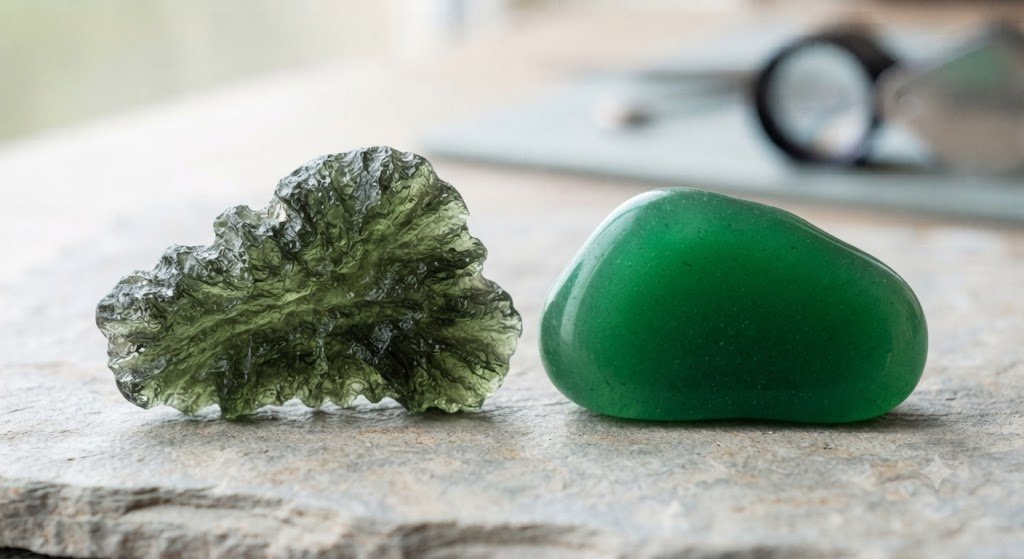
Is My Moldavite Real? How to Tell Genuine Moldavite from Fakes
A convincing green glass imitation can resemble Moldavite closely enough to pass casual inspection. Artificial etching can reproduce a rugged exterior, while bubbles occur in both natural impact glass and manufactured glass. Therefore, no single surface pit, bubble, color, seller card, or online photograph proves that the piece you own is genuine.
The most useful approach is cumulative. Preserve the piece as received, review the seller’s claims, examine it under neutral lighting and magnification, compare its measurements with its weight, and decide whether its value justifies professional testing.
This page is a post-purchase diagnostic for an individual piece already in your possession. The educational profile of authentic material belongs to real Moldavite, while the formal side-by-side distinctions belong to real versus fake Moldavite.
Start by Preserving the Evidence
Do not clean, oil, polish, scratch, heat, burn, acid-etch, or intentionally break the specimen before documenting it. An alteration can remove useful surface evidence, contaminate internal features, weaken the glass, or compromise a return claim.
Before handling it extensively, photograph:
- The front, back, sides, and edges
- Any polished or broken areas
- The item beside a millimeter ruler
- The weight displayed on a reliable scale
- Packaging, labels, seller cards, and receipts
- The original listing and seller photographs
- Any claimed locality, mine, or collection history
Save screenshots of the transaction. Online listings can disappear or change after a dispute begins.
Record Exactly What the Seller Claimed
Write down the wording rather than summarizing it from memory. Relevant claims include:
- “Natural Moldavite”
- “Czech Moldavite”
- A specific locality such as Besednice, Chlum, Slavče, or Moravia
- “Museum grade”
- “Untreated”
- “Raw” or “unpolished”
- A specific weight and dimension
- A laboratory report
- A personal mining or collection story
Locality names are not proof. They can be copied into listings and printed on generic cards. Nevertheless, an internally consistent provenance record adds value when it identifies previous owners, dates, invoices, legal source, and the connection between the record and the exact specimen.
The Moldavite buying guide explains what a seller should disclose before purchase. At this stage, the purpose is to compare those expectations with the evidence you actually received.
Confirm That the Object Matches the Listing
Measure the longest length, width, and thickness. Then record the weight to at least 0.01 gram when the piece is small enough for that precision.
A difference of a few tenths of a millimeter may reflect measurement technique. A large discrepancy in weight, dimensions, shape, damage, or surface pattern suggests that the delivered item may not be the photographed specimen.
Check whether:
- Chips shown in the listing are present in the same locations.
- The silhouette matches from several angles.
- Surface pits form the same pattern.
- Polished windows or broken edges match.
- The listed weight agrees with your scale.
- The seller substituted a similar-looking piece from a bulk lot.
Authenticity and fulfillment are separate questions. A natural Moldavite that does not match the advertised item can still justify a complaint.
Examine the Color in Neutral Light
View the piece against white and neutral gray backgrounds in diffused daylight or a high-quality neutral LED. Avoid strongly warm lamps, colored display boxes, and phone filters.
Natural Moldavite occurs in a range of green tones, including yellowish green, olive, bottle green, brownish green, and darker green. A pale or dark color does not establish authenticity by itself.
Potential concerns include an extremely uniform bright green, a fluorescent-looking neon hue, or color that appears painted onto the surface. However, genuine pieces can also look vivid when thin or strongly backlit.
The general Moldavite meaning guide covers the material’s broader identity and traditional interpretations. Color observed during this diagnostic should be treated as one clue rather than a symbolic quality.
Inspect the Surface Without Assuming Texture Proves Anything
Natural rough Moldavite can show grooves, pits, ridges, channels, fluting, rounded projections, and irregular etched relief. Transport and sediment exposure can soften sharp textures, while freshly broken or polished areas may look smooth.
Unfortunately, manufactured glass can be mechanically shaped or chemically etched to imitate those features. Repetitive pits, uniformly sharp spikes, molded seams, perfectly repeated textures, and an unnaturally symmetrical outline may raise concern, but realistic artificial surfaces exist.
Ask three questions:
- Does the texture vary naturally across the specimen?
- Do ridges, pits, broken edges, and internal flow features relate coherently?
- Does the object look individually weathered, or mechanically repeated?
Surface appearance can support a conclusion. It should not be the conclusion.
Use a 10× Loupe on a Clean Viewing Area
A jeweler’s loupe or gemological microscope offers more useful evidence than unaided inspection. Choose a polished facet, naturally smooth broken edge, or thin translucent area when possible.
Look for several categories of internal feature.
Flow Structure
Natural Moldavite may display swirling, layered, streaked, or schlieren-like variations created while the glass was molten. These features can appear as subtle ribbons rather than obvious stripes.
Manufactured glass can also contain flow lines, so flow structure is supportive rather than decisive.
Bubbles
Natural Moldavite commonly contains gas bubbles. Some appear elongated, stretched, flattened, or irregular because the glass moved while cooling.
A single round bubble does not prove the material is fake, and abundant bubbles do not prove it is genuine. Ordinary manufactured glass can contain bubbles, while some natural pieces show few obvious bubbles in the available viewing direction.
Lechatelierite Features
Fine threadlike, wirelike, or contorted inclusions of lechatelierite provide stronger evidence. Lechatelierite is high-temperature silica glass that can appear optically distinct from the surrounding Moldavite.
These features may be difficult to see in dark, rough, thick, dirty, or strongly textured pieces. Their absence during a brief loupe examination does not automatically condemn the specimen.
A trained gemologist can use controlled illumination and immersion methods to improve visibility without relying on a casual surface view.
Do Not Confuse Dirt With Inclusions
Soil, polishing compound, wax, oil, and skin residue can fill surface pits and resemble internal material. Before deciding that a dark streak or white line is diagnostic, change the lighting angle and focus.
A true internal inclusion should remain beneath the surface as focus moves through the specimen. Surface debris usually sharpens only at the exterior plane.
Do not apply oil to “make the piece clearer.” Oil can enter pits and fractures, alter appearance, attract dirt, interfere with return conditions, and complicate later examination.
Evaluate Shape, Size and Weight Together
Extremely large, unusually perfect, or highly symmetrical rough pieces deserve closer scrutiny. Genuine Moldavite exists in many sizes and forms, yet very large intact pieces are uncommon and command substantial attention.
A large specimen offered cheaply without provenance presents a stronger concern than a small irregular fragment from a reputable seller. Still, size alone cannot prove imitation.
Density provides more objective evidence. Natural Moldavite generally has lower density than many common imitation glasses. However, home testing becomes unreliable when:
- The scale lacks sufficient precision.
- Air bubbles cling during immersion.
- Thread or wire adds weight.
- The piece is mounted.
- Surface cavities trap water.
- The specimen is too small.
- Temperature and water density are ignored.
Record weight and dimensions for a professional rather than treating an improvised kitchen test as a verdict.
Examine Faceted or Polished Moldavite Differently
Faceted Moldavite lacks most of the rough exterior used in online visual discussions. Fortunately, a polished surface gives clearer access to internal bubbles, flow structure, and lechatelierite features.
Check whether the stone shows:
- Internal features at more than one depth
- Natural variation rather than a perfectly empty interior
- Scratches and facet wear consistent with Moldavite’s moderate hardness
- A coherent relationship between bodycolor and thickness
- No coating concentrated at facet edges
- No assembled layers or backing
A completely inclusion-free appearance does not prove imitation, but an expensive faceted stone deserves laboratory confirmation when the interior provides no supportive evidence.
The glass versus crystal guide explains why appearance alone cannot reliably separate natural glass from manufactured glass.
Review Any Certificate Critically
A seller card, laminated authenticity note, handwritten locality label, or branded guarantee is not automatically an independent gemological report.
Check whether the document includes:
- The issuing laboratory’s full name
- A unique report number
- The item’s weight and dimensions
- A photograph or identifying diagram
- The tested material’s conclusion
- Treatment or alteration comments
- A verifiable database entry
- The laboratory’s current contact details
Reports from established gemological laboratories carry more weight than certificates created by the retailer selling the item. The guide to gemstone certification laboratories explains how identification reports differ from appraisals and seller paperwork.
A genuine report can still be separated from its original stone. Confirm that measurements, weight, shape, and photographed features match your piece.
Check the Price Without Using It as Proof
Moldavite’s value depends on weight, color, translucency, texture, locality confidence, shape, damage, cutting, documentation, and current demand. A low price can be a warning, although bargains, estate sales, old inventory, and small fragments exist.
An expensive price is even less useful as evidence because manufactured glass can be marked up aggressively. The dedicated Moldavite price guide owns market valuation; here, price functions only as part of the risk profile.
The strongest concern occurs when several factors align: exceptional claimed grade, unusually large size, perfect shape, weak provenance, generic certificate, and a price far below comparable documented material.
Separate Authenticity From Treatment and Alteration
A natural piece can still be polished, tumbled, repaired, coated, oiled, artificially etched, or assembled into jewelry. Such alteration does not necessarily turn the underlying material into imitation, but it changes disclosure, appearance, collectability, and value.
The dedicated guide to treated Moldavite covers those alterations separately. During a post-purchase check, record evidence of:
- Gloss concentrated in pits
- Resin filling a fracture
- Unnaturally uniform surface coating
- Artificial frosting
- Drill-hole repairs
- Joined fragments
- Glue beneath a bail or cap
- Fresh polishing presented as natural weathering
The broader guide to gemstone treatments explains why alteration and identity should be reported as separate findings.
“Synthetic Moldavite” Is Usually the Wrong Term
A manufactured green glass imitation is not a laboratory-grown Moldavite counterpart with the same impact origin. It is an imitation or simulant.
The distinction in lab-grown versus natural gemstones is important. A true laboratory-grown gemstone has substantially the same crystal structure and composition as its natural equivalent. Moldavite is natural impact glass with a specific geologic origin, so ordinary furnace glass should not be marketed as synthetic Moldavite.
At-Home Tests to Avoid
Do not use destructive or hazardous tests. The following methods can damage the specimen, injure the owner, or produce ambiguous results:
- Scratching glass or metal
- Heating with a flame or hot needle
- Breaking an edge to inspect the fracture
- Applying acid or household chemicals
- Using hydrofluoric-acid etching
- Dropping the piece
- Leaving it in strong sunlight to test color
- Drilling or grinding powder
- Testing taste or smell
- Relying on an uncontrolled UV lamp as the only test
Artificially etched imitations may involve dangerous industrial chemicals. Never attempt to reproduce or reverse that process at home.
The general guide to spotting fake crystals explains why a non-destructive evidence hierarchy is more reliable than viral home-test shortcuts.
Contact the Seller With Specific Questions
Instead of asking only, “Is this real?”, request evidence that can be checked.
Useful questions include:
- Which locality was represented, and what supports that attribution?
- Was the piece purchased from a miner, dealer, estate, or collection?
- Has it been polished, oiled, coated, repaired, or artificially etched?
- Is the certificate independent from the seller?
- Will the seller accept an established laboratory’s identification?
- Does the return policy remain valid during non-destructive testing?
- Can the seller explain any difference between the listing and delivered item?
Keep communication in writing. A seller who offers only spiritual claims, urgency, and unverifiable stories has not supplied gemological evidence.
The broader safeguards in buying gemstones online remain useful after purchase when return rights or payment disputes are still available.
When Professional Testing Is Worthwhile
Seek a qualified gemologist or laboratory when:
- The piece was expensive.
- You intend to insure or resell it.
- The seller’s claim conflicts with its features.
- It is unusually large or supposedly locality-specific.
- A return deadline is approaching.
- The item is mounted and difficult to inspect.
- Treatment or assembly is suspected.
- A family or estate description needs confirmation.
- Your observations remain mixed.
A laboratory may use microscopy, refractive index, hydrostatic density, spectroscopy, and chemical analysis. Natural Moldavite generally falls within characteristic refractive-index and density ranges, while many imitation glasses differ measurably.
No single measurement should be copied from the internet and applied carelessly at home. Laboratories interpret multiple observations and account for measurement uncertainty.
Possible Diagnostic Outcomes
A responsible examination may produce more than a binary “real” or “fake” answer.
| Outcome | What it means | Appropriate next step |
|---|---|---|
| Natural Moldavite supported | Internal and physical properties are consistent | Preserve documentation and obtain a report if value justifies it |
| Manufactured glass imitation | Properties do not match natural Moldavite | Use the seller’s return or dispute process |
| Natural but altered | Underlying material may be Moldavite, with polishing, coating, repair, or artificial etching | Request accurate disclosure and reassess value |
| Composite or assembled object | Natural and manufactured components may be combined | Obtain a written laboratory description |
| Inconclusive | Available observations do not establish identity | Seek better microscopy or laboratory testing |
The educational tektite guide provides the wider impact-glass context. Moldavite should not be confused with Libyan Desert Glass or with a meteorite, even though all three are marketed within impact-related collecting categories.
What to Do After the Result
When the piece appears consistent with natural Moldavite, store the specimen with its invoice, report, photographs, weight, dimensions, and seller correspondence. Avoid polishing or oiling collectible rough.
When evidence points to imitation, preserve the item and packaging while contacting the seller or payment provider. Do not return it without tracked shipping and photographic documentation.
When the answer remains uncertain, avoid replacing it immediately with another unverified specimen. A specialist tektite dealer or the guide to buying real tektite can help establish better provenance standards for a future purchase.
Traditional cleansing practices belong to the separate guide on cleansing and charging Moldavite. They cannot authenticate the material and should not replace physical testing.
Frequently Asked Questions
1. Do bubbles prove that my Moldavite is genuine?
No. Natural Moldavite commonly contains bubbles, but manufactured glass can contain them as well. Bubble shape, abundance, flow structure, lechatelierite features, and physical measurements must be considered together.
2. Does a rough etched surface prove authenticity?
No. Artificial etching can imitate natural-looking pits, grooves, and ridges. Surface texture supports a diagnosis only when it agrees with internal and physical evidence.
3. Is bright green Moldavite always fake?
No. Thin genuine pieces can appear bright green, especially when backlit. An extremely uniform neon color may justify closer examination, but color alone cannot determine authenticity.
4. Can genuine Moldavite be smooth?
Yes. Natural abrasion, broken surfaces, polishing, tumbling, faceting, and jewelry manufacture can all produce smoother areas. The seller should disclose intentional alteration.
5. Are perfectly round bubbles a sign of fake glass?
Not necessarily. Natural Moldavite can contain rounded bubbles, while stretched or irregular bubbles may provide more supportive context. No bubble shape works as a stand-alone test.
6. Can I identify Moldavite with a phone flashlight?
A flashlight can reveal translucency, bubbles, and flow features, but its color and glare can distort observations. Use neutral lighting and magnification, then seek testing when value matters.
7. Does genuine Moldavite fluoresce under ultraviolet light?
Natural Moldavite is generally inert, while some imitations fluoresce. However, some imitation glass can also remain inert, so ultraviolet response cannot provide a final answer.
8. Is a seller’s authenticity card enough?
No. A retailer-produced card expresses the seller’s claim. An independent laboratory report tied to the exact piece through weight, dimensions, and photographs provides stronger evidence.
9. Can I perform a density test at home?
It is possible in principle, but small rough pieces, trapped air, surface cavities, inaccurate scales, mountings, and poor technique can create misleading results. Professional hydrostatic measurement is preferable.
10. Does a Czech locality name guarantee real Moldavite?
No. Locality labels can be copied or applied incorrectly. Strong provenance connects the exact specimen to documented ownership, acquisition, and source history.
11. Can real Moldavite be artificially etched?
Yes. A natural piece can be altered to exaggerate or recreate surface texture. It remains natural material but should be disclosed as altered because the process affects appearance and value.
12. When should I pay for a laboratory report?
Testing is most worthwhile for expensive, unusually large, locality-attributed, inherited, insured, or disputed pieces. A low-value fragment may cost less to replace than to submit, although a gemologist can still provide useful screening.
A genuine result should emerge from converging evidence rather than one exciting feature. Preserve the specimen, compare it with the transaction record, inspect internal characteristics, and use professional testing when the financial or collecting stakes justify certainty.
Do not use flame, hot needles, acids, intentional breakage, drilling, grinding, or other destructive home tests on suspected Moldavite. Such methods can damage the specimen, invalidate returns, release hazardous substances, or cause personal injury without producing a reliable identification.