Buy Alexandrite: How to Choose, Price, Quality & Documentation
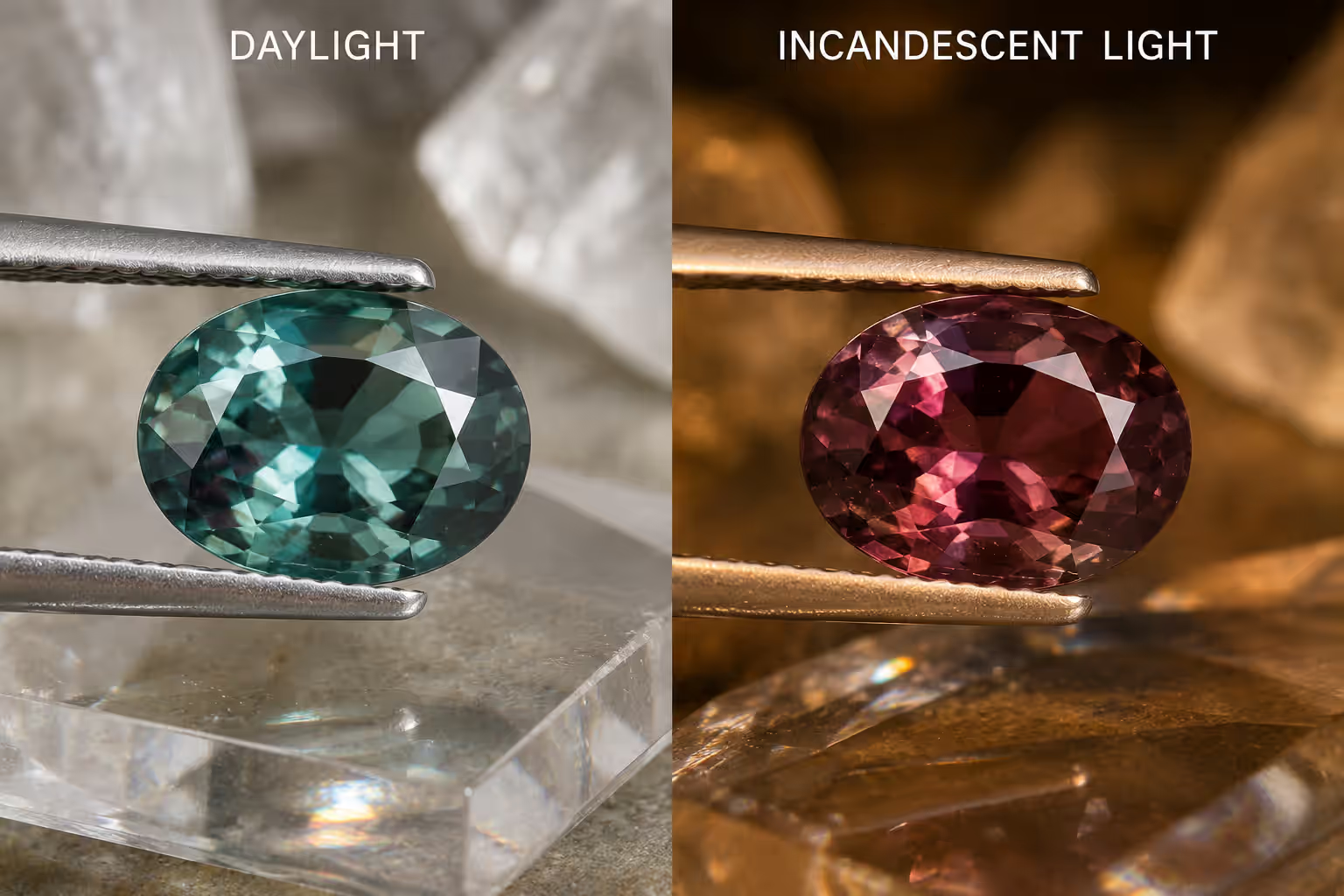
If you want to buy alexandrite, concentrate first on whether the stone is natural, how strong and attractive its color change is, whether the daylight and warm-light colors are desirable, how well it is cut, how much visible inclusion affects appearance, and whether an independent laboratory report supports the seller’s claims. Natural alexandrite with a strong green or bluish-green appearance in daylight and a distinct red, purplish-red, or reddish-purple appearance under warmer light is substantially more desirable than a stone showing only a weak shift between similar colors.
Alexandrite is one of the gemstone markets where documentation becomes increasingly important as price rises. Synthetic alexandrite exists, and other color-changing gems can be sold or misunderstood as alexandrite. A convincing visual color change alone is therefore not enough to establish natural origin.
Price also changes dramatically with quality and size. Fine natural alexandrite is scarce, particularly in larger clean stones with strong color change, so two gems of the same carat weight can sit in entirely different value ranges. Buying well requires looking beyond carat weight and asking exactly what makes the individual stone desirable.
Buy Alexandrite At a Glance
| Buying factor | What to prioritize |
|---|---|
| Identity | Natural chrysoberyl alexandrite confirmed when value warrants it |
| Color change | Strong, clearly visible change between appropriate lighting conditions |
| Daylight color | Attractive green to bluish-green is generally preferred |
| Warm-light color | Red to purplish-red tones are generally more desirable than muddy brown |
| Change strength | Distinct change across much of the visible stone |
| Clarity | Eye-clean appearance is desirable, but fine color can outweigh minor inclusions |
| Cut | Good brightness, balanced proportions, minimal dark extinction |
| Size | Larger fine stones become progressively scarcer |
| Documentation | Independent laboratory report for important purchases |
| Seller terms | Clear disclosures, photographs, lighting details, and return policy |
Understand What Alexandrite Actually Is Before Buying
Alexandrite is a color-change variety of chrysoberyl, a mineral with the chemical formula BeAl₂O₄. Its distinctive change in appearance occurs because chromium influences how the stone absorbs different wavelengths of light.
Under daylight or daylight-equivalent illumination, fine alexandrite can appear green or bluish green. Under warmer incandescent-style illumination, the same stone may appear red, purplish red, or reddish purple. Real stones vary considerably, and many do not display the dramatic textbook combination buyers imagine.
Some natural alexandrites appear yellowish green, olive, brownish, grayish, or muted in one lighting condition. Others change only partly or shift into brown-red rather than a strong red. These stones may still be natural alexandrite, but their market appeal usually differs from material with a vivid, distinct change.
Understanding this variation matters because sellers can use the alexandrite name correctly while offering very different quality levels.
The dramatic reputation of alexandrite should never be assumed to describe every stone carrying the name.
Color Change Should Be the First Quality Check
The defining buying feature is color change, not simply attractive color under one lamp.
When comparing stones, observe the gem under at least two meaningfully different light sources. Daylight-equivalent lighting should reveal its cooler appearance, while a warmer light source should reveal the warmer side of the change.
Do not judge the stone only from one photograph.
Online images can exaggerate color through camera settings, white balance, editing, lighting intensity, and display differences. A serious seller should be able to show the same stone under clearly different lighting conditions without making the photographs look artificially saturated.
The percentage and strength of change also matter. A stone in which most of the visible face changes clearly is generally more compelling than one where only small areas shift noticeably.
A beautiful stone does not need to match a rigid green-to-red formula perfectly, but weak change should not be priced as if it were exceptional material.
The detailed factors behind alexandrite quality grading become particularly important when several stones look similar at first glance but differ substantially in saturation, change strength, tone, and cutting.
Judge Both Colors, Not Just the Change
A strong change between two unattractive colors is not automatically high quality.
The daylight appearance matters on its own. Green and bluish-green colors are commonly sought, especially when they have enough saturation to look lively rather than gray or brown. Stones that lean heavily toward dull olive or brownish tones may be less desirable even if the change is visible.
The warm-light appearance deserves the same scrutiny.
Red, purplish red, and attractive reddish-purple tones can command strong interest. Brownish-red or muddy colors may still be natural, but the market usually distinguishes them from cleaner, more vivid warmer colors.
This is why shopping solely by a seller’s claimed percentage of color change can be misleading.
A buyer should evaluate four things together: the first color, the second color, how distinct the transition is, and whether the stone remains attractive under both lighting conditions.
That combination is more useful than any single marketing label.
Natural Alexandrite Versus Synthetic and Imitation Stones
One of the most important buying distinctions is whether the gemstone is natural alexandrite, laboratory-grown alexandrite, or another material showing a similar visual effect.
Synthetic alexandrite is not fake in the sense of being glass. Proper synthetic alexandrite has essentially the same crystal identity as natural chrysoberyl alexandrite but is produced in a laboratory rather than mined from the earth.
Its value structure is very different from rare natural material.
Imitations create another category. Certain synthetic or natural color-change sapphires, glass products, and other stones can resemble alexandrite to an inexperienced buyer while having different physical and optical properties.
Visual inspection alone may not reliably separate every possibility.
The distinctions covered in real vs fake alexandrite become especially important when a listing combines a strong color change, large size, high apparent clarity, and an unexpectedly low price.
That combination does not automatically prove a problem, but it should increase scrutiny.
A seller should state clearly whether the stone is natural, synthetic, treated, or an imitation.
Do Not Assume a Large Clean Stone Is a Bargain
Fine natural alexandrite becomes increasingly difficult to find as size increases.
This is one reason large, highly transparent, strongly color-changing stones deserve careful verification when offered cheaply.
Carat weight alone does not determine value. A smaller stone with superior color change can be more desirable than a larger stone with weak change, muddy colors, poor cutting, or questionable identification.
The relationship between size and value is also not perfectly linear. Better stones can rise sharply in price as carat weight increases because larger examples combining attractive color, change, clarity, and cut are scarcer.
The alexandrite price per carat therefore needs to be interpreted by quality band and stone size rather than treated as one universal number.
Be particularly cautious with marketplace listings that compare a low-quality stone directly with exceptional auction or dealer material simply because the weights are similar.
Weight is only one part of the comparison.
Clarity Matters, but Color Usually Matters More
Alexandrite can contain inclusions, and natural inclusions are not automatically a defect serious enough to reject a stone.
The real question is how much they affect beauty, transparency, durability, and price.
A fine color-changing stone with small internal features may be more desirable than an exceptionally clean stone with weak or unattractive color change. Eye-visible fractures, cloudy areas, dark inclusions, or inclusions that interrupt the face-up appearance deserve more attention.
Surface-reaching fractures can also influence durability.
The best balance depends on budget. Buyers seeking investment-level or collector-grade material may demand much higher overall quality, while someone purchasing jewelry may reasonably accept visible inclusions in exchange for better color or a larger size.
Do not pay a premium merely because a seller uses terms such as “flawless” without independent support.
Colored gemstones are not evaluated exactly like diamonds, and attractive natural alexandrite should be judged as a complete stone.
Cut Has a Major Effect on What You Actually See
A good alexandrite cut should allow the stone to display brightness, color, and color change effectively.
Poor cutting can create excessive darkness, a washed-out center, obvious windowing, uneven shape, or unnecessary weight hidden in a deep pavilion. A stone may weigh more because it was cut to retain carats rather than maximize beauty.
This is especially important with alexandrite because rough can be valuable. Cutters may sometimes preserve weight even when ideal proportions would produce a more attractive finished gem.
Look at the stone face-up rather than relying only on dimensions and carat weight.
Large dark areas that remain black across different viewing angles can indicate extinction. A pale transparent center through which the background is easily visible can indicate windowing.
Some degree of compromise may be reasonable in rare material, particularly when color change is excellent.
The question is whether the price reflects that compromise.
Alexandrite Price Can Vary Enormously
There is no single meaningful retail price for alexandrite.
Natural origin, strength of color change, color quality, carat weight, clarity, cut, provenance, market demand, and documentation all influence what a particular stone may command.
Fine natural alexandrite can belong among the more valuable colored gemstones, while commercial-quality material with weak change can sell for far less. Synthetic alexandrite belongs to a different market again.
The practical way to use an alexandrite price reference is to compare stones with similar characteristics rather than simply asking what one carat of alexandrite costs.
If one stone is considerably more expensive than another, identify the reason.
Does it have a stronger change? Better colors? Greater size? Better transparency? More attractive cutting? Verified natural origin? Credible geographic provenance?
A large price difference should normally correspond to a meaningful quality, rarity, or documentation difference.
If the seller cannot explain it, comparison shopping becomes especially important.
Origin Can Matter, but It Must Be Documented
Alexandrite was historically discovered in Russia’s Ural region, and Russian material has acquired significant reputation in the gem trade. Alexandrite has also been found in other sources, including Brazil, Sri Lanka, and parts of East Africa.
Origin alone does not make a stone beautiful.
A weak-color stone from a famous locality should not automatically be considered superior to an attractive stone from another source. Color change, appearance, size, clarity, cut, and documentation remain central.
Origin claims can nevertheless affect collector interest and price, particularly for important stones.
That is where laboratory documentation matters.
Do not pay a major origin premium based solely on a seller’s verbal statement, handwritten card, or old family story. If geographic origin materially affects the asking price, an appropriate independent gemological report should support the claim when such determination is possible.
Provenance and geographic origin are also different concepts. Provenance describes documented ownership or history, while geographic origin refers to where the gem formed and was mined.
Both can influence value, but they require different evidence.
Documentation Matters More as the Purchase Becomes More Expensive
For an inexpensive synthetic alexandrite bought with full disclosure, extensive laboratory documentation may be unnecessary.
For a costly natural stone, the standard should be much higher.
A reputable independent laboratory report can help establish that the gem is alexandrite, whether it is natural or synthetic, and what treatments or relevant observations were detected within the scope of the examination. Some reports may also address geographic origin when enough evidence is available and the laboratory offers that service.
The principles behind gemstone certification are important here because a laboratory report and a seller appraisal serve different purposes.
A gemological report identifies or characterizes the stone. An appraisal generally estimates monetary value for a stated purpose. One does not automatically substitute for the other.
Check the report number, laboratory name, stone weight, dimensions, description, and identifying details against the actual gem.
A photocopy of a report belonging to another stone has no value to the buyer.
Check Whether the Laboratory Report Matches the Stone
A report should not simply exist. It should correspond to the gemstone you are purchasing.
Compare the recorded carat weight and measurements with the seller’s listing. If the stone is already mounted, some measurements may be limited, but the available information should still make sense.
Look for inconsistencies.
A report describing a 1.12-carat oval should not accompany a listing for a 1.38-carat cushion unless the seller clearly explains why. Photographs, report dates, inscriptions if present, and documented dimensions can all help establish continuity.
For expensive transactions, verify the report through the issuing laboratory’s own verification system when one is available.
The report should also be legible.
Blurry photographs of documents, missing pages, hidden report numbers, or repeated excuses for why verification is impossible should increase caution.
Documentation is valuable only when it can be connected reliably to the actual stone.
Seller Quality Is Part of Gemstone Quality
Even an attractive alexandrite becomes a risky purchase when the seller does not provide adequate information or buyer protection.
A strong listing should describe whether the stone is natural or synthetic, give its carat weight and dimensions, explain known treatment status, show representative photographs or video under more than one lighting condition, and state return terms clearly.
For expensive stones, independent documentation should be available before the return period expires.
Be cautious when the seller refuses basic questions, pressures you to buy immediately, relies entirely on rarity language, or treats a laboratory report as unnecessary for a high-value natural stone.
A generous return policy is especially valuable when buying online because alexandrite can look materially different in person from digital photographs.
The ability to examine the stone under your own lighting is part of responsible buying.
Compare the Stone Under Different Light Sources
Alexandrite cannot be evaluated properly under one source of light.
When examining a stone in person, compare its appearance in natural daylight or good daylight-equivalent lighting with its appearance under a warmer incandescent-style source.
Give your eyes time to adjust.
Also observe the gemstone in ordinary mixed lighting because that is how jewelry is frequently experienced in daily life. Some stones show dramatic change only under carefully controlled conditions but look less distinctive in normal environments.
That does not make them undesirable, but it affects how much practical enjoyment the color change provides.
Do not use colored bulbs to force an impressive result. The purpose is to understand the gem, not manufacture a photograph.
A seller confident in the stone should be comfortable showing realistic lighting rather than only the combination that creates the strongest promotional image.
Treatments Should Be Disclosed
Alexandrite is not generally associated with the extensive routine treatment landscape seen in some other colored gemstones, but buyers should never assume treatment status without disclosure or appropriate examination.
Ask what the seller knows.
The more expensive the stone, the less reasonable it becomes to rely on vague statements such as “probably untreated” or “looks natural.”
A laboratory report can help clarify whether relevant treatments were detected within the laboratory’s testing limits.
Synthetic origin also needs clear disclosure. Laboratory-grown alexandrite can be attractive and durable, and there is nothing inherently wrong with buying it when represented honestly.
The problem begins when synthetic material is sold or priced as rare natural alexandrite.
Disclosure protects both value and expectations.
Think Carefully Before Treating Alexandrite as an Investment
Alexandrite’s rarity and high prices can make it tempting to view any natural stone as an investment.
That assumption is too simple.
Resale depends on quality, documentation, purchase price, dealer margins, market demand, liquidity, provenance, and whether another buyer is willing to pay for the same characteristics. Retail asking prices are not guaranteed resale values.
The same principle applies across the question of whether gemstones hold value.
Exceptional alexandrite can be highly collectible, but that does not mean every commercial stone appreciates or can be resold quickly.
Buy primarily because the gemstone itself suits your collecting or jewelry goals.
If financial preservation is important, documentation, conservative purchasing, independent evaluation, and realistic expectations become essential.
A rare gemstone is not the same thing as a liquid financial asset.
Common Red Flags When Buying Alexandrite
A surprisingly low price should not be judged in isolation, but it deserves explanation when the listing claims a large, clean, natural stone with a dramatic green-to-red change.
Descriptions such as “Russian quality” are not the same as documented Russian origin.
Likewise, words such as AAAA, investment grade, museum grade, or heirloom quality may have no standardized meaning when used by a seller. Focus on measurable or observable characteristics instead.
Photographs that show completely different saturation, cutting, or inclusion patterns under the two lighting conditions may even represent different stones.
Generic stock photography is particularly unhelpful for expensive individual gems.
The identification issues surrounding real vs fake alexandrite matter because color change itself is not sufficient proof.
Large natural alexandrite should not become inexpensive simply because a seller calls the transaction a special opportunity.
Extraordinary claims require correspondingly strong evidence.
How Much Should You Spend?
Set the budget after deciding which qualities matter most.
If color change is your priority, a smaller stone with a stronger and more attractive change may provide more satisfaction than a larger weak-color example. If you want a substantial jewelry presence, accepting less dramatic color change may allow greater size within the same budget.
Collectors may place more emphasis on natural origin, locality, exceptional change, rarity, and laboratory documentation.
Jewelry buyers may care more about appearance, cut, durability, mounting style, and how the stone looks in ordinary lighting.
Do not stretch a budget simply because alexandrite is rare.
Scarcity does not make every example worth any asking price.
Compare several stones before deciding. The exercise quickly reveals how strongly appearance and documentation differ even within the same nominal weight.
Buying Loose Alexandrite Versus Finished Jewelry
A loose stone is often easier to evaluate because the entire gem can be examined, weighed accurately, measured, and observed for inclusions and cutting characteristics.
It can also be easier to match the gem to laboratory documentation.
Finished jewelry offers convenience and may suit buyers who care more about the complete piece than the stone as a collectible gem. The mounting, however, can hide portions of the pavilion and girdle, and metal color can influence how the stone appears.
For expensive alexandrite jewelry, request information about both the gemstone and the setting.
The value of gold or platinum does not compensate for weak gem documentation.
If the center stone represents most of the purchase price, evaluate it with the same care you would use for a loose alexandrite.
Alexandrite Is Durable but Not Indestructible
Chrysoberyl has a Mohs hardness of about 8.5, giving alexandrite good scratch resistance for many forms of jewelry.
That does not mean it cannot chip or fracture.
Protect the stone from hard impacts, especially around exposed corners or thin areas. Settings for rings should provide appropriate support if the piece will be worn frequently.
Routine cleaning can often be straightforward for untreated, structurally sound stones, but jewelry containing fractures, unusual treatments, delicate settings, or other gems may require different care.
When in doubt, use gentle cleaning and ask a qualified jeweler who can inspect the actual piece.
Durability should be evaluated as a combination of hardness, toughness, cut, inclusions, and setting design rather than through the Mohs number alone.
Conclusion
To buy alexandrite well, prioritize verified natural identity, attractive color in both lighting conditions, a strong and distinct color change, good cutting, appropriate clarity, and documentation that matches the actual stone. Compare price only with alexandrites of similar quality and size, and be especially cautious when a large, clean, strongly color-changing natural stone is offered far below comparable material. The best purchase is not necessarily the largest alexandrite you can afford, but the stone whose appearance, documentation, condition, and price make sense together.
FAQs
What should I look for when buying alexandrite?
Focus on natural versus synthetic origin, strength of color change, the attractiveness of both colors, clarity, cutting, carat weight, documentation, treatment disclosure, seller reputation, and return terms.
What color should good alexandrite be?
Fine alexandrite is often valued for green to bluish-green colors in daylight and red to purplish-red colors under warmer illumination, although natural stones occur across a wider range.
Is stronger color change more valuable?
A strong and distinct color change is generally an important value factor, but the actual colors, saturation, size, clarity, cut, and documentation also matter.
Is natural alexandrite expensive?
Fine natural alexandrite can be expensive because desirable material is scarce, particularly in larger sizes with strong color change, good transparency, and attractive cutting. Commercial-quality stones can cost substantially less.
Is synthetic alexandrite real alexandrite?
Proper synthetic alexandrite is laboratory-grown chrysoberyl with the relevant color-change characteristics, but it is not naturally mined alexandrite and normally belongs to a very different value category.
Do I need a certificate for alexandrite?
For a costly natural alexandrite, an independent gemological laboratory report is strongly advisable. Low-cost synthetic material may not justify the expense of extensive laboratory documentation.
Can I identify natural alexandrite from photographs?
Photographs can help evaluate appearance, but they cannot reliably establish natural origin. Cameras, lighting, editing, and displays can also distort the apparent color change.
Is Russian alexandrite always more valuable?
Documented Russian origin can carry a premium in some parts of the market, but origin does not replace color, change strength, clarity, cut, size, and overall appearance. A major origin premium should be supported by credible documentation.
Is alexandrite good for everyday jewelry?
Alexandrite is relatively hard and can be suitable for regular jewelry wear, but it should still be protected from hard impacts and evaluated for fractures, cut vulnerability, and setting quality.
Should I buy the largest alexandrite I can afford?
Not necessarily. A smaller stone with stronger color change, better colors, better cutting, and stronger documentation may be a better purchase than a larger weak-quality stone.
Does alexandrite hold its value?
Exceptional natural alexandrite can be collectible, but resale is not guaranteed. Purchase price, quality, rarity, documentation, dealer margins, market demand, and liquidity all influence resale outcomes.
What is the biggest warning sign when buying alexandrite?
A large, highly transparent, dramatically color-changing stone represented as natural but offered at an unusually low price without credible independent documentation deserves substantial caution.
Disclaimer: Gemstone identity, origin, treatment, quality, and value can require professional testing, and photographs or seller descriptions alone may not establish that an alexandrite is natural or justify its market price.