
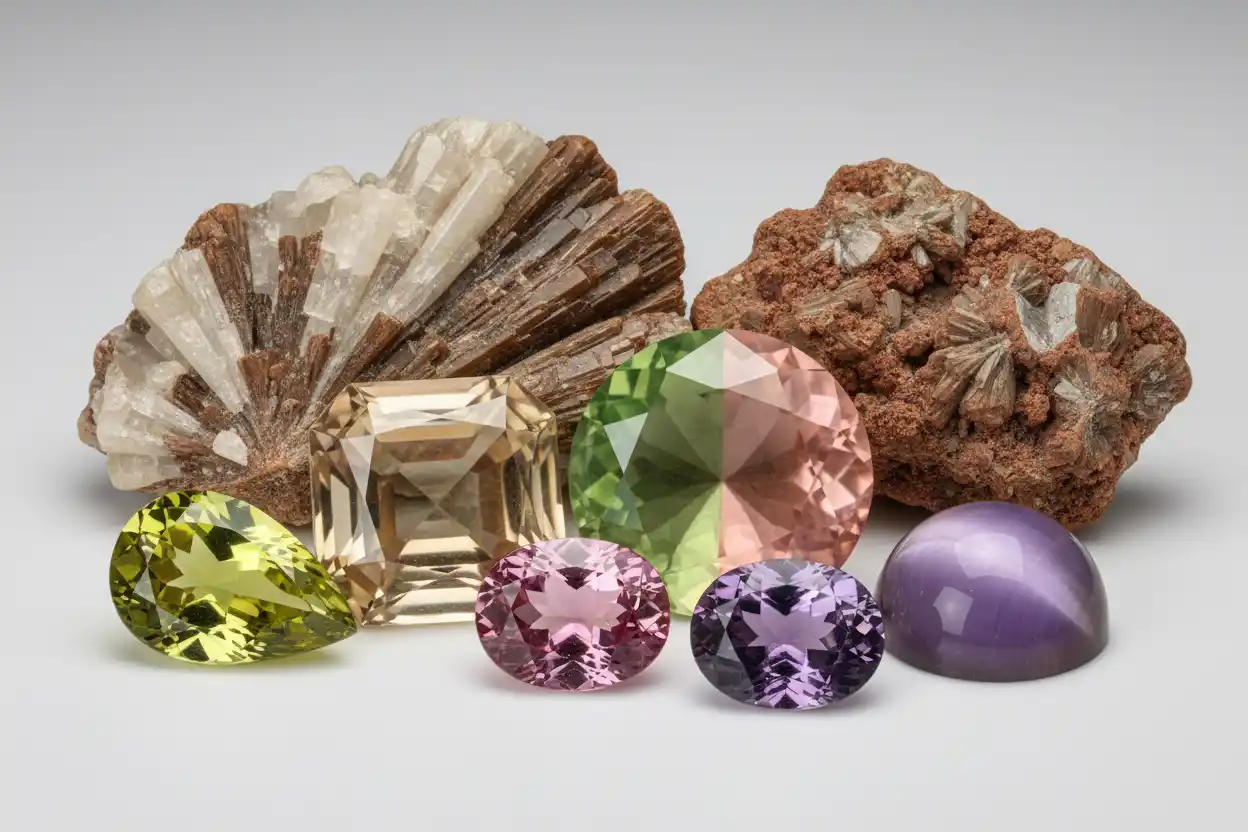

Diaspore is an aluminum oxide hydroxide mineral known in jewelry for strong pleochroism and, in certain gem-quality material, a striking change between cool and warm lighting. However, most diaspore in nature is opaque, massive, scaly, or associated with bauxite rather than suitable for faceting.
The meaningful types of diaspore are distinguished by transparency, color, optical phenomenon, chemistry, locality, crystal form, and commercial naming. Zultanite and Csarite are not separate mineral species; they are trade names associated primarily with color-changing Turkish diaspore. The parent diaspore meaning and properties guide covers the mineral’s broader identity.
Diaspore at a Glance
| Property | Diaspore |
|---|---|
| Composition | Aluminum oxide hydroxide, AlO(OH) |
| Mineral group | Diaspore group |
| Main colors | Colorless, white, gray, pale yellow, golden yellow, greenish yellow, brown, pink, rose-red, lilac, and purple |
| Crystal system | Orthorhombic |
| Typical habit | Flattened, bladed, prismatic, tabular, acicular, scaly, foliated, and massive |
| Luster | Vitreous; pearly on cleavage surfaces |
| Transparency | Transparent to opaque |
| Mohs hardness | Approximately 6.5–7 |
| Cleavage | Perfect in one principal direction |
| Tenacity | Very brittle |
| Common uses | Rare faceted gems, cat’s-eye cabochons, mineral specimens, and aluminum-ore research |
| Main care concern | Perfect cleavage, brittle edges, heat sensitivity, setting pressure, and misleading Zultanite or Csarite claims |
What Counts as a Diaspore Variety?
Diaspore does not have numerous formally named mineral varieties. Most labels describe color, locality, optical performance, or commercial branding.
A transparent yellow-green gem and an opaque gray bauxite mineral may share the same basic formula. Likewise, a Turkish stone sold as Zultanite and an unbranded color-change diaspore remain the same mineral species.
This distinction is especially important because branding can make ordinary material seem like a different gem. The types of gemstones guide explains why trade names should not be confused with mineralogical classification.
Common Massive Diaspore
Most diaspore occurs as massive, scaly, foliated, or fine-grained material rather than transparent crystals.
It is a major aluminum-bearing component in some bauxite deposits, together with boehmite, gibbsite, iron oxides, clays, and other minerals. Rocks dominated by diaspore may be called diasporite.
Massive diaspore can appear white, gray, brown, yellowish, greenish, or reddish. It is usually collected for mineralogical, geological, or ore-related interest rather than jewelry.
Because bauxite is a rock containing several minerals, an attractive piece of bauxite should not automatically be described as gem diaspore.
Transparent Gem-Quality Diaspore
Gem-quality diaspore must be transparent enough for faceting, sufficiently large, and free from cleavage fractures that would prevent cutting.
Transparent rough is rare because diaspore commonly forms thin blades, flattened crystals, included material, or fragile cleavage fragments. Even promising rough can lose substantial weight during orientation.
Fine faceted stones show strong brilliance, noticeable birefringence, and vivid pleochroic colors. However, their appearance depends heavily on lighting, orientation, cut, and body color.
Diaspore’s rarity places superior material among the specialist gems discussed in the rarest gemstones in the world.
Pale Yellow Diaspore
Pale yellow is one of the most common colors among transparent faceted diaspore.
Stones may appear straw yellow, light gold, champagne, or yellow-gray. Many show green, pink, or brown flashes as they turn because of strong pleochroism.
Commercial pale-yellow material can be attractive but may display only a subtle light-source change. Therefore, it should not automatically command the premium associated with strongly transforming color-change gems.
Pale examples fit within the broader yellow gemstones guide, although their cleavage makes them less forgiving than sapphire, chrysoberyl, or many garnets.
Golden and Champagne Diaspore
Golden diaspore has a warmer and more saturated yellow appearance. Champagne stones add beige, tan, pale brown, peach, or greenish modifiers.
Warm-light photographs often emphasize champagne and pink tones, while cool daylight may reveal olive, kiwi, or yellow-green colors.
“Champagne diaspore” is a descriptive market label rather than a fixed mineralogical variety. Color alone does not establish Turkish origin, color-change strength, or branded status.
Green and Yellow-Green Diaspore
Yellow-green and greenish diaspore commonly provides the daylight side of the classic Turkish color change.
The color may range from pale celery and kiwi to olive, sage, or brownish green. Strong pleochroism can make the same gem appear greenish from one direction and yellow or brown from another.
Green color does not automatically indicate chromium-rich material. Trace chemistry, orientation, and absorption bands must be evaluated together.
Other green gems appear in the green gemstones guide, but diaspore’s strong birefringence and perfect cleavage provide important identification differences.
Brown and Brownish Diaspore
Brown, tan, gray-brown, and yellow-brown are common colors in ordinary diaspore crystals and lower-saturation faceted stones.
Some material shows warm rose or orange flashes under incandescent lighting despite a restrained daylight appearance. Other stones remain brown under most conditions.
Historically, brownish color limited diaspore’s popularity before strongly color-changing Turkish material entered wider commercial distribution.
A brown body color is not necessarily a defect in a mineral specimen, where crystal form, luster, twinning, locality, and matrix may be more important than faceting color.
Turkish Color-Change Diaspore
The best-known gem diaspore comes from the İlbir Mountains in southwestern Turkey, particularly deposits associated with the Milas area of Muğla Province.
Gem crystals occur in metamorphosed bauxite horizons within marble. Geological heating and pressure recrystallized aluminum-rich material, while localized conditions allowed transparent diaspore crystals to develop.
Fine Turkish stones may appear kiwi, celery, yellow-green, olive, or golden in daylight and shift toward champagne, peach, pink, raspberry, or reddish brown under incandescent light.
The strength of change varies. Some stones transform dramatically, while others show only a modest shift. Larger well-oriented gems often display the effect more clearly because the longer light path strengthens absorption.
Zultanite
Zultanite is a commercial name historically associated with Turkish color-change diaspore.
It does not describe a different chemical composition. A genuine Zultanite stone is diaspore, and its value should depend on color change, clarity, size, cutting, condition, provenance, and documentation rather than the name alone.
Trademark history and distribution rights have changed over time. Consequently, older certificates, newer invoices, and resale listings may use the term differently.
The workbook’s alias rule correctly routes Zultanite to the canonical diaspore page rather than creating a competing mineral article.
Csarite
Csarite is another commercial name used for Turkish color-changing diaspore.
Like Zultanite, it identifies branded market material rather than a separate species. A stone may be mineralogically genuine diaspore without qualifying for one company’s branding or supply chain.
Sellers should not use Csarite as a generic synonym for every pale yellow or brown diaspore. When a trademark claim materially increases the price, documentation should support it.
Non-Branded Turkish Diaspore
Not all Turkish diaspore is sold under a trademark.
Unbranded stones may come from the same general gem-producing region and show excellent pleochroism or color change. Others may have lighter color, more inclusions, weaker transformation, or older provenance.
An unbranded stone is not automatically inferior. In many cases, transparent disclosure and independent testing provide more useful information than a marketing label.
Pink and Purplish Pink Afghan Diaspore
Gem-quality diaspore from Afghanistan has been reported in purplish pink, violet-pink, pale rose, and related colors.
Some Afghan material shows a light-source color shift or strong pleochroism rather than the classic Turkish kiwi-to-raspberry change. Larger stones may reveal the pink or purple component more strongly than small examples.
The color may involve chromium, manganese, iron, or combinations of trace elements and structural effects. Laboratory analysis is needed before assigning a specific chromophore to an individual stone.
Afghan origin should be supported by credible documentation because appearance alone cannot distinguish locality.
Purple and Lilac Diaspore
Diaspore can occur in pale lilac, gray-purple, violet, and deeper purple tones.
Chromium-bearing material may display purple or reddish-purple components, while manganese-rich diaspore can produce pink to rose-red colors.
Many purple diaspore crystals are specimen material rather than transparent faceting rough. Thin blades, acicular growth, and cleavage surfaces may display attractive pearly luster even when the crystal is not gem transparent.
Purple diaspore can resemble amethyst, purple scapolite, spinel, sapphire, fluorite, or glass, but its refractive properties and cleavage differ.
Pink, Rose, and Red Diaspore
Manganese-bearing diaspore may appear pink, rose-red, or dark red. Some examples are transparent to translucent, while others occur as mineral specimens in massive or bladed form.
Pink color should not automatically be labeled Zultanite. The Zultanite name refers to a specific commercial context, whereas pink diaspore can occur in other deposits and chemical environments.
The pink gemstones guide provides a broader color comparison, but diaspore remains uncommon in ordinary pink-gem jewelry.
Colorless, White, and Gray Diaspore
Colorless transparent diaspore is rare as a faceted gem because much pale material shows at least a faint yellow, green, gray, or brown tint.
White and gray diaspore is more common in massive, scaly, or opaque mineral aggregates. Cleavage surfaces may show pearly reflections.
Colorless faceted material can resemble quartz, topaz, danburite, colorless sapphire, or synthetic stones. Instrumental testing is necessary because visual brilliance alone is inconclusive.
Color Change Versus Pleochroism
Diaspore’s color change and pleochroism are related to light absorption but represent different observations.
Pleochroism means the gem displays different colors when viewed along different crystallographic directions. Diaspore is strongly trichroic and may show three directional colors.
Color change means its overall appearance shifts under light sources with different spectral output, such as daylight-equivalent illumination and warm incandescent light.
A stone may be strongly pleochroic but show weak light-source change. Conversely, an expertly oriented stone may combine both effects dramatically.
Cat’s-Eye Diaspore
Cat’s-eye diaspore is a rare chatoyant variety containing aligned needles, fibers, tubes, or growth features.
When cut as a correctly oriented cabochon, those inclusions reflect a narrow moving band of light. The effect should travel across the dome as the stone turns under a single point source.
Some cat’s-eye diaspore also changes color between light sources, combining two optical phenomena in one gem.
A weak broad sheen is less valuable than a sharp, centered eye with an attractive body color and strong movement.
Diaspore Crystals and Mineral Specimens
Collectors value diaspore crystals for shape, luster, twinning, color, transparency, locality, and association with matrix minerals.
Crystals may be bladed, tabular, prismatic, acicular, flattened, or V-twinned. Cleavage surfaces can produce a pearly appearance distinct from the vitreous luster of intact crystal faces.
Russian type-locality specimens, Turkish gem crystals, Massachusetts purple examples, South African manganese-rich material, and Japanese nodules appeal to different collecting specialties.
Cutting a sharp or historically important crystal may destroy more value than it creates.
Diaspore Geology and Formation
Diaspore commonly forms in aluminum-rich rocks and deposits, especially bauxite subjected to suitable pressure, temperature, and fluid conditions.
It may occur through hydrothermal alteration, metamorphism, or weathering-related concentration of aluminum. The mineral is dimorphous with boehmite, meaning both share the same basic composition but have different crystal structures.
In Turkey, gem-quality crystals occur in metamorphosed bauxite layers enclosed by marble. That geological setting differs from ordinary tropical bauxite deposits where diaspore is fine-grained and opaque.
Major Localities
Turkey remains the defining locality for commercial color-change gem diaspore. Transparent material from Afghanistan has expanded interest in pink, purple, and subtly shifting colors.
Diaspore also occurs in Russia, Greece, France, Switzerland, Norway, Sweden, the United States, South Africa, China, Japan, Brazil, and many other countries.
Most localities produce specimens, ore minerals, or opaque aggregates rather than consistent faceting rough. Therefore, a country name alone should not imply gem quality.
Inclusions and Internal Features
Diaspore may contain cleavage feathers, growth tubes, needles, veils, fluid inclusions, mineral crystals, and color zoning.
Aligned inclusions can create chatoyancy. However, randomly distributed inclusions usually reduce transparency without producing a distinct optical effect.
Surface-reaching cleavage fractures create special concern because pressure from a prong or polishing wheel can split the gem.
Some inclusions can support natural origin, yet no single internal feature proves locality or establishes that a stone qualifies for a trademarked name.
How Diaspore Is Identified
Diaspore is orthorhombic, strongly birefringent, and biaxial. Its refractive indices are substantially higher than quartz and its birefringence may create visible doubling of back facets in a well-cut stone.
Specific gravity is approximately 3.2–3.5. Hardness falls around 6.5–7, but perfect cleavage and brittleness reduce practical toughness.
Pleochroism, color change, refractive index, birefringence, optic character, spectroscopy, and microscopic features separate diaspore from most lookalikes.
The general crystal identification guide explains why home scratch tests are unsuitable for valuable faceted stones.
Common Lookalikes
Color-change diaspore may resemble alexandrite, color-change garnet, color-change sapphire, andalusite, synthetic corundum, glass, or coated material.
Alexandrite is chrysoberyl and usually has higher hardness, different refractive properties, and different typical colors. Its varieties are covered in types of alexandrite.
Andalusite can show strong pleochroism in green, yellow, brown, and reddish tones, but its optical measurements differ from diaspore.
Artificial glass doped with rare-earth elements has been sold under Zultanite-like descriptions. A dramatic color change combined with a suspiciously low price deserves laboratory verification.
Treatments
Most fine gem diaspore is marketed as untreated. Routine heating does not play the same commercial role it has in sapphire, tanzanite, or citrine.
Coatings, assembled stones, fracture filling, and deceptive lighting remain possible market concerns even when no standard diaspore enhancement dominates.
Because color is the central value feature, treatment or coating that changes appearance should be disclosed.
The general gemstone treatments guide provides terminology without duplicating diaspore-specific buying guidance.
Synthetic Diaspore and Imitations
Diaspore has been produced for scientific and industrial study, but laboratory-grown gem diaspore is not a routine mainstream jewelry product.
Imitations present the greater practical concern. Color-change glass, synthetic sapphire, synthetic spinel, coated quartz, and assembled stones can be marketed with Zultanite-style language.
A seller should distinguish “created color-change gem” from actual synthetic diaspore. The principles in lab-grown versus natural gemstones clarify the difference between a synthetic counterpart and an unrelated simulant.
Cutting Behavior
Diaspore is difficult to cut because of perfect cleavage, brittle tenacity, thin rough, directional color, and frequent inclusions.
The cutter must orient the stone to display the strongest color change and pleasing pleochroism while keeping cleavage away from vulnerable facet positions.
Elongated cushions, ovals, pears, marquises, and emerald-style cuts often retain more weight from bladed rough. Large round stones require substantial material loss.
Facet junctions can chip during polishing, while excessive pressure can open cleavage fractures. Skilled cutting therefore contributes significantly to the value of a finished gem.
Cat’s-eye material requires cabochon orientation perpendicular to aligned inclusions. An incorrect cut can eliminate the optical effect entirely.
Durability and Jewelry Suitability
Diaspore’s hardness of 6.5–7 provides moderate scratch resistance. The gemstone hardness chart places it near quartz but below topaz, sapphire, moissanite, and diamond.
Perfect cleavage makes it less durable than the hardness number suggests. The distinction is explained in gemstone cleavage and chipping.
Earrings, pendants, brooches, and protected occasional-wear rings are safer than exposed daily-wear rings. A bezel or halo can protect the girdle, but the setter must avoid excessive pressure.
Marquise points, sharp corners, thin girdles, and surface-reaching feathers require particular caution.
Diaspore Prices in 2026
Diaspore has one of the most inconsistent retail markets among rare faceted gems.
Current commercial listings show pale yellow or weakly changing sub-carat stones at approximately $20–$60 per stone, often around $30–$80 per carat.
Attractive unbranded stones between one and several carats may range from roughly $75–$500 per carat, depending on clarity, color change, cutting, and seller.
Strongly color-changing Turkish material, premium branded goods, fine pink or purple stones, and large clean gems may be listed from $500 to several thousand dollars per carat. Exceptional branded asking prices can reach higher, although asking price does not guarantee resale value.
Large rough and specimen material follows a different market. An impressive crystal may command hundreds or thousands of dollars even if cutting would produce poor yield.
The dedicated diaspore price guide should retain detailed value tables and future updates.
Buying Guidance
View color-change diaspore under at least two clearly identified light sources. Daylight-equivalent illumination and warm incandescent light reveal more than a seller’s edited split-screen image.
Request video while the gem moves because pleochroism can create impressive flashes that disappear face-up. Determine whether the listing describes color change, color shift, or merely directional pleochroism.
Ask for treatment status, exact weight, dimensions, origin, return policy, laboratory report, and documentation supporting any Zultanite or Csarite claim.
Inspect girdles and corners for cleavage damage. A large stone with a shallow pavilion may look broad but show a dead window through the center.
The dedicated diaspore buying guide owns the full transaction checklist.
Cleaning and Storage
Clean diaspore briefly with lukewarm water, mild soap, and a very soft brush. Support the jewelry over a padded surface so an accidental drop does not strike a hard sink.
Avoid steam, sudden temperature changes, harsh chemicals, and prolonged ultrasonic cleaning. Vibration may enlarge a cleavage fracture or loosen a brittle stone.
The general guide to gemstones in ultrasonic cleaners explains why hardness alone does not establish machine safety.
Store diaspore separately in a padded compartment. Do not allow diamond, sapphire, topaz, or metal edges to strike exposed corners.
Meaning and Symbolism
Modern spiritual traditions often associate diaspore’s shifting colors with adaptability, perspective, self-discovery, and the ability to respond thoughtfully to changing circumstances.
Green-yellow tones may be linked with renewal or confidence, while pink and champagne colors may symbolize warmth, affection, or emotional openness.
Zultanite marketing has also connected the stone with rarity, transformation, and individuality. Those associations can carry personal meaning but do not represent scientifically demonstrated effects of aluminum oxide hydroxide.
Frequently Asked Questions
1. What are the main types of diaspore?
The principal practical types include massive ore-grade diaspore, transparent gem diaspore, Turkish color-change material, branded Zultanite or Csarite, pink or purple Afghan material, manganese-rich red specimens, and cat’s-eye diaspore.
2. Is Zultanite a separate gemstone?
No. Zultanite is a commercial name associated with certain Turkish color-change diaspore. The mineral species remains diaspore.
3. Is Csarite different from Zultanite?
Both names have been used commercially for Turkish color-changing diaspore. Branding and distribution history differ, but neither represents a different mineral species.
4. Does every diaspore change color?
No. Many stones show only pleochroism, weak color shift, or no commercially significant light-source change.
5. What colors does Turkish diaspore show?
Fine material may appear kiwi, celery, yellow-green, olive, or golden in cool light and champagne, peach, pink, raspberry, or reddish brown in warm light.
6. What is the difference between color change and pleochroism?
Color change occurs between different light sources. Pleochroism appears when the gem is viewed from different crystallographic directions.
7. Is pink diaspore always from Afghanistan?
No. Pink and rose diaspore can occur in multiple localities and chemical environments. Afghan origin should be documented rather than inferred from color.
8. Can diaspore show a cat’s-eye effect?
Yes. Rare material with aligned inclusions can display chatoyancy when cut as a correctly oriented cabochon.
9. Is diaspore suitable for an engagement ring?
It can be used in a protected occasional-wear ring, but perfect cleavage and brittle tenacity make it less practical than sapphire, spinel, or chrysoberyl for unrestricted daily wear.
10. Is gem diaspore usually treated?
Most fine material is marketed as untreated, and no routine enhancement dominates the market. Coatings, imitations, and misleading branding remain possible.
11. Why are large diaspore gems uncommon?
Rough commonly occurs as thin blades with cleavage, inclusions, and directional color. Cutting removes substantial weight and can cause breakage.
12. Why do diaspore prices vary so widely?
Color-change strength, lighting, clarity, size, cut, locality, branding, documentation, and seller positioning produce an unusually fragmented market.
Diaspore’s varieties reflect geology, trace chemistry, optical orientation, and commerce rather than a long list of separate minerals. Common bauxite material, pale faceted stones, Turkish kiwi-to-raspberry gems, pink Afghan crystals, and rare cat’s-eye cabochons all belong to the same orthorhombic aluminum mineral, yet they serve very different collectors and buyers. Related entries appear in the crystals that start with D directory and the gemstones that start with D guide.