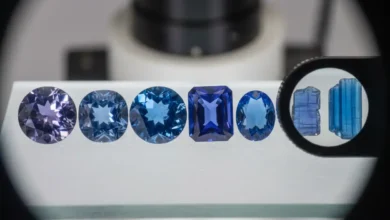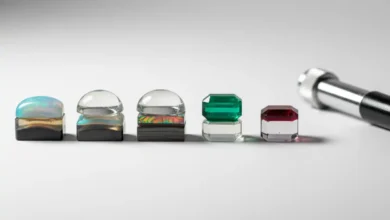

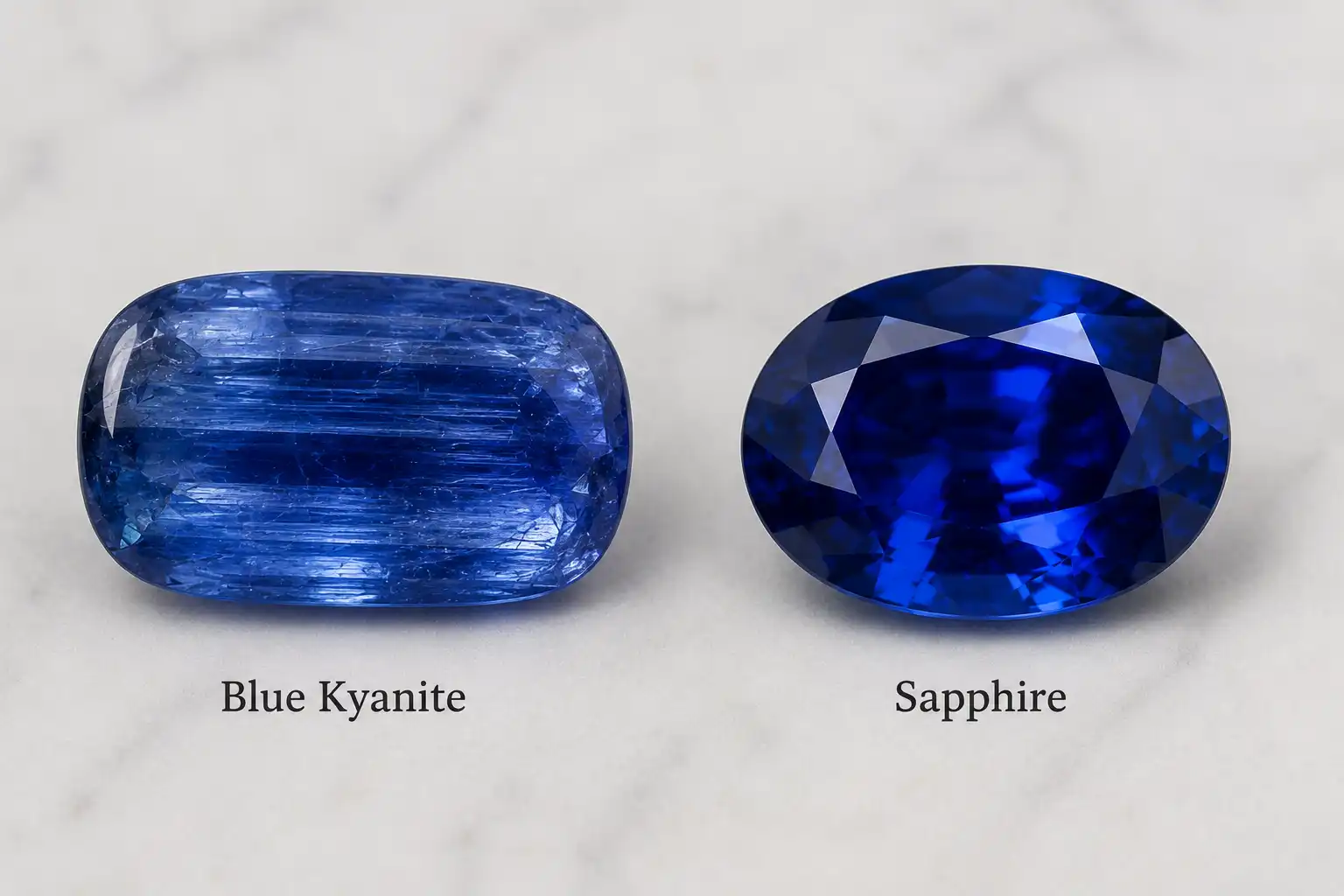

Blue kyanite can resemble sapphire because both stones may display strong blue color, vitreous luster, transparency, pleochroism, and faceted cutting. Their physical and optical properties, however, differ enough that a gemologist can separate them through standard testing.
Sapphire is corundum with hardness 9, high density, no cleavage, and strong suitability for daily jewelry. Kyanite is an aluminum silicate with directional hardness, prominent cleavage, lower refractive index, and a bladed crystal structure that requires more cautious cutting and wear.
Color alone cannot distinguish them. A blue stone should not be called sapphire merely because it appears saturated, nor should every long bladed blue crystal be assumed to be kyanite without confirming its properties.
Kyanite and sapphire at a glance
| Property | Kyanite | Sapphire |
|---|---|---|
| Chemical composition | Aluminum silicate | Aluminum oxide |
| Crystal system | Triclinic | Trigonal |
| Common blue cause | Iron-related absorption and trace-element effects | Commonly iron and titanium interactions |
| Mohs hardness | Directional; approximately 4.5–5 along one direction and 6.5–7 across another | 9 |
| Cleavage | Distinct to perfect in important directions | No true cleavage |
| Toughness | Fair to poor for exposed daily jewelry | Excellent |
| Typical refractive index | Approximately 1.71–1.73 | Approximately 1.762–1.770 |
| Typical specific gravity | Usually around the mid-3 range | About 4.00 |
| Optical character | Biaxial | Uniaxial negative |
| Pleochroism | Often distinct blue, colorless, greenish, or violet-blue directions | Commonly blue and greenish-blue or violet-blue directions |
| Common crystal habit | Flattened or bladed crystals | Barrel-shaped or tabular crystals; often rounded rough |
| Treatment market | Usually untreated, though stabilization, dye, coating, and composites can occur | Heat is common; diffusion, filling and laboratory growth also occur |
| Best jewelry use | Earrings, pendants, protected occasional-wear rings | Rings, bracelets, earrings, pendants and daily jewelry |
What is kyanite?
Kyanite is an aluminum silicate mineral that forms mainly in metamorphic rocks. It belongs to the same chemical system as andalusite and sillimanite, but each mineral has a different crystal structure and forms under different temperature and pressure conditions.
Blue is the best-known kyanite color, although the mineral can also occur in green, orange, gray, white, colorless, black, and color-zoned material.
Kyanite commonly grows as flattened blades. Those crystals can contain strong color zoning, cleavage cracks, inclusions, and areas of different transparency, all of which make faceting difficult.
The completed Types of Kyanite guide owns the color and variety classification. The completed Blue Kyanite Guide and Black Kyanite Guide provide material-specific context.
What is sapphire?
Sapphire is corundum in every color except the red category called ruby. Blue sapphire is the most commercially recognized variety, but sapphire can also be pink, yellow, green, purple, orange, white, black, color-changing, parti-colored, or star-forming.
Corundum’s compact crystal structure gives sapphire hardness 9 and excellent practical toughness. These properties make it far more suitable than kyanite for rings and other jewelry exposed to repeated contact.
The planned Sapphire Guide covers sapphire’s geology, properties, and symbolism, while the completed Types of Sapphire owns its color and variety range.
The fastest practical difference: durability
Sapphire resists scratches far better than kyanite.
Kyanite has unusual directional hardness. It can be much softer along the length of a blade than across it. Consequently, one surface may scratch or polish differently from another.
This anisotropy complicates cutting. A lapidary must orient and polish the stone carefully because changing facet direction can produce uneven wear or polish.
Sapphire has no comparable directional hardness problem. Its hardness of 9 remains one of the strongest identifying and practical differences.
The Gemstone Hardness Chart provides the complete Mohs comparison.
Do not perform a scratch test on a finished stone
Although sapphire should scratch kyanite in principle, intentionally testing one gemstone against another is a poor identification method.
The test can:
- Scratch genuine kyanite
- Chip a girdle
- Damage a polished facet
- Transfer material and create a false mark
- Harm the setting
- Reduce the stone’s value
Hardness also cannot establish whether sapphire is natural, laboratory-grown, heated, diffused, or filled.
Use measured optical properties rather than destructive testing.
Cleavage makes kyanite more vulnerable
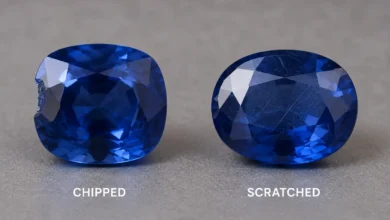
Kyanite has distinct to perfect cleavage in important directions. A sharp impact can separate the mineral along a structural plane, especially when a facet, girdle, or prong aligns unfavorably.
Sapphire has no true cleavage. It can still chip or fracture, but it lacks the same preferred splitting planes.
This difference matters in rings. An exposed kyanite may survive light wear yet crack after one concentrated impact. Sapphire generally tolerates daily wear much more reliably.
Gemstone Cleavage Explained covers the relationship between structure and breakage, while Gemstone Toughness vs. Hardness explains why resistance to scratching and resistance to impact are separate properties.
Color overlap
Blue kyanite commonly ranges from:
- Pale blue
- Greenish blue
- Medium blue
- Violet-blue
- Deep blue
- Strongly zoned blue and colorless
Blue sapphire covers an equally broad range:
- Grayish blue
- Greenish blue
- Cornflower-like blue
- Violet-blue
- Deep royal blue
- Inky or nearly black blue
- Unevenly zoned combinations
A fine transparent kyanite can show a saturated blue similar to sapphire. Conversely, dark sapphire and heavily zoned kyanite can both appear uneven or nearly black in parts.
Color is therefore useful for describing the stone but weak for identifying the species.
Pleochroism
Both stones can display directional color changes.
Kyanite pleochroism
Kyanite may show blue, violet-blue, greenish blue, or nearly colorless directions. Rotation can produce a noticeable change in intensity.
Sapphire pleochroism
Blue sapphire commonly shows blue and greenish-blue or violet-blue directional colors.
A dichroscope can make those directions easier to compare, yet the reactions overlap. Pleochroism supports an identification only when combined with refractive index, optical character, density, and microscopy.
Refractive index
A refractometer provides one of the clearest standard separations.
Kyanite normally produces readings around the low 1.70s, while sapphire reads higher, approximately 1.762–1.770.
The ranges do not overlap under ordinary testing. A suitable polished facet can therefore establish whether the stone’s optical behavior is consistent with one material or the other.
A mounted stone, curved cabochon, heavily included specimen, or inaccessible facet may complicate measurement.
The broader workflow in How to Identify Crystals explains how refractive index fits with other tests.
Optical character
Kyanite is biaxial, while sapphire is uniaxial negative.
A polariscope, refractometer, and conoscopic observations can establish the difference when the stone and orientation permit.
This distinction is especially useful because color and pleochroism can overlap. The internal optical symmetry comes from crystal structure and cannot be inferred from a blue photograph.
Density and heft
Sapphire is generally denser than kyanite. A sapphire and kyanite of identical dimensions will not normally weigh the same.
Specific gravity can support identification through hydrostatic weighing. The test needs:
- Accurate weight in air
- Accurate suspended weight in water
- No trapped bubbles
- No porous material
- No attached mounting
- Correct calculation
Judging heft in the hand is not precise enough for a valuable stone, although an unexpectedly heavy blue gem may prompt further testing.
Crystal habit and rough material
Kyanite rough commonly appears as elongated, flattened blades with lengthwise striations and cleavage surfaces. Blue color may be confined to narrow zones within a paler crystal.
Sapphire rough can appear as barrel-shaped, tabular, prismatic, or water-worn crystals. Alluvial sapphire may have rounded surfaces that reveal little of the original habit.
A cut stone no longer displays its original form. Moreover, glass, synthetic crystals, and other minerals can be cut into elongated shapes. Crystal habit provides stronger evidence in intact rough than in finished jewelry.
Luster and brilliance
Both materials can show vitreous luster.
Sapphire’s higher refractive index generally supports stronger brilliance when cutting, clarity, and color allow. Kyanite can be bright, but its cleavage, zoning, and directional hardness often limit the quality of the cut.
A well-cut kyanite may still appear more attractive than a dark, windowed sapphire. Visual beauty does not identify the mineral or determine durability.
Inclusions
Common kyanite features
Kyanite may contain:
- Mineral crystals
- Cleavage cracks
- Color zoning
- Irregular transparent and translucent zones
- Needles
- Two-phase inclusions
- Bladed growth structures
Common sapphire features
Natural sapphire may contain:
- Rutile needles
- Crystal inclusions
- Fingerprints and healed fractures
- Color zoning
- Growth bands
- Cavities
- Stress halos
Inclusions can support natural origin or treatment detection, but neither stone has one universal inclusion pattern.
Laboratory-grown sapphire may show curved growth lines, gas bubbles, flux residues, seed-related features, or other process-specific structures.
Treatments
Kyanite treatments
Faceted kyanite is often sold untreated. However, the broader market can include:
- Stabilized bead material
- Dyed low-quality kyanite
- Surface coating
- Filled fractures
- Composite beads
- Glass imitations
- Other blue minerals sold under the kyanite name
An unusually inexpensive, highly uniform strand should not be assumed natural and untreated.
The planned Where to Buy Real Kyanite will own seller selection and imitation avoidance.
Sapphire treatments
Heat treatment is common and widely accepted when disclosed. Other treatments can include:
- Diffusion
- Fracture filling
- Glass filling
- Irradiation in selected colors
- Coating
- Dye in low-grade aggregate material
- Composite construction
Laboratory-grown sapphire is also widely available.
The planned How to Spot Treated or Synthetic Sapphire owns treatment-specific evidence. The planned Real vs. Fake Sapphire will address synthetics, glass, spinel, doublets, and other imitations.
Price differences
Fine sapphire generally occupies a much larger and higher-value market than kyanite. Color, treatment, origin, size, clarity, and documentation can push exceptional sapphire prices far beyond ordinary blue gems.
Kyanite remains more accessible because its jewelry market is smaller and its durability limits demand for daily-wear rings.
However, price cannot identify a stone. Synthetic sapphire, treated sapphire, dark commercial sapphire, glass, and seller overpricing all complicate assumptions based on cost.
The completed Sapphire Price Guide owns sapphire valuation, while the completed Sapphire Buying Guide explains the qualities that justify different market levels.
Which stone is better for jewelry?
Rings
Sapphire is the clear choice for daily rings. Kyanite should be reserved for a protective bezel, low-profile design, or occasional wear.
Earrings
Both stones work well because earrings receive less impact. Kyanite earrings can display rich blue color without the risks created by a ring.
Pendants
Kyanite is highly suitable for pendants when the design protects the edge and prevents repeated impacts.
Bracelets
Sapphire performs much better. Kyanite beads and stones can rub against hard surfaces and one another, accelerating abrasion or breakage.
The completed Best Gemstones for Everyday Wear compares practical durability across the broader market.
Engagement rings
Sapphire is one of the best colored engagement-ring stones because of its hardness, toughness, color range, and established laboratory-report market.
Kyanite can create a distinctive engagement ring for someone who accepts limited wear, frequent removal, and potential repolishing or replacement. It should not be represented as equivalent to sapphire in durability.
The planned Sapphire Engagement Ring Guide will own sapphire settings, color choices, and ring-specific buying decisions.
Laboratory reports
A significant blue sapphire purchase should generally have an independent report addressing:
- Natural or laboratory-grown origin
- Detectable treatments
- Weight and dimensions
- Color description
- Geographic origin opinion when requested and possible
A kyanite report may be useful when the stone is expensive, unusually large, sold with a rare locality, or difficult to distinguish from another blue gem.
Gemstone Certification Labs Compared explains service selection. How to Read a Gem Lab Report explains why a report identifies the material but does not guarantee retail value.
Kyanite-versus-sapphire checklist
When comparing an unknown blue stone:
- Do not identify it by color alone.
- Examine the crystal habit if the piece is rough.
- Look for cleavage and directional wear.
- Avoid destructive scratch tests.
- Compare density using proper measurement.
- Obtain refractive-index readings.
- Determine whether the stone is biaxial or uniaxial.
- Examine pleochroism with a dichroscope.
- Study inclusions and color zoning under magnification.
- Ask whether treatment is present.
- Separate natural sapphire from laboratory-grown sapphire.
- Check whether filling or diffusion affects value.
- Match jewelry use to durability.
- Obtain a laboratory report when price depends on identity.
- Preserve invoices and treatment disclosures.
Frequently Asked Questions
1. Can kyanite look like sapphire?
Yes. Transparent blue kyanite can resemble sapphire in color, luster, zoning, and pleochroism.
2. Is kyanite a type of sapphire?
No. Kyanite is aluminum silicate, while sapphire is aluminum oxide corundum.
3. Which is harder, kyanite or sapphire?
Sapphire is much harder at Mohs 9. Kyanite has directional hardness ranging roughly from 4.5–5 to 6.5–7.
4. Does kyanite have cleavage?
Yes. Kyanite has important cleavage directions that make it more vulnerable to splitting and chipping.
5. Does sapphire have cleavage?
Sapphire has no true cleavage, although it can still fracture or chip under a severe blow.
6. Is kyanite suitable for a daily ring?
It is generally better for protected or occasional-wear rings. Sapphire is substantially more suitable for daily wear.
7. Can a scratch test separate kyanite and sapphire?
It could damage the stone and should not be used on finished gems. Refractive index and optical testing provide safer evidence.
8. Is sapphire heavier than kyanite?
Sapphire is generally denser and should weigh more when the stones have identical dimensions.
9. Is blue kyanite usually treated?
Much faceted kyanite is sold untreated, but stabilization, dye, coating, filling, composites, and imitations can occur.
10. Is blue sapphire usually treated?
Heat treatment is common. Diffusion, filling, coating, and laboratory growth also occur and require accurate disclosure.
11. Can a jeweler identify kyanite and sapphire with a loupe?
Magnification may reveal useful clues, but refractive index, specific gravity, optical character, and spectroscopy provide stronger identification.
12. Which stone is more valuable?
Fine sapphire normally commands much higher prices, although treatment, quality, size, origin, and documentation determine the individual result.
Conclusion
Kyanite and sapphire can share beautiful blue color, but they are fundamentally different gems. Sapphire is dense, hard, tough, and free from cleavage, while kyanite has directional hardness, distinct cleavage, lower refractive index, and a bladed metamorphic structure.
A buyer should choose sapphire for demanding daily jewelry and kyanite for distinctive color in more protected designs. When identity affects price, visual resemblance should give way to refractive-index, density, optical, microscopic, and laboratory evidence.