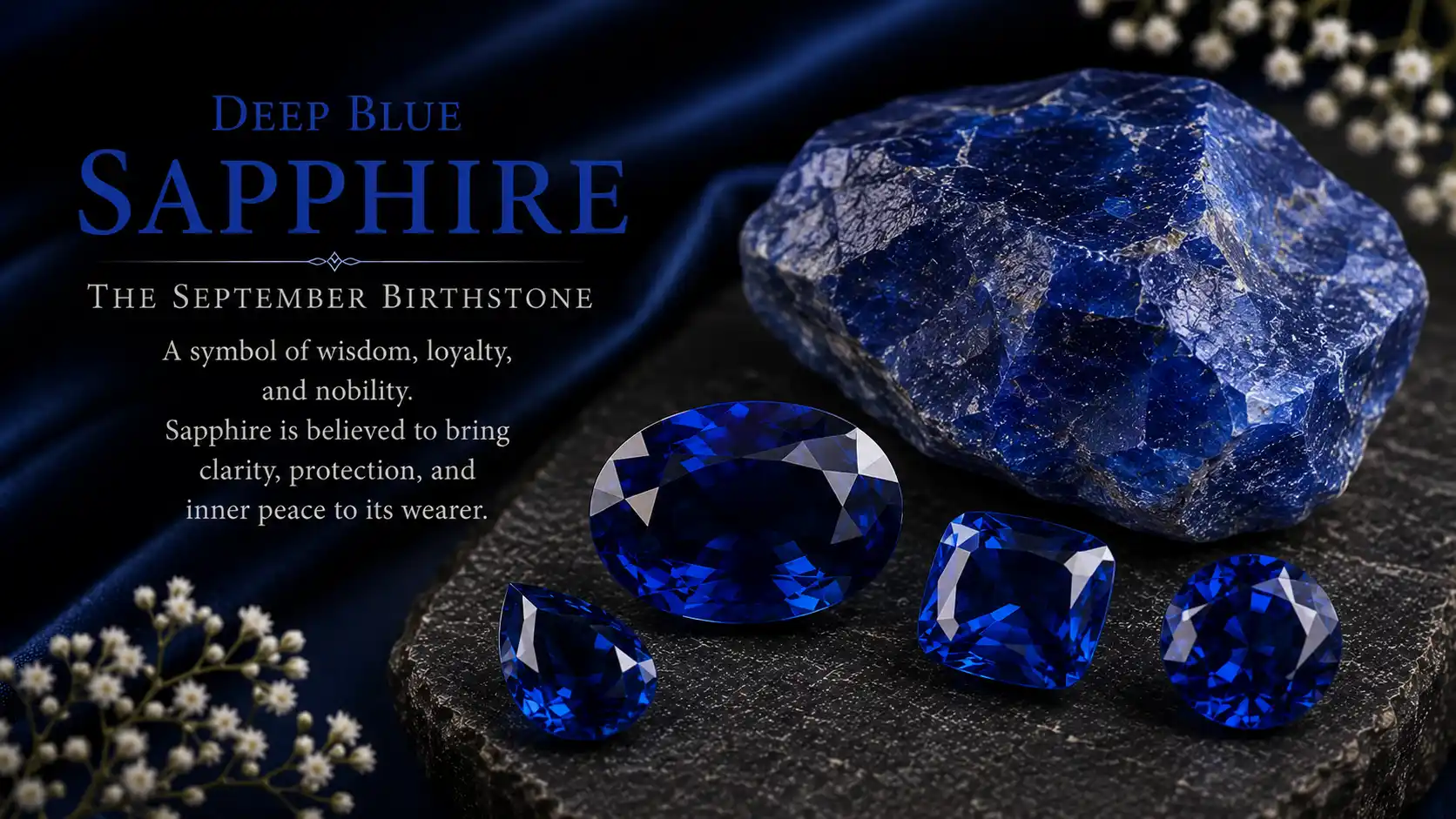
September Birthstone: Sapphire’s Meaning, Color & History
Sapphire is the modern September birthstone, celebrated for its rich blue color, exceptional durability and long association with loyalty, wisdom and commitment. Although royal blue remains its best-known appearance, sapphire occurs in nearly every color except the red classified as ruby.
Its combination of beauty and toughness makes sapphire unusually versatile. September birthstone jewelry can range from an affordable laboratory-grown pendant to a significant untreated natural sapphire accompanied by an independent gemological report.
September Birthstone at a Glance
| Feature | September Sapphire |
|---|---|
| Mineral species | Corundum |
| Chemical composition | Aluminum oxide, Al₂O₃ |
| Traditional color | Blue |
| Other colors | Pink, yellow, green, orange, purple, white and color-change |
| Mohs hardness | 9 |
| Cleavage | None |
| Toughness | Excellent |
| Common treatments | Heat; less commonly lattice diffusion, filling or dye |
| Common jewelry | Rings, earrings, necklaces, bracelets and engagement jewelry |
| Cultural symbolism | Truth, loyalty, wisdom, sincerity and commitment |
| Main buying priority | Attractive color with treatment disclosure |
What Is the September Birthstone?
Sapphire is the recognized modern birthstone for September. Jewelers in the United States standardized a commercial birthstone list in 1912, although connections between gems, months, religious traditions and astrology extend much further into history.
The calendar association should not be confused with zodiac gemstone traditions. September includes portions of Virgo and Libra, but zodiac stone lists vary between cultures and modern practitioners. The calendar birthstone remains sapphire regardless of whether a September birthday falls under either sign.
The companion September birthstone jewelry guide focuses on choosing a finished gift. This page concentrates on sapphire’s calendar history, color, symbolism and gemological identity.
How Sapphire Became September’s Birthstone
Historic birthstone systems developed from several overlapping traditions. Writers connected sets of twelve stones with religious texts, the months of the year and signs of the zodiac, although names used for ancient gems do not always match modern mineral definitions.
By the early twentieth century, jewelers wanted a consistent list that customers could recognize. The American National Retail Jewelers Association, an organization now represented by Jewelers of America, established a standardized United States list in 1912. Sapphire was assigned to September and has remained the month’s principal modern birthstone.
The choice suited a gem that already carried strong historical prestige. Sapphires had appeared in royal ornaments, religious jewelry and ceremonial objects for centuries. Their enduring blue color encouraged associations with the sky, truth and constancy.
Sapphire’s Mineral Identity
Sapphire is gem-quality corundum, a crystalline aluminum oxide. Red corundum is classified as ruby; corundum in blue and other qualifying colors is called sapphire.
The broader Sapphire meaning and properties guide examines the mineral’s geology, sources, properties and symbolism in greater depth. From a practical birthstone perspective, its most important physical advantage is durability.
Sapphire ranks 9 on the Mohs scale. It is harder than nearly every common jewelry gemstone except diamond and has no cleavage. As a result, a well-set sapphire can withstand routine use in rings, earrings and bracelets more successfully than softer birthstones.
Hardness does not make a stone indestructible. Thin corners, exposed points, existing fractures and poorly designed settings can still chip. Nevertheless, sapphire remains one of the strongest colored-gem choices for daily jewelry.
Why Blue Is the Traditional September Color
Blue sapphire became the conventional image of the September birthstone because blue has historically been the most celebrated sapphire color. Trace elements within corundum create shades that range from pale gray-blue to saturated royal blue, violetish blue, greenish blue and nearly black navy.
The most desirable color depends on personal taste and market context. Fine blue sapphires often combine strong saturation with enough brightness to avoid looking inky. Uneven zoning, excessive darkness or a gray modifier may reduce visual appeal, although an attractive medium or dark stone can still make an excellent personal gift.
The Sapphire color meaning guide examines the symbolism associated with blue and fancy-color sapphire. Buyers interested in mineral varieties and optical phenomena can also consult the guide to types of sapphire.
Fancy-Color September Sapphires
A September birthstone does not have to be blue. Fancy sapphires occur in pink, yellow, orange, green, purple, white, brown, gray and combinations of these colors.
Pink sapphire offers a softer alternative to traditional blue and pairs naturally with rose gold or white metal. Yellow sapphire can appear sunny and contemporary, while green sapphire suits buyers who prefer subdued or earthy color. White sapphire provides a colorless corundum option, although its brilliance differs from diamond.
Pinkish orange padparadscha sapphire is especially distinctive. Its accepted color range is narrow and debated, so significant examples deserve laboratory documentation. The dedicated Padparadscha Sapphire guide explains the name, color and identity of this variety.
Other recognizable options include white sapphire, yellow sapphire and star sapphire. A star sapphire is normally cut as a cabochon so aligned inclusions can produce a star under direct light.
September Birthstone Meaning and Symbolism
Sapphire has accumulated layers of symbolism through religious, courtly and romantic traditions. Blue sapphire commonly represents truth, loyalty, wisdom, sincerity and disciplined commitment.
These associations make it a natural gift for a partner, close friend, family member or graduate. A sapphire can commemorate a relationship without being limited to romantic meaning. Its durability also supports the idea of constancy because the gem can remain wearable for generations when properly set and maintained.
Different colors encourage different modern interpretations. Pink may suggest affection, yellow optimism, green renewal and white clarity. These are cultural associations rather than measurable properties of the mineral.
For a broader treatment of spiritual practices and traditional beliefs, see the separate Sapphire healing properties guide. The calendar-birthstone tradition does not require the wearer to adopt any metaphysical interpretation.
Natural and Laboratory-Grown Sapphire
Natural sapphire crystallizes through geological processes within the Earth. Laboratory-grown sapphire has essentially the same chemical composition and crystal structure but is produced under controlled manufacturing conditions.
A laboratory-grown stone is a real synthetic sapphire rather than blue glass or cubic zirconia. It can provide strong color, high clarity and larger sizes at a substantially lower cost than comparable natural material.
The laboratory-grown Sapphire meaning guide explains how synthetic corundum relates to its natural counterpart. Buyers comparing options can consult the dedicated lab Sapphire buying guide.
Natural origin tends to matter more to collectors, buyers seeking rarity and people who attach meaning to geological formation. Laboratory-grown sapphire may suit a recipient who prioritizes size, color consistency, budget control or a clearly documented manufactured origin.
Sapphire Treatments
Heat treatment is common in the sapphire market. Controlled heating can improve color, reduce some visible inclusions or transform pale material into a more attractive gem. The treatment is generally stable and accepted when disclosed.
Lattice diffusion introduces color-causing elements into the sapphire under high-temperature conditions. The resulting color may penetrate deeply or remain concentrated near the surface, depending on the method. Diffusion-treated material is generally valued below comparable untreated or conventionally heated sapphire.
Fracture filling, cavity filling and dyeing are less desirable for durable daily jewelry because the added substances can require special care. The treated Sapphire guide explains treatment types and disclosure in detail.
A seller should state whether a sapphire is natural or laboratory-grown and disclose known treatments. For a valuable stone, an independent report can confirm identity, natural or laboratory-grown origin and detectable enhancement.
How Sapphire Quality Is Evaluated
Color usually has the greatest influence on a sapphire’s appearance and market value. A strong, balanced hue with lively brightness tends to command more interest than an overly dark, gray or washed-out stone.
Clarity expectations differ from those for diamonds. Natural sapphires often contain inclusions, and a completely clean appearance can be unusual in certain origins and qualities. Inclusions become problematic when they dominate the face-up view or threaten structural durability.
Cutters must manage color zoning, pleochroism and rough weight. A deep pavilion may preserve carat weight but make a stone appear dark. A shallow cut may produce a pale or windowed center. An effective cut distributes color while returning light across most of the face.
Carat weight matters in combination with color, clarity, treatment and origin. Two sapphires of equal weight may have dramatically different prices. The Sapphire price guide covers value factors, while the Sapphire buying guide provides a fuller purchasing process.
Important Sapphire Sources
Sri Lanka has supplied blue and fancy-color sapphire for more than two millennia. Its alluvial deposits produce a broad range of colors, including material that responds well to heat treatment.
Kashmir gained an exceptional reputation for velvety blue sapphire after discoveries in the nineteenth century. Historic Kashmir material is scarce and can command major premiums when origin and quality are supported by respected laboratory evidence.
Myanmar, Madagascar, Australia, Thailand, Cambodia, Tanzania and Montana in the United States are also important sources. Origin alone does not guarantee quality. Every deposit produces a range of colors, clarity grades and commercial values.
A report offering a geographic-origin opinion may add significance to an exceptional stone, but visual quality, treatment and documentation remain essential.
September Sapphire Jewelry
Sapphire’s durability allows it to appear in nearly every jewelry category. Sapphire rings suit daily wear when the setting protects vulnerable corners. Sapphire earrings provide color without requiring ring sizing, while a Sapphire necklace offers an easy gift for recipients who prefer understated jewelry.
A Sapphire bracelet can range from a delicate station design to a formal line bracelet. Because bracelets receive frequent contact with surfaces, secure links and low-profile settings matter.
Sapphire is also a practical alternative for commitment jewelry. The Sapphire engagement-ring guide covers settings, center-stone considerations and long-term wear. Buyers deciding among major colored stones may find the Sapphire, Emerald and Ruby comparison useful.
Identifying Imitations and Misrepresentation
Blue glass, synthetic spinel, doublets and other materials can imitate sapphire’s color. Laboratory-grown sapphire is not an imitation, but it must be disclosed as synthetic rather than natural.
Visual inspection alone rarely proves natural origin or treatment status. Bubbles may suggest glass, while curved growth structures can occur in some flame-fusion synthetic sapphire, but conclusive identification often requires professional instruments.
The guide to real versus fake Sapphire discusses common substitutes and basic warning signs. Significant purchases should rely on seller disclosure, return rights and an independent gemological report rather than a home scratch test.
Cleaning September Birthstone Jewelry
Warm water, mild soap and a soft brush are generally appropriate for untreated and heat-treated sapphire. Rinse carefully and dry with a lint-free cloth.
Ultrasonic and steam cleaners may be suitable for many untreated, heated and diffusion-treated stones, but the jewelry’s setting and treatment history must also be considered. Fracture-filled, cavity-filled or dyed sapphire needs more conservative care.
The dedicated guide on cleaning Sapphire jewelry explains safe methods for settings, accent stones and disclosed treatments. Spiritual cleansing traditions are covered separately in the guide to cleansing and charging Sapphire.
Choosing a September Birthstone
Start with the recipient rather than the traditional color. Someone who wears navy, gray or white may appreciate classic blue sapphire, while a person drawn to warm colors might prefer yellow, peach or pink. An unconventional recipient may enjoy green, purple or color-change sapphire.
Next, decide whether natural origin, rarity, stone size or budget matters most. A small natural sapphire with documented treatment may carry more geological significance, whereas a larger laboratory-grown sapphire can deliver dramatic color within a controlled budget.
Finally, prioritize honest disclosure and practical design. A beautiful sapphire in a secure setting will make a more successful birthstone gift than a nominally rare stone that looks too dark, sits awkwardly or lacks credible documentation.
Frequently Asked Questions
1. What is the official September birthstone?
Sapphire is the principal modern September birthstone. It appears as September’s gem on the standardized United States birthstone list established by the jewelry trade in 1912.
2. Is September’s birthstone always blue?
No. Blue is traditional, but sapphire also occurs in pink, yellow, green, orange, purple, white and color-change varieties.
3. Why is sapphire associated with September?
Sapphire was assigned to September when jewelers standardized the modern monthly birthstone list. The choice also reflected sapphire’s long-standing prestige and symbolic associations.
4. Are sapphire and ruby the same mineral?
Yes. Both are varieties of corundum. Red corundum is classified as ruby, while blue and most other colors are classified as sapphire.
5. Is sapphire hard enough for everyday jewelry?
Yes. Sapphire ranks 9 on the Mohs scale, has excellent toughness and lacks cleavage. A secure setting is still necessary because any gemstone can chip after a severe impact.
6. Are September sapphires commonly treated?
Many natural sapphires are heat treated to improve color or clarity. Heat is widely accepted when disclosed, while diffusion, filling and dyeing affect value and sometimes care requirements.
7. Is a laboratory-grown sapphire a real sapphire?
It is a real synthetic sapphire with essentially the same composition and structure as natural corundum. Its manufactured origin must be disclosed.
8. Which sapphire color is most valuable?
Fine velvety blue to violetish blue sapphire is highly valued, but exceptional padparadscha and other rare fancy colors can also command strong prices. Quality depends on more than hue alone.
9. Does every natural sapphire need a laboratory report?
Small commercial stones may not justify the cost. A report becomes increasingly important when the sapphire is expensive, represented as untreated, assigned a prestigious origin or described as a rare variety.
10. Is sapphire also a zodiac stone?
Sapphire appears in some zodiac and astrological traditions, but those lists vary. Its September calendar-birthstone status is separate and more standardized.
11. Can sapphire be used in an engagement ring?
Yes. Its hardness and toughness make it one of the strongest colored-gem options for engagement jewelry. Setting design and treatment disclosure remain important.
12. What does a September sapphire symbolize?
Cultural traditions commonly connect sapphire with truth, loyalty, wisdom, sincerity and lasting commitment. These meanings are symbolic rather than scientific properties.