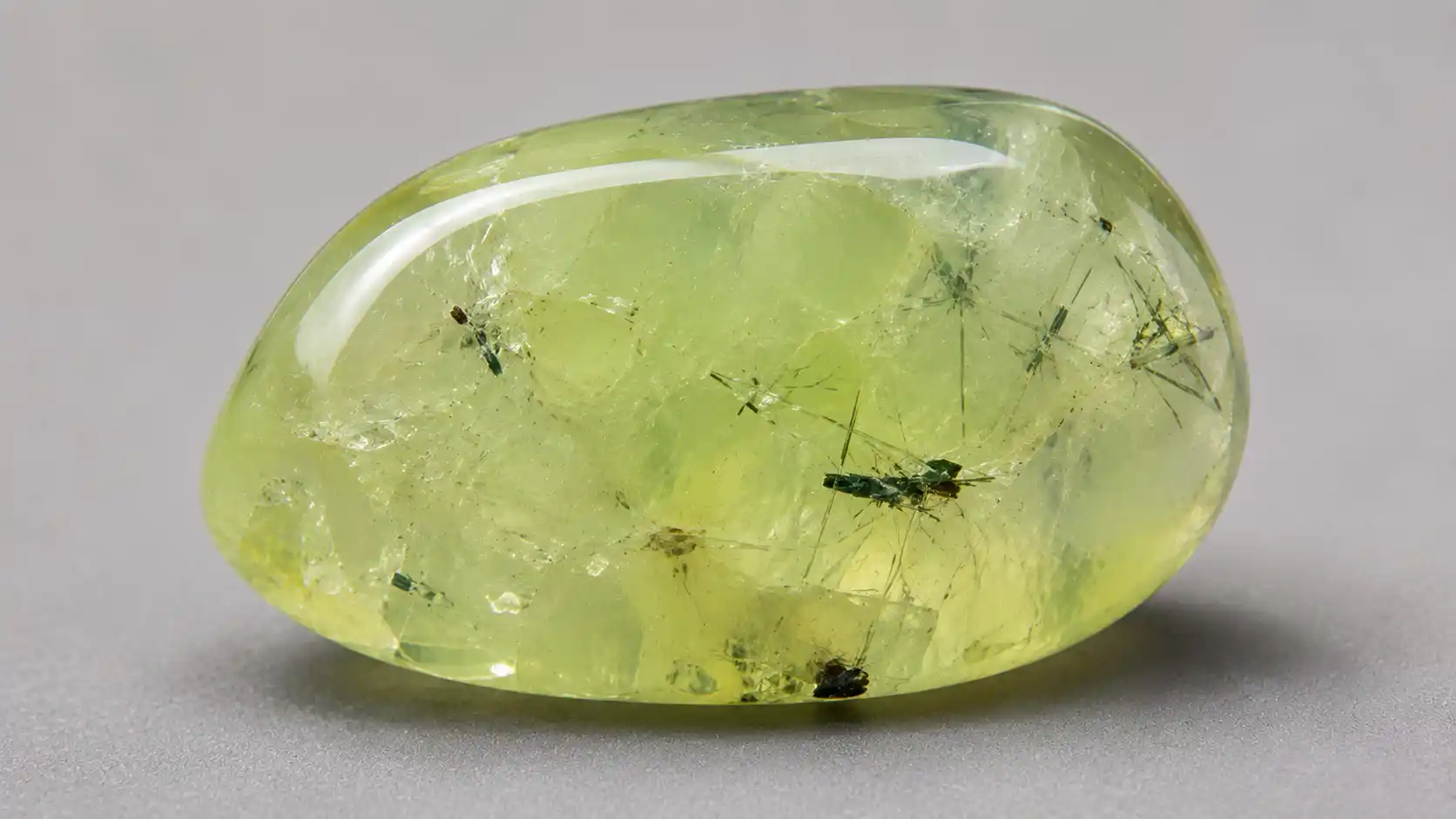
Prehnite Meaning, Healing Properties, Uses and Care
Prehnite is a calcium aluminum silicate hydroxide best known for its pale apple-green, yellow-green and softly translucent appearance. It commonly forms rounded botryoidal surfaces, fan-shaped aggregates, crusts and cavity linings rather than the sharply defined individual crystals associated with quartz or tourmaline.
The mineral develops in low-temperature hydrothermal environments and during very low-grade metamorphism, particularly within fractures and cavities in basaltic and other calcium-rich rocks. Its frequent association with epidote, calcite, zeolite minerals and apophyllite gives prehnite specimens a distinctive geological context that should not be replaced by generic “green crystal” descriptions.
Modern crystal traditions connect prehnite with preparation, calm, intuition and releasing possessions or habits that no longer serve a useful purpose. These are cultural and personal interpretations rather than scientifically established therapeutic effects.
Prehnite at a Glance
| Property | Prehnite |
|---|---|
| Mineral type | Calcium aluminum silicate hydroxide |
| Chemical formula | Ca₂Al₂Si₃O₁₀(OH)₂ |
| Crystal system | Orthorhombic |
| Common colors | Pale green, yellow-green, white, gray, yellow, colorless and uncommon pink |
| Common habit | Botryoidal, globular, reniform, fanlike, stalactitic and compact aggregates |
| Transparency | Translucent to semitransparent; transparent material is uncommon |
| Luster | Vitreous, sometimes weakly pearly |
| Mohs hardness | Approximately 6–6.5 |
| Tenacity | Brittle |
| Cleavage | Good in one direction and poorer in another |
| Specific gravity | Approximately 2.80–2.95 |
| Typical cuts | Cabochon, bead, carving and occasional faceted cut |
| Common associations | Epidote, calcite, zeolites, datolite, apophyllite and copper minerals |
| Main jewelry concern | Scratching, cleavage, brittle edges and included material |
| Common symbolic themes | Preparation, calm, intuition, organization and emotional release |
Prehnite is a mineral in its own right rather than a variety of jade, quartz or calcite. The broader types of gemstones guide explains how mineral gems, rocks, mineraloids and organic materials differ.
What Is Prehnite?
Prehnite contains calcium, aluminum, silicon, oxygen and hydroxyl groups. It crystallizes in the orthorhombic system, although collectors rarely encounter large, sharply separated crystals.
Instead, many specimens develop as compact rounded masses whose surfaces consist of tightly packed crystal blades. These aggregates can resemble clusters of grapes, bubbles, kidney-shaped forms or smooth pale-green domes.
Fine translucent material may be cut into cabochons that produce a soft internal glow. Transparent rough suitable for conventional faceting is much less common and may attract collector interest when its clarity and color are strong.
Prehnite is sometimes described casually as a zeolite because it occurs beside zeolite minerals in basalt cavities. It is not itself a zeolite. The zeolite guide owns that mineral-group distinction and its specimen-care requirements.
How Prehnite Forms
Prehnite commonly develops when hot, mineral-rich fluids move through fractures, vesicles and cavities in mafic volcanic rocks. As the fluids cool and react with the surrounding rock, calcium, aluminum and silica can crystallize as prehnite.
The mineral is also characteristic of the prehnite–pumpellyite metamorphic facies. This geological term describes very low-grade metamorphic conditions that alter existing rocks without reaching the higher temperatures and pressures associated with schist or gneiss formation.
Because prehnite forms through fluid–rock interaction, it often appears with other secondary minerals. Epidote may occur as dark green needles or crystals within pale prehnite. Calcite can develop as white or colorless crystals over prehnite surfaces.
Apophyllite and datolite may also occur in similar cavities. These associations reveal a shared geological environment, although each mineral retains its own chemistry and physical properties.
Prehnite Crystal Shapes and Textures
Botryoidal prehnite consists of rounded surfaces resembling a bunch of grapes. Reniform aggregates resemble kidney-shaped masses, while stalactitic material grows in hanging or column-like forms.
Fan-shaped aggregates develop when thin crystal blades spread outward from a common point. Under magnification, an apparently smooth dome may reveal small curved or intergrown crystal faces.
Well-formed individual crystals are unusual. When present, they may appear tabular, prismatic or steeply pyramidal. Collectors often value these crystals for their rarity rather than for the intense brilliance expected from conventional faceted gems.
Polished prehnite preserves much of this soft visual character. Cabochons can show clouds, mossy zones, needles and internal veils instead of the sharp transparency of emerald or peridot.
Prehnite Color
Light green is the color most strongly associated with prehnite. Shades include apple green, celery green, mint, yellow-green and gray-green.
The green may be even or cloudy. Some material has a milky body with brighter translucent edges, while other pieces contain dark mineral inclusions that create strong contrast.
Prehnite can also be white, colorless, yellow, gray or uncommon pink. Rare orange material has been reported from manganese-rich deposits, but unusually vivid retail colors should be examined carefully for treatment or misidentification.
The green crystals guide places prehnite within the wider symbolic color category. The green gemstones guide compares its gemological identity and jewelry performance with other green materials.
Prehnite with Epidote
Prehnite with epidote is one of the most recognizable commercial forms. Pale translucent prehnite may contain dark green, brown-green or nearly black epidote crystals.
The contrast can create branching, needle-like or landscape patterns. Some pieces are marketed as though the dark inclusions make the specimen a separate mineral variety, but the material is more accurately described as prehnite containing epidote.
Epidote inclusions can add character and support a natural appearance. Nevertheless, they may also occur beside fractures, cavities and areas of uneven polish.
A buyer should judge the entire specimen rather than assuming that more epidote always means higher quality. Fine collector pieces balance attractive crystal placement, visible prehnite color and good structural condition.
Prehnite Localities
Prehnite occurs at numerous localities because the necessary hydrothermal and low-grade metamorphic environments are geographically widespread.
South Africa is historically important because the mineral was named for Hendrik von Prehn, who was associated with material from the Cape region. Prehnite is commonly cited as one of the earliest minerals named for an individual.
Australia has produced significant quantities of gem and lapidary material, including rounded pale-green masses suitable for cabochons and beads. Namibia is known for attractive specimens associated with epidote and other cavity minerals.
Additional material comes from India, China, Pakistan, Canada, the United States and several European localities. Origin may add specimen interest, but appearance alone rarely proves where a polished stone was mined.
Is Prehnite a Type of Jade?
Prehnite is not jade. True jade consists of jadeite or nephrite, both of which differ from prehnite in composition, structure, toughness and market history.
Some pale-green prehnite can resemble jade visually, especially when cut into smooth cabochons or beads. Trade descriptions that call it “new jade,” “Cape jade” or a similar name can create confusion unless the actual mineral identity is disclosed.
Jade is noted for exceptional toughness, while prehnite is brittle and has cleavage. A prehnite carving should therefore not be expected to tolerate the same impacts as a comparable jade carving.
Prehnite Versus Green Calcite
Green calcite is generally softer and reacts readily with acids. Prehnite is harder, has different cleavage and occurs in a different crystal system.
Both may appear pale, cloudy and softly translucent. A quick visual judgment is unreliable when stones are polished.
The dedicated green calcite guide explains calcite’s identity and care. Professional testing can distinguish the materials through hardness, refractive properties and other measurements without damaging the object.
Prehnite Versus Serpentine
Serpentine includes several magnesium silicate minerals that commonly appear green, waxy and opaque to translucent.
Prehnite often has a glassier luster and a lighter internal glow. Serpentine can feel softer and may show fibrous, mottled or greasy textures.
Because both materials are sold as beads and carvings, mislabeling is possible. A seller should provide the mineral name rather than relying on vague descriptions such as “natural green stone.”
Identifying Prehnite
Prehnite identification combines color, aggregate habit, hardness, optical properties, density and associated minerals.
A rounded pale-green surface growing with epidote or calcite on basalt strongly suggests prehnite, but polished stones lose much of that geological context. Cabochons may resemble jade, chalcedony, serpentine, glass or green calcite.
The crystal identification guide provides a safe initial workflow. Avoid scratch tests on finished jewelry, acid testing, hot-needle tests or attempts to chip an edge.
A gemologist can measure refractive properties and specific gravity. Magnification may also reveal aggregate structure, cleavage-related fractures or mineral inclusions consistent with prehnite.
Treatments, Imitations and Mislabeling
Prehnite is not known for one universally routine enhancement comparable with sapphire heating or emerald oiling. However, that does not mean every commercial piece is untreated.
Dyed pale material, coated stones, glass and incorrectly labeled green minerals may appear in the market. Beads may also be stabilized or assembled without clear disclosure.
Very bright emerald-green, blue-green or uniformly neon material deserves caution. Natural prehnite generally has a restrained pastel or yellow-green appearance.
No home test proves treatment history reliably. A seller should describe whether the material is natural, dyed, coated, stabilized or composite.
Prehnite Hardness and Durability
Prehnite measures approximately 6–6.5 on the gemstone hardness chart. It can resist light wear but scratches more readily than quartz, tourmaline, sapphire or diamond.
Hardness does not describe resistance to breakage. The gemstone toughness-versus-hardness guide explains why prehnite’s brittleness and cleavage can matter more than its Mohs number after a sharp impact.
Thin cabochon edges, drilled bead holes and included areas are particularly vulnerable. Rings and bracelets receive more contact than earrings and pendants.
A prehnite ring should use a protective bezel or substantial prongs and should be removed during exercise, gardening, cleaning and mechanical work.
Prehnite Jewelry
Cabochons are the most common jewelry form because they suit translucent aggregate material. Domed cuts emphasize the stone’s glow and can position attractive epidote inclusions as part of the design.
Beads range from pale cloudy green to highly included material. Drill holes should be smooth because chipped openings can abrade thread or elastic.
Pendants and earrings are comparatively safe choices. They expose the mineral to less repeated impact and allow larger botryoidal or polished pieces to be displayed.
Faceted prehnite is uncommon but can be attractive when the rough is transparent. These stones often show soft brilliance rather than intense fire.
Yellow gold emphasizes the warm yellow-green component. Silver and white gold create a cooler contrast, while oxidized metal can complement dark epidote inclusions.
Buying Prehnite
Color should be attractive and sufficiently visible in ordinary light. Pale material can be beautiful, but it should not disappear completely against a light background.
For cabochons, examine the polish, dome symmetry and placement of inclusions. Large flat areas, pits and undercut sections may indicate weak workmanship or soft inclusions.
Collector specimens should be checked for repaired crystals, glue, unstable matrix and damage around exposed botryoidal surfaces.
The dedicated where-to-buy-prehnite guide owns seller checks, authenticity concerns and purchasing channels.
Price should reflect transparency, color, workmanship, specimen quality and rarity rather than unsupported claims of extraordinary healing strength.
Can Prehnite Go in Water?
Brief contact with clean water during ordinary physical cleaning is generally less concerning than prolonged soaking. Nevertheless, jewelry may contain adhesives, porous inclusions, fractures or metals that react differently.
Do not place prehnite in drinking water or prepare crystal elixirs. Mineral identity, surface contamination and treatments may not be known well enough to make ingestion-related rituals appropriate.
The broader crystal water-safety guide explains why hardness alone does not determine whether soaking is sensible.
Dry the stone thoroughly after cleaning, particularly around drill holes and closed settings.
Does Prehnite Fade in Sunlight?
Prehnite is not usually treated as one of the most light-sensitive gemstones, but prolonged intense sunlight and heat are unnecessary.
Strong exposure can heat the stone and setting unevenly. Dyed or coated material may also behave differently from untreated prehnite.
The sunlight-safety guide explains why display location, treatment history and temperature matter even when a mineral is not famous for rapid fading.
Store valued specimens away from windows that receive intense direct sun for many hours.
Cleaning and Storage
Use lukewarm water, a small amount of mild soap and a soft cloth or brush. Clean around settings gently rather than applying pressure to inclusions or thin edges.
Avoid steam, harsh chemicals and sudden temperature changes. Ultrasonic cleaning is not advisable for heavily included, fractured, coated or assembled material.
Store prehnite separately from harder stones. A diamond, sapphire or quartz point can scratch a polished prehnite surface.
Botryoidal specimens should rest in a padded box rather than beneath heavier minerals. Their rounded surfaces can chip when repeatedly handled or knocked against shelf edges.
Prehnite Meaning
Prehnite is commonly associated with preparation, foresight, peaceful organization and becoming ready for the next stage of a project or life transition.
Its symbolism is sometimes linked with the idea of clearing physical and emotional clutter. In a grounded practice, this can mean sorting possessions, completing an unfinished task or identifying a commitment that no longer fits.
The mineral cannot predict future events. “Foresight” is more usefully interpreted as planning, reviewing available information and considering consequences.
Emotional Healing Beliefs
Modern crystal practitioners describe prehnite as calming and reassuring. Some use it during periods of stress, indecision or emotional overload.
The stone has not been scientifically demonstrated to treat anxiety, trauma, depression or sleep disorders. It may serve as a tactile reminder to breathe slowly, organize a problem or use an established coping strategy.
The broader crystals for anxiety guide and crystals for stress guide retain those roundup intents and their safety boundaries.
Prehnite and Intuition
Prehnite is frequently marketed as a stone of intuition, inner knowing or spiritual foresight.
A grounded interpretation treats intuition as rapid judgment based on experience, pattern recognition and emotional information. It can be useful, but it can also be influenced by fear, bias or incomplete evidence.
Within the crystals for intuition guide, prehnite can represent pausing long enough to compare instinct with verifiable facts.
It should not be used to make high-stakes medical, legal or financial decisions without qualified advice.
Prehnite and the Heart Chakra
Green prehnite is commonly assigned to the heart chakra in contemporary crystal systems. It may symbolize compassion, emotional openness and releasing attachment.
The heart chakra guide explains the spiritual framework, while heart chakra crystals compares stones commonly placed within it.
Chakras are spiritual concepts rather than anatomical structures. Chest pain, palpitations or shortness of breath require medical attention rather than crystal placement.
Prehnite and the Solar Plexus Chakra
Yellow-green stones may also be connected with the solar plexus chakra, particularly when practitioners emphasize confidence, preparation and deliberate action.
The solar plexus chakra guide owns that symbolic center and its wider traditions.
A practical intention could involve choosing one responsibility, defining the next action and completing it rather than waiting to feel perfectly prepared.
Meditation with Prehnite
Prehnite’s pale color and rounded surfaces make it a comfortable visual focus for meditation.
Place the stone on a stable surface or hold a smooth cabochon without pressure. Choose one theme, such as preparation, clearing clutter or distinguishing intuition from anxiety.
The crystals for meditation guide covers the wider practice. Afterward, translate the reflection into one manageable action.
The mineral does not deliver hidden facts or guarantee prophetic dreams.
Cleansing and Combining Prehnite
Symbolic cleansing should remain physically gentle. Sound, quiet reflection or wiping the stone with a clean dry cloth avoids the risks created by salt, oils, smoke residue and prolonged soaking.
The how-to-cleanse-crystals guide explains common belief-based methods, but mineral-specific safety should always take priority.
Prehnite may be combined symbolically with epidote for growth themes, clear quartz for focus or grounding stones for practical action. Physical storage is a separate issue: harder or sharp crystals can scratch it.
The crystals-not-to-combine guide explains the difference between conflicting intentions and actual material incompatibility.
Frequently Asked Questions
1. What does prehnite symbolize?
Prehnite commonly symbolizes preparation, calm, organization, emotional release and the considered use of intuition.
2. Is prehnite a zeolite?
No. It commonly occurs with zeolite minerals in basalt cavities, but it has a different structure and composition.
3. Is prehnite a type of jade?
No. Prehnite is a calcium aluminum silicate hydroxide, while true jade is jadeite or nephrite.
4. Why is epidote found inside prehnite?
Both minerals can crystallize during related hydrothermal or low-grade metamorphic processes. Epidote crystals may become enclosed as prehnite continues growing.
5. Is transparent prehnite rare?
Transparent material suitable for faceting is less common than translucent botryoidal or compact prehnite.
6. Is prehnite suitable for everyday jewelry?
Pendants and earrings can be worn regularly with care. Rings and bracelets face greater scratching and impact risk.
7. Is prehnite commonly treated?
No single treatment dominates the market, but dyed, coated, stabilized or mislabeled material can occur and should be disclosed.
8. Can prehnite go in water?
Brief gentle washing is generally preferable to soaking. Do not use it in drinking water or crystal elixirs.
9. Can prehnite fade in sunlight?
It is not among the best-known rapidly fading minerals, but prolonged intense sunlight and heat should still be avoided.
10. Which chakra is prehnite associated with?
Modern practitioners most often connect green prehnite with the heart chakra and yellow-green stones with the solar plexus chakra.
11. Does prehnite improve intuition?
There is no scientific evidence that it creates psychic ability. It can serve as a reminder to examine intuition alongside facts and experience.
12. How should prehnite be cleaned?
Use lukewarm soapy water and a soft cloth or brush. Avoid steam, harsh chemicals, sudden heat and ultrasonic cleaning of included material.
Prehnite’s quiet appearance reflects a specific geological history: low-temperature fluids, altered volcanic rocks and growth beside epidote, calcite and cavity minerals. Its symbolism can make it a useful reminder to prepare and simplify, but its real identity is equally important. Choose pieces with honest mineral labeling, stable structure and workmanship suited to a brittle, moderately hard stone.
Prehnite is indexed in Crystals That Start With P and Gemstones That Start With P.
Prehnite healing, chakra, intuition and dream-related claims are cultural or contemporary spiritual beliefs. The mineral does not diagnose, prevent or cure medical or mental-health conditions and should not replace professional advice.