
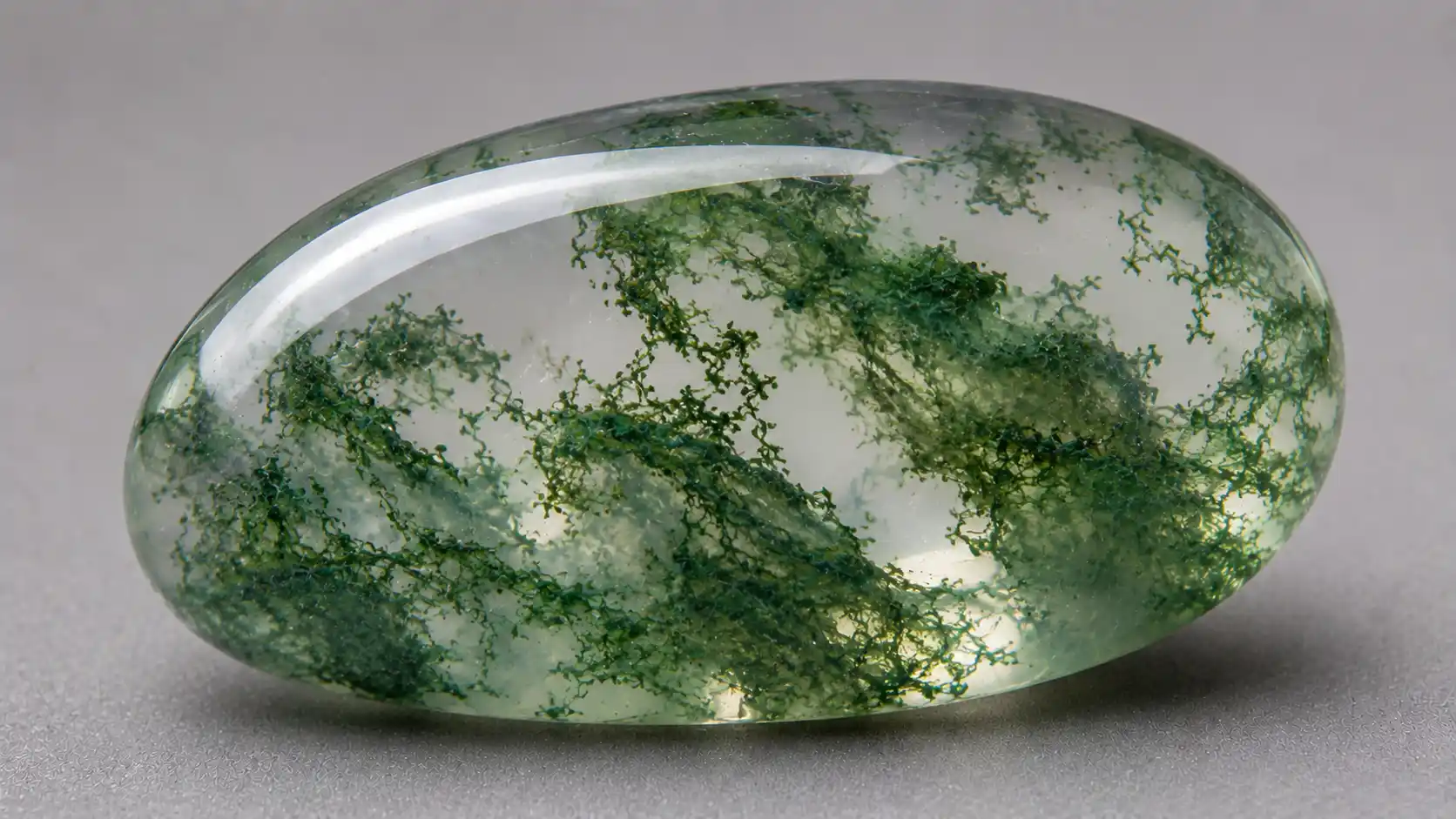

Moss Agate is translucent chalcedony containing green, brown, black, red or cream-colored mineral inclusions that resemble moss, roots, branches and miniature landscapes. Despite the name, the patterns are not trapped vegetation, fossilized plants or biological moss.
The material belongs to the quartz family and consists primarily of microcrystalline silica. Mineral inclusions formed within or alongside the chalcedony, creating scenic patterns that can look remarkably organic after cutting and polishing.
Moss Agate is traditionally associated with nature, steady growth, abundance, agriculture and emotional grounding. Those meanings come from its plantlike appearance and cultural interpretation rather than scientifically demonstrated healing energy.
Gemologically, its appeal depends on the balance between a translucent host and clearly visible inclusions. A fine stone should reveal depth, contrast and an attractive natural composition without becoming so crowded that the internal scene disappears.
Moss Agate at a Glance
| Property | Moss Agate |
|---|---|
| Material identity | Inclusion-bearing chalcedony |
| Mineral family | Quartz |
| General formula | SiO₂ |
| Structure | Microcrystalline quartz and moganite intergrowth |
| Typical bodycolor | Colorless, white, gray or pale translucent chalcedony |
| Inclusion colors | Green, brown, black, rust red, yellow and cream |
| Common inclusion types | Chlorite, celadonite, amphibole-related minerals, iron oxides and manganese oxides |
| Transparency | Transparent at thin edges to translucent or nearly opaque |
| Luster | Waxy to vitreous when polished |
| Mohs hardness | Approximately 6.5–7 |
| Cleavage | None |
| Fracture | Conchoidal to uneven |
| Common cuts | Cabochons, slices, beads, carvings and freeforms |
| Main quality factor | Attractive inclusion pattern visible through a sufficiently clear host |
| Main care concern | Hard impact, hidden fractures, dye and resin-filled material |
What Is Moss Agate?
Moss Agate is a descriptive variety of Agate or, more precisely in many specimens, inclusion-bearing Chalcedony.
Strict mineralogical use of the word agate often implies visible banding. Many Moss Agates show little or no regular banding, so some gemologists prefer the term moss chalcedony.
The traditional trade name remains widely accepted because the inclusions create the material’s defining appearance. Whether a specimen is called Moss Agate or moss chalcedony does not change its underlying quartz-family composition.
The Types of Agate guide places it among banded, plume, dendritic, fire, lace and other commercial varieties without implying that every trade variety has identical structure.
Is There Real Moss Inside Moss Agate?
No biological moss is present.
The green clouds, filaments and branching forms consist of minerals that grew, precipitated or became enclosed within silica. Their forms can resemble plants because minerals may spread through cracks and fluid pathways in branching or feathery patterns.
This resemblance is an example of visual pattern recognition. Human perception readily identifies forests, trees, underwater plants and landscapes within irregular mineral forms.
A stone may look like a fern or miniature garden without preserving any former organism. Sellers should not describe the inclusions as fossil moss unless independent geological evidence identifies actual fossil material, which ordinary Moss Agate does not contain.
What Creates the Mosslike Inclusions?
The inclusions do not have one universal composition.
Green areas may contain chlorite, celadonite, nontronite, hornblende, actinolite or related iron- and magnesium-bearing silicates. Brown, black and reddish patterns may involve manganese oxides, iron oxides, goethite, hematite or other mineral phases.
Color alone cannot identify the exact mineral. Several inclusion species can produce similar greens or browns, while microscopic mixtures may occur within one stone.
Some inclusions form soft clouds or filaments suspended through the chalcedony. Others occupy thin fractures and produce sharply branching dendrites.
A laboratory may use microscopy, Raman spectroscopy, X-ray diffraction or chemical analysis when the inclusion identity matters scientifically.
How Moss Agate Forms
Moss Agate commonly develops in cavities, fractures and porous zones within volcanic or other silica-bearing rocks.
Silica-rich fluids enter the available space and deposit microscopic quartz and related silica phases. Mineral-bearing fluids may arrive during the same episode or through later fractures.
As conditions change, green silicates or iron- and manganese-rich compounds precipitate within the developing chalcedony. Repeated fluid movement can create several generations of inclusion growth.
The final piece may contain transparent areas, white chalcedony, quartz-lined cavities, weak banding and several inclusion colors.
Formation is therefore not one simple act of moss-shaped minerals being trapped in finished agate. It can involve multiple episodes of silica deposition, cracking, mineral growth and rehealing.
Moss Agate vs Dendritic Agate
Moss Agate and Dendritic Agate overlap, but their typical visual emphasis differs.
Moss Agate commonly contains soft green filaments, clouds, plumes and irregular plantlike masses. The inclusions may look three-dimensional and appear suspended at different depths.
Dendritic Agate usually shows sharper tree- or fern-like branches. Black and brown manganese or iron oxides commonly spread along thin fractures, producing flatter graphic patterns.
A specimen can contain both mossy clouds and distinct dendrites. Commercial naming often depends on which feature dominates.
Neither material contains actual plants. The words moss and dendritic describe appearance rather than biological origin.
Moss Agate vs Tree Agate
Tree Agate usually has an opaque or nearly opaque white body with green branching inclusions.
Moss Agate tends to be more translucent, allowing the inclusions to appear suspended inside the material.
The distinction is commercial rather than a strict boundary between mineral species. Both belong to inclusion-bearing chalcedony and can use similar descriptive language.
A translucent stone with visible depth is generally marketed as Moss Agate. An opaque white stone with bold green branching patterns is more likely to be sold as Tree Agate.
Photographs should show whether light passes through the host instead of relying only on the product name.
Colors and Pattern Types
Moss Agate is best known for green inclusions, but natural stones can contain black, brown, red, orange, yellow and cream-colored features.
Green patterns may resemble moss beds, underwater plants, fields or forests. Black and brown dendrites create sharper branches, while red iron staining can produce autumnal or landscape-like scenes.
The host can be colorless, smoky gray, milky white or faintly blue.
The Agate Color Meaning guide covers the symbolism attached to agate colors without treating color as proof of locality or mineral composition.
Some stones include open cavities lined with tiny Quartz crystals. These vugs can add interest but may collect dirt and weaken thin sections.
Important Sources
Moss Agate occurs in several countries rather than one exclusive deposit.
India supplies substantial quantities of green inclusion-bearing material used in beads, cabochons and carvings. Brazil, Uruguay, Madagascar, Indonesia and parts of Africa also produce scenic chalcedony.
The United States is known for material from several western states. Montana Moss Agate, especially material associated with Yellowstone River gravels, often contains translucent chalcedony with black, brown or red iron- and manganese-rich patterns.
A locality name should be supported by reliable provenance. Color and pattern may suggest a regional style, but they cannot prove one mining district.
Quality Factors
Moss Agate is judged differently from a uniformly colored transparent gemstone.
The inclusion pattern is the primary attraction. Fine stones may resemble balanced landscapes, forests, branches or underwater scenes without looking artificially arranged.
Host clarity matters because the moss should remain visible at several depths. Excessive milkiness can obscure the scene, while an entirely clear host with sparse weak inclusions may lack character.
Contrast also contributes to value. Dark green or black forms against pale translucent chalcedony are easier to see than low-contrast gray inclusions.
Cutting should frame the strongest part of the scene. A careless cut can remove the best branch, place an empty area at the center or expose an inclusion that was structurally weak.
Polish, fracture condition, size and rarity of the pattern complete the evaluation.
Cutting Scenic Moss Agate
The cutter often approaches Moss Agate like a miniature landscape rather than a uniform block of color.
A thin slice can reveal depth and backlighting, while a high cabochon can preserve several layers of inclusions. Freeform cuts allow the outline to follow the most attractive natural scene.
The design should avoid major cracks, open cavities and weak inclusion boundaries near the girdle.
Backlighting may make a stone look far more transparent than it appears in ordinary jewelry. Buyers should examine both transmitted and reflected-light images.
Matched pairs are difficult because no two inclusion patterns are identical. Earrings can coordinate in color and visual weight without reproducing the same internal scene.
Moss Agate Jewelry
Moss Agate is suitable for pendants, earrings, beads, brooches and carefully worn rings.
Its hardness provides reasonable scratch resistance, as shown in the Gemstone Hardness Chart. However, internal fractures and open vugs can create local weaknesses.
Pendants and earrings provide the safest positions for highly scenic or thin material. Rings should use a bezel or another setting that protects the perimeter.
Bead strands need smooth drill holes. A hidden chip can cut elastic or cord and may expand through repeated pressure.
The stone should remain separated from Sapphire, Diamond, Topaz and other harder gems during storage.
Moss Agate Engagement Rings
Moss Agate has become popular in alternative engagement rings because each stone offers a unique landscape.
The visual individuality does not make it as durable as Diamond or Sapphire. A ring intended for daily bridal wear should use a structurally sound cabochon or rose cut, a low protective setting and realistic removal habits.
Resin filling, backing and doublet construction must be disclosed. A thin scenic slice may be mounted over another material to strengthen the image.
The buyer should also consider replacement. An exact internal pattern cannot be reproduced if the center is lost or broken.
A unique stone can remain meaningful without being represented as maintenance-free.
Treatments and Alterations
Natural Moss Agate may be dyed to intensify green, blue, red or black color.
Resin can enter fractures or open cavities, while surface coating may improve apparent polish. Thin slices can be backed or assembled with another material.
Artificially etched surfaces and manufactured resin pieces may imitate natural inclusions.
The broader Treated Agate guide owns dye, filling, coating and reconstructed-material questions.
Treatment does not automatically make a piece unsuitable, but it changes care and value. The seller should disclose whether the color and structural appearance are natural.
Imitations
Glass, resin and polymer products can contain suspended green material that resembles moss.
Some imitations show round gas bubbles, repeated patterns, flow lines or inclusions that look embedded in a perfectly uniform manufactured host.
Natural Moss Agate usually contains irregular mineral forms integrated with chalcedony, although visual inspection alone may not resolve every case.
The Real vs Fake Agate guide owns the complete authentication process.
Do not use flame, hot needles, acids or destructive scratch tests. A gemologist can combine microscopy, refractive index, density and spectroscopy when identification matters.
Buying Moss Agate
The dedicated guide to Where to Buy Real Moss Agate owns seller evaluation and purchase checks.
Request photographs of the front, back and side under neutral light. A video should show how the pattern changes when the stone moves and whether fractures reach the surface.
Ask whether the material is dyed, resin-filled, backed or assembled. The seller should provide exact dimensions rather than carat weight alone because cabochons and slices vary widely in depth.
Price should reflect pattern quality, transparency, cutting, structural condition and workmanship. A marketing phrase such as rare forest scene is not a substitute for examining the actual stone.
Moss Agate Meaning
Moss Agate traditionally symbolizes growth, patience, nature, renewal and steady progress.
The visual association is direct: green mineral patterns resemble plants extending through pale earth or water.
Rather than symbolizing sudden transformation, Moss Agate is commonly interpreted as gradual development. It may represent a project that needs consistent attention, a relationship growing through trust or recovery supported by repeated small actions.
These meanings are cultural and personal. The mineral does not biologically stimulate growth or cause an external situation to improve.
Healing Properties and Emotional Traditions
The broader Agate Healing Properties guide covers shared Agate traditions.
Moss Agate is often described as emotionally stabilizing, calming and supportive during slow change. Some practitioners use it when they feel disconnected from routine, community or the natural environment.
There is no scientific evidence that Moss Agate treats anxiety, depression, inflammation, infection or chronic illness.
A grounded use might involve holding the stone while identifying one sustainable habit. The benefit comes from planning and repetition rather than energy emitted by chalcedony.
Grounding and Connection With Nature
Moss Agate appears frequently among Crystals for Grounding.
Its patterns can act as reminders to slow down, observe physical surroundings and reconnect with ordinary routines.
Practical grounding includes eating, sleeping, walking safely, noticing sensory details and contacting supportive people.
The stone cannot protect someone from environmental hazards, prevent falls or replace mental-health support.
Its natural imagery can make a grounding exercise more engaging without being the source of the physiological effect.
Money, Work and Abundance
Moss Agate is sometimes called a gardener’s stone, agriculture stone or abundance stone.
Modern practitioners place it among Crystals for Money and Abundance because plantlike patterns suggest growth and accumulated results.
It cannot generate income, improve soil chemistry, increase crop yield or guarantee business success.
A responsible abundance practice can connect the stone with budgeting, saving, learning a skill or completing one revenue-producing task.
That approach preserves the symbolism while keeping financial outcomes connected to behavior and circumstances.
Manifestation and Long-Term Goals
Moss Agate is also used among Crystals for Manifestation.
Its strongest symbolic role involves persistence rather than instant results.
Write the desired outcome, identify what can be measured and choose the next action. Review progress regularly instead of treating the stone as proof that success is already guaranteed.
Moss Agate cannot override another person’s choices, remove market risk or ensure a requested event.
Heart Chakra Associations
Green Moss Agate is commonly connected with the Heart Chakra.
Within this spiritual framework, it may represent compassion, patience, trust and connection with living systems.
Chakras are cultural and spiritual concepts rather than measurable anatomical structures.
The stone cannot treat heart disease, blood pressure, respiratory conditions or chest symptoms.
A heart-centered reflection can focus on one relationship that needs appreciation, honesty or a clearer boundary.
Meditation and Personal Use
Moss Agate works well as a visual meditation stone because the internal patterns reward slow observation.
Place the stone on a stable cloth and follow one branch or cloud through the chalcedony. Notice where the pattern becomes clear, disappears and returns at another depth.
A journal entry can describe the scene and connect it with one current process that requires patience.
The practice may support attention, but the stone does not induce altered consciousness or reveal future events.
Cleaning and Care
Use lukewarm water, mild soap and a soft brush or cloth.
Avoid steam and ultrasonic cleaning when the stone contains fractures, open cavities, resin or assembled construction.
Do not soak dyed or backed material. Prolonged water exposure may affect adhesives and fillers even though stable untreated chalcedony itself tolerates brief washing.
Dry around drill holes and vugs carefully.
Store Moss Agate separately in a padded compartment. The Green Crystals guide provides broader color-based context, while Crystals That Start With M and Gemstones That Start With M place it within the alphabetical directories.
Frequently Asked Questions
1. What is Moss Agate?
Moss Agate is translucent chalcedony containing mineral inclusions that resemble moss, plants, branches or landscapes.
2. Is there real moss inside the stone?
No. The patterns consist of minerals such as chlorite, celadonite, iron oxides or manganese oxides.
3. Is Moss Agate a true Agate?
It is an accepted trade variety, although many pieces lack the regular banding expected from Agate in a strict mineralogical definition.
4. What is the difference between Moss Agate and dendritic Agate?
Moss Agate commonly has softer green clouds and filaments. Dendritic Agate usually shows sharper black or brown tree-like branches.
5. How is Tree Agate different?
Tree Agate generally has an opaque white host, while Moss Agate is usually more translucent and shows greater internal depth.
6. What creates the green color?
Green inclusions may contain chlorite, celadonite, amphibole-related minerals or other iron-bearing silicates.
7. Is Moss Agate durable?
Its hardness is approximately 6.5–7, but internal fractures, open cavities and thin edges can still break.
8. Can Moss Agate be dyed?
Yes. Dye may intensify green, blue, red or black color and should be disclosed.
9. Is Moss Agate suitable for an engagement ring?
It can be used in a protected setting with careful wear, but it is less durable and less replaceable than Diamond or Sapphire.
10. Does Moss Agate attract money?
No scientific evidence supports that claim. It can be used symbolically alongside budgeting and practical work.
11. Does Moss Agate have healing properties?
Medical and emotional-healing claims are not scientifically established. The stone can serve as a personal reflection or habit cue.
12. How should Moss Agate be cleaned?
Use lukewarm water, mild soap and a soft brush. Avoid steam, ultrasonics and prolonged soaking when treatment or assembly is uncertain.
Moss Agate turns mineral growth into an image that resembles biological growth. Chalcedony supplies the translucent field, while several possible inclusion minerals create the apparent branches, roots and forests. Its traditional symbolism follows naturally from that appearance, but the real achievement belongs to geology: fluids, silica and mineral precipitation building a landscape without a single living plant.
Moss Agate healing, abundance, manifestation, chakra and agricultural claims are cultural or personal beliefs rather than scientifically established effects. Do not use the gemstone to replace medical care, mental-health support, financial planning or evidence-based agricultural practice.