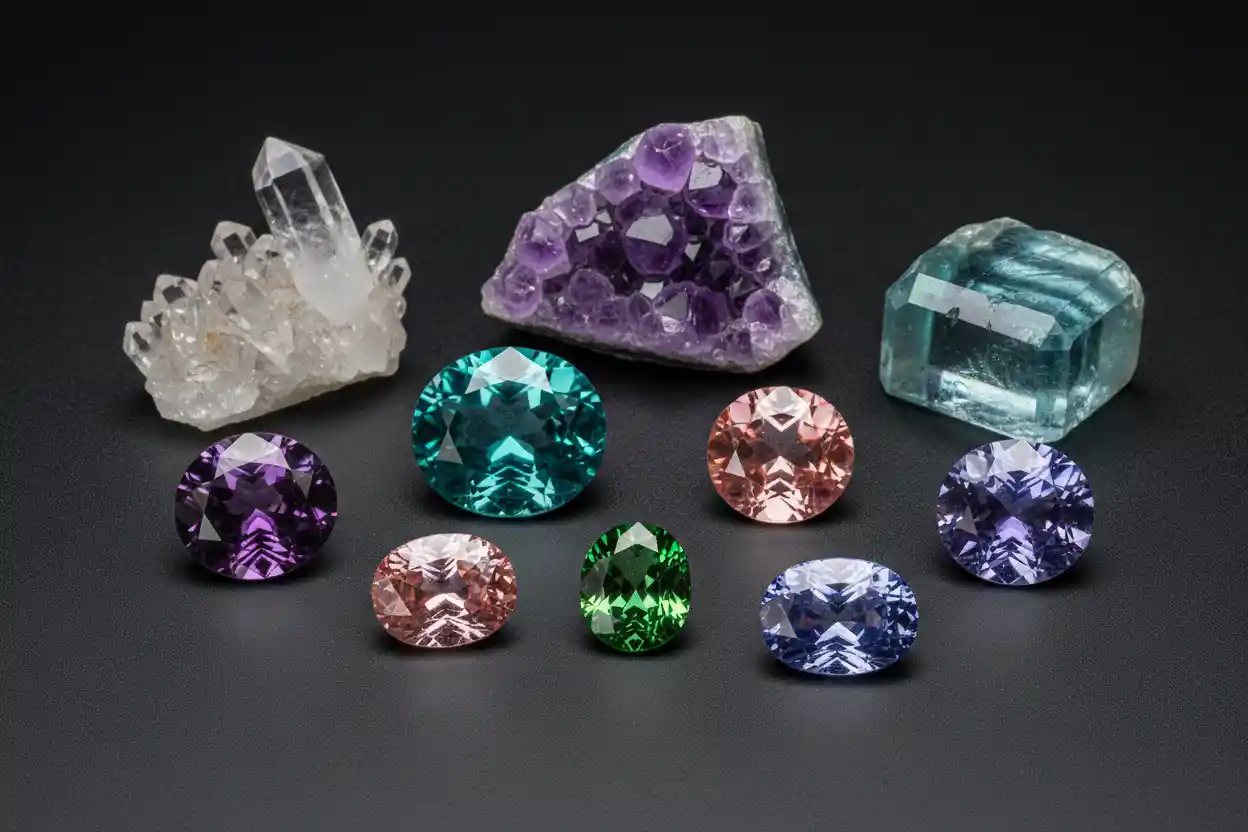
Rarest Gemstones in the World: Scarce Stones, Origins & Value Factors
The rarest gemstones in the world cannot be placed into one permanent, scientifically precise ranking. Rarity can describe a mineral species found at very few localities, a familiar mineral that almost never forms transparent gem material, or a gemstone that becomes exceptionally scarce above a certain size. Commercial supply creates another distinction because geological abundance does not automatically predict what reaches the gem market. Collector demand, documented origin, durability, color, clarity, treatments, and laboratory confirmation can further change how scarcity translates into value. This is why a gemstone described as extremely rare may sell for less than a more familiar ruby, sapphire, emerald, or diamond. Likewise, the stone with the highest public sale price is not automatically Earth’s rarest gem. Readers comparing rarity with monetary records should treat the most expensive gemstones as a separate question from geological or gem-quality scarcity. GIA likewise identifies rarity as only one factor within a broader value equation that includes size, durability, beauty, history, and origin.
At a Glance: What Does “Rare” Mean for a Gemstone?
| Type of rarity | What it describes | Why it matters |
|---|---|---|
| Mineral rarity | How uncommon the mineral species itself is in nature | A species may occur at only a few known geological environments |
| Gem-quality rarity | How rarely the material forms transparent, attractive, cuttable crystals | A mineral can exist in nature yet provide almost no facetable rough |
| Locality rarity | Dependence on one deposit or a very small group of deposits | Exhaustion or interrupted mining can sharply constrain supply |
| Size scarcity | How quickly availability falls as clean crystal or cut-stone size increases | A one-carat example may be scarce while a multi-carat example is exceptional |
| Commercial scarcity | How little material reaches normal gem and jewelry markets | Geological existence does not guarantee regular market availability |
| Collector scarcity | Limited supply of desirable crystals, specimens, or verified cut gems | Specialized collectors can compete for material ignored by mainstream jewelry buyers |
| Origin scarcity | Rarity associated with a historically or gemologically important source | Verified provenance may add desirability when origin can be established |
| Quality scarcity | Rarity of an unusually strong combination of color, clarity, cut, size, and phenomena | Fine quality can be dramatically scarcer than average material of the same gem |
Rarest gemstones in the world often conflict
These categories explain why descriptions of the rarest gemstones in the world often conflict. One list may emphasize uncommon mineral species, while another focuses on faceted gems that rarely enter commerce. A third may measure price, even though price reflects demand as well as scarcity. Gemology therefore benefits from describing the specific kind of rarity instead of treating “rare” as a single measurable property. A mineral could be exceptionally scarce but visually modest, fragile, poorly known, or difficult to facet. Another gem could occur in several countries yet become extraordinarily difficult to find with ideal color, clarity, size, and origin. That second stone may command far stronger prices because more buyers recognize it and compete for the finest examples. The distinction also prevents old discovery stories from becoming misleading market claims when later mining reveals additional material.
There Is No Permanent Scientific Ranking of the Rarest Gemstones
A fixed numbered ranking becomes unreliable because gemstone availability changes whenever miners locate new deposits or recognize material that was previously overlooked. Painite provides one of the clearest examples. For many years, only a tiny number of painite crystals were known, which established its reputation as an extraordinary mineralogical rarity. Later discoveries around the Mogok region of Myanmar produced additional crystals and revealed new occurrences. Those discoveries did not make painite common, but they invalidated the old idea that the world’s entire supply consisted of only a few specimens. GIA documented this change and described how the perception of painite’s extreme rarity shifted after additional material appeared.
This pattern matters beyond painite. Improved exploration can uncover new deposits, while laboratory testing can identify stones that dealers previously classified as more familiar materials. Mining conditions also change. A productive pocket may release unusually fine rough for a brief period and then disappear. New material can reduce scarcity in one size or quality range without making exceptional stones abundant. For that reason, a careful discussion of gemstone rarity should identify why each material is scarce rather than claim an unsupported global order. It should also avoid statements such as “only ten exist” unless a reliable inventory truly documents every known specimen. Geological discovery remains an active process, so absolute counts are unusually vulnerable to becoming obsolete.
Rare Mineral Species and Rare Gem-Quality Varieties Are Different
Mineralogists define minerals by properties such as chemistry and crystal structure, while gemology asks an additional question: can suitable material become an attractive and reasonably durable gem? Some extremely uncommon mineral species attract collectors because the species itself is rare. Their faceted examples may be even scarcer because most crystals are opaque, included, tiny, fractured, or unsuitable for cutting. Painite, poudretteite, jeremejevite, grandidierite, taaffeite, and musgravite belong naturally in discussions of rare gem minerals because their mineralogical scarcity combines with limited supplies of attractive cut material. Their identities can also require advanced analytical work when physical properties overlap with related species.
A gem-quality variety presents another type of scarcity. Red beryl, for example, belongs to the familiar beryl mineral species, yet its red gem material is exceptionally restricted. Alexandrite is chrysoberyl rather than a separate mineral species, but the combination of color change, attractive color, transparency, size, and quality can make fine examples very scarce. Emerald provides a useful contrast. Emerald itself has substantial global recognition and several major producing regions, yet an unusually clean stone with excellent color can still be rare within its quality class. GIA notes that eye-clean emeralds are especially valuable because most emeralds contain visible inclusions. This is why mineral rarity and gem-quality rarity should never be treated as interchangeable terms.
Painite: A Lesson in Changing Rarity
Painite remains an important rare gem mineral, but its history also demonstrates why old scarcity statistics require caution. The mineral became famous after only a very small number of crystals were documented for decades. Additional discoveries in Myanmar later expanded the known supply, including material from secondary deposits around the Mogok area. GIA reported that these findings changed the earlier picture of painite as a mineral represented by only a few known crystals. The correct conclusion is not that painite became ordinary. Instead, its story shows that “rarest gemstone” claims can age badly when they depend on an early specimen count.
Gem-quality scarcity still matters greatly for painite because finding the mineral does not guarantee transparent, attractive, facetable material. Color, clarity, crystal size, fractures, and cutting potential separate mineral specimens from desirable finished gems. Mogok itself contains an unusually diverse geological environment and has produced both major commercial gems and rare collector minerals, including painite. Buyers therefore need more information than a dramatic rarity label. A properly identified painite with good transparency and strong appearance can have substantial collector interest, but its market should not be described through outdated claims about a fixed worldwide specimen count.
Taaffeite: Rare, Easily Confused and Historically Unusual
Taaffeite occupies a distinctive place among rare gemstones because its recognition began with an already cut stone rather than a newly collected crystal. GIA describes taaffeite as one of the rarest gemstone minerals and notes that Richard Taaffe recognized the unusual specimen after it had entered the jewelry trade as an apparent spinel. That history highlights a practical problem with unusual gem species: physical resemblance to another gemstone can conceal rare material in mixed parcels or older collections. Taaffeite has since been documented from sources including Sri Lanka and Myanmar, and GIA’s gem collection contains faceted examples from both countries.
Rarity does not mean that every taaffeite deserves the same value. Color, clarity, cut, size, laboratory identification, and overall attractiveness remain critical. Some specimens carry more collector interest than jewelry appeal, while stronger colors and cleaner faceted stones can attract a broader audience. Identification also matters because taaffeite belongs to a mineral group containing closely related materials. A seller’s name alone cannot replace gemological evidence when the stone’s value depends heavily on its exact species. This principle becomes even more important when separating taaffeite from musgravite.
Musgravite: Extreme Gem Scarcity with an Identification Challenge
Musgravite, commonly referred to in modern mineralogical terminology as magnesiotaaffeite, belongs to the taaffeite group and remains highly sought after among rare-stone collectors. GIA describes musgravite as a rare mineral closely related to taaffeite and has documented individual faceted specimens through advanced testing. Its scarcity becomes particularly meaningful when material is transparent enough for faceting, has an attractive appearance, and reaches a useful size. The market therefore responds not simply to the name musgravite but to the unusual combination of confirmed identity and gem quality.
Laboratory confirmation deserves special attention because ordinary gemological observations may not reliably distinguish musgravite from taaffeite. In examinations of suspected Myanmar material, GIA noted overlapping physical properties and used Raman spectroscopy for conclusive identification. The same report explained that Raman spectroscopy or X-ray diffraction can distinguish the two minerals. This makes documentation part of the practical value equation. A buyer considering an expensive rare stone should not rely on appearance or a seller’s verbal identification when analytical testing can resolve the species. Readers comparing scarcity, quality, size, and market behavior can explore these factors further in the Gems Lore guide to musgravite price.
Poudretteite: From Tiny Crystals to Rare Faceted Gems
Poudretteite demonstrates the difference between discovering a mineral and establishing it as a gemstone. The borosilicate was initially known from tiny crystals at Mont Saint-Hilaire in Quebec, Canada. A gem discovered in Mogok, Myanmar, later provided material suitable for detailed gemological study and showed that poudretteite could occur as a facetable gemstone. GIA’s examination characterized the material using advanced chemical and spectroscopic methods. This history makes poudretteite a strong example of genuine mineral rarity combined with gem-quality rarity.
The gemstone market adds another layer because very uncommon species often have limited mainstream recognition. A visually beautiful ruby, sapphire, emerald, or diamond can attract buyers who already understand the category. Poudretteite requires more specialized knowledge, which concentrates demand among collectors and rare-gem specialists. That does not diminish its scarcity. It simply demonstrates why geological rarity and market value do not move in a perfectly straight line. A documented specimen with attractive color, good transparency, substantial size, and confirmed identification may be highly desirable within its niche. An included or weakly colored stone can remain mineralogically rare while attracting far less commercial demand.
Grandidierite: When Transparent Material Is Far Rarer Than the Mineral Name Suggests
Grandidierite is an uncommon magnesium-iron aluminous borosilicate first associated with Madagascar. It commonly appears in bluish green to greenish blue tones, but transparent gem-quality crystals are much more difficult to obtain than the simple existence of the mineral suggests. Research on a Madagascar deposit documented transparent crystals that could be faceted into small, eye-clean jewelry-quality stones. GIA described grandidierite itself as extremely rare while showing that newer discoveries expanded access to usable material.
That distinction prevents an important misunderstanding. A new deposit does not automatically erase rarity because the percentage of material suitable for transparent faceted gems may remain small. Rough crystals can contain fractures, inclusions, unfavorable shapes, or areas with insufficient transparency. Cutting also reduces weight as the cutter removes unsuitable sections and creates a balanced finished gem. Larger clean stones therefore become disproportionately difficult to produce. Grandidierite illustrates how mining volume, facetable yield, finished size, and visual quality should all enter a serious rarity assessment. Simply counting known localities tells only part of the story.
Jeremejevite: Rare Mineral, Collector Gem and Limited Fine Material
Jeremejevite is a rare aluminum borate mineral that can form prismatic crystals in geological environments associated with pegmatitic or volcanic deposits. GIA continues to examine jeremejevite as an unusual gem material and describes the species as rare. Earlier gemological research also documented faceted specimens and used spectroscopy and chemical analysis to establish reliable identifying information for a gemstone that had received relatively little coverage in standard gem references.
For collectors, jeremejevite can be desirable both as natural crystal specimens and as faceted gems. Those two markets do not always value the same characteristics. A sharp crystal with interesting morphology may appeal strongly to a mineral collector even when cutting it would destroy much of its specimen value. A jewelry buyer, by contrast, may prioritize transparency, color, brilliance, wearable proportions, and an attractive cut. This difference creates a form of collector scarcity that cannot be measured through faceted supply alone. Fine pieces can therefore remain difficult to replace even when more modest examples occasionally reach the market.
Benitoite: Locality-Limited Gem Quality
Benitoite is a barium titanium silicate closely associated with California’s New Idria district in San Benito County. The mineral has been found in small quantities elsewhere, but GIA notes that the California occurrence produced the greatest number and best-quality crystals. Detailed research on the district described commercial quantities of gem-quality benitoite from the Benitoite Gem mine and documented its geological occurrence in altered blueschist within serpentinite. Its vivid blue color, high dispersion, and unusual locality history give the material an identity beyond rarity alone.
Size adds another scarcity layer. GIA’s discussion of colored gemstone value uses benitoite as an example of a gem that is rarely encountered above a few carats. That means two benitoites of similar color and clarity can occupy very different rarity classes if one is substantially larger. A collector considering benitoite should therefore examine size together with color, transparency, cut quality, and documentation. The mineral’s restricted gem-quality production history makes locality particularly important, but locality does not eliminate the need to judge the individual stone.
Red Beryl: A Familiar Mineral Species with Exceptionally Scarce Gem Material
Red beryl shows why a rare gemstone does not have to belong to an obscure mineral species. It belongs to beryl, the same mineral family that includes emerald and aquamarine. Yet natural gem-quality red material has an exceptionally restricted occurrence. GIA’s research identified the Ruby Violet deposit in Utah’s Wah Wah Mountains as the only known commercial occurrence of gem-quality red beryl in its detailed study, and later GIA reporting continued to note that gem-quality red beryl had been mined only in Utah.
Facetable yield makes the scarcity even more significant. GIA’s deposit study estimated that only a fraction of recovered red beryl production was suitable for faceting. Size also becomes critical because many finished gems are very small. GIA reporting from the trade described half-carat stones as large and stones above one carat as exceptionally rare within that material. These figures belong to documented production context rather than a universal promise about current inventory. They nevertheless illustrate how locality restriction, facetable yield, and size scarcity can combine to make a gem variety far rarer than its parent mineral.
Alexandrite: Rare Quality Matters More Than the Name Alone
Alexandrite is the color-change variety of chrysoberyl, and fine material remains exceptionally scarce. The original Russian deposits established the gem’s reputation, but alexandrite has since been found in countries including Brazil, Sri Lanka, Tanzania, and other parts of East Africa. GIA emphasizes that fine material is still rare despite these additional sources. This makes alexandrite a useful counterexample to the idea that a gemstone must come from one locality to qualify as genuinely scarce.
Quality depends strongly on the color-change effect. Desirable stones show attractive colors under different illumination, good saturation, usable clarity, and enough transparency to display the phenomenon clearly. Size adds another premium because attractive jewelry-quality alexandrites commonly occur below one carat, while fine larger stones are much harder to obtain. Geographic origin can influence market value as well. GIA research has shown that origin carries commercial importance for alexandrite and has developed laboratory methods using trace-element chemistry, inclusions, and other characteristics to evaluate source. A detailed look at these interacting factors appears in the Gems Lore guide to alexandrite price.
Haüyne and Other Collector Gems Show Another Type of Scarcity
Haüyne illustrates how some stones remain much better known to specialist collectors than to mainstream jewelry buyers. GIA has described haüyne as both a rare mineral and an extremely rare gemstone. Gem-quality blue material from Germany is particularly recognized, while laboratory examination has also documented unusual green gem-quality material from Afghanistan. New color or locality discoveries can therefore broaden scientific knowledge without turning the material into an ordinary commercial gem.
This pattern applies to several collector-oriented species. Rarity may arise from limited geological occurrence, tiny crystal size, poor durability, cutting difficulties, or the small proportion of crystals with useful transparency. Such stones can be genuinely scarce even when their prices remain below those of prestigious commercial gems. A narrow buyer base can restrain prices because value requires demand as well as limited supply. Collectors may still compete strongly for an exceptional crystal or faceted example when its quality, size, provenance, or unusual optical properties separate it from ordinary specimens. This is another reason rarity should never be inferred from retail price alone.
Locality-Limited Occurrence Can Create Powerful Scarcity
Some gemstones owe much of their scarcity to geological conditions found in very few places. Red beryl’s Utah occurrence and benitoite’s classic California deposit demonstrate this clearly. Locality restriction can limit future production because a gem cannot simply be mined somewhere else when one deposit becomes inaccessible, uneconomic, exhausted, or highly irregular. It also creates provenance value when a particular locality develops scientific, historical, or collector significance. Yet geographic restriction does not guarantee high prices because the gem still needs enough beauty, durability, market recognition, and demand to support a strong commercial market.
The reverse also occurs. A gem may have many global localities but very few sources capable of producing top material. Alexandrite occurs in several countries, yet stones combining strong color change, appealing hue, clarity, and larger size remain scarce. Emerald has numerous important mining regions, but exceptional stones can command very high values because quality varies dramatically. GIA stresses that subtle differences in emerald color, transparency, clarity, and treatment can strongly affect value. Readers comparing those variables can use the Gems Lore guide to emerald price rather than assuming every rare-looking emerald belongs to the same value tier.
Size Scarcity Changes the Meaning of “Rare”
Carat weight must be interpreted within the normal size distribution of a specific gemstone. A five-carat quartz does not represent the same level of scarcity as a five-carat benitoite, red beryl, or fine alexandrite. Crystal growth conditions, fractures, inclusions, rough shape, and cutting losses limit the finished sizes available for each material. As stones move beyond the sizes commonly encountered for their species or variety, supply can decline sharply. GIA specifically notes that gemstone value per carat can increase with size when larger examples enter a range where demand remains strong and supply becomes limited.
Large size alone still cannot define quality. A rare gemstone may gain weight by retaining dark areas, inclusions, poor proportions, or an unattractive cut. Another cutter might sacrifice weight to improve brilliance and face-up appearance. Buyers should therefore ask whether a large stone remains attractive rather than treating carat weight as a standalone achievement. This issue becomes especially important in species where fine transparent rough is already scarce. A clean, well-cut multi-carat gem can represent several overlapping filters: the crystal had to grow large enough, survive geological processes, remain sufficiently transparent, reach the cutter intact, and retain substantial weight after fashioning.
Rarity Alone Does Not Determine Gemstone Value
A gemstone’s market value develops from an interaction between scarcity and desirability. GIA identifies rarity, size, durability, beauty, lore, and geographic origin among factors that can affect colored-stone value. Color, clarity, cut, size, and origin also interact within individual stones rather than operating independently. This explains why an obscure mineral found in only a handful of geological settings can cost less than an excellent emerald that belongs to a much larger global market.
Recognition matters because demand gives scarcity economic force. Ruby, sapphire, emerald, diamond, and alexandrite have established jewelry traditions and large international buyer groups. Some rare mineral species primarily attract specialists. Their supply may be tiny, but demand can also remain small. Durability changes buyer behavior as well. A beautiful gem that scratches, cleaves, fractures, or reacts poorly to everyday wear may remain primarily a collector stone. Meanwhile, a durable gem with strong color and broad recognition can command intense competition even when its mineral species is not exceptionally rare. This is why the rarest mineral, rarest faceted gemstone, and most valuable gemstone can be three different things.
Documented Origin Can Add Value, but Provenance Must Be Evidence-Based
Geographic origin can matter when the market associates a locality with limited supply, historic production, or a particular quality profile. The effect is strongest when an independent laboratory can support an origin opinion using inclusions, chemistry, spectroscopy, or other diagnostic evidence. GIA’s work on alexandrite, for example, combines trace-element chemistry, color-change behavior, and internal features to distinguish material from several producing countries. Such testing transforms an origin story into evidence that buyers can evaluate more confidently.
Origin still needs careful interpretation. Every mine can produce a range of quality, so a famous locality does not guarantee that an individual stone is exceptional. GIA makes this point when discussing origin and value in emeralds, noting that exceptional quality must still be judged on the stone itself. Provenance works best as one component of a broader assessment. Color, clarity, size, treatment status, cut, condition, and rarity within that locality remain important. Buyers should be particularly skeptical when a seller attaches a famous origin to a rare gemstone without laboratory support.
Laboratory Identification Matters More as Rarity Claims Become Stronger
Rare gemstones can create difficult identification problems because some species share overlapping visual and physical properties. Taaffeite and musgravite provide a direct example. GIA has documented cases where refractive index and specific gravity overlapped, requiring Raman spectroscopy or X-ray diffraction for confident separation. Poudretteite and other unusual collector gems have likewise required advanced spectroscopic and chemical techniques for full characterization.
The financial implication is straightforward. The more a seller’s price depends on an unusual species name, natural origin, locality, or lack of treatment, the more valuable independent testing becomes. A laboratory report does not make a gem beautiful or guarantee its market value. It can, however, answer essential identification questions and reduce the risk of paying a rare-species premium for the wrong material. GIA’s colored-stone laboratory methods can include spectroscopy, chemical analysis, microscopic examination, and other techniques when determining identity, natural versus laboratory-grown origin, treatment, and sometimes geographic source.
Treatments and Synthetic Material Can Complicate Rare-Gem Buying
Scarcity naturally encourages attempts to imitate desirable gemstones or produce laboratory-grown equivalents. Alexandrite provides a familiar example. GIA notes that synthetic alexandrite exists and that color-change synthetic corundum or spinel can also imitate natural alexandrite. A natural gem and its laboratory-grown counterpart can share important chemical or physical characteristics, yet they occupy very different rarity categories because one formed geologically and the other formed through human-controlled synthesis.
Treatments create a separate issue. They may improve color or clarity without changing the underlying mineral species. The impact on value depends on the gem, treatment type, stability, disclosure, and market expectations. Buyers should therefore separate four questions: What mineral or variety is this? Is it natural or laboratory-grown? Has it received detectable treatment? Can its claimed origin be supported? These questions matter for mainstream gems and become even more important for expensive collector rarities. A persuasive story about scarcity should never replace identification evidence.
Durability Determines Whether a Rare Gem Is Practical for Jewelry
Mineralogical rarity does not automatically make a material suitable for everyday wear. Hardness receives much attention, but toughness, cleavage, fractures, stability, and setting style also affect durability. A very uncommon gem may work beautifully as a protected pendant or collector stone while remaining poorly suited to a frequently worn ring. Buyers should therefore resist the assumption that a high price or rare name guarantees practical performance.
Durability also affects demand. Jewelry buyers often prefer stones that can survive normal use with reasonable care, which can support a broader market. A fragile collector mineral may remain highly desirable to specialists without developing the same commercial depth. This difference helps explain why some exceptionally rare species receive less public attention than comparatively available gems. When selecting a rare stone for jewelry, the best choice balances scarcity with beauty, wearability, replaceability, and personal use. A stone that would be extremely difficult to replace deserves a setting designed around that reality.
How to Evaluate a Gemstone Marketed as “One of the Rarest”
The first question should be: rare in what sense? A seller might mean the mineral species is uncommon, that transparent rough is scarce, that the locality is limited, or that larger clean examples rarely appear. Each claim requires different evidence. A statement about mineral occurrence belongs to mineralogical research. A claim about treatment or identity belongs to laboratory testing. A statement about market scarcity requires current trade knowledge rather than an old specimen count. A claim about geographic origin should rely on recognized gemological evidence whenever a reliable origin service exists.
Next, examine the individual stone. Strong color, useful transparency, attractive cutting, appropriate size, and good condition can separate an exceptional gem from merely rare material. Ask whether the price reflects documented quality or simply an exotic name. Compare multiple examples when possible because unfamiliar species can be difficult to judge without a reference point. Finally, understand the resale market. A gem can be extraordinarily scarce while remaining illiquid because only a small collector community actively buys it. True rarity deserves respect, but rarity and easy resale are not the same thing.
Scarcity Should Be Described Precisely, Not Sensationally
The most reliable way to discuss the rarest gemstones in the world is to identify the bottleneck that makes each stone unusual. Painite demonstrates mineral rarity and the danger of outdated specimen counts. Musgravite and taaffeite highlight identification challenges within rare related species. Poudretteite and jeremejevite show how collector minerals can have extremely limited faceted supplies. Grandidierite demonstrates the gap between mineral occurrence and transparent gem quality. Benitoite emphasizes locality and size scarcity, while red beryl combines restricted origin with low facetable yield. Alexandrite shows how exceptional quality can remain rare even after multiple deposits become known.
This approach also makes gemstone comparisons more useful. Instead of asking whether one rare gem is universally rarer than another, ask which form of scarcity matters. Geological occurrence, transparent rough, finished size, fine color, locality, commercial supply, and documented provenance can all produce different answers. Those distinctions protect buyers from exaggerated claims and give collectors a better framework for understanding why certain stones remain difficult to replace.
Conclusion
The rarest gemstones in the world form a diverse group rather than a permanent numbered list. Some are rare because their mineral species occurs in very few geological settings. Others become exceptional only when nature produces transparent, attractively colored crystals large enough for faceting. Locality restrictions, low cutting yield, unusual size, collector demand, documented origin, durability, and laboratory verification add further layers of scarcity. Painite, taaffeite, musgravite, poudretteite, grandidierite, jeremejevite, benitoite, red beryl, and fine alexandrite each illustrate a different part of this picture.
Rarity also does not guarantee maximum value. Market recognition, beauty, color, clarity, size, cutting, durability, history, provenance, and demand determine whether scarce material also becomes expensive. That distinction is essential when comparing collector minerals with celebrated jewelry gems. The most useful question is therefore not simply “Which gemstone is rarest?” A better question asks why a particular stone is scarce, how its identity and origin are supported, how difficult comparable quality is to replace, and whether the market values the characteristics that make it unusual.
Frequently Asked Questions
What is considered the rarest gemstone in the world?
There is no universally defensible single gemstone that can permanently hold that title under every definition of rarity. Painite became famous because only a few specimens were known for a long period, but additional discoveries later expanded the known supply. Other materials may be rarer as transparent faceted gems, rarer at large sizes, or restricted to fewer commercially significant deposits. Taaffeite, musgravite, poudretteite, grandidierite, jeremejevite, red beryl, and benitoite all qualify for serious discussions of gemstone scarcity for different reasons. A useful comparison should therefore state whether it measures mineral occurrence, gem-quality material, locality restriction, size, or commercial availability rather than assigning an unsupported universal rank.
Is painite still one of the world’s rarest gemstones?
Painite remains a rare mineral and collector gemstone, but older statements claiming that only a few pieces exist should not be repeated as current fact. Additional deposits and specimens were discovered in Myanmar after the mineral’s early period of extreme documented scarcity. GIA specifically recorded how those discoveries changed the earlier picture. Fine facetable painite can still be difficult to obtain because the presence of the mineral does not guarantee useful transparency, attractive color, clean crystal structure, or sufficient cutting size. Its modern rarity is therefore better described through gem quality and limited supply than through obsolete worldwide specimen counts.
Is musgravite rarer than taaffeite?
Both belong among exceptionally uncommon gem materials, and a simple universal comparison can become misleading because availability changes by locality, quality, size, and confirmed identification. GIA describes musgravite as a rare mineral closely related to taaffeite and notes that separating the two can require Raman spectroscopy or X-ray diffraction. Confirmed faceted musgravite has historically attracted intense collector interest because suitable material appears infrequently. Taaffeite is also described by GIA as one of the rarest gemstone minerals. For an individual purchase, laboratory-confirmed identity and the stone’s quality matter more than an unsupported claim that one species is always rarer.
Why is red beryl so rare?
Red beryl combines a familiar mineral species with an unusually restricted gem occurrence. GIA research documented the Ruby Violet deposit in Utah’s Wah Wah Mountains as the known commercial occurrence of gem-quality material, while later GIA reporting continued to identify Utah as the source of mined gem-quality red beryl. Only part of the recovered material has been suitable for faceting, which further reduces the supply of finished stones. Size creates another bottleneck because many faceted examples are small. Red beryl therefore illustrates three scarcity mechanisms at once: locality restriction, limited facetable yield, and a rapid decline in availability as finished size increases.
Why is grandidierite considered rare if new deposits have been discovered?
A new deposit increases known supply without necessarily making fine gemstone material common. Grandidierite itself is an extremely rare mineral, and transparent crystals suitable for faceting represent a narrower portion of available material. GIA’s study of a Madagascar deposit documented transparent crystals that produced small, eye-clean faceted gems. The finding expanded gemological knowledge and commercial possibilities, but it did not mean large, transparent, attractive grandidierite suddenly became plentiful. This difference between mineral occurrence and gem-quality yield is one of the most important concepts when discussing the rarest gemstones in the world.
Are the rarest gemstones always the most expensive?
No. Rarity can support value, but demand is equally important. GIA identifies rarity alongside size, durability, beauty, lore, and geographic origin as factors that can influence gemstone value. An obscure mineral may occur in exceptionally limited quantities yet attract only a small collector market. A fine ruby, sapphire, emerald, diamond, or alexandrite may have a larger potential supply but also far more buyers competing for exceptional quality. Color, clarity, cut, origin, treatment status, and size can then push prices higher. For this reason, the rarest mineral species, the rarest faceted gem, and the highest-priced gemstone should be treated as separate categories.
Does a famous mine automatically make a gemstone more valuable?
No. A prestigious or historically important origin can influence desirability, but the individual stone must still possess sufficient quality. GIA notes that geographic origin can affect value for some colored stones, particularly where certain deposits have limited production or strong reputations. However, mines produce varied material. Color, transparency, clarity, cut, size, treatment status, and overall beauty remain essential. Origin also deserves independent confirmation when it materially affects price. A laboratory-supported locality can strengthen provenance, while an unsupported seller claim should not justify a large premium by itself.
Why are large examples of rare gemstones disproportionately scarce?
A large finished gemstone requires several favorable conditions to occur together. The original crystal must grow to sufficient size, avoid destructive fractures, preserve attractive color, remain transparent enough for cutting, survive mining, and retain substantial weight during fashioning. Each requirement removes potential stones from the final supply. GIA explains that certain gem materials are rarely encountered above relatively small sizes and that price per carat can rise when size enters a scarce but desirable range. This explains why the difference between a one-carat and five-carat stone can represent far more than a simple fivefold increase in available material.
Should rare gemstones have laboratory reports?
A respected laboratory report becomes increasingly important when a gemstone’s price depends on unusual identity, natural origin, geographic source, or treatment status. Closely related species can share properties that make visual identification unreliable. GIA has documented musgravite and taaffeite as an example where Raman spectroscopy or X-ray diffraction may be needed for confident separation. Laboratories can also use spectroscopy, chemical analysis, microscopy, and other methods to investigate natural versus laboratory-grown origin and detectable treatments. A report does not determine market price, but it can establish the factual identity on which a rarity premium depends.
Can a laboratory-grown gemstone be chemically identical to a rare natural gemstone?
A laboratory-grown material can share essentially the same chemical, optical, and physical properties as its natural counterpart while having a completely different origin and scarcity profile. GIA explains this distinction in its discussion of synthetic gem materials and specifically notes the existence of synthetic alexandrite. Laboratory growth does not make the material fake in a chemical sense, but it does mean the gem did not form through the natural geological process responsible for the rarity of mined material. Proper disclosure therefore matters. Buyers paying a premium for natural rarity should obtain reliable confirmation that the stone is natural rather than laboratory-grown or an imitation.