Buy Ametrine: How to Compare Quality, Provenance, Treatments & Returns
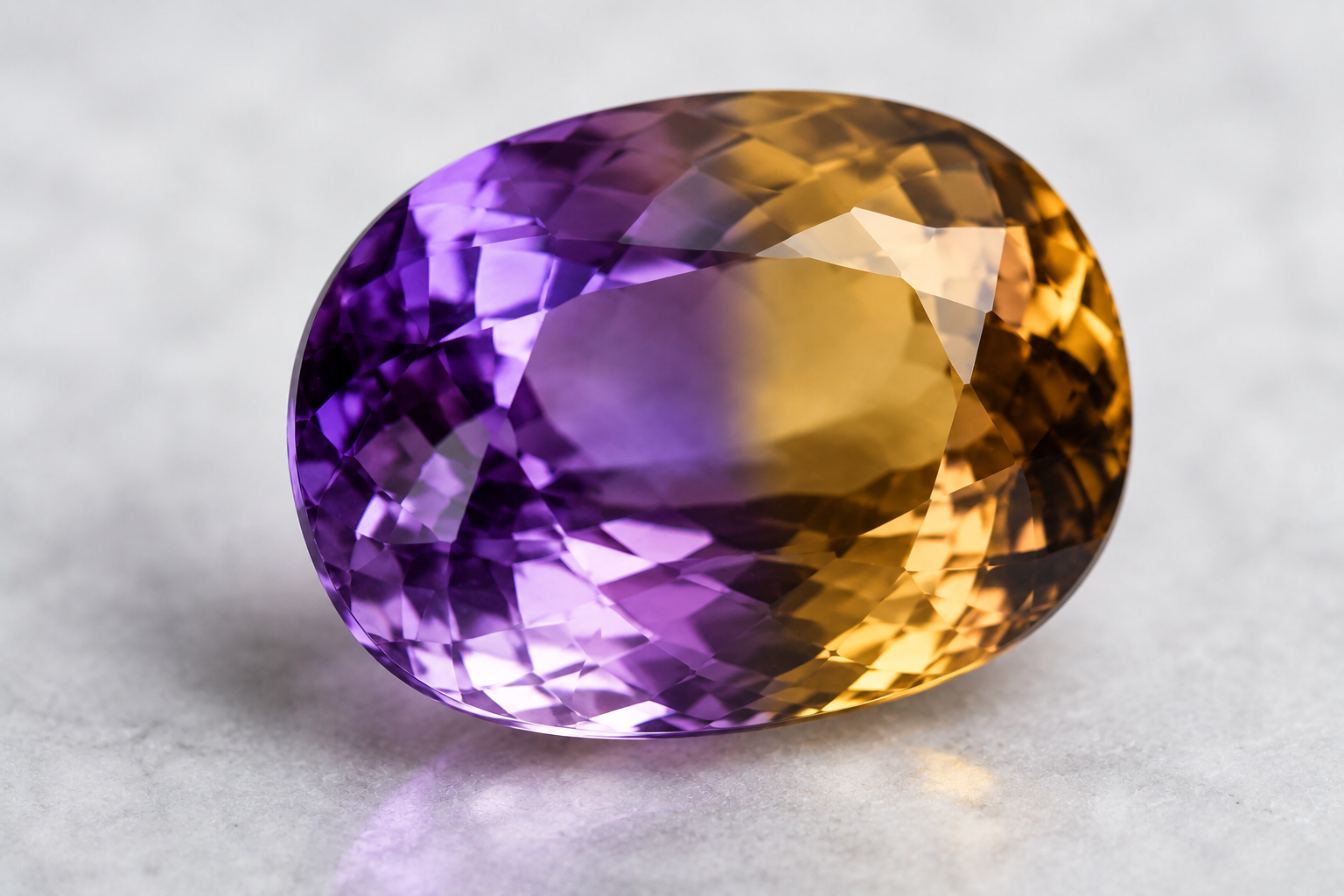
If you want to buy ametrine with confidence, focus first on whether the stone is actually natural ametrine, then compare the quality and balance of its purple and yellow-to-orange color zones, clarity, cut, size, treatment disclosure, provenance, and return terms. Ametrine is bicolored quartz containing both amethyst and citrine colors within the same crystal rather than two separate gemstones joined together. GIA lists its composition as SiO₂, refractive index at approximately 1.544–1.553, specific gravity near 2.66, and Mohs hardness of 7.
Natural ametrine is unusual because both color regions develop within one quartz crystal, but rarity should not replace ordinary buying discipline. GIA currently identifies Bolivia’s Anahí mine as the only commercial source of natural ametrine, while acknowledging that small non-commercial occurrences have been found elsewhere. Laboratory-grown ametrine also exists, which means a convincing purple-and-yellow appearance does not by itself establish geological origin.
A strong purchase therefore combines attractive appearance with precise disclosure. The best stone for one buyer may be a sharply divided half-purple, half-yellow emerald cut, while another person may prefer a fantasy cut that mixes both colors through internal reflections. Neither style is automatically superior. What matters is whether the stone looks attractive, matches its description, has appropriate documentation for its price, and can be returned if the actual gem differs materially from the listing.
Buying Ametrine at a Glance
| Buying Factor | What to Look For | What Deserves Caution |
|---|---|---|
| Gem identity | Bicolored quartz containing amethyst and citrine colors | Purple-yellow glass, assembled stones, coated material, or vague “ametrine crystal” wording |
| Natural vs laboratory-grown | Clear written disclosure | “Created,” “hydrothermal,” or “synthetic” language hidden deep in the listing |
| Purple color | Strong purple or violetish purple with useful brightness | Weak grayish purple or excessively dark areas |
| Yellow-orange color | Attractive yellow to orangy yellow with reasonable saturation | Brownish or washed-out areas marketed as premium |
| Color balance | Clear, attractive relationship between both zones | One color dominating unintentionally or weak muddy transitions |
| Boundary | Sharp division for traditional bicolor cuts or deliberate blending in designer cuts | Uneven distribution that appears accidental rather than intentional |
| Clarity | Eye-clean appearance in most faceted material | Distracting fractures, clouds, chips, or surface-reaching cracks |
| Cut | Good symmetry, polish, brilliance, and thoughtful color orientation | Large window, excessive extinction, or weight-retaining proportions |
| Size | Evaluate together with color saturation and face-up dimensions | Paying primarily for carat weight without checking visible quality |
| Treatment | Written disclosure of known enhancement | “Untreated” presented as guaranteed without evidence |
| Provenance | Credible Bolivian sourcing information when origin matters | Unsupported mine stories or vague “Brazilian ametrine” claims |
| Documentation | Independent identification for unusually valuable stones | Seller-created cards treated as independent gemological reports |
| Return terms | Enough time to inspect the exact stone | Final-sale purchase where color, treatment, or identity is uncertain |
GIA describes fine ametrine as showing medium-dark to moderately strong orange together with vivid to strong purple or violetish purple. Dealers commonly prefer attractive color balance and, in traditionally fashioned stones, a distinct boundary near the center. Larger stones, often above five carats, can show stronger saturation because they provide enough material for both color zones to become visually substantial.
Understand What Ametrine Actually Is
Ametrine belongs to the quartz mineral species. Its name combines amethyst and citrine because both familiar quartz colors occur within the same crystal. This is not the same situation as a doublet, where separate materials are bonded together, or a piece of jewelry containing one amethyst beside one citrine. Natural ametrine is one bicolored quartz crystal whose purple and yellow-to-orange regions developed under different structural and chemical conditions.
That distinction matters when comparing listings. A seller may describe any purple-and-yellow object as “ametrine,” but true ametrine should have the mineralogical identity of quartz. Imitation glass can reproduce both colors visually, while manufactured quartz can reproduce ametrine more convincingly because synthetic material shares the fundamental properties of quartz. The FTC advises sellers to distinguish mined gemstones from laboratory-created or imitation materials clearly and to avoid using an unqualified gemstone name for a product that is not actually a mined stone of that type.
For buyers already familiar with purple quartz, the Gems Lore guide to buy amethyst provides useful background on quartz color, synthetic material, clarity, and cut. Ametrine adds another complication because both color zones and their relationship become part of the quality assessment.
Color Is the Defining Quality Feature
Ametrine receives most of its visual appeal from the contrast between purple amethyst color and yellow-to-orange citrine color. GIA describes the most desirable material as showing vivid to strong purple or violetish purple together with moderately strong orange. A buyer should therefore evaluate the quality of each color separately before judging the overall bicolor effect.
The purple zone should remain recognizably purple under normal lighting rather than turning nearly black. The yellow-orange region should appear lively rather than gray, muddy, or dull brown. A stone with a dramatic boundary between two weak colors may be less attractive than one with slightly softer separation but richer color on both sides.
Online images can exaggerate both saturation and contrast. Camera white balance, background color, editing, exposure, and display settings can make yellow appear more orange or purple appear richer than it will in person. Requesting video under neutral daylight-type lighting gives a more realistic idea of how the gem behaves when it moves.
Color Balance Matters as Much as Saturation
Traditional ametrine cutting often aims for a visually balanced division between its two color zones. GIA notes that dealers commonly favor an attractive half-and-half appearance with a sharp division through the center of the finished gemstone. This balanced look can make rectangular step cuts especially effective because the geometry emphasizes the contrast.
A perfect 50/50 division is not a requirement for every beautiful ametrine. Designer cutters may deliberately favor one color, create diagonal boundaries, or use brilliant and fantasy faceting to mix reflections from both zones. In such stones, visual composition matters more than mathematical equality.
The key question is whether the color distribution looks intentional. A stone that appears 80% pale purple with a small weak yellow corner may still be genuine ametrine, but it should not automatically carry the same premium as a strongly colored gem where both halves contribute significantly to the face-up appearance.
Sharp Separation Is Desirable in Traditional Cuts
A clean boundary between purple and yellow-orange makes the bicolor identity immediately visible. GIA notes that the classic market preference often favors a clearly defined central color split. Rectangular step cuts, emerald-style outlines, and elongated shapes frequently use this geometry effectively.
The boundary should still be evaluated together with brilliance. A stone can display an excellent straight separation but look lifeless because the pavilion is too shallow or too deep. Color arrangement and optical performance need to work together.
Some natural stones also show transitional zones or complex internal patterns. Those features are not automatically defects. They simply create a different aesthetic from the clean half-purple, half-yellow presentation often associated with commercial ametrine.
Designer Cuts Can Be Worth a Premium
Ametrine is especially attractive to creative cutters because the same piece of rough contains two contrasting colors. GIA highlights fantasy and free-form cutting as important parts of ametrine’s appeal and notes that internal reflections can be used to mingle or redistribute the visible colors.
A precision-cut or artist-cut ametrine may therefore cost considerably more than a commercial stone of similar weight. The premium can reflect design, cutting time, yield loss, polish quality, symmetry, and the lapidary artist’s reputation rather than raw ametrine rarity alone.
When comparing designer pieces, judge them as finished works. Examine whether the pattern remains balanced as the stone moves, whether dead areas interrupt the design, and whether the cutter has used the natural zoning effectively. A sophisticated cut should enhance the two-color effect rather than merely add facets.
Clarity Is Usually Expected to Be High
Most faceted ametrine in the market is eye-clean. GIA specifically notes that faceted material generally lacks inclusions visible to the unaided eye. This means buyers usually do not need to accept conspicuous internal flaws in ordinary commercial stones.
Minor inclusions may still be perfectly acceptable, particularly in unusually attractive color or large material. The location of an inclusion matters as much as its existence. A small feature near the girdle may have little visual effect, while a prominent fracture beneath the table can remain distracting during normal wear.
Surface-reaching fractures deserve extra attention because they can affect durability and may also relate to treatment. GIA states that ametrine is rarely treated but that fracture filling can occur. A significant fracture should therefore be considered in both the price and the care requirements.
Eye-Clean Does Not Prove Natural Origin
Because clean ametrine is common, transparency cannot be used as evidence that a stone is natural. Synthetic ametrine has existed commercially for decades, and GIA reports that gem-quality Russian synthetic material entered the market in the 1990s. Laboratory-grown material can be highly transparent and may show strong purple-yellow zoning.
The reverse assumption also fails. A natural stone can contain inclusions, but the presence of an inclusion does not automatically prove geological origin. Synthetic quartz can develop growth features that require trained examination to interpret correctly.
GIA research shows that natural and synthetic ametrine can be separated using characteristics such as twinning, zoning orientation, optical behavior, chemistry, and spectroscopy. Those methods are laboratory or gemologist tools rather than reliable consumer shortcuts. A meaningful natural-origin premium should therefore rest on credible disclosure rather than visual guessing.
Natural and Laboratory-Grown Ametrine Are Different Buying Categories
Laboratory-grown ametrine is synthetic quartz rather than imitation glass. It can possess essentially the same core mineral composition and optical properties as mined quartz while originating from controlled manufacturing. The FTC recommends that laboratory-created gemstones be described clearly with qualifying terms such as laboratory-grown, laboratory-created, or synthetic so buyers do not mistake them for mined material.
A disclosed synthetic stone can be a sensible purchase for someone who values appearance, large size, or creative cutting more than geological rarity. The problem is not laboratory growth itself; the problem is selling laboratory-grown material as natural.
Before paying a strong premium, ask the seller to state natural or laboratory-grown origin in writing. Terms such as “created ametrine,” “hydrothermal ametrine,” or “lab ametrine” should be treated as manufacturing disclosures, not stylistic descriptions.
Do Not Rely on Color Pattern Alone to Authenticate Ametrine
Natural ametrine often develops characteristic zoning related to quartz crystal structure, and trained gemologists can use the orientation of the color boundary relative to the optic axis as part of separation from synthetic material. GIA’s review of conventional identification methods explains that natural and synthetic ametrine can show different relationships between the color boundary and optical orientation.
That does not create a simple home test. Cutting can place the table at different orientations, and interpreting interference patterns or optic-axis behavior requires proper equipment and knowledge.
Online claims that every straight color boundary is synthetic, every triangular zone is natural, or every diagonal division proves treatment oversimplify the gemology. Pattern can provide evidence to a trained examiner, but a consumer should not base a costly natural-origin decision on one photograph.
Provenance Matters Because Natural Commercial Supply Is Concentrated
GIA currently describes Bolivia’s Anahí mine as the world’s only commercial source of natural ametrine. The mine lies in southeastern Bolivia near the Brazilian border and also produces amethyst and citrine. This concentrated supply makes provenance more relevant than it is for many quartz varieties.
A credible Bolivian sourcing story can therefore be useful, especially for collector material or mine-to-market jewelry. GIA has documented efforts at the Anahí operation to maintain greater control over production, cutting, manufacturing, and chain of custody.
Provenance still needs to be separated from laboratory identification. A seller’s invoice stating “Bolivia” records the seller’s representation, while an identification report addresses what the stone is. Neither automatically proves every detail of mine-specific history unless the supporting documentation actually traces the material.
Be Careful with “Brazilian Ametrine” Claims
Bolivia lies beside Brazil, and Bolivian rough has historically moved through regional cutting and trading networks. That can create confusing commercial descriptions. Current GIA consumer guidance nevertheless identifies the Anahí mine in Bolivia as the only commercial natural source.
A listing described as “Brazilian ametrine” should therefore prompt a simple question: does the seller mean the stone was mined in Brazil, cut in Brazil, purchased in Brazil, or merely shipped through Brazil? Those statements are not equivalent.
The same caution applies to vague locality labels such as “South American ametrine.” Geographic language should describe something specific enough to verify rather than function as a premium-sounding adjective.
Origin Does Not Replace Quality
Even though Bolivia has special importance in the ametrine market, a Bolivian origin label does not automatically make every stone fine quality. Weakly saturated material, poor cutting, obvious fractures, or unattractive color distribution remains lower quality regardless of locality.
The strongest purchase combines credible natural origin with appealing color and good craftsmanship. A transparent, beautifully cut synthetic stone may look better than a weak natural stone, while the natural gem may still command a geological-origin premium for buyers who value rarity.
Decide which attribute matters most before shopping. Collectors may prioritize natural Bolivian origin, while jewelry buyers may care more about color balance and cutting.
Size Can Improve Ametrine’s Visual Impact
Unlike many gemstones where smaller material can show the best saturation, ametrine often benefits from sufficient size because both color areas need enough space to become visually distinct. GIA notes that the richest purple and orange colors are commonly seen in larger stones, often above five carats.
This does not mean every five-carat stone is premium. A large gem may still have washed-out color, poor balance, excessive depth, or weak brilliance.
Face-up dimensions should be compared with carat weight because quartz can be cut unnecessarily deep to retain mass. A ten-carat stone that faces up like a much smaller gem may be carrying hidden weight in the pavilion rather than providing proportional visual presence.
Ametrine Is Available in Large Sizes
GIA notes that ametrine is available across a wide size range, including substantial faceted gems, and has documented designer-cut examples weighing dozens of carats. Large size can therefore be impressive without automatically establishing exceptional rarity.
A buyer should resist listings that use carat weight as the main proof of quality. Once enough material exists to display both colors effectively, additional weight matters only in combination with saturation, clarity, cutting, and overall visual appeal.
The best comparison asks what the extra carats actually add. If they produce deeper, richer color and a stronger bicolor presentation, a premium may be sensible. If the additional weight sits in an overly deep pavilion, the benefit is much smaller.
Cut Orientation Is Crucial
Ametrine cutting requires more planning than cutting a uniformly colored quartz because the lapidary must decide how the purple and yellow regions will appear through the finished crown. GIA notes that rectangular step cuts are frequently used because they can display the bicolor structure clearly, while brilliant, mixed, free-form, and fantasy cuts can blend or contrast the colors in different ways.
Poor orientation can leave one color confined to a corner or make the boundary appear awkward. Effective orientation allows both colors to participate visibly in the design.
Inspect the stone straight on and while rotating it. If one zone disappears from ordinary viewing angles or the gem suddenly becomes dominated by a single color, decide whether that behavior is intentional and whether the price reflects it.
Windowing Can Make a Large Ametrine Look Weak
Windowing occurs when pavilion angles allow the viewer to see through a central portion of a transparent gemstone rather than receiving strong reflected light. In ametrine, a large window can be particularly distracting because it weakens both saturation and the visual relationship between the color zones.
A stone may still have respectable carat weight, but hidden depth or shallow central proportions can reduce face-up beauty. Buyers should therefore examine the center against a neutral background and watch whether objects behind the gem remain clearly visible through a broad area.
Commercially cut quartz is abundant enough that strong windowing should be reflected in the price unless the rough had some exceptional characteristic worth preserving.
Extinction Can Hide the Color You Are Paying For
Extinction creates dark face-up areas where facets return little visible light to the observer. Some darkness changes naturally as a transparent gem moves, but excessive extinction can make purple regions look almost black and yellow regions look brownish.
This problem becomes easier to detect in video than in still photography. Rotate the exact stone slowly under ordinary lighting and watch whether most facets take turns becoming active.
A fine ametrine should offer enough movement and brilliance that both colors remain identifiable. Deep saturation is valuable only when the cut allows the viewer to see it.
Treatments Are Uncommon but Still Matter
GIA states that ametrine is rarely treated, though fracture filling may occur. Rare treatment does not mean buyers should assume every stone is untreated without asking.
The FTC advises disclosure when a gemstone treatment is non-permanent, creates special care requirements, or has a significant effect on value. A seller should therefore describe known filling or other relevant enhancement before purchase rather than relying on the assumption that quartz is normally untreated.
Treatment becomes more important as the price rises. An inexpensive fashion stone may not justify laboratory testing, but an unusually costly piece sold as natural, untreated, and collector quality deserves stronger evidence.
Fracture Filling Changes Both Value and Care
A fracture-filled ametrine has surface-reaching breaks that contain an introduced substance intended to reduce their visibility or improve apparent clarity. Filling can make the stone look cleaner, but it also changes the material’s treatment status and may affect how it should be cleaned.
GIA advises warm soapy water for ametrine and specifically cautions that ultrasonic cleaning should be avoided when a stone is fracture-filled or dyed. Steam cleaning is not recommended.
A filled stone can still be attractive jewelry. Buyers simply need disclosure so they can compare it with untreated material fairly and follow appropriate care instructions.
Ask About Dyeing if the Color Looks Unusual
GIA’s care guidance acknowledges the possibility of dyed ametrine, even though such treatment is not typical of most commercial material. An unusually intense or unnatural-looking stone should therefore be evaluated rather than assumed to be naturally saturated.
Color concentrations in fractures or surface-reaching features can sometimes provide clues to dye, but visual inspection is not always conclusive. The safer buying approach is written treatment disclosure and independent testing when enough money is at stake.
A strong purple-yellow contrast can occur naturally, so vivid color alone is not evidence of dye. Suspicion should lead to verification rather than an automatic conclusion.
“AAA Ametrine” Is Not a Standardized Grade
Retailers frequently use A, AA, AAA, AAAA, premium, collector grade, or investment grade to organize their inventories. GIA states explicitly that no standardized quality-grading scale exists for ametrine, even though individual businesses can create their own commercial descriptions.
A seller’s AAA designation is meaningful only if the seller defines what it measures. One company may prioritize color saturation, while another uses the term for clarity, size, or an overall combination.
Rather than paying for the label, compare the actual attributes: purple quality, yellow-orange quality, color balance, sharpness of the boundary, clarity, cut, dimensions, weight, natural or synthetic origin, treatment, provenance, and documentation.
Natural Origin Should Be Stated Clearly on the Invoice
When geological origin matters to you, ask for the invoice to identify the stone as natural ametrine rather than simply “ametrine.” The FTC’s gemstone guidance emphasizes clear distinctions between mined, laboratory-created, and imitation products.
This written description becomes particularly useful if the jewelry is later appraised, insured, inherited, or resold. Memory of a salesperson’s verbal assurance is much less useful than a dated document.
If the seller also claims Bolivian or Anahí provenance, ask for that statement in writing and learn what evidence supports it. A precise invoice helps preserve the history being used to justify the purchase.
Documentation Is Not Necessary for Every Ametrine
GIA offers a Colored Stone Identification Report for ametrine but notes that such reports are not commonly requested because the cost may be high relative to the value of ordinary ametrine. Reports make more sense for gems of significant value.
This practical balance is important. Paying for extensive laboratory testing on a modestly priced commercial stone may provide little economic benefit, while relying only on a seller’s word for a costly collector piece can create unnecessary risk.
Use documentation where it solves a meaningful question: natural versus laboratory-grown origin, unexpected treatment, or another material issue that materially affects price.
What a Gemological Report Can and Cannot Do
A reputable identification report can establish gem identity and investigate whether the material is natural or synthetic, depending on the laboratory and service offered. It may also record measurable characteristics and detectable treatments. The report does not automatically tell you whether the cut is beautiful, whether the color split appeals to you, or whether the retail price is competitive.
GIA’s statement that no standardized ametrine grading scale exists is especially relevant here. A report should not be confused with an official AAA quality certificate.
Market judgment still belongs to the buyer, seller, or qualified appraiser. Identification reduces uncertainty about what the stone is; it does not decide whether you personally should buy it.
Provenance and Laboratory Identification Answer Different Questions
Provenance documents the path or claimed history of the stone, while gemological identification investigates the physical material. A mine-to-market record might show that rough came from a particular Bolivian operation, whereas laboratory analysis might confirm that the finished stone is natural ametrine.
Neither source of evidence completely replaces the other. A laboratory generally cannot reconstruct every ownership transfer, while an invoice chain does not necessarily prove gem identity without independent testing.
For collector purchases, the strongest package may combine both: a credible sourcing record and an appropriate independent gemological report.
Look Carefully at Ametrine Jewelry Settings
A loose gemstone is easier to inspect because the pavilion, girdle, cut depth, inclusions, and entire color pattern remain visible. Once mounted, metal can hide parts of the stone and make exact weight harder to verify.
Finished jewelry adds value through precious metal, craftsmanship, design, side stones, and brand reputation. Those components should be separated mentally from the value of the ametrine itself.
Inspect prongs and bezels for even contact, check whether the gem moves in the setting, and look for chips around exposed edges. Quartz is durable enough for broad jewelry use, but a loose mounting can cause loss regardless of the stone’s hardness.
Ametrine Is Durable Enough for Most Jewelry
Ametrine has Mohs hardness 7 and good toughness. GIA considers it suitable for all jewelry types, including rings, when owners understand that quartz can still scratch and should receive reasonable care.
Hardness measures resistance to scratching rather than complete resistance to damage. Strong impacts can still chip edges, and everyday dust may contain quartz particles capable of producing gradual surface wear.
Pendant and earring designs generally face fewer impacts than rings and bracelets. A frequently worn ring can remain practical, but protective settings and sensible handling help preserve polish and facet junctions.
Ametrine Can Fade or Fracture Under Harsh Conditions
GIA warns that some ametrine colors can fade after prolonged exposure to intense light and that abrupt temperature changes can cause fracturing. Certain chemicals, including hydrofluoric acid and some strongly reactive compounds, can also damage quartz.
Normal jewelry wear does not require extreme precautions. The practical lesson is to avoid leaving a valuable stone for long periods in intense sunlight, exposing it to strong heat, or subjecting it to sudden temperature shifts.
These considerations matter when buying display specimens as well as jewelry. A gemstone purchased for its strong purple-yellow contrast deserves storage conditions that help preserve that appearance.
Warm Soapy Water Is the Safest General Cleaning Method
GIA recommends warm soapy water as a safe cleaning method for ametrine. Ultrasonic cleaners are usually acceptable for untreated stones but not for dyed or fracture-filled material, while steam cleaning is not recommended.
That guidance gives buyers another reason to ask about treatment before purchasing. A stone’s care requirements should be known before it enters regular wear.
For valuable jewelry, periodic setting inspection may matter as much as cleaning. A secure mount and gentle maintenance preserve both the gemstone and the investment in the finished piece.
Do Not Buy Ametrine Based on Spiritual Claims
Ametrine is sometimes marketed with claims about balancing masculine and feminine energies, improving focus, attracting prosperity, removing negativity, or combining the metaphysical effects of amethyst and citrine. These ideas belong to modern symbolic or spiritual traditions rather than measured gemological properties.
Such symbolism can remain personally meaningful, but it should not determine authenticity or price. A stone does not become higher quality because a seller calls it more powerful, energetic, healing, or spiritually balanced.
Physical buying decisions should rely on mineral identity, color, clarity, cut, treatment, provenance, documentation, and condition. Symbolic interpretation can remain a separate personal choice.
Compare Price Only After Comparing Quality
Ametrine prices vary across commercial cuts, precision-cut gems, collector material, synthetic stones, and finished jewelry. The useful comparison is therefore not simply “price per carat,” but price for stones that are genuinely similar.
Begin by separating natural from laboratory-grown material. Next compare purple saturation, yellow-orange saturation, color balance, boundary quality, clarity, cutting, size, dimensions, treatment, and provenance. Only then compare asking prices.
A lower price may indicate weaker color or commercial cutting rather than a bargain. A higher price may reflect precision cutting or credible natural provenance rather than overpricing. Context determines which explanation makes sense.
Face-Up Dimensions Can Reveal Hidden Weight
Two ametrines with the same carat weight can look very different in size because one may be cut considerably deeper. Millimeter dimensions therefore deserve as much attention as the weight figure.
A deep pavilion can preserve rough and increase weight while reducing visible spread. That is not always undesirable because the cutter may need depth to preserve color or brilliance, but buyers should know what the additional carats provide.
Compare length, width, depth, and face-up appearance together. Paying for weight makes more sense when the weight contributes to richer color or stronger visual presence.
Photos Should Show the Exact Stone
Natural ametrine has variable color distribution, which makes stock photography particularly problematic. Two stones from the same parcel may differ in saturation, color balance, boundary shape, zoning, and cut performance.
For a meaningful online purchase, ask whether the photograph shows the exact gemstone that will be shipped. Request front, back, side, and moving views if the price justifies the effort.
Neutral backgrounds are useful because saturated purple or yellow surroundings can alter perceived color. A hand shot can demonstrate scale, but neutral lighting and a white or gray background usually make comparison easier.
Video Is Especially Useful for Ametrine
Ametrine changes visually as the stone moves because facets reflect purple and yellow regions differently. A static image can make the boundary appear cleaner or the saturation stronger than normal viewing reveals.
Slow video under daylight-type and ordinary indoor lighting helps expose windowing, extinction, surface abrasions, uneven zoning, and whether one color disappears at common angles.
Ask the seller to avoid strong color filters or highly colored backgrounds. The goal is to understand the exact gemstone rather than see the most dramatic possible presentation.
A Return Policy Is Part of the Value
Online gemstone purchases involve unavoidable uncertainty because screens cannot reproduce color perfectly. A sensible return period lets you inspect the actual ametrine under your own lighting and verify whether it matches the listing.
Review whether returns remain available after independent gemological examination, provided the item is not altered or damaged. A seller who advertises natural untreated Bolivian ametrine but refuses a return if qualified testing disagrees places much more risk on the buyer.
The length of the return window also matters. A few hours after delivery may be inadequate for an expensive transaction, while a clearly stated multi-day inspection period provides more practical protection.
Read Restocking and Shipping Terms Before Paying
A nominal return policy may still be costly if the seller charges large restocking fees, refuses to refund original shipping, requires expensive insured international shipping, or excludes gemstones removed from temporary packaging.
These conditions are contractual purchasing issues rather than gemological quality factors, yet they directly affect the real cost of trying a stone.
For an international purchase, also clarify customs charges, duties, currency conversion, and responsibility if the parcel is lost on return. A cheaper overseas listing may not remain cheaper after every transaction cost is included.
Ask Who Bears the Risk During Return Shipping
A high-value gemstone can be lost or damaged in transit. Before purchasing, determine whether the buyer or seller carries responsibility during return shipping and whether the required courier offers insurance for loose gemstones or jewelry.
Some ordinary shipping insurance policies exclude precious stones or limit compensation. The seller may specify a particular carrier or shipping method to preserve coverage.
Written instructions are safer than improvising after a return becomes necessary. Save photographs of the item, packaging, tracking, and documentation until the refund is complete.
Examine the Return Policy for Custom Jewelry
Custom ametrine rings, engraved pieces, resized jewelry, and made-to-order settings may be excluded from normal returns. The stone itself might otherwise have been returnable, but customization can change the contractual position.
If you have not seen the exact gem in person, consider approving the loose stone first before authorizing irreversible work. This separates the gemstone decision from the setting decision.
A good jeweler may offer photographs, video, dimensions, and written approval checkpoints before final fabrication. Those practices reduce misunderstandings about color and appearance.
Questions to Ask Before You Buy Ametrine
A knowledgeable seller should be able to answer direct questions about identity, origin, treatment, measurements, and returns without relying on vague statements about rarity or energy. Before paying a meaningful premium, clarify the points that will remain important after the sale.
Is this natural ametrine, laboratory-grown ametrine, or an imitation?
If natural, what evidence supports Bolivian or Anahí provenance?
Has the stone been dyed, fracture-filled, coated, heated, or otherwise treated?
Are the photographs and video of the exact stone?
What are the carat weight and full millimeter dimensions?
Does the seller use a defined grading system when describing the stone as AAA or premium?
Is the stone eye-clean under normal viewing?
Does the cut show obvious windowing or excessive extinction?
Will natural or laboratory-grown origin and known treatments appear on the invoice?
Does an independent gemological report accompany the stone?
How long is the inspection period?
Are there restocking fees or exclusions?
Can the stone be independently tested without voiding the return?
Who pays and insures return shipping?
Does resizing, engraving, or custom mounting make the sale final?
Clear answers to these questions make comparisons between sellers much easier.
Red Flags When Buying Ametrine
An extremely low price is not automatically suspicious because quartz can be affordable, but an unusually large, flawless, strongly saturated stone described as rare natural Anahí ametrine deserves verification if the price seems inconsistent with the claim. Synthetic material is commercially available, so visual perfection does not confirm natural origin.
Another warning sign is inconsistent terminology. A listing that alternates among natural, lab-grown, hydrothermal, simulated, and Bolivian without explaining which term actually applies may indicate poor disclosure.
Be cautious when a seller refuses neutral-light photographs, cannot explain a mine-origin claim, hides return conditions until checkout, or uses an unverifiable “certificate” as the primary basis for a large premium. Strong evidence should accompany strong claims.
Seller Certificates Are Not the Same as Independent Reports
A retailer can issue an authenticity card or certificate, and that document may provide a useful written record of the seller’s claims. It does not automatically represent independent laboratory analysis.
Check who issued the report, whether the issuer operates a recognized gemological laboratory, what conclusions were actually reached, and whether the identifying information corresponds to the exact stone.
For ordinary ametrine, extensive documentation may be unnecessary. When documentation is used to justify a high price, however, its independence and scope become important.
Is Mine-to-Market Ametrine Worth More?
Traceable mine-to-market material can appeal to buyers who value provenance, origin transparency, and a more documented supply history. GIA has described efforts associated with Bolivia’s Anahí production to manage extraction, cutting, manufacturing, and distribution more closely.
Whether that traceability deserves a price premium is a personal and market decision. The premium should reflect real documentation and operational transparency rather than a generic “ethical” label.
A mine-to-market record also does not guarantee superior color. Provenance and visual quality remain separate attributes, and a careful buyer can value both without confusing them.
Ethical Sourcing Claims Need Specific Evidence
Terms such as ethical, responsible, sustainable, and conflict-free sound reassuring but have little meaning unless the seller explains what standards or practices support them. Gemological origin alone does not establish labor conditions, environmental performance, community benefits, or supply-chain transparency.
Ask whether the seller can explain mine relationships, traceability, cutting location, labor standards, or independent certifications where relevant. Avoid assuming that a gemstone is ethically sourced merely because its country of origin is known.
Responsible sourcing questions should remain separate from physical quality. A beautifully cut ametrine can have uncertain provenance, while a well-documented stone can still have modest color.
Loose Ametrine Versus Finished Jewelry
Buying a loose ametrine makes it easier to inspect the entire gem and choose a setting afterward. You can examine the pavilion, girdle, depth, zoning, inclusions, polish, and exact face-up dimensions without metal obstructing the view.
Finished jewelry offers convenience and lets you judge the complete aesthetic immediately. The tradeoff is that metal may hide parts of the gem, and the price includes design and manufacturing costs.
For an expensive custom project, selecting and approving the loose stone first often provides the greatest control over color and quality.
Compare Ametrine with Amethyst Carefully
Because half of ametrine’s visual identity comes from amethyst coloration, buyers familiar with purple quartz can use amethyst as a reference for saturation and brightness. The Gems Lore amethyst price guide explains why strong reddish-purple color, good brightness, minimal zoning, and competent cutting are important in purple quartz.
Ametrine should not simply be valued as amethyst plus citrine, however. Its distinctive feature is the relationship between both colors within a single crystal.
The cutting challenge, color balance, source concentration, and bicolor appearance create a separate market category.
Do Not Assume Ametrine Is Two Stones Fused Together
A genuine natural ametrine is not created by bonding an amethyst to a citrine. Both colors occur in the same quartz crystal. This is one of the easiest misconceptions to correct when evaluating listings.
Assembled products using separate colored components could imitate the visual concept, but they should not be represented simply as natural ametrine.
If a piece shows an unusually perfect physical seam, glue-like boundary, bubbles near a junction, or other signs of assembly, professional examination may be warranted.
Ametrine Is Not Simply “Half Amethyst, Half Citrine” by Weight
The familiar phrase describes the visual idea rather than a requirement that exactly 50% of the crystal mass be purple and 50% yellow. Natural rough can contain unequal zones, and cutters choose how those zones appear in the finished gem.
A beautifully cut stone may present a near-even division face-up even when its three-dimensional internal color distribution is more complex.
Judge the visible design rather than trying to calculate a literal percentage of each quartz color.
Should You Pay More for a Perfect 50/50 Split?
A symmetrical division can be highly attractive and is valued in traditional bicolor cutting, but a mathematically perfect split is not an independent guarantee of top quality. GIA emphasizes the combination of good saturation and attractive distribution rather than requiring exact numerical equality.
Weak colors remain weak even when perfectly divided. Likewise, an inventive fantasy cut with unequal zones can be more beautiful than a routine 50/50 commercial cut.
Pay for the overall stone rather than one geometric attribute in isolation.
Is Ametrine Good for Rings?
Ametrine is suitable for rings because quartz has Mohs hardness 7 and good toughness, but rings expose gemstones to more contact than earrings or pendants. GIA advises that ametrine works in all jewelry types when normal precautions are taken.
A protective setting can reduce direct blows to edges and corners, especially in elongated rectangular stones. Periodic inspection helps identify loose prongs before a gemstone is lost.
Someone expecting diamond-like scratch resistance should adjust expectations. Ametrine is durable, but it can show wear over years of frequent ring use.
Is Ametrine Suitable for Everyday Jewelry?
Yes, provided everyday wear includes reasonable handling. Quartz has enough hardness and toughness for practical jewelry, yet strong impacts, abrasive contact, extreme heat, and harsh chemicals should be avoided.
Earrings and pendants generally experience fewer knocks than rings or bracelets, making them particularly forgiving choices for larger ametrines.
Everyday suitability should also consider the setting. A securely mounted medium-sized stone can be more practical than an enormous exposed gem even though both share the same mineral hardness.
Ametrine Buying Sequence
A practical buying sequence begins with identity. Establish whether the gem is natural, laboratory-grown, or an imitation. Next examine purple and yellow-orange color separately, then judge their balance and the boundary between them. Evaluate clarity and cutting before considering size.
After the visual assessment, ask about treatment and provenance. Review documentation only to the extent justified by the purchase value. Finally, compare price and return terms across similar stones.
This order prevents a large carat figure, AAA label, Bolivian story, or dramatic photograph from distracting you from the physical qualities that will determine whether you actually enjoy owning the gem.
Conclusion
To buy ametrine well, begin with accurate material identity and then evaluate the relationship between its two colors. Natural ametrine is bicolored quartz containing amethyst and citrine zones, and GIA currently identifies Bolivia’s Anahí mine as its only commercial source. Fine stones combine attractive purple and yellow-to-orange color, useful saturation, strong clarity, thoughtful cutting, and a bicolor pattern that looks deliberate rather than accidental.
Laboratory-grown ametrine exists, so appearance alone cannot prove natural geological origin. Treatments are uncommon but possible, particularly fracture filling, and significant natural stones may justify independent identification. The final purchasing decision should also include return rights, shipping risk, precise written disclosure, and provenance where it materially affects price. A beautiful stone with clear documentation and fair inspection terms is a stronger purchase than one supported mainly by an undefined grade, a dramatic origin story, or an unusually high carat weight.
Frequently Asked Questions About Buying Ametrine
What should I look for when I buy ametrine?
Look first for clear disclosure of natural or laboratory-grown origin, then examine both color zones, their balance, saturation, clarity, cut, dimensions, treatment, provenance, documentation, and return terms. GIA describes fine ametrine as combining attractive orange with vivid to strong purple or violetish purple. A large stone should still show good brilliance and intentional-looking color distribution.
What is natural ametrine?
Natural ametrine is quartz that contains both purple amethyst and yellow-to-orange citrine color in the same naturally formed crystal. It is not simply two separate gems glued together.
Where does natural ametrine come from?
GIA currently identifies the Anahí mine in southeastern Bolivia as the world’s only commercial source of natural ametrine, while small non-commercial occurrences have been reported elsewhere.
Is all ametrine from Bolivia?
Commercial natural ametrine is overwhelmingly associated with Bolivia, and GIA identifies the Anahí mine as the only commercial source. Laboratory-grown ametrine, however, is manufactured rather than mined in Bolivia.
Is “Brazilian ametrine” real?
The material may be genuine ametrine, but a Brazilian label should be clarified because GIA identifies Bolivia as the commercial natural source. The term could refer to cutting, trading, or processing in Brazil rather than mining. Ask the seller exactly what the origin claim means and what evidence supports it.
What are the best ametrine colors?
GIA describes fine ametrine as showing medium-dark to moderately strong orange together with vivid to strong purple or violetish purple. Attractive brightness and contrast matter more than simply choosing the darkest possible stone.
Should ametrine be exactly half purple and half yellow?
No. A balanced half-and-half pattern is traditionally desirable and commonly favored by dealers, but natural color distribution varies. Designer cuts may intentionally blend or redistribute the two colors.
Is a sharp color boundary better?
A sharp boundary can be especially attractive in traditional rectangular or step-cut ametrine because it emphasizes the bicolor effect. A fantasy cut may deliberately mix the two colors instead. The better option depends on whether the finished design looks intentional and attractive.
What does AAA ametrine mean?
AAA is generally a retailer-created quality category. GIA states that there is no standardized quality-grading scale for ametrine. Ask the seller to define exactly what the grade represents before paying a premium.
Does GIA grade ametrine?
GIA does not use a standardized A, AA, or AAA quality-grading system for ametrine. It does offer Colored Stone Identification Reports for ametrine, although GIA notes that reports are usually requested only for stones of significant value.
Can ametrine be laboratory-grown?
Yes. GIA documents commercially produced synthetic ametrine and notes that gem-quality Russian synthetic material entered the market in the 1990s. Laboratory-grown material should be clearly disclosed rather than represented as mined ametrine.
Is laboratory-grown ametrine fake?
Laboratory-grown ametrine is synthetic quartz rather than a simple imitation such as glass. It is manufactured instead of geologically formed, so sellers should clearly describe it as laboratory-grown, laboratory-created, or synthetic. The FTC advises clear qualification of laboratory-created gemstone products.
Can I identify synthetic ametrine by eye?
Not reliably in every case. GIA research shows that gemologists can separate natural and synthetic material using characteristics such as twinning, optical orientation, zoning, chemistry, and spectroscopy. These methods require more expertise than casual visual inspection.
Is ametrine usually treated?
GIA states that ametrine is rarely treated, although fracture filling can occur. Rare treatment should still be disclosed because it can affect care and value.
Can ametrine be dyed?
Dyed material can occur, and GIA’s care guidance specifically treats dye as a possibility when discussing safe cleaning. If unusual color materially affects the price, ask for treatment disclosure.
Does fracture filling reduce ametrine value?
It can affect market preference because filling modifies a natural fracture and may create special care requirements. The amount of any discount depends on the severity of the fracture, quality of filling, overall stone, and market context rather than one fixed percentage.
How clear should ametrine be?
Most faceted ametrine is expected to be eye-clean. GIA notes that market material generally lacks inclusions visible without magnification. An obvious fracture or dark inclusion should therefore be considered when comparing price.
Is larger ametrine better?
Not automatically, but larger stones often display stronger saturation because both color zones have more physical space to develop visually. GIA notes that stones above roughly five carats commonly show the richest colors. Cut and color still matter more than weight alone.
Is ametrine rare?
Natural ametrine has a very concentrated commercial source, which makes it geologically unusual. GIA identifies only one commercial source, the Anahí mine in Bolivia. Large faceted stones are nevertheless available, so rarity should not be interpreted to mean that every ametrine is extremely expensive.
What cut is best for ametrine?
Rectangular step cuts are popular because they can display the purple-yellow division clearly. Brilliant, mixed, fantasy, and free-form cuts can also be excellent when they use internal reflections to blend or contrast the colors effectively.
Are designer-cut ametrines worth more?
They can be. Precision cutting, complex geometry, artistic color placement, reduced rough yield, and the cutter’s reputation can add value beyond the raw stone. Judge whether the design improves brilliance and the bicolor effect rather than paying simply for an unusual shape.
Is ametrine durable enough for a ring?
Yes. GIA gives ametrine Mohs hardness 7 and good toughness and considers it suitable for all jewelry types, including rings, with appropriate care. It can still scratch or chip under sufficiently harsh wear.
Can ametrine go in an ultrasonic cleaner?
GIA states that ultrasonic cleaning is usually safe for untreated ametrine but should not be used when the stone is dyed or fracture-filled. Warm soapy water remains the safest general method, and steam cleaning is not recommended.
Can sunlight fade ametrine?
GIA notes that some ametrine colors may fade after prolonged exposure to intense light. Normal wear is generally reasonable, but long-term intense sunlight exposure is best avoided for valuable pieces.
Can heat damage ametrine?
Yes. Abrupt temperature changes can fracture ametrine, and GIA advises against steam cleaning or unnecessary heat exposure. Jewelers should also protect the gemstone during repair work involving heat.
Do I need a laboratory report for ametrine?
Not for every stone. GIA offers identification reports but notes that they are generally requested only for significant-value ametrine because report cost can be high relative to ordinary stones. A report becomes more useful when natural versus synthetic origin materially affects the price.
Does a laboratory report prove that an ametrine is high quality?
No. An identification report can help establish what the material is and investigate treatments, but GIA does not provide a standardized AAA quality grade for ametrine. Beauty, color balance, cutting, and price still need separate evaluation.
How important is Bolivian provenance?
It can be important because Bolivia is the commercial natural source identified by GIA. Provenance becomes more valuable when it is documented rather than used as an unsupported marketing story.
What should be written on the invoice?
For a significant purchase, the invoice should identify whether the stone is natural or laboratory-grown ametrine and record known treatments. If Bolivian or mine-specific provenance materially affects the price, ask for that representation in writing as well.
Is a seller’s certificate enough?
A seller certificate documents what the seller claims but is not automatically independent gemological evidence. For expensive stones, verify who issued the report, what testing was performed, and whether the report corresponds to the exact gemstone.
Is a no-return ametrine purchase risky?
It can be, especially online. Screens alter color, and photographs may not reveal windowing, extinction, treatment, or natural versus synthetic origin. A meaningful inspection period allows the buyer to evaluate the exact stone before the transaction becomes irreversible.
What is a reasonable return policy for ametrine?
The policy should provide enough time to inspect the stone under your own lighting and, for a high-value purchase, obtain independent examination if necessary. Review restocking fees, shipping obligations, insurance requirements, and customization exclusions before payment.
Can I return ametrine after laboratory testing?
That depends on the seller’s terms. Ask before purchase whether non-destructive independent gemological examination voids the return policy. For expensive natural-stone claims, a policy that permits professional inspection provides stronger buyer protection.
What is the biggest mistake when buying ametrine?
The biggest mistake is paying for a large carat weight, AAA label, or dramatic Bolivian story before confirming material identity and examining the actual colors and cut. Natural versus laboratory-grown origin, color quality, balance, clarity, treatment, provenance, and return rights should all be understood before price becomes the deciding factor.