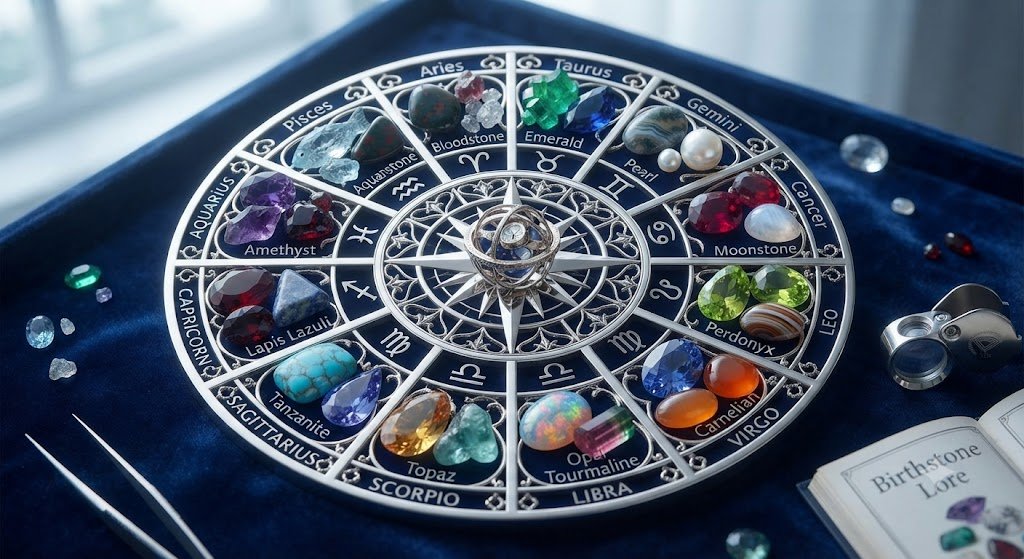
Zodiac Birthstones: Your Star Sign’s Stone and Its Meaning
Zodiac birthstones are gemstones associated with the twelve astrological signs rather than the twelve calendar months. Aries, Taurus, Gemini and the remaining signs each have several traditional, historical or modern stone correspondences.
Unlike modern monthly birthstone lists, zodiac gemstone systems have never had one universal authority. Associations vary among Western astrology, Vedic traditions, historical lapidaries, planetary correspondences, commercial jewelry charts and contemporary crystal practices.
Therefore, a zodiac sign does not have only one correct stone. Bloodstone may be presented as an Aries stone in one tradition, while Diamond, Carnelian or Red Jasper appears in another.
This guide identifies widely recognized correspondences while keeping each sign’s detailed list on its dedicated page. The birthstones-by-month guide owns the separate January-to-December system.
Zodiac Birthstones at a Glance
| Zodiac sign | Approximate tropical dates | Common primary stone | Other widely used stones | Traditional themes |
|---|---|---|---|---|
| Aries | March 21–April 19 | Bloodstone | Diamond, Carnelian, Red Jasper | Initiative, courage and directed action |
| Taurus | April 20–May 20 | Emerald | Rose Quartz, Malachite, Jade | Stability, value and patient growth |
| Gemini | May 21–June 20 | Agate | Citrine, Tiger’s Eye, Aquamarine | Communication, curiosity and adaptability |
| Cancer | June 21–July 22 | Moonstone | Pearl, Ruby, White Opal | Care, memory and emotional reflection |
| Leo | July 23–August 22 | Peridot | Sunstone, Citrine, Tiger’s Eye | Visibility, generosity and creative confidence |
| Virgo | August 23–September 22 | Sapphire | Amazonite, Moss Agate, Carnelian | Discernment, service and practical order |
| Libra | September 23–October 22 | Opal | Lapis Lazuli, Rose Quartz, Sapphire | Balance, relationship and aesthetic judgment |
| Scorpio | October 23–November 21 | Topaz | Obsidian, Malachite, Garnet | Depth, transformation and emotional honesty |
| Sagittarius | November 22–December 21 | Turquoise | Tanzanite, Lapis Lazuli, Citrine | Exploration, meaning and broad perspective |
| Capricorn | December 22–January 19 | Garnet | Onyx, Smoky Quartz, Jet | Discipline, endurance and long-term structure |
| Aquarius | January 20–February 18 | Amethyst | Aquamarine, Labradorite, Fluorite | Independence, ideas and collective vision |
| Pisces | February 19–March 20 | Aquamarine | Amethyst, Moonstone, Pearl | Imagination, empathy and intuitive reflection |
These dates are conventional approximations used in Western tropical Sun-sign astrology. Exact sign transitions can vary by year, time and location, while sidereal systems use different boundaries.
Zodiac Birthstones Versus Monthly Birthstones
Monthly birthstones are assigned according to a person’s calendar month of birth.
For example:
- January uses Garnet
- February uses Amethyst
- March uses Aquamarine or Bloodstone
- April uses Diamond
- May uses Emerald
- June uses Pearl, Moonstone or Alexandrite
- July uses Ruby
- August uses Peridot, Spinel or Sardonyx
- September uses Sapphire
- October uses Opal or Tourmaline
- November uses Topaz or Citrine
- December uses Turquoise, Tanzanite or Zircon
Zodiac stones follow an astrological sign, which usually spans parts of two months.
A person born on April 10 falls under Aries in the common tropical system, so Bloodstone may be treated as the zodiac stone while Diamond remains the April monthly birthstone.
Neither system is a mineralogical classification. Both reflect history, culture, symbolism and jewelry tradition.
Someone can choose the monthly stone, zodiac stone, both or neither.
Why Zodiac Stone Lists Differ
Historical gemstone names were often imprecise.
Words such as Sapphire, Carbuncle, Emerald and Topaz did not always refer to the exact mineral species those names identify today.
Regional availability also influenced correspondences. A culture could not build a widely used tradition around a gemstone that was unknown or inaccessible locally.
Later systems connected stones with:
- Planets
- Constellations
- Religious texts
- Colors
- Classical elements
- Seasonal symbolism
- Character traits
- Protective talismans
- Jewelry marketing
- Modern crystal meanings
As a result, several stones can have a defensible association with one sign.
A seller should not claim that one commercial list represents an ancient universal standard.
Tropical, Sidereal and Constellation Dates
Western popular astrology commonly uses the tropical zodiac.
This system divides the ecliptic into twelve equal 30-degree signs beginning at the March equinox. Its signs are seasonally defined rather than being identical to the modern astronomical constellation boundaries.
Sidereal astrological systems account for precession through an offset and therefore use different sign dates.
Astronomical constellations also occupy unequal sections of the sky, so the Sun does not spend exactly one month inside each constellation.
This guide uses common tropical dates because they are the most familiar in English-language Sun-sign astrology.
A person born near a boundary may need the exact birth date, year, time and location to determine the sign within a chosen system.
Fire-Sign Birthstones
The fire signs are Aries, Leo and Sagittarius.
Modern astrology associates them with initiative, visibility, enthusiasm, creativity and action. These are symbolic categories rather than scientifically established personality types.
The dedicated crystals for fire signs guide owns the broader element-level list.
Typical fire-sign stones include:
- Bloodstone
- Carnelian
- Ruby
- Citrine
- Sunstone
- Peridot
- Tiger’s Eye
- Turquoise
- Garnet
- Red Jasper
Fire-sign correspondences often use warm colors, but a stone does not need to be red, orange or yellow. Turquoise is one of the most established Sagittarius choices despite its blue-green appearance.
Earth-Sign Birthstones
Taurus, Virgo and Capricorn form the earth-sign group.
Traditional themes include stability, material reality, patience, structure, craft and long-term effort.
The crystals for earth signs guide owns the wider list.
Common earth-sign stones include:
- Emerald
- Jade
- Rose Quartz
- Malachite
- Sapphire
- Amazonite
- Moss Agate
- Garnet
- Onyx
- Smoky Quartz
The category includes green stones associated with growth and dark stones associated with steadiness. These color associations are symbolic rather than universal.
Air-Sign Birthstones
Gemini, Libra and Aquarius belong to the air group.
Modern astrology links them with communication, ideas, social exchange, comparison and abstraction.
The crystals for air signs guide owns the full element-level roundup.
Common air-sign stones include:
- Agate
- Citrine
- Aquamarine
- Lapis Lazuli
- Opal
- Rose Quartz
- Sapphire
- Amethyst
- Labradorite
- Fluorite
Air-sign lists often emphasize blue, violet and multicolored stones, reflecting communication and conceptual symbolism rather than mineral properties.
Water-Sign Birthstones
Cancer, Scorpio and Pisces form the water-sign group.
Traditional themes include emotional depth, memory, sensitivity, imagination and transformation.
The crystals for water signs guide owns the broader list.
Common water-sign stones include:
- Moonstone
- Pearl
- Ruby
- Opal
- Topaz
- Obsidian
- Malachite
- Aquamarine
- Amethyst
- Labradorite
The term water sign does not mean every associated mineral is physically safe in water. Malachite, Pearl, Opal and several other stones need material-specific care.
Aries Birthstones
Aries is the first sign in the tropical zodiac and is commonly associated with March 21 through April 19.
Bloodstone is one of its strongest historical correspondences. Its dark green Chalcedony body with red inclusions has long been linked symbolically with courage, vitality and purposeful action.
Bloodstone is also a March birthstone, creating overlap between month and sign for some Aries birthdays.
Other common Aries stones include:
- Diamond
- Carnelian
- Red Jasper
- Ruby
- Hematite
- Clear Quartz
Diamond reflects Aries’ April overlap, while Carnelian and Red Jasper follow modern color-based associations with initiative and confidence.
The dedicated Aries birthstone guide owns the full list, historical variations and jewelry choices.
Taurus Birthstones
Taurus is commonly associated with April 20 through May 20.
Emerald is its most established modern gemstone because Taurus overlaps much of May, whose recognized monthly birthstone is Emerald.
Emerald has traditional associations with growth, loyalty, fertility, renewal and cultivated value.
Supporting Taurus stones include:
- Rose Quartz
- Malachite
- Jade
- Green Aventurine
- Lapis Lazuli
- Sapphire
Rose Quartz emphasizes relationship and comfort, while Malachite and Jade reflect green color symbolism and enduring material value.
The completed Taurus birthstone guide owns the sign-specific hierarchy and meanings.
Gemini Birthstones
Gemini is commonly associated with May 21 through June 20.
Agate is a frequent traditional correspondence. Its layered patterns and wide range of colors fit modern Gemini themes of communication, variety and adaptability.
Agate is a banded form of Chalcedony rather than one single-color gemstone.
Other Gemini stones include:
- Citrine
- Tiger’s Eye
- Aquamarine
- Pearl
- Moonstone
- Chrysocolla
Citrine reflects yellow Mercury-related symbolism in some modern systems, while Aquamarine and Pearl connect with Gemini’s June overlap.
The dedicated Gemini birthstone guide owns the complete sign-level discussion.
Cancer Birthstones
Cancer is commonly associated with June 21 through July 22.
Moonstone is its best-known modern correspondence. Its moving adularescence and traditional relationship with lunar cycles align with Cancer’s Moon rulership in Western astrology.
Moonstone is a feldspar gemstone rather than a stone created by moonlight.
Supporting Cancer stones include:
- Pearl
- Ruby
- White Opal
- Rose Quartz
- Carnelian
- Emerald
Pearl reflects June, while Ruby reflects July. Therefore, Cancer has especially strong overlap with both adjoining monthly birthstone systems.
The dedicated Cancer birthstone guide owns the detailed list.
Leo Birthstones
Leo is commonly associated with July 23 through August 22.
Peridot is one of its primary stones because Leo overlaps much of August.
Peridot is the gem-quality green variety of Olivine and is traditionally associated with sunlight, renewal and protection.
Other Leo stones include:
- Sunstone
- Citrine
- Tiger’s Eye
- Ruby
- Carnelian
- Yellow Sapphire
Sunstone provides the most direct modern solar symbolism, while Ruby reflects Leo’s July overlap.
The completed Leo birthstone guide owns sign-specific meanings and practical choices.
Virgo Birthstones
Virgo is commonly associated with August 23 through September 22.
Sapphire is one of its most established stones because Virgo overlaps much of September.
Sapphire traditionally symbolizes truth, discernment, commitment and disciplined thought.
Other Virgo stones include:
- Amazonite
- Moss Agate
- Carnelian
- Peridot
- Jade
- Fluorite
Moss Agate and Amazonite fit modern earth-sign symbolism, while Peridot reflects the late-August portion of the sign.
The completed Virgo birthstone guide owns the complete correspondence list.
Libra Birthstones
Libra is commonly associated with September 23 through October 22.
Opal is the most familiar Libra birthstone because Libra overlaps much of October.
Opal can display spectral play-of-color and has traditional associations with creativity, imagination and changing perspective.
Other Libra stones include:
- Lapis Lazuli
- Rose Quartz
- Sapphire
- Tourmaline
- Aquamarine
- Jade
Rose Quartz follows relationship symbolism, while Lapis Lazuli reflects themes of judgment and communication.
The completed Libra birthstone guide owns the full sign-level treatment.
Scorpio Birthstones
Scorpio is commonly associated with October 23 through November 21.
Topaz is one of its strongest traditional correspondences because Scorpio overlaps much of November.
Topaz occurs in several colors and has historical associations with strength, truth and protection.
Supporting Scorpio stones include:
- Obsidian
- Malachite
- Garnet
- Opal
- Labradorite
- Smoky Quartz
Obsidian and Malachite appear frequently in modern transformation-focused lists. However, those interpretations belong to contemporary symbolism rather than ancient mineral science.
The completed Scorpio birthstone guide owns the detailed hierarchy.
Sagittarius Birthstones
Sagittarius is commonly associated with November 22 through December 21.
Turquoise is its most established modern stone and one of December’s recognized birthstones.
Turquoise has a long history in jewelry, protection traditions and cultural art across several regions.
Other Sagittarius stones include:
- Tanzanite
- Lapis Lazuli
- Citrine
- Topaz
- Amethyst
- Sodalite
Tanzanite reflects December, while Topaz and Citrine connect with the sign’s November portion.
The completed Sagittarius birthstone guide owns the full comparison.
Capricorn Birthstones
Capricorn is commonly associated with December 22 through January 19.
Garnet is its strongest modern correspondence because Capricorn overlaps most of January.
Garnet is a mineral group containing several species and colors rather than one exclusively red gemstone.
Supporting Capricorn stones include:
- Onyx
- Smoky Quartz
- Jet
- Black Tourmaline
- Ruby
- Blue Sapphire
Dark stones appear in many modern Capricorn lists because of their symbolic association with structure and endurance.
The dedicated Capricorn birthstone guide owns the full list and month overlap.
Aquarius Birthstones
Aquarius is commonly associated with January 20 through February 18.
Amethyst is its best-known modern stone because Aquarius overlaps most of February.
Amethyst is purple Quartz and has historical associations with moderation, clarity and protection.
Other Aquarius stones include:
- Aquamarine
- Labradorite
- Fluorite
- Garnet
- Sapphire
- Clear Quartz
Aquamarine appears frequently because of the sign’s water-bearer image, although Aquarius belongs to the air element in Western astrology.
The dedicated Aquarius birthstone guide owns the complete correspondence list.
Pisces Birthstones
Pisces is commonly associated with February 19 through March 20.
Aquamarine is one of its strongest correspondences and the recognized modern March birthstone.
Aquamarine is blue-to-greenish-blue Beryl traditionally associated with the sea, safe travel and clear communication.
Other Pisces stones include:
- Amethyst
- Moonstone
- Pearl
- Bloodstone
- Labradorite
- Fluorite
Amethyst reflects February, while Aquamarine and Bloodstone reflect March.
The completed Pisces birthstone guide owns the complete sign-level guidance.
How to Choose Between Several Zodiac Stones
Start with the correspondence that has personal or historical meaning.
A person may choose:
- The most traditional sign stone
- The monthly birthstone
- A stone linked to the sign’s element
- A ruling-planet correspondence
- A preferred color
- A family or inherited gemstone
- A stone suitable for the intended jewelry
- A locally sourced material
- A stone connected with a personal event
- A gem that simply feels visually appealing
Durability should override symbolism when choosing a daily ring.
For example, Taurus may be associated with both Emerald and Malachite. Emerald is generally better suited to fine rings when properly treated and set, while Malachite is softer and more vulnerable to chemicals.
The correct symbolic stone is not useful when its physical care conflicts with the intended jewelry.
Zodiac Stones for Rings
Diamond, Sapphire, Ruby, Chrysoberyl and Spinel offer strong scratch resistance for daily rings.
Aquamarine, Garnet, Tourmaline, Citrine and many Quartz varieties can work with sensible protection.
Moonstone, Opal, Turquoise, Malachite, Pearl and Fluorite need more deliberate care.
The best gemstones for engagement rings guide compares durability without relying on zodiac symbolism.
A sign stone can be placed inside the band, used as a small accent or worn in a pendant when the primary correspondence is too delicate for the desired ring.
Zodiac Stones for Necklaces and Earrings
Pendants and earrings suit a wider range of sign stones because they experience less impact.
Moonstone, Opal, Pearl, Turquoise, Malachite and Labradorite become more practical in these formats.
A necklace can combine the zodiac stone with the monthly birthstone without forcing two different materials into one high-impact ring.
Earrings also allow matched stones whose color reflects the sign without needing maximum hardness.
Care should follow the most sensitive material in the design.
Zodiac Stones and Traditional Meanings
Astrological gemstone meanings function as symbolic correspondences.
Someone may use a stone to represent:
- A personal strength
- A trait they want to practice
- A seasonal transition
- A relationship
- A family birth date
- A cultural tradition
- An artistic identity
- A private intention
- A religious or spiritual practice
- A memorable gift
The mineral does not scientifically determine personality or change a person’s fate.
A meaningful use can still exist through ritual, storytelling, aesthetics and deliberate action.
Care and Safety
Zodiac lists combine materials with radically different properties.
Diamond and Sapphire tolerate conditions that would damage Opal, Pearl, Malachite or Moonstone.
Do not place all zodiac stones in water merely because they share an astrological category.
Avoid acids on Pearl, Malachite and carbonate minerals. Keep Pyrite and metallic sulfides dry. Protect Opal from heat and dehydration.
The crystals safe in water guide provides broad material guidance but does not replace a stone-specific care article.
Always identify the mineral and its treatments before cleaning it.
Frequently Asked Questions
1. What is a zodiac birthstone?
It is a gemstone traditionally or commercially associated with an astrological sign rather than a calendar month.
2. Is there one official stone for every zodiac sign?
No. Zodiac gemstone correspondences vary among historical, regional, astrological and modern crystal systems.
3. Are zodiac birthstones the same as monthly birthstones?
No. Monthly stones follow the calendar month, while zodiac stones follow an astrological sign that spans parts of two months.
4. Can one person have two birthstones?
Yes. A person may use a monthly birthstone, zodiac stone, planetary stone or several personally meaningful gems.
5. What stone is associated with Aries?
Bloodstone is one of the strongest traditional Aries choices, while Diamond, Carnelian and Red Jasper are also common.
6. What stone is associated with Taurus?
Emerald is the most familiar Taurus stone, with Rose Quartz, Malachite and Jade as common alternatives.
7. What stone is associated with Gemini?
Agate is a frequent Gemini correspondence, supported by Citrine, Tiger’s Eye and Aquamarine.
8. What stone is associated with Cancer?
Moonstone is the best-known Cancer stone, while Pearl and Ruby reflect the sign’s June and July overlap.
9. What stone is associated with Leo?
Peridot is a leading Leo stone, while Sunstone, Citrine and Ruby are also widely used.
10. What stone is associated with Scorpio?
Topaz is a major Scorpio correspondence, while Obsidian, Malachite and Garnet appear in modern lists.
11. Do zodiac stones have scientifically proven effects?
No. Their associations belong to astrology, folklore and personal symbolism rather than established medical or physical effects.
12. How should I choose my zodiac stone?
Choose through tradition, appearance, durability, budget, cultural meaning and intended use rather than treating one commercial chart as universal.
Use the Correspondence as a Starting Point
A zodiac birthstone does not need to be the only gem a person wears. Aries can choose Bloodstone or Diamond, Pisces can choose Aquamarine or Amethyst, and someone may prefer a monthly stone over every astrological correspondence.
The dedicated sign pages provide the complete lists, while the birthstones-by-month guide explains the calendar system. Choose the stone whose history, appearance and practical care support the meaning you want it to carry.
Belief and wellness note: Zodiac and gemstone correspondences belong to astrological, cultural and spiritual traditions. They are not scientifically validated personality tests, medical treatments or predictions of future events. Use them for personal symbolism without replacing professional health, financial or relationship guidance.