

Nellite is a modern lapidary trade name applied to patterned, chatoyant material combining golden-brown, cream, gray, and blue areas reminiscent of tiger’s eye and pietersite. Depending on the seller, the name may describe a naturally intergrown quartz-rich rock, a particular visual grade of pietersite, or another mixed tiger’s-eye-like material.
Nellite is not an approved mineral species and has no standardized composition, crystal system, type locality, or universally accepted gemological definition. Buyers should therefore evaluate the underlying material rather than treating the commercial name as a complete identification.
Nellite at a Glance
| Property | Nellite |
|---|---|
| Material type | Ambiguous lapidary trade name |
| Most common market description | Quartz- or chalcedony-rich material combining tiger’s-eye-like and pietersite-like areas |
| Composition | Variable; commonly silica-rich with altered amphibole fibers, iron oxides, and possible jasper-like or brecciated zones |
| Common colors | Golden yellow, honey brown, cream, red-brown, gray, blue-gray, black, and mixed multicolor patterns |
| Crystal system | No single crystal system applies to the trade material |
| Texture | Fibrous, chatoyant, brecciated, massive, banded, or mixed |
| Luster | Silky to vitreous after polishing |
| Transparency | Usually opaque; thin edges or silica-rich zones may be translucent |
| Mohs hardness | Variable; quartz-rich areas commonly approach 6.5–7 |
| Cleavage | No single cleavage applies to the composite material |
| Tenacity | Brittle; fractures and brecciated boundaries may reduce durability |
| Common uses | Cabochons, beads, pendants, palm stones, spheres, towers, carvings, and display pieces |
| Main care concern | Uncertain identity, hidden fractures, coatings or resin, edge chipping, and silica-rich lapidary dust |
A Trade Name Before a Mineral Name
A mineral species requires a defined composition and crystal structure. Nellite does not meet that standard because the name developed through commercial use rather than formal mineralogical classification.
Mineral specialists generally treat nellite as a nonstandard name for variable combinations of tiger’s-eye-like and pietersite-like material. Retail descriptions also use terms such as honey pietersite, lion skin stone, golden nellite, or nellite jasper, although none has a fixed scientific meaning.
As a result, two stones labeled nellite may not be equivalent. One may consist largely of golden tiger’s-eye-like chalcedony, while another may contain chaotic blue-gray and brown pietersite-style brecciation.
The tracker correctly assigns nellite to the trade-name and composite-material cluster rather than presenting it as a newly discovered mineral. That classification also means that formula, hardness, locality, and treatment claims must follow the actual stone rather than the product name.
The broader guide to identifying crystals provides the appropriate framework: first establish whether the material is a mineral, rock, glass, composite, or trade-name product, and only then interpret its properties.
What Material Is Sold as Nellite?
Most commercial nellite appears to be silica-rich lapidary material related visually and structurally to tiger’s eye and pietersite.
Tiger’s eye consists mainly of quartz or chalcedony that preserves an aligned fibrous texture. When a cabochon is oriented correctly, light moves across those fibers as a narrow silky band called chatoyancy.
Pietersite is also chalcedony containing altered amphibole fibers, but its structure is commonly broken, folded, fragmented, or brecciated. The resulting flash appears more turbulent and irregular than the orderly band of classic tiger’s eye.
Material sold as nellite may combine straighter golden bands with broken blue-gray or brown areas. However, the proportions vary, and some marketplace products resemble ordinary tiger’s eye more closely than true pietersite.
The silica-rich host connects nellite with the wider quartz family and, more specifically, with chalcedony. Opaque iron-rich portions may also resemble jasper, but the word jasper should not be applied merely because the stone is patterned and opaque.
How the Fibrous Flash Develops
The moving line or patch of light in nellite comes from oriented microscopic fibers, fibrous pseudomorphs, or parallel internal structures within a silica-rich host.
In classic tiger’s eye, silica replaces or surrounds earlier fibrous amphibole material while preserving its alignment. Iron alteration and oxidation help create golden, yellow-brown, and reddish colors.
Blue-gray material retains less oxidized or differently altered fibrous structures and is commonly marketed as blue tiger’s eye. Golden-brown zones develop as iron-bearing components oxidize more extensively.
Pietersite-like areas have undergone additional deformation or brecciation. Broken fiber bundles point in several directions, so the reflected light appears as swirling flashes rather than one straight eye.
A nellite cabochon can contain both effects. One section may show a narrow golden band, while an adjacent blue-gray patch flashes from several angles.
The detailed differences between regular banding and chaotic brecciation belong on the dedicated tiger’s eye versus pietersite comparison.
Color and Pattern
Golden yellow and honey brown are the most common market colors. Iron oxides and altered iron-bearing fibers contribute these warm tones.
Blue-gray and black areas may reflect less oxidized fibrous material, darker mineral inclusions, or pietersite-like zones. Cream and white sections commonly contain silica with fewer visible iron compounds.
Red-brown patches can form through stronger iron oxidation. However, vivid uniform red material may be heated, dyed, or better classified as red tiger’s eye.
Patterns range from straight bands to folded ribbons, flames, swirls, angular breccia fragments, and landscape-like mixtures. The most convincing natural material shows pattern continuity through the stone rather than a colored design confined to the surface.
Because no grading standard exists, descriptions such as blue nellite, golden nellite, premium nellite, and AAA nellite communicate a seller’s visual category rather than a formal variety.
The established color and structural categories within tiger’s eye are explained in the types of tiger’s eye guide.
Where Does Nellite Come From?
Nellite has no formally recognized type locality. Retailers frequently associate it with southern Africa, especially Namibia or South Africa, because Namibia is a famous source of pietersite and the region supplies several tiger’s-eye materials.
Nevertheless, a geographic claim should not be inferred from color alone. Similar quartz-rich chatoyant stones can occur in different countries, while commercial rough may be cut and distributed far from its geological source.
Some sellers provide only “African nellite” or “Namibian nellite” without naming a mine, district, or original supplier. Such descriptions carry less evidentiary value than a documented source chain.
Marketplace listings also use Indian origin labels. In many cases, India may be the cutting or wholesale location rather than the geological source.
For ordinary low-cost cabochons, mine-level documentation is uncommon. Buyers should therefore prioritize correct material disclosure and treatment information rather than paying a substantial premium for an unsupported locality story.
How to Recognize Nellite
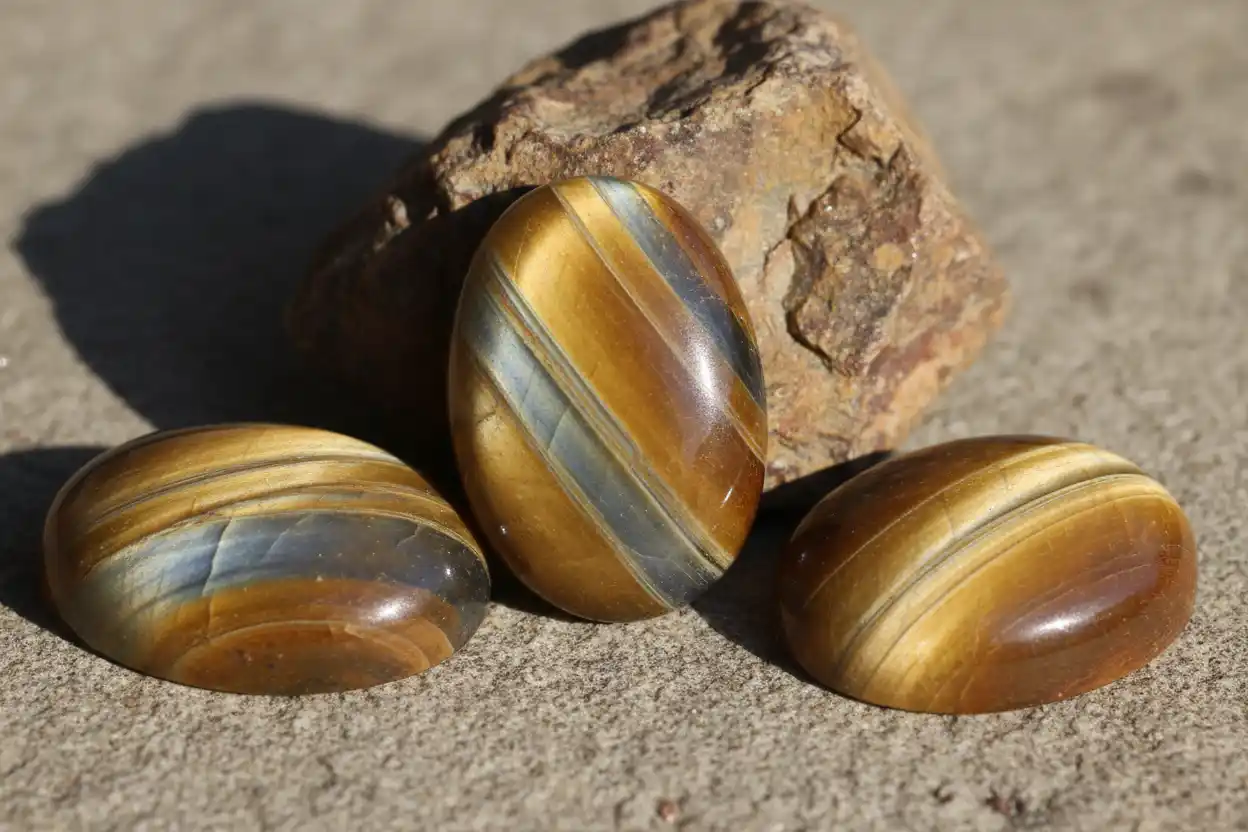
Begin by looking for a mixture of organized and irregular chatoyancy. Straight golden bands suggest tiger’s-eye-like material, while blue-gray or brown flashes moving in several directions suggest pietersite-like brecciation.
Rotate the stone beneath one stationary light. A natural internal flash should move as the viewing angle changes rather than remaining fixed like metallic paint.
Magnification may reveal fine parallel fibers, broken fiber bundles, iron-rich patches, fractures, pits, resin, and polishing marks. Dye may accumulate around cracks or drill holes.
The pattern should usually continue around cabochon edges and across the back when those areas expose the same rough. A surface-only design may indicate coating, paint, a thin veneer, or assembled material.
Quartz-rich areas commonly resist scratching by steel and approach a Mohs hardness of 7. Nevertheless, destructive scratch testing is unsuitable for jewelry and cannot confirm a variable trade material by itself.
The gemstone hardness chart helps place quartz-dominant material in context, but a brecciated or resin-filled stone may have weaker local zones.
Laboratory methods such as microscopy, Raman spectroscopy, X-ray diffraction, and chemical analysis can identify the constituent phases. The laboratory may describe the stone as quartz, chalcedony, pietersite, tiger’s-eye-like quartz, or a mixed rock rather than endorsing the name nellite.
Nellite, Tiger’s Eye, and Pietersite
Classic tiger’s eye generally has organized parallel fibers and a continuous moving band. Its colors are commonly gold, yellow-brown, red-brown, or blue-gray.
Pietersite shows more broken, folded, or chaotic fiber orientation. Its blue, gray, gold, red, and brown flashes can resemble storm clouds or flames.
Nellite occupies an uncertain commercial space between the two. Retailers commonly reserve the name for material that combines golden tiger’s-eye-like bands with pietersite-style blue or brecciated zones.
However, that distinction is not enforced consistently. One seller may label a stone nellite, another honey pietersite, and a third mixed tiger’s eye.
The comparison is therefore visual rather than taxonomic. Buyers seeking a recognized material should choose a clearly described tiger’s eye or pietersite, while buyers choosing nellite should value the individual pattern rather than the name’s supposed rarity.
Treatments, Stabilization, and Imitations
Good-quality silica-rich material may need only cutting and polishing. Nevertheless, fractures and brecciated zones make resin stabilization practical for some nellite.
Clear resin can strengthen weak boundaries and improve polish. Surface fillers may also conceal pits, cracks, or undercut areas.
Dye may intensify blue, red, brown, or black colors. Concentrated pigment in fractures and drill holes provides a useful clue.
Wax or oil can darken the stone temporarily and increase contrast. Clear coatings may create a stronger gloss but can scratch or peel.
Glass and resin imitations can reproduce golden and blue swirls. Round bubbles, mold seams, low weight, repeated patterns, and surface scratches may indicate manufactured material.
Ordinary tiger’s eye may also be relabeled as nellite to support a higher price. This is a naming problem rather than a synthetic imitation, but it still affects value.
The general signs of resin, glass, dye, and misleading trade names are covered in how to spot fake crystals, while the processes themselves appear in gemstone treatments explained.
Jewelry Suitability
A dense, well-polished nellite cabochon can work in pendants, earrings, brooches, bracelets, beads, and protected rings.
Quartz-rich areas offer good scratch resistance. However, the stone remains brittle, and brecciated seams may chip or open after impact.
A bezel setting protects cabochon edges more effectively than widely spaced prongs. Rounded forms also survive wear better than sharp points or thin corners.
Rings expose the material to more impact than pendants. An everyday ring should have a low profile and should not contain open fractures running to the girdle.
Beaded bracelets can work, although large beads may strike desks and metal spacers repeatedly. Knots or softer separators reduce direct contact.
The distinction between a hard surface and a structurally tough stone is explained in gemstone toughness versus hardness.
Current Nellite Asking Prices
Nellite remains an inexpensive-to-moderately priced lapidary product. Its nonstandard identity makes price comparisons less reliable than those for an accepted mineral species.
| Nellite product | Broad retail asking range |
|---|---|
| Small tumbled stone | About $3–$10 |
| Small cabochon | About $3–$15 |
| Large or strongly chatoyant cabochon | About $10–$40 |
| Cabochon lot | About $20–$80, depending on quantity and quality |
| Bead strand | About $10–$40 |
| Simple pendant or earrings | About $20–$100 |
| Palm stone or polished freeform | About $15–$60 |
| Tower, sphere, or carving | About $30–$150 |
| Large designer jewelry piece | Highly variable according to metal and workmanship |
These figures represent broad July 2026 retail asking prices rather than appraisals or guaranteed resale values.
Deep marketplace discounts are common. Therefore, a crossed-out “original price” provides little evidence of value.
A seller should not price ordinary tiger’s-eye-like material as rare pietersite merely because the nellite name sounds unfamiliar. Buyers seeking a documented comparison can consult the dedicated guide to buying real tiger’s eye.
What Gives Nellite Value?
Chatoyancy has the greatest visual influence. Strong movement across the surface is more desirable than a dull pattern that changes little under light.
Color balance also matters. Contrasting gold, blue-gray, cream, and brown areas generally attract more interest than a stone dominated by muddy brown.
Pattern orientation determines whether a cabochon emphasizes its best fibers. A cutter can lose most of the eye effect by placing the dome at the wrong angle.
Structural condition affects wearability. Open seams, resin pools, undercut fragments, deep pits, and edge-reaching cracks reduce value.
Treatment disclosure supports confidence. Stabilized material may be practical, but it should not be sold as completely untreated.
Finally, the commercial name itself adds little inherent value. A well-cut, accurately described mixed chatoyant chalcedony is more desirable than a poorly cut stone promoted through unsupported rarity claims.
Buying Nellite
Ask what the seller believes the stone contains. A useful description should mention quartz, chalcedony, tiger’s-eye-like fibers, pietersite-like brecciation, or another identifiable host.
Request a video under one moving light. Static photographs can exaggerate flash or conceal that the effect appears only from one narrow angle.
Inspect the back and sides for pattern continuity, dye, resin, glue, open cracks, and surface coating.
Treat locality statements cautiously unless the seller names a source or documents the supply chain. “African” is not a precise provenance.
Avoid listings that assign one exact chemical formula or crystal system to nellite. Such claims misunderstand its trade-name status.
The name appears in both the crystals beginning with N directory and the gemstones beginning with N directory, but those directory placements do not turn it into a mineral species.
Cleaning and Storage
Clean a sound nellite cabochon with lukewarm water, mild soap, and a soft cloth or brush. Rinse briefly and dry the piece completely.
Avoid prolonged soaking when the stone contains fractures, resin, dye, glue, or a porous matrix. Water may enter open seams even when the quartz-rich portions remain stable.
Do not use steam or ultrasonic cleaners on brecciated material. Vibration can enlarge fractures or loosen filled fragments.
Avoid bleach, strong acids, abrasive powders, and solvent-based cleaners. These products can affect coatings, resin, metal settings, and polished surfaces.
Store nellite separately from diamond, sapphire, topaz, and other hard stones. A fabric pouch protects its polish and cabochon edges.
Tiger’s-eye jewelry has similar routine requirements, which are covered more fully in the tiger’s-eye jewelry cleaning guide.
Nellite Meaning and Symbolism
Modern crystal sellers commonly combine the symbolism assigned to tiger’s eye and pietersite when describing nellite.
Golden bands are associated with focus, confidence, practical action, and stability. Blue-gray or turbulent areas inspire interpretations involving adaptation, insight, and remaining composed during change.
Because the name is recent and commercially inconsistent, claims that nellite had one established ancient spiritual tradition are not historically credible.
The stone’s mixed appearance may still offer a useful personal metaphor: organized bands and chaotic swirls can represent balancing a clear plan with flexibility.
These meanings remain modern, spiritual, artistic, or personal interpretations. Scientific evidence does not show that nellite heals illness, protects against danger, changes luck, or produces guaranteed psychological effects.
Frequently Asked Questions
Is nellite a recognized mineral?
No. Nellite is a nonstandard commercial name applied to variable patterned lapidary material.
What is nellite made from?
Most examples appear to be quartz- or chalcedony-rich material containing tiger’s-eye-like fibers, pietersite-like areas, iron oxides, and occasional brecciated zones.
Is nellite the same as pietersite?
Not consistently. Some sellers describe it as a pietersite grade or mixture, while others use the name for material closer to ordinary tiger’s eye.
How does nellite differ from tiger’s eye?
Nellite commonly shows a mixture of straight chatoyant bands and more chaotic multicolored areas. Classic tiger’s eye normally has more organized parallel banding.
Where is nellite found?
Retailers often associate it with southern Africa, but no standardized type locality exists. Specific origin claims require documentation.
What creates nellite’s moving flash?
Aligned or broken fibrous structures within silica reflect light in changing bands or patches as the stone is rotated.
How hard is nellite?
Quartz-rich areas commonly approach 6.5–7 on the Mohs scale. Fractures, resin, softer matrix, and brecciated boundaries can reduce practical durability.
Is nellite suitable for jewelry?
Yes, when the stone is dense and well polished. Pendants and earrings are safer than exposed everyday rings.
Is nellite normally treated?
Some material is untreated, but resin stabilization, filling, dye, oil, wax, and surface coatings can occur.
How can I recognize fake nellite?
Look for mold seams, round bubbles, repeated printed patterns, surface-only color, low weight, excessive resin, and descriptions that provide no underlying material identity.
Can nellite go in water?
Brief washing is usually acceptable for intact material. Avoid soaking stones that are fractured, dyed, coated, glued, or resin-filled.
What makes a nellite cabochon valuable?
Strong chatoyancy, contrasting colors, attractive orientation, structural stability, fine polish, treatment disclosure, and careful cutting matter more than the trade name.
Nellite is most rewarding when chosen as an individual patterned lapidary stone rather than as a supposedly rare mineral. Its mix of fibers, brecciation, and shifting light also makes it well suited to the cutting approaches discussed in the guide to gemstones for cabochons and carving.
Cutting, drilling, or grinding nellite can release respirable silica dust and dust from altered amphibole-bearing fibers. Finished polished pieces are generally suitable for normal external wear, but lapidary work should use wet methods, effective extraction, eye protection, and appropriate respiratory protection.