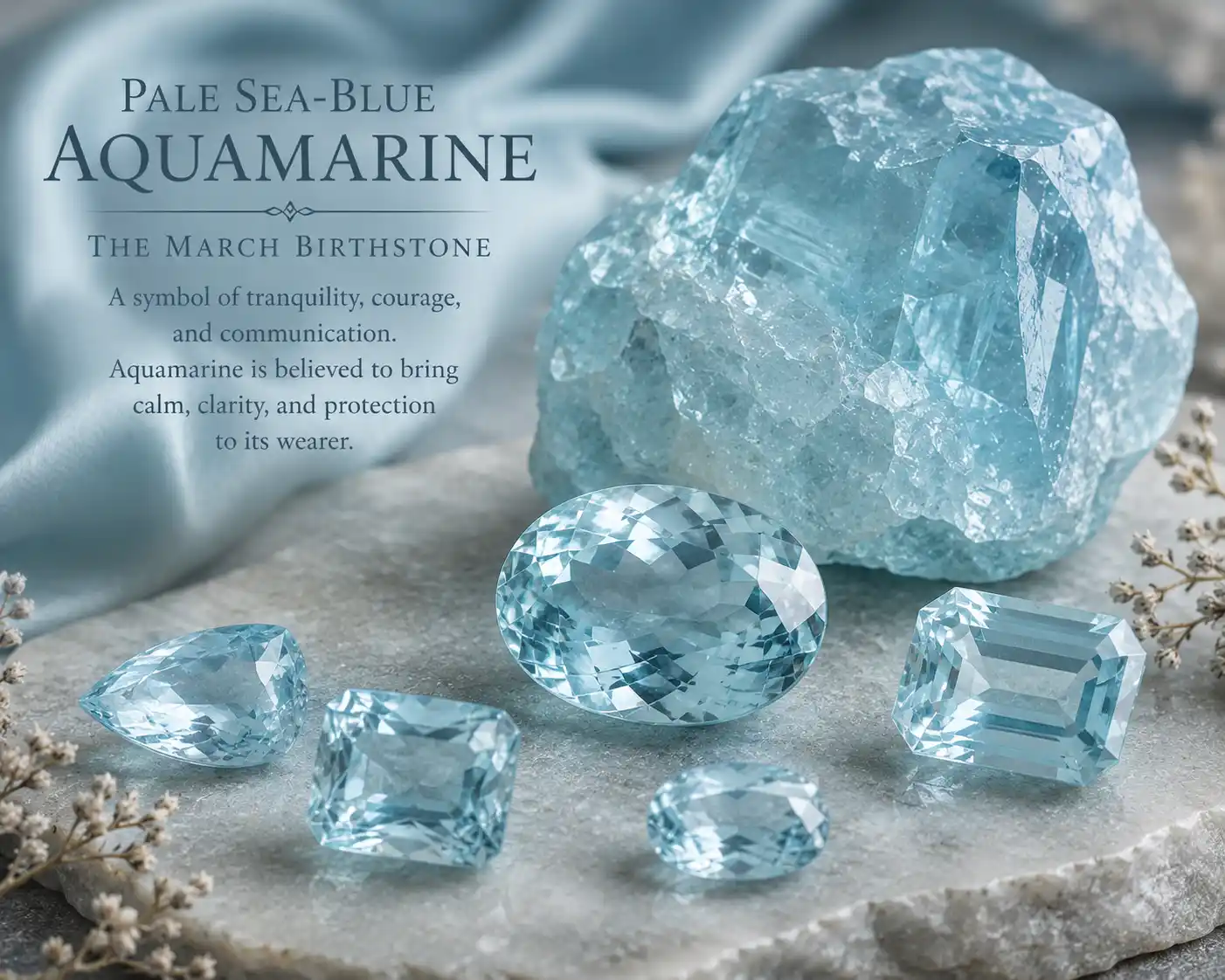
March Birthstone: Aquamarine’s Meaning, Color & History
Aquamarine is the best-known modern birthstone for March. Its blue-to-greenish-blue color evokes clear water, open sky and the sea, while its strong transparency gives fine faceted stones an unusually clean, luminous appearance.
March also has a traditional alternative: Bloodstone, an opaque dark-green chalcedony marked with red iron-oxide spots. The two stones look entirely different, yet both developed historical associations with protection, strength and well-being.
This guide focuses on Aquamarine’s role as a March birthstone—its color, history, symbolism and place within the birthstone system. The complete Aquamarine gemstone guide owns the material’s broader geology, healing traditions and uses.
March Birthstones at a Glance
| Feature | Aquamarine | Bloodstone |
|---|---|---|
| Role | Best-known modern March birthstone | Traditional March alternative |
| Mineral identity | Blue-to-greenish-blue beryl | Chalcedony or jasper containing red iron-oxide spots |
| Typical appearance | Transparent pale blue to greenish blue | Opaque dark green with red, brown or yellow markings |
| Mohs hardness | 7.5–8 | Approximately 6.5–7 |
| Common cut | Faceted emerald, oval, round and pear cuts | Cabochons, beads, signets and carvings |
| Traditional symbolism | Safe travel, calm water, loyalty and happy marriage | Strength, vitality, courage and protection |
| Best jewelry strength | Suitable for most jewelry | Durable but generally used in opaque designs |
| Common treatment concern | Heat and occasional filling or laboratory growth | Dye, misleading names and substitute green jasper |
| Visual appeal | Clarity, watery color and brilliance | Pattern, contrast and historical character |
Why Aquamarine Is the March Birthstone
Modern birthstone lists in the United States identify Aquamarine with March. The standardized list developed through the jewelry trade, giving each month a recognizable gemstone that could be used consistently in rings, pendants, bracelets and gifts.
Bloodstone remains associated with March through older and alternative traditions. Consequently, some references present Aquamarine alone, while others recognize both stones.
The complete Birthstones by Month guide explains how modern and traditional lists differ. The Zodiac Birthstones guide covers a separate astrological system that should not be confused with calendar-month stones.
Aquamarine became the dominant March jewelry choice partly because it is transparent, durable and available in sizes suitable for many designs. Its color also offers a clear visual identity for the month.
What Is Aquamarine?
Aquamarine is the blue-to-greenish-blue variety of beryl.
Its chemical family also includes green Emerald, pink Morganite, yellow Heliodor and colorless Goshenite. All share the same basic beryl crystal structure, although trace elements and defects create different colors.
Aquamarine has the formula Be₃Al₂Si₆O₁₈ and commonly grows as six-sided prismatic crystals in granite pegmatites and related geological settings.
It ranks 7.5–8 on the Mohs scale, making it durable enough for rings and frequently worn jewelry when protected from severe blows.
The Gemstone Hardness Chart provides the numerical comparison. Aquamarine is less scratch-resistant than sapphire or diamond but considerably stronger than March’s softer ornamental alternatives.
Aquamarine Color
Aquamarine ranges from pale blue through slightly greenish blue, green-blue and deeper medium blue.
Most stones in ordinary jewelry are light in tone. The deepest natural-looking blue is comparatively uncommon, especially in small gems.
Larger Aquamarines often show stronger color because the light travels through more material. This is one reason a five-carat stone may appear noticeably richer than small matching accents cut from similar rough.
Fine color should remain blue or slightly greenish blue under ordinary lighting rather than becoming gray, nearly colorless or artificially electric.
The Types of Aquamarine guide owns the complete discussion of named colors, trade varieties, cat’s-eye material and deep-blue terminology.
What Causes Aquamarine’s Blue Color?
Aquamarine’s color is primarily related to iron within the beryl structure.
Different oxidation states and structural positions of iron influence whether the crystal appears blue, greenish blue or yellow-green.
Heating can reduce unwanted yellow or green components, leaving a purer blue appearance. This treatment is common, generally stable and often difficult to detect conclusively.
Heat does not turn glass or topaz into Aquamarine. The treated stone remains beryl, although enhancement should be disclosed when known.
The dedicated Treated Aquamarine guide owns the separation of natural color, heating, filling and laboratory-grown material.
Aquamarine Clarity
Fine faceted Aquamarine is usually expected to appear clean to the unaided eye.
Beryl crystals can grow large and relatively transparent, so visible inclusions are less accepted in Aquamarine than in Emerald.
Some crystals contain hollow tubes, liquid inclusions, healed fractures or mineral crystals. Parallel tubes can occasionally produce a cat’s-eye effect when the rough is cut as a cabochon.
Included material can still be attractive in beads, carvings and artistic jewelry, but it should not be priced as a clear high-quality faceted gem.
The Aquamarine Buying Guide owns the full color, clarity, cut and carat assessment.
Aquamarine Cuts
Aquamarine can be fashioned into almost every standard gem shape.
Emerald cuts are particularly common because the long rectangular outline suits prismatic beryl rough and highlights clarity. Ovals, rounds, pears, cushions and elongated radiant cuts are also widely used.
A pale stone requires precise cutting. A large central window can make it appear nearly colorless, while excessive depth hides weight without increasing visible size.
Designer and fantasy cuts work well in Aquamarine because large clear crystals provide enough material for complex faceting and carving.
The cut should distribute color across the face rather than concentrating blue only around the perimeter.
Aquamarine Meaning
The name Aquamarine comes from Latin words associated with water and the sea.
Historical lore connected the gem with sailors, calm waves, safe voyages and protection during travel. It was also associated with harmonious marriage, loyalty and clear communication.
These meanings developed through cultural storytelling and gemstone symbolism rather than measurable forces within beryl.
For a March birthday, the sea imagery can represent calm judgment, adaptability and an ability to remain clear during change.
A birthstone may carry personal significance without being described as medically or astrologically active.
Aquamarine and Sailors
Aquamarine’s marine name encouraged stories of sailors carrying the stone for protection.
Ancient and later writers associated blue-green beryl with safe passage, calm seas and favorable travel. Such accounts became central to Aquamarine marketing and birthstone lore.
The gem cannot prevent storms, mechanical failure or accidents. A modern traveler can use its symbolism as a reminder to prepare carefully, check conditions and follow safety guidance.
Historical belief should be presented as tradition rather than evidence that the stone controls water or weather.
Aquamarine and Marriage
Aquamarine has also been connected with happy marriage, loyalty and reconciliation.
The stone is the traditional gem for a nineteenth wedding anniversary, reinforcing its relationship symbolism beyond March birthdays.
Its clear blue appearance supports modern meanings involving calm communication and emotional honesty.
A gemstone cannot preserve a relationship or guarantee faithfulness. Its meaning is strongest when paired with practical acts such as listening, keeping commitments and addressing conflict directly.
The Best Gemstones for Anniversary Gifts provides wider milestone-gift context.
The History of the Modern March Birthstone
The modern American birthstone list was standardized by the jewelry trade in the early twentieth century. Aquamarine was assigned to March and remains the stone most commonly shown in contemporary birthstone jewelry.
The standardization did not erase older traditions. Bloodstone continued to appear as a March gem, creating the two-stone system recognized by many gemological and educational sources today.
This history explains why a shopper may encounter Aquamarine alone in one jewelry chart and Aquamarine plus Bloodstone in another.
Neither list changes the mineral identity of the stones. Birthstone status is a cultural convention rather than a geological property.
Famous Aquamarines
Aquamarine’s ability to form very large transparent crystals has produced several notable cut objects.
The Dom Pedro Aquamarine is a monumental fantasy-cut obelisk fashioned by lapidary artist Bernd Munsteiner. Its scale and internal design demonstrate why Aquamarine is especially suitable for sculptural cutting.
In 1936, the Brazilian government presented Eleanor Roosevelt with a 1,298-carat rectangular step-cut Aquamarine. The gem remains an important example of the stone’s connection with Brazil and diplomatic gift-giving.
These famous objects are exceptional in size, but large Aquamarine is not automatically rare in the same way as a large fine Ruby. Color, clarity and cut remain more important than weight alone.
Where Aquamarine Is Found
Brazil, particularly Minas Gerais, has been one of the world’s best-known Aquamarine sources.
Pakistan produces crystals from high-altitude pegmatites in the Karakoram region. Nigeria, Madagascar, Mozambique, Zambia and other countries also supply gem material.
Source can add collecting interest, yet geographic origin is not usually the primary Aquamarine value factor. A fine stone remains fine because of its color, clarity and cut rather than a famous mine name alone.
A seller should not assign a premium locality from color without reliable provenance.
Aquamarine Treatments and Laboratory Growth
Heating is the most common Aquamarine treatment. It generally reduces greenish or yellowish components and leaves a more desirable blue.
Fracture filling is uncommon but possible. Filled stones need more conservative cleaning because heat and cleaning equipment may affect the filler.
Laboratory-grown blue beryl and other blue gems can imitate Aquamarine’s appearance.
The Real vs Fake Aquamarine guide owns the complete separation from glass, blue topaz, synthetic beryl and other substitutes. The direct Aquamarine vs Blue Topaz guide addresses the most common commercial comparison.
An independent report can identify natural or laboratory-grown origin and detectable treatments. The Gemstone Certification guide explains what such documentation does and does not guarantee.
Bloodstone: March’s Alternative Birthstone
Bloodstone, also called heliotrope, is generally dark-green chalcedony or jasper marked with red iron-oxide spots.
It is opaque and normally cut into cabochons, beads, signets and carvings rather than transparent faceted gems.
The name refers to its red markings and the extensive symbolism that developed around them. Historical traditions associated Bloodstone with strength, health, courage and protection.
Those beliefs should not be treated as evidence that the stone affects blood, circulation or athletic performance.
The full Bloodstone guide owns the material’s geology and symbolism. Buyers seeking natural material can consult Where to Buy Real Bloodstone.
Aquamarine vs Bloodstone for a March Birthday
Aquamarine suits someone who prefers transparent faceted jewelry, cool blue color and designs that can range from delicate to formal.
Bloodstone suits someone who prefers opaque stones, historical signets, dark green, red-speckled patterns or less conventional birthstone jewelry.
Aquamarine is generally the stronger choice for a brilliant engagement-style ring. Bloodstone works particularly well in signets, pendants, cufflinks and substantial cabochons.
Neither option is more authentic as a March birthstone. They represent different stages of the tradition.
March Zodiac Connections
March birthdays can fall under Pisces or Aries in the common Western tropical zodiac.
The Pisces Birthstone guide and Aries Birthstone guide own those separate astrological systems.
A March birthstone comes from the calendar month, while a zodiac stone comes from an astrological sign. A person born in late March can therefore have Aquamarine as a monthly birthstone and a different optional Aries stone.
These systems can overlap symbolically, but neither should be presented as a scientific influence over personality.
Choosing a March Birthstone
Begin with the preferred material rather than a supposed rule.
For Aquamarine, compare color under neutral light, examine cut quality, confirm treatment disclosure and ensure the setting suits the wearer’s habits. The Aquamarine Price Guide owns value considerations.
For Bloodstone, examine the green bodycolor, distribution of red spots, polish, cracks and seller description.
The companion March Birthstone Jewelry Gift Guide focuses on rings, necklaces, earrings, bracelets and recipient-specific choices.
Cleaning and Care
Aquamarine is durable enough for regular wear, but it should still be protected from hard blows and harsh heat.
Follow How to Clean Aquamarine Jewelry Safely. Warm water, mild soap and a soft brush provide the safest routine method.
Ultrasonic and steam cleaning may be appropriate for sound untreated Aquamarine, but they should be avoided when the stone contains significant fractures, liquid inclusions or filling.
Bloodstone can also be cleaned with warm mild soapy water and a soft cloth or brush. Both stones should be stored separately from harder gems that may scratch them.
Frequently Asked Questions
1. What is the March birthstone?
Aquamarine is the best-known modern March birthstone. Bloodstone is also recognized as a traditional March alternative.
2. Why does March have two birthstones?
Modern standardized jewelry lists emphasize Aquamarine, while older and alternative traditions preserve Bloodstone.
3. What color is Aquamarine?
Aquamarine ranges from pale blue through slightly greenish blue and green-blue to stronger medium blue.
4. What mineral is Aquamarine?
Aquamarine is the blue-to-greenish-blue variety of beryl.
5. What does Aquamarine symbolize?
Traditional meanings include safe travel, calm seas, loyalty, clear communication and marital happiness.
6. Is Aquamarine durable enough for a ring?
Yes. Its hardness of 7.5–8 makes it suitable for rings when protected from severe impact.
7. Is Aquamarine usually treated?
Much commercial material is heated to reduce green or yellow components and create a purer blue.
8. Is deep-blue Aquamarine more valuable?
Stronger, evenly distributed blue generally attracts higher demand, provided the stone also has good clarity and cut.
9. Is Bloodstone really a March birthstone?
Yes. Bloodstone remains a recognized traditional or alternative March birthstone.
10. Is Bloodstone related to Aquamarine?
No. Aquamarine is transparent beryl, while Bloodstone is opaque chalcedony or jasper with iron-oxide markings.
11. Is Aquamarine also an anniversary gemstone?
Yes. It is traditionally associated with the nineteenth wedding anniversary.
12. Does Aquamarine have scientifically proven calming powers?
No. Maritime, calming and relationship meanings are historical or personal symbolism rather than scientifically established effects.
Aquamarine became March’s defining modern birthstone because it combines a memorable sea-blue identity with transparency, durability and design versatility. Bloodstone preserves an older, earthier side of the month’s tradition. Together, they show how birthstone systems can hold both modern jewelry practice and historical symbolism without requiring the stones to look alike.
Aquamarine and Bloodstone meanings, protective traditions and zodiac associations are cultural or personal symbolism rather than scientifically established medical or supernatural effects.