April Birthstone: Meaning, Colors & Buying Guide
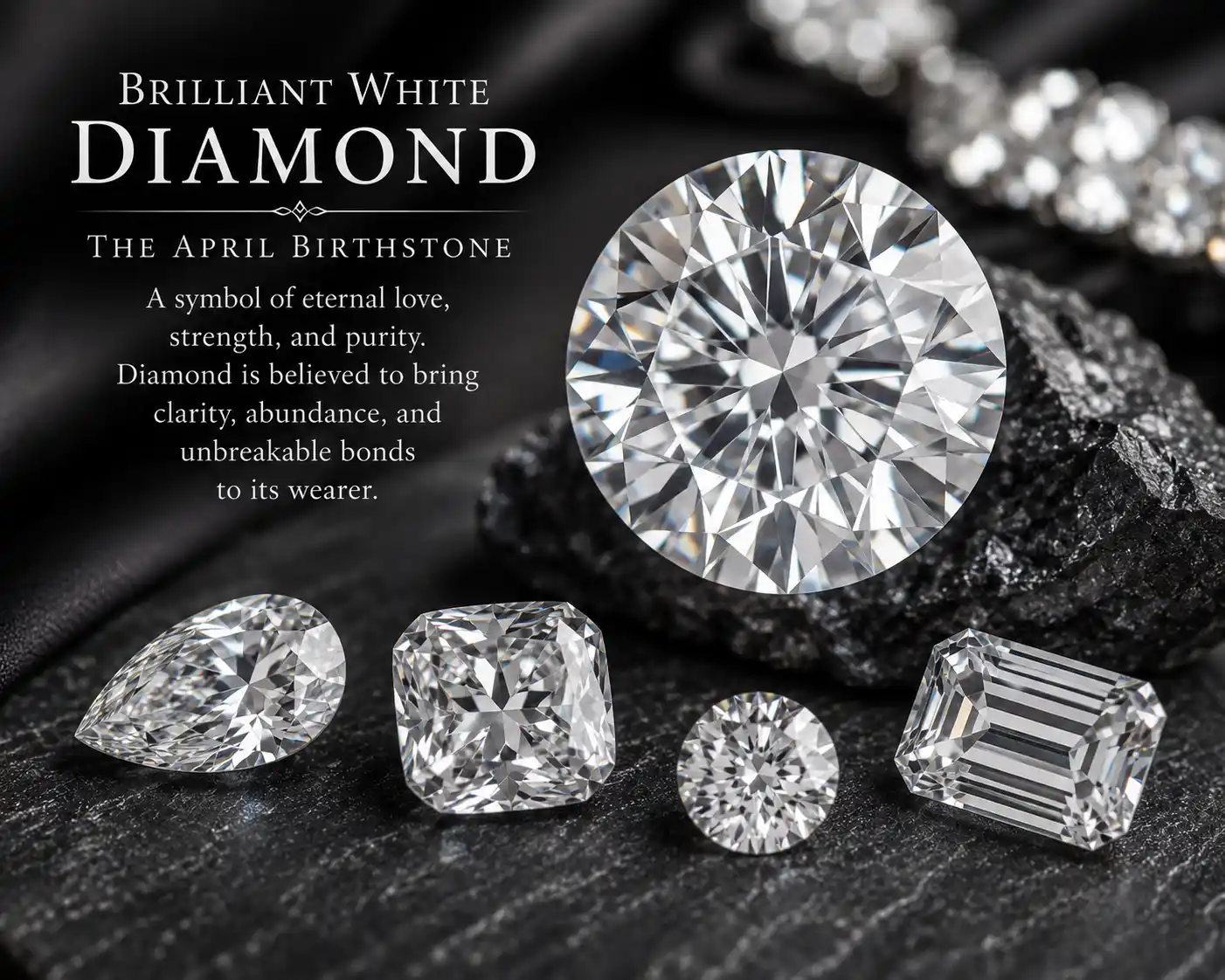
The April birthstone is diamond, a crystalline form of carbon prized for exceptional scratch resistance, adamantine luster, brilliance, fire, and a long jewelry tradition connected with strength, clarity, commitment, and endurance. Although colorless diamond is the appearance most closely associated with the April birthstone, natural and laboratory-grown diamonds can occur in yellow, brown, pink, blue, green, orange, gray, black, and other colors, creating far more choice than the familiar clear brilliant suggests.
Choosing an April birthstone is also more complex than selecting the largest diamond within a budget, because cut quality, color, clarity, carat weight, natural or laboratory-grown origin, treatments, documentation, shape, setting, and visible condition can materially change both appearance and value. Diamond defines 10 on the Mohs scale, yet even this exceptionally hard material can chip along cleavage directions, which means its reputation for durability should not be confused with indestructibility.
The April birthstone tradition is cultural rather than scientific. Diamond can represent resilience, honesty, commitment, or an important personal milestone, but wearing one does not guarantee loyalty, improve health, protect a relationship, or create a particular future outcome.
April Birthstone at a Glance
| Property | April Birthstone: Diamond |
|---|---|
| Material | Diamond |
| Composition | Carbon, C |
| Mineral class | Native element |
| Crystal system | Cubic |
| Common appearance | Colorless to near-colorless |
| Other colors | Yellow, brown, pink, blue, green, orange, red, gray, black |
| Luster | Adamantine |
| Transparency | Transparent to opaque |
| Mohs hardness | 10 |
| Cleavage | Perfect in four octahedral directions |
| Refractive index | About 2.42 |
| Main optical effects | Brilliance, fire and scintillation |
| Main quality factors | Cut, color, clarity and carat weight |
| Origins | Natural geological formation or laboratory growth |
| Common treatments | Color modification, laser drilling, fracture filling |
| Traditional symbolism | Strength, clarity, commitment, endurance |
| Jewelry suitability | Excellent when stone and setting are appropriate |
Anyone comparing the April birthstone with the rest of the calendar can use the birthstones by month overview to see how diamond differs from stones such as amethyst, aquamarine, emerald, ruby, sapphire, opal, and turquoise.
What Is the April Birthstone?
Diamond is the principal modern April birthstone.
Mineralogically, diamond consists almost entirely of carbon arranged in a three-dimensional cubic crystal structure. Graphite is also made from carbon, yet its atoms are arranged differently, which is why graphite is extremely soft while diamond possesses extraordinary resistance to scratching.
The April birthstone occurs naturally when carbon crystallizes under very high pressure and temperature deep within Earth before being transported toward the surface by unusual volcanic processes. Laboratory-grown diamonds reach the same basic material identity through controlled manufacturing methods rather than geological formation.
That distinction is important: a laboratory-grown diamond is not cubic zirconia, glass, or moissanite. It is diamond with a different origin.
The broader diamond meaning and properties guide examines diamond as a mineral and gemstone in greater depth, while this page focuses specifically on its role as the April birthstone.
Why Is Diamond the April Birthstone?
The modern connection between diamond and April developed through birthstone traditions that were influenced by older gemstone symbolism, regional customs, religious interpretations, and later jewelry-industry standardization.
It is misleading to describe today’s April birthstone list as one completely unchanged system passed down intact from antiquity. Older gem lists used different names, some historical stone identities remain uncertain, and regional traditions did not always assign identical materials.
The standardized modern tradition places diamond firmly with April, which is why contemporary jewelers, gemological organizations, and birthstone charts consistently present it as the month’s principal gemstone.
Diamond also fits the role unusually well from a practical perspective. Its scratch resistance allows an April birthstone gift to be made as a ring, pendant, earrings, bracelet, or other lasting jewelry piece without the severe wear limitations that affect softer birthstones.
April Birthstone History
Diamond’s history began long before its modern birthstone association.
Some of the earliest important diamond sources were in India, where rough crystals were recovered from river gravels and entered long-distance trade. Because diamonds were difficult to cut with early technology, natural crystal shape, rarity, and association with political or social status contributed strongly to their value.
Brazil later became an important diamond source as supplies from older deposits changed, while discoveries in southern Africa transformed the scale of production and helped establish the modern global diamond trade.
Additional deposits and mines were subsequently developed in countries including Botswana, Russia, Canada, and other diamond-producing regions.
This history matters to an April birthstone buyer because “natural diamond” describes geological origin, not one universal supply chain. Two natural diamonds can have very different provenance, mining histories, documentation, and sourcing evidence.
April Birthstone Meaning
April birthstone meaning most commonly centers on strength, clarity, commitment, endurance, loyalty, and permanence.
These symbolic themes make intuitive sense when connected with diamond’s physical identity. Its extraordinary hardness creates an obvious metaphor for resilience, while a transparent well-cut stone can represent openness or clarity.
Commitment became another powerful part of April birthstone meaning through diamond’s role in engagement and wedding jewelry. A diamond given for a birthday, relationship milestone, achievement, or family occasion may therefore represent a promise, memory, or relationship that the giver intends to honor over time.
The meaning comes from the person and context.
Diamond cannot guarantee fidelity, preserve a relationship, prevent separation, or determine another person’s feelings. At Gems Lore, April birthstone meaning is best treated as personal and cultural symbolism attached to a real gemstone rather than evidence that diamond causes the outcome it represents.
April Birthstone Colors
The April birthstone offers a much wider color range than most people expect.
Colorless and near-colorless diamonds dominate traditional fine jewelry, but natural fancy-color diamonds can occur in yellow, brown, pink, blue, green, orange, red, violet, gray, and black appearances. Laboratory-grown diamonds can also be produced in colorless and colored varieties.
Different colors arise from different causes, including trace elements, defects in the crystal lattice, plastic deformation, radiation-related processes, inclusions, and combinations of structural features.
| Diamond Color | Common Physical Cause or Influence | Traditional or Modern Symbolism |
|---|---|---|
| Colorless | Minimal color-producing impurities or defects | Clarity, unity, simplicity |
| Yellow | Commonly nitrogen-related absorption | Optimism, warmth, confidence |
| Brown | Often linked with lattice deformation and related defects | Stability, practicality |
| Pink | Commonly associated with structural deformation | Affection, individuality |
| Blue | Often associated with boron in natural material | Composure, depth, perspective |
| Green | Can involve natural radiation-related defects | Renewal, growth |
| Black | Numerous inclusions, graphitic material or treatment may influence appearance | Strength, independence |
| Red | Rare structural color mechanisms related to pink diamonds | Intensity, passion |
These symbolic associations are optional interpretations, not scientific properties.
The dedicated diamond color meaning guide examines the difference between body color, grading, physical color causes, fancy colors, and symbolism more closely.
Is a Colorless Diamond the Best April Birthstone?
Not automatically.
A colorless April birthstone provides the classic diamond appearance, but the best choice depends on the recipient’s taste, budget, jewelry style, and whether rarity or visible color matters more.
Near-colorless diamonds can appear beautifully white in normal jewelry settings without requiring the highest color grade. Yellow and rose gold can also make subtle warmth less noticeable or visually harmonious.
Fancy-color diamonds follow a different value logic. A strong attractive yellow, pink, blue, or other fancy color may be more desirable because of its color rather than because it approaches colorlessness.
Black diamonds create yet another appearance and are frequently chosen for contemporary or unconventional jewelry.
The types of diamond guide explains how origin, color, crystal structure, transparency, and commercial categories can overlap within the same gemstone species.
The Four Cs of the April Birthstone
The Four Cs—cut, color, clarity, and carat weight—provide a practical framework for comparing polished diamonds, but they should be considered together rather than treated as four independent scores.
| Quality Factor | What It Describes | Why It Matters |
|---|---|---|
| Cut | Proportions, symmetry, polish and light performance | Strongly affects brightness, fire and scintillation |
| Color | Degree of colorlessness or fancy-color quality | Influences appearance, rarity and value |
| Clarity | Internal inclusions and external blemishes | Affects rarity, sometimes appearance and durability |
| Carat | Weight of the diamond | Influences size and price but not beauty by itself |
For many buyers, cut quality deserves particularly strong attention because a well-cut April birthstone can look bright and lively even when its color and clarity grades are not at the extreme top of the scale.
A larger diamond with weak proportions can leak light and look dull.
A smaller well-cut diamond may appear more visually impressive.
April Birthstone Cut vs. Shape
Cut and shape are related but not identical.
Shape describes the outline: round, oval, pear, cushion, emerald, radiant, marquise, princess, Asscher, or another form.
Cut quality describes how effectively the gemstone’s proportions, symmetry, and polish handle light.
This distinction matters when shopping for an April birthstone because two diamonds of the same shape and carat weight can perform very differently. One round stone may produce strong brightness and fire, while another of the same nominal weight can look dark or small because too much mass is hidden in excessive depth.
Fancy shapes introduce their own considerations. Ovals and pears may show bow-tie darkness, pointed shapes need protection at vulnerable tips, and step cuts reveal inclusions differently from brilliant-style cuts.
A buyer should judge the actual stone rather than assuming that a shape name guarantees performance.
April Birthstone Color Grades
For colorless-to-light-yellow diamonds, color is commonly evaluated along a grading scale that begins with the highest colorless range and moves progressively toward more noticeable yellow or brown.
The important buying point is that the highest grade is not automatically necessary.
A near-colorless April birthstone can appear white when viewed face-up, especially after it is mounted, and the difference between neighboring high grades may be difficult to see without controlled side-by-side comparison.
Metal choice affects perception as well. White metals tend to emphasize body color, whereas yellow or rose gold can make mild warmth blend more naturally with the setting.
Fancy-color diamonds should not be evaluated using the same consumer logic. In a fancy yellow diamond, for example, stronger attractive yellow color can increase desirability rather than reduce it.
April Birthstone Clarity
Natural diamonds frequently contain inclusions formed during or after crystal growth.
These may include tiny crystals, feathers, clouds, needles, graining, or other internal features. External characteristics such as polish marks, scratches, or naturals can also influence clarity evaluation.
A higher clarity grade generally indicates fewer or less noticeable characteristics under standardized examination, but an April birthstone does not need microscopic perfection to be beautiful.
Many diamonds with moderate clarity grades appear completely clean to the unaided eye.
Location matters as much as quantity. A small inclusion hidden near the edge may have little visible effect, while a dark feature under the center of the table can attract attention. Large feathers, cavities, or inclusions reaching vulnerable edges may also deserve consideration from a durability perspective.
Buying solely for the highest clarity grade can therefore spend money on rarity that makes little visible difference during normal wear.
April Birthstone Carat Weight
Carat is a measure of weight, not visible size.
Two one-carat diamonds can look different from above because shape, depth, girdle thickness, and proportions determine how much of that weight is visible face-up.
A deeply cut April birthstone can hide substantial mass below the setting and appear smaller than a better-proportioned stone of equal weight.
Elongated shapes such as oval, pear, and marquise can also create a larger visual footprint than some round stones of similar weight.
Carat should therefore be considered with millimeter dimensions and cut quality rather than as a standalone measure of size.
The detailed diamond buying guide goes further into proportions, quality trade-offs, documentation, and comparison strategies.
Natural vs. Lab-Grown April Birthstone
Both natural and laboratory-grown diamonds can serve as an April birthstone because both are diamond.
Natural diamond formed through geological processes within Earth.
Laboratory-grown diamond is produced using controlled processes such as high-pressure, high-temperature growth or chemical vapor deposition.
Their essential chemistry, crystal structure, hardness, and many optical properties are extremely similar. The important difference is origin, and that difference has consequences for rarity, supply, price behavior, provenance, and resale expectations.
A laboratory-grown April birthstone can often provide greater visible size or higher apparent specifications for the same initial budget, while a natural stone may appeal more strongly to someone who values geological formation and natural rarity.
Neither choice should be disguised as the other.
The broader lab-grown vs natural gemstones comparison explains why origin disclosure matters even when two materials share the same fundamental gemstone identity.
Can You Identify Natural vs. Lab-Grown Diamond by Eye?
Not reliably.
High-quality laboratory-grown diamonds can look essentially identical to natural diamonds in normal visual inspection because both materials are crystalline carbon with closely related physical and optical properties.
Magnification may reveal clues in some specimens, but the absence of an obvious clue does not establish natural origin.
Professional laboratories use combinations of spectroscopy, fluorescence imaging, growth-pattern analysis, and specialized instrumentation to separate natural from laboratory-grown material.
This is why a seller’s unsupported visual assurance is not enough for a significant April birthstone purchase.
Diamond Simulants Are Different
A simulant looks like diamond but is not diamond.
Moissanite, cubic zirconia, white sapphire, white topaz, and glass can all imitate aspects of a colorless April birthstone, yet their composition, hardness, density, refractive properties, brilliance, and long-term wear differ.
Moissanite is particularly durable and can show strong spectral fire.
Cubic zirconia can provide substantial size at a low cost but has different density and wear behavior.
White sapphire offers a natural or laboratory-grown corundum alternative but does not reproduce diamond’s optical performance.
There is nothing inherently wrong with choosing a simulant when it is accurately disclosed. The problem occurs when a substitute is represented as diamond.
The real vs fake diamond guide explains why fog tests, casual scratch tests, and appearance alone cannot provide dependable identification.
April Birthstone Treatments
Natural origin does not automatically mean untreated.
Some diamonds receive treatment to change their apparent color or improve the appearance of inclusions. High-pressure and high-temperature processes or irradiation-related techniques can modify color in suitable material, while laser drilling and fracture filling may reduce the visual prominence of certain inclusions.
Treatments differ in permanence, detectability, effect on value, and care requirements.
Fracture-filled material deserves particular caution around repair and aggressive cleaning because the filling material does not behave exactly like diamond.
An April birthstone seller should disclose known treatment rather than relying on the word “natural” to imply an untreated stone.
April Birthstone Certification and Reports
For a significant loose or center diamond, an independent grading or identification report can reduce uncertainty substantially.
A reputable report may document whether the diamond is natural or laboratory-grown, carat weight, dimensions, color, clarity, cut information where applicable, polish, symmetry, fluorescence, treatments, and identifying characteristics.
A grading report is not the same thing as an appraisal.
The report describes the gemstone.
An appraisal estimates monetary value for a particular purpose and may include the finished jewelry, metal, labor, market context, and replacement considerations.
The gemstone certification laboratory guide explains why the laboratory issuing a document matters and why a seller-created “certificate” should not automatically be treated as independent grading.
How to Buy an April Birthstone Without Overpaying
A sensible April birthstone purchase begins with priorities rather than grades.
Decide first whether natural origin matters, whether the stone will be worn frequently, what visible size works for the design, and which characteristics are actually noticeable without magnification.
Then prioritize cut and face-up appearance.
Color and clarity can be balanced around what is visible in the particular stone instead of automatically pursuing the highest available grades.
Compare millimeter measurements alongside carat weight, especially when different shapes are involved.
For a significant purchase, verify the grading report independently rather than relying on a screenshot supplied by the seller. Confirm that identifying numbers and measurements correspond with the stone being offered.
Return terms should also be clear enough to allow independent examination if necessary.
Is a Bigger April Birthstone Better?
No.
Size is only one factor.
A large diamond with poor light return, obvious inclusions, awkward proportions, weak color, surface damage, or undisclosed treatment can be less desirable than a smaller stone selected carefully.
Visible balance matters particularly in jewelry because a diamond should suit the mounting rather than overpower it mechanically or visually.
A good April birthstone purchase uses size as part of the decision, not as a substitute for quality.
April Birthstone Durability
Diamond defines the top of the Mohs scale, making the April birthstone exceptionally resistant to scratching.
That does not make diamond impossible to break.
Its crystal structure includes perfect cleavage in octahedral directions, meaning a sufficiently concentrated impact in an unfavorable direction can chip or split the material. Points on pear, marquise, princess, and other angular shapes can be particularly vulnerable when left exposed.
The distinction becomes clearer in the gemstone hardness chart: hardness describes scratch resistance rather than complete resistance to damage.
Similarly, gemstone toughness vs hardness explains why impact performance is a separate property, while the gemstone cleavage guide shows how a hard gemstone can still possess structural directions of weakness.
Is the April Birthstone Good for Everyday Wear?
Yes, diamond is one of the strongest gemstone choices for regular jewelry use.
Its exceptional scratch resistance helps preserve facet polish over long periods, which is particularly valuable in rings and bracelets that repeatedly contact clothing, surfaces, and other objects.
Still, the setting requires maintenance.
Prongs can thin or bend, pavé stones can loosen, clasps can wear, and an exposed diamond edge can receive a sharp impact even when the gemstone itself remains largely scratch-free.
An April birthstone worn frequently should therefore be inspected periodically for mounting wear rather than assuming that the hardness of diamond protects the entire jewelry piece.
April Birthstone Jewelry
Diamond can be used successfully in almost every conventional jewelry format, but this core April birthstone guide intentionally focuses on the gemstone itself rather than repeating form-specific shopping advice.
Rings place diamonds in a highly visible position but expose the setting to regular impact. Earrings generally experience less mechanical wear, while pendants protect the gemstone well and avoid ring-sizing concerns. Bracelets combine substantial movement with frequent surface contact, making clasp and link construction important.
The separate April birthstone jewelry guide compares those forms, gift considerations, settings, and construction details directly.
How to Clean the April Birthstone
Diamond attracts oils readily, so an April birthstone can lose visible brilliance even when the gemstone itself has not been damaged.
Skin oil, lotion, cosmetics, soap film, and other residue accumulate particularly around the underside of the stone, reducing the amount of light entering and returning through the crown.
For ordinary untreated diamond jewelry in sound condition, mild soap, warm water, and a soft brush are generally sufficient. Clean gently beneath the stone and rinse carefully.
Avoid abrasive household powders and toothpaste because the metal setting can be scratched even though the diamond resists them.
Steam and ultrasonic cleaning are not universally appropriate. Fracture-filled stones, damaged settings, loose pavé, or jewelry containing other sensitive gemstones may require a more conservative method.
The full procedure is covered in how to clean diamond jewelry.
April Birthstone Sourcing and Provenance
Natural diamond origin is not visible from a polished stone.
A seller cannot reliably determine a specific mine or country merely by inspecting a finished diamond. Credible geographic-origin claims require documented supply-chain information or specialized systems that connect polished stones with known rough material.
Responsible sourcing is also broader than a simple “conflict-free” phrase.
Environmental practices, worker conditions, local economic effects, chain-of-custody documentation, recycling, laboratory-grown alternatives, and the credibility of seller claims can all matter to a buyer.
An April birthstone does not become ethical solely because a marketing page uses reassuring language.
Ask what evidence supports the claim.
April Birthstone and Zodiac Stones Are Different Traditions
The April birthstone follows a calendar-based birthstone tradition.
Zodiac gemstone systems work differently because astrological signs overlap portions of different calendar periods and have accumulated multiple regional and modern stone associations.
Someone born in April may therefore encounter diamond on a monthly birthstone chart while seeing several additional stones on an Aries or Taurus gemstone list.
Neither system establishes a scientific connection between a person’s birth and a mineral.
They are symbolic traditions used for personalization, gifting, jewelry, and spiritual practice.
April Birthstone Symbolism in Everyday Use
April birthstone meaning does not require supernatural claims to feel personal.
A diamond can represent an achievement someone worked toward for years, a family connection, a birthday, an important decision, or a commitment between people.
Someone drawn to the symbolism of clarity might use the April birthstone as a reminder to communicate directly and verify assumptions.
Someone who associates diamond with strength can connect the stone with a difficult period they endured.
Commitment can represent a promise made to another person or to oneself.
In each case, the gemstone marks the meaning; it does not create the behavior.
Frequently Asked Questions
What is the April birthstone?
The April birthstone is diamond on the principal modern birthstone list. Diamond is crystalline carbon with a cubic structure and exceptional scratch resistance.
What does the April birthstone mean?
April birthstone meaning commonly includes strength, clarity, commitment, endurance, loyalty, and permanence. These are cultural and personal symbolic associations rather than scientifically proven effects.
Is diamond the only April birthstone?
Diamond is the principal modern April birthstone. Older, regional, zodiac, and alternative gemstone traditions may use different associations, so not every historical list is identical.
What color is the April birthstone?
The classic April birthstone is colorless or near-colorless, but diamonds can also be yellow, brown, pink, blue, green, orange, red, gray, black, and other colors.
Can a lab-grown diamond be an April birthstone?
Yes. Laboratory-grown diamond has essentially the same diamond composition and crystal structure as natural diamond, although its manufactured origin, rarity, price behavior, and documentation differ.
Is cubic zirconia an April birthstone?
Cubic zirconia is not diamond, so it is technically a diamond simulant rather than the April birthstone material itself. It can still be chosen as an affordable symbolic substitute when accurately identified.
Is moissanite the April birthstone?
No. Moissanite is a different material that can resemble diamond. It may serve as a durable diamond alternative, but it is not mineralogically the same as the April birthstone.
Is the April birthstone always expensive?
No. Diamond prices vary enormously with natural or laboratory-grown origin, size, cut, color, clarity, treatment, shape, documentation, and seller. Smaller diamonds and laboratory-grown options can provide substantially different price points.
Which of the Four Cs matters most?
All four matter, but cut quality often has the strongest immediate influence on the brilliance, fire, and scintillation visible in a polished April birthstone.
Does an April birthstone need the highest color grade?
No. Many near-colorless diamonds appear white in normal jewelry settings, and selecting a slightly warmer grade can allow more budget for cut, size, or another visible feature.
Does an April birthstone need flawless clarity?
No. Many diamonds with inclusions visible under magnification still look clean to the unaided eye. Paying for extremely high clarity can add rarity without creating an obvious visual improvement.
Can the April birthstone chip?
Yes. Diamond is extraordinarily hard but has cleavage, so a sharp impact at a vulnerable orientation can chip or split it.
Can I identify a natural diamond at home?
Not reliably in every case. Modern laboratory-grown diamonds and some simulants can defeat simplistic home tests, while destructive scratch or heat tests can damage jewelry. Significant stones are better evaluated using appropriate gemological instruments.
How should I choose an April birthstone?
Choose according to intended wear, natural or laboratory-grown preference, cut quality, visible color and clarity, dimensions, carat weight, treatment disclosure, documentation, setting, and budget rather than focusing on one grade alone.
What makes an April birthstone meaningful?
The strongest meaning usually comes from why the diamond was chosen: a birthday, relationship, achievement, family connection, personal milestone, or symbolic idea such as strength or clarity. The April birthstone can preserve that association without being treated as a source of guaranteed physical, emotional, or spiritual effects.
The April birthstone combines an unusually strong modern tradition with a gemstone whose real physical properties help explain its symbolism. Diamond’s carbon structure, extreme scratch resistance, brilliant optical performance, broad color range, natural and laboratory-grown origins, measurable quality factors, and long jewelry history make it far more than a generic clear stone, while meanings such as strength, clarity, commitment, and endurance remain most credible when understood as traditions and personal choices rather than promises made by the gemstone itself.