
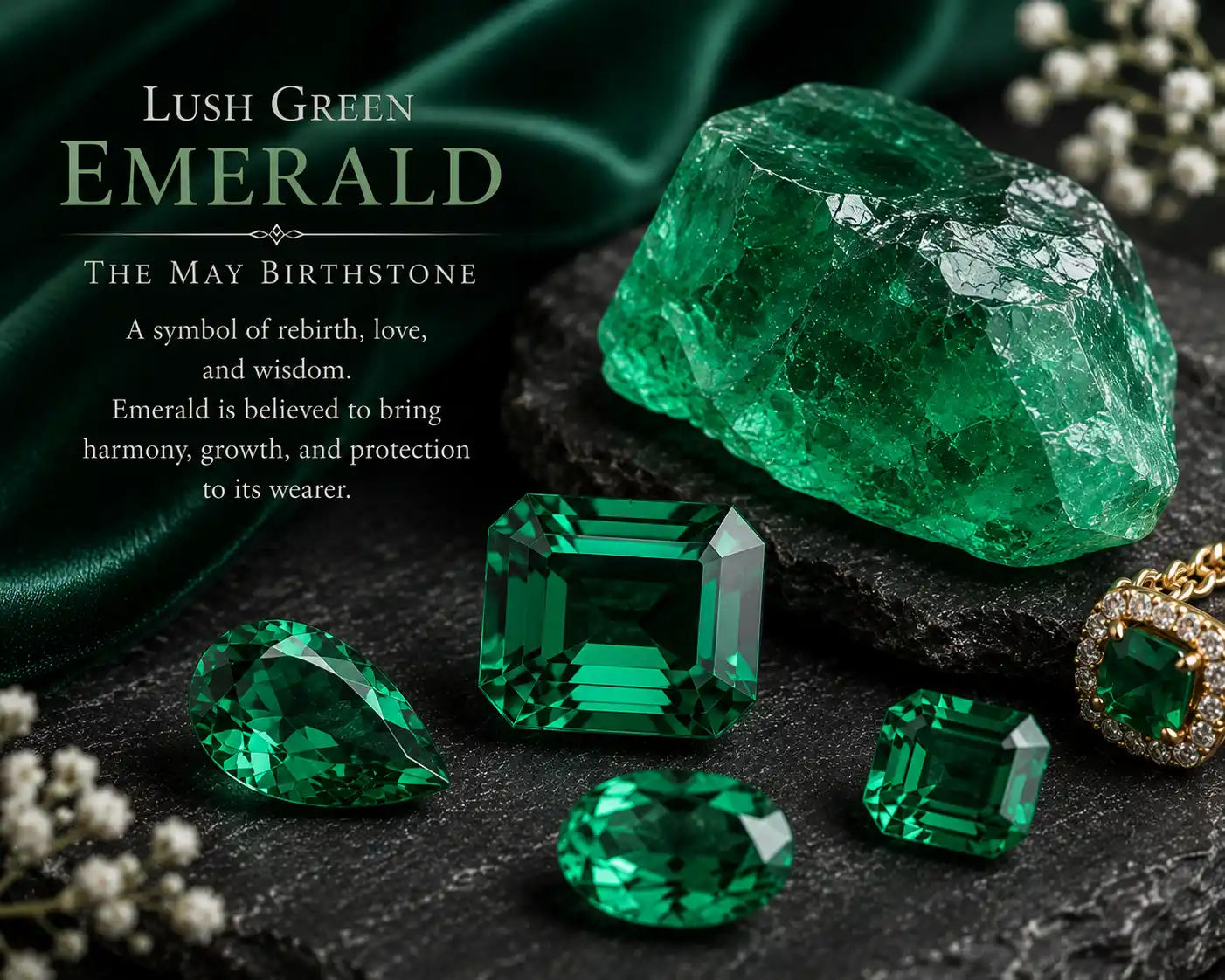

Emerald is the birthstone for May, a month commonly associated with spring growth, renewal and increasingly vivid green landscapes in the Northern Hemisphere. Its saturated green color has made it one of the world’s best-known precious gemstones and a symbol of rebirth, loyalty, hope and enduring affection.
Mineralogically, Emerald is the green variety of beryl. It belongs to the same family as Aquamarine, Morganite, Heliodor and colorless Goshenite, although trace chromium, vanadium or both produce the green color required for the Emerald name.
The stone’s beauty comes with practical complexity. Emerald ranks 7.5–8 on the Mohs scale, yet natural crystals commonly contain fissures and inclusions. These features influence cutting, treatment, value and jewelry design more strongly than the hardness number alone suggests.
The complete Emerald gemstone guide owns the mineral’s full geology, symbolism and material profile. This article focuses on Emerald specifically as May’s birthstone: how that tradition developed, what the color represents, which historical associations shaped its reputation and how to choose it responsibly.
May Birthstone at a Glance
| Feature | Emerald |
|---|---|
| Birth month | May |
| Mineral family | Beryl |
| General formula | Be₃Al₂Si₆O₁₈ |
| Main color causes | Chromium, vanadium or both |
| Typical colors | Bluish green, pure green and slightly yellowish green |
| Crystal system | Hexagonal |
| Mohs hardness | 7.5–8 |
| Main durability concern | Fissures, inclusions and clarity-enhancing fillers |
| Common cuts | Emerald cut, oval, cushion, pear, round and cabochon |
| Major sources | Colombia, Zambia, Brazil, Afghanistan, Pakistan and others |
| Common treatment | Oil, wax or resin filling of surface-reaching fissures |
| Traditional symbolism | Renewal, love, loyalty, hope and wisdom |
| Anniversary associations | Twentieth and thirty-fifth wedding anniversaries |
| Best-known alternative | Laboratory-grown Emerald for a lower-cost green option |
Why Emerald Is the May Birthstone
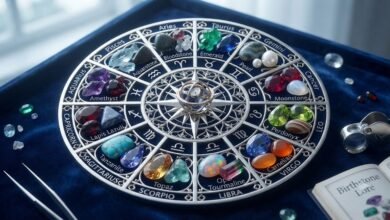
Modern birthstone systems assign Emerald to May. Jewelry-industry lists standardized in the early twentieth century helped establish a consistent stone for each calendar month, but Emerald’s relationship with spring and green growth is older than those formal lists.
The saturated green naturally suits May in regions where vegetation becomes especially vivid during late spring. As a result, the stone became associated with renewal, fertility, flourishing relationships and the return of life after winter.
The broader Birthstones by Month guide explains how modern, traditional and alternative lists developed. Unlike months that have several widely recognized birthstones, May remains closely identified with one primary gemstone.
Emerald’s monthly status is a cultural convention rather than a geological property. A crystal does not become physically different because it is worn by someone born in May, but the tradition can give the gemstone personal and commemorative meaning.
What Is Emerald?
Emerald is green beryl of sufficient color saturation to receive the Emerald name.
Beryl’s basic crystal structure can host different trace elements. Iron contributes to Aquamarine’s blue-to-greenish-blue color, manganese can produce Morganite’s pink, and chromium or vanadium creates Emerald’s green.
Not every green beryl is automatically Emerald. Very pale stones may be marketed more accurately as green beryl, particularly when their color lacks the saturation conventionally expected from Emerald.
The boundary is partly based on professional judgment rather than one universally fixed color measurement. This is why two laboratories or dealers may occasionally describe a borderline pale-green beryl differently.
Laboratory-grown material has the same essential beryl crystal structure and green color mechanisms but forms through human-controlled growth rather than natural geology. The Lab Emerald guide explains that distinct origin without treating synthetic Emerald as glass or a simple imitation.
Emerald Color
Color is Emerald’s dominant quality factor.
Fine stones generally display medium to medium-dark green with strong saturation. A slight blue component is often highly desirable, although attractive Emerald can range from bluish green through visually balanced green to slightly yellowish green.
A gem that is too dark may lose transparency and appear nearly black in weak light. A very pale stone may lack the intensity expected from Emerald.
Color should be judged under neutral daylight-equivalent illumination as well as normal indoor light. Store spotlights can make a stone appear brighter or more saturated than it will look in everyday conditions.
The Green Gemstones guide compares Emerald with Tsavorite, Demantoid, Peridot, Jade, Green Tourmaline and other green materials. The companion Green Crystals guide focuses more on specimens and symbolism.
What Gives Emerald Its Green Color?
Chromium and vanadium are the principal coloring elements in Emerald.
These trace elements replace small amounts of aluminum within the beryl structure and absorb selected wavelengths of visible light. The remaining transmitted and reflected light appears green.
Iron can modify the color, sometimes introducing a bluer, yellower or duller component depending on concentration and oxidation state.
Historically, some gem markets placed greater emphasis on chromium-bearing material, but modern gemological usage recognizes that vanadium can also produce genuine Emerald color.
Color chemistry alone does not determine value. Saturation, tone, transparency, inclusions, cutting and treatment must be assessed together.
Emerald Clarity and the Jardin
Most natural Emeralds contain inclusions.
These may include crystals, fluid-filled cavities, growth features, fissures and complex three-phase inclusions. The internal landscape is sometimes described by the French word jardin, meaning garden.
The term can be poetic, but it should not excuse serious durability problems. A surface-reaching fracture near a corner or prong may threaten the stone even when other inclusions merely confirm natural origin.
Eye-clean Emeralds are much less common than eye-clean Aquamarine or many sapphires. Consequently, the clarity expectations applied to diamond should not be transferred directly to Emerald.
The Emerald Buying Guide owns the complete color, clarity, cut and treatment assessment. This birthstone guide summarizes those issues only to explain why two apparently similar May stones can have very different prices and wearability.
Why the Emerald Cut Was Developed
The rectangular step cut with truncated corners is closely associated with Emerald because it helps manage the material’s color and structural risks.
Broad step facets emphasize transparency and saturated green rather than producing the intense scintillation expected from a round diamond. Cut corners reduce the vulnerability of sharp rectangular points.
The cut also works efficiently with many elongated hexagonal Emerald crystals.
An emerald cut is a shape, not a gemstone identity. Diamonds, Aquamarines, Moissanites and other materials can also receive an emerald cut.
Emeralds may additionally be fashioned as ovals, cushions, pears, rounds and cabochons. A heavily included stone may perform better as a cabochon than as a faceted gem whose fissures remain conspicuous.
Emerald Treatments
Clarity enhancement is extremely common.
Colorless oil, wax, natural resin or artificial resin may enter surface-reaching fissures and reduce their visibility. The process can improve apparent transparency without healing the crystal.
The amount and type of filler affect value. A stone with minor colorless oil treatment occupies a different market position from one with extensive artificial resin or colored filler.
Treatments can dry, leak, cloud or be removed by heat, solvents, ultrasonic vibration and aggressive cleaning. Re-oiling may sometimes be performed by a specialist, but repeated treatment can complicate long-term ownership.
A laboratory report can describe detectable filler type and extent. The Gemstone Certification guide explains why a report identifies a stone and its treatment but does not set a universal retail price.
Emerald Hardness and Durability
Emerald’s Mohs hardness of 7.5–8 provides good resistance to ordinary scratching.
However, many natural stones contain fissures that reduce practical toughness. A sharp impact can extend a fracture even when the surface has resisted abrasion.
The Gemstone Hardness Chart provides numerical context, but a buying decision should also consider fracture position, setting and intended wear.
Earrings and pendants are safer than rings and bracelets. A ring can still be practical when the stone is structurally sound and protected by a thoughtful design.
The dedicated Emerald Rings guide owns setting and wear decisions, while the Emerald Engagement Ring guide addresses long-term bridal use.
Historic Emerald Sources
Emerald has been treasured for thousands of years.
Ancient Egyptian deposits supplied stones long before modern mining, and Cleopatra became closely associated with Emerald in later historical accounts. Egyptian material is generally of greater archaeological than modern commercial importance today.
Colombia later became the most famous source. Muzo, Chivor and Coscuez Emeralds developed reputations for vivid green, although quality varies within every mine and country.
Zambia is a major modern source and often produces stones with a somewhat cooler or bluish-green appearance. Brazil, Afghanistan, Pakistan, Ethiopia, Russia and several other countries also supply material.
Origin can affect market perception, but a mine name should never replace an assessment of the individual stone. A poor-quality Emerald does not become exceptional merely because it came from Colombia.
Emerald in Ancient and Medieval Traditions
Emerald’s green color attracted associations with vegetation, fertility, vision, truth and protection.
Ancient cultures used the stone in jewelry, carved objects and royal decoration. Later European traditions connected Emerald with foresight, faithful love and relief for the eyes.
Historical belief does not establish medical efficacy. Wearing Emerald cannot treat vision disorders, prevent deception or reveal the future.
Those traditions remain part of the stone’s cultural history and help explain why it became linked with renewal and wisdom.
A responsible account separates what people believed from what gemology can test.
Emerald and Royal Jewelry
Emerald has appeared in crowns, ceremonial objects, religious treasures and royal collections across several regions.
The Crown of the Andes is one of the best-known historic Emerald objects associated with colonial South America. Large stones also appear in museum collections, including the Hooker Emerald and Chalk Emerald.
Such objects derive value from more than carat weight. Provenance, craftsmanship, historical context, rarity and documented ownership can exceed the value of the raw gemstone.
Modern jewelry marketed as royal or Cleopatra-style usually references design aesthetics rather than direct historical ownership.
Emerald Meaning and Symbolism
Emerald’s most consistent modern meanings include renewal, loyalty, love, hope, wisdom and growth.
These associations suit May’s spring imagery and help explain the stone’s popularity in relationship jewelry.
The dedicated Emerald Healing Properties guide owns heart-chakra, meditation and metaphysical claims. Those traditions should not be inserted into mineral identification or medical advice.
A May birthstone can symbolize a new phase, a long-term commitment or a family connection. The meaning comes from the occasion and the wearer’s interpretation rather than a scientifically measurable force.
Emerald as an Anniversary Stone
Emerald is associated with both the twentieth and thirty-fifth wedding anniversaries in widely used jewelry traditions.
The green color can represent a relationship that continues to grow rather than one preserved unchanged.
The Anniversary Gemstones by Year guide places Emerald within the complete milestone sequence.
For an anniversary ring or necklace, the stone’s treatment history and setting security matter as much as symbolic meaning. A sentimental gift should be designed for the recipient’s actual wearing habits.
May Zodiac Connections
May birthdays can fall under Taurus or Gemini in the common Western tropical zodiac.
Taurus is generally associated with birthdays in the earlier part of May, while Gemini covers later May birthdays. Exact sign boundaries can vary slightly by year and system.
The Best Crystals for Taurus page owns modern Taurus crystal associations, while the Gemini Birthstone guide covers the later-May zodiac context.
A calendar birthstone and zodiac stone belong to different traditions. Someone can use Emerald as a May birthstone regardless of astrological sign.
Natural vs Laboratory-Grown Emerald
Laboratory-grown Emerald is real synthetic beryl rather than natural mined Emerald.
It can have the same essential chemical composition, crystal structure and green color as natural material. Growth features and inclusions differ according to the laboratory process.
Synthetic Emerald usually offers stronger apparent clarity or larger size at a lower price. Its resale and rarity characteristics differ substantially from natural Emerald.
The Lab Emerald Price Guide owns that market question, while the natural Emerald Price Guide should be used for mined stones.
Origin must be disclosed clearly. A laboratory-grown Emerald should never be sold merely as Emerald in a context that implies natural formation.
Choosing a May Birthstone
Start with the recipient’s intended use.
A pendant or pair of earrings allows a broader selection of natural Emeralds because the stone receives little impact. A daily ring requires stricter attention to fissures and setting protection.
Color should remain attractive under more than one light source. Clarity enhancement should be disclosed, and an expensive stone should have independent identification.
The companion May Birthstone Jewelry Gift Guide owns recipient, metal and jewelry-style decisions.
Buyers shopping remotely should follow How to Buy Gemstones Online Without Getting Scammed and request video, treatment disclosure, dimensions, return terms and any report number before committing.
Cleaning and Care
Follow How to Clean Emerald Jewelry Safely.
Lukewarm water, mild soap and a soft brush provide the safest general method. Cleaning should remain brief, especially when the filler is unknown.
Ultrasonic and steam cleaning are inappropriate for most Emeralds because vibration and heat can affect fissures and clarity enhancement.
Avoid alcohol, acetone, strong detergents, acids and sudden temperature changes.
Store Emerald separately from harder gemstones and protect it from blows. A jeweler should inspect frequently worn settings periodically.
Frequently Asked Questions
1. What is the May birthstone?
Emerald is the recognized birthstone for May.
2. What mineral is Emerald?
Emerald is the green variety of beryl.
3. What gives Emerald its green color?
Chromium, vanadium or a combination of both produces the green color.
4. What does the May birthstone symbolize?
Common traditions associate Emerald with renewal, growth, loyalty, hope, wisdom and lasting love.
5. Is Emerald durable enough for a ring?
Yes, when the stone is structurally sound and well protected. Natural fissures make it less impact-resistant than its hardness alone suggests.
6. Why do Emeralds have so many inclusions?
Their geological growth conditions commonly produce crystals, fluids, fissures and other internal features.
7. Are most Emeralds treated?
Many are filled with oil, wax or resin to make surface-reaching fissures less visible.
8. Is a laboratory-grown Emerald a real Emerald?
It is real synthetic Emerald with the beryl structure, but it formed in a laboratory rather than nature and must be disclosed as laboratory-grown.
9. Which country produces the best Emeralds?
Colombia has the most famous reputation, but fine stones also come from Zambia, Brazil, Afghanistan, Pakistan, Ethiopia and other sources. Individual quality matters more than country alone.
10. Is Emerald an anniversary gemstone?
Yes. It is associated with the twentieth and thirty-fifth wedding anniversaries.
11. Can Emerald be cleaned ultrasonically?
Generally no. Vibration can affect fissures and clarity-enhancing fillers.
12. Does Emerald have scientifically proven healing powers?
No. Healing, chakra and protective meanings are spiritual or cultural traditions rather than established medical effects.
Emerald’s connection with May works because its color and cultural history both evoke renewal. Yet the stone’s real identity is more complex than a symbol of spring: trace elements color a beryl crystal, geological stress creates its internal garden and careful cutting and filling make much of that beauty wearable. Understanding those details gives a May birthstone greater meaning than color alone.
Emerald healing, zodiac and protective meanings are cultural or personal traditions rather than scientifically established effects. The gemstone should not replace medical, psychological, financial or safety-related advice.