
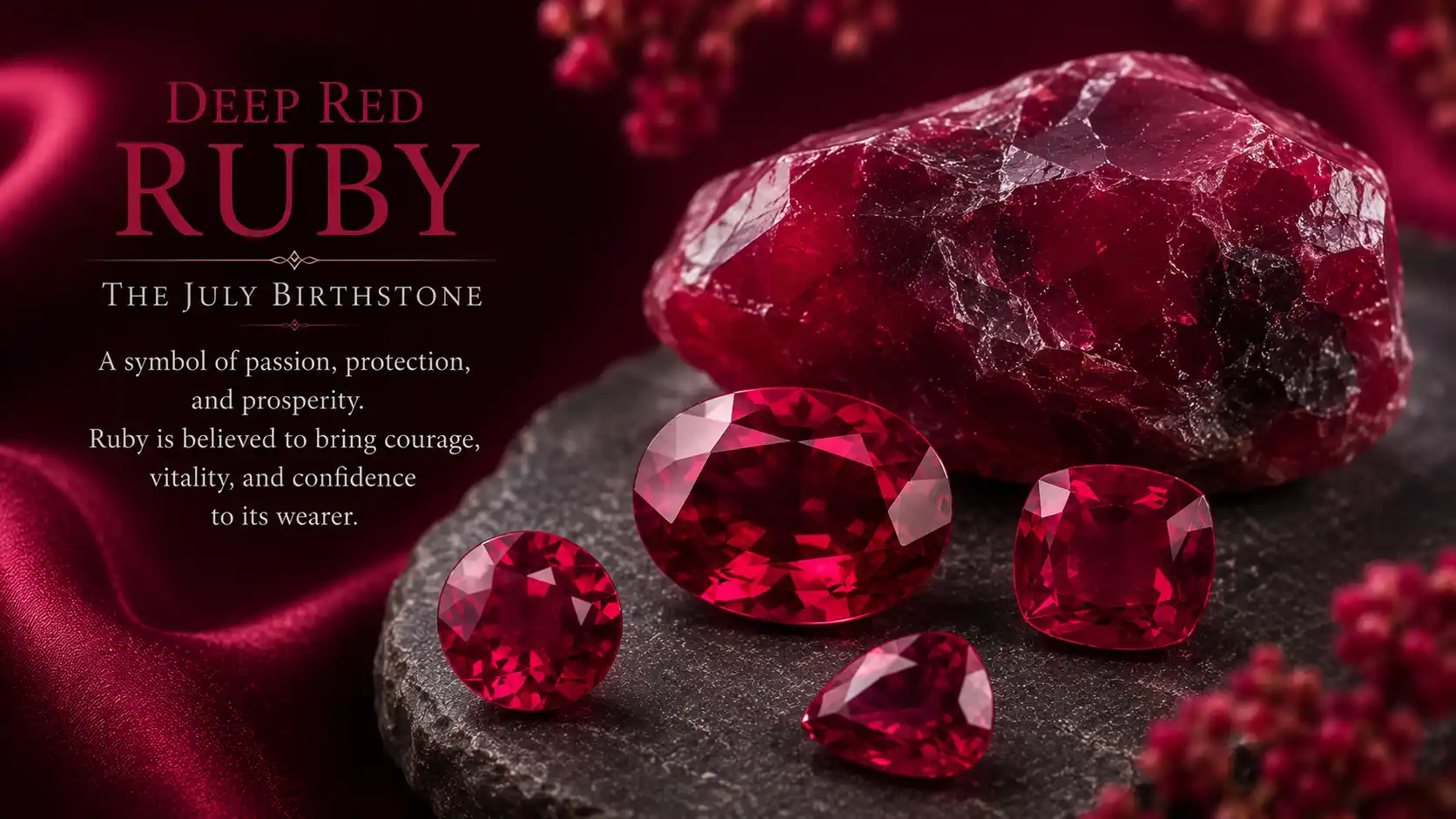

Ruby is July’s birthstone and the red variety of corundum, the same mineral species that produces sapphire. Its color comes primarily from chromium, which can create red fluorescence and add visible intensity to fine stones.
The finest rubies combine an attractive red hue, strong saturation, suitable tone, transparency, lively cutting, and minimal treatment. Yet ruby’s significance extends beyond quality grading. For centuries, red corundum and stones believed to be ruby have been associated with royalty, protection, vitality, love, courage, wealth, and enduring status.
The complete birthstones-by-month guide places ruby within the annual calendar. Readers choosing a present can use the dedicated July birthstone jewelry gift guide. This article focuses on July’s month stone: its identity, colors, history, symbolism, sources, treatments, durability, and relationship with other red gems.
July Birthstone at a Glance
| Feature | Ruby birthstone details |
|---|---|
| Birth month | July |
| Gemstone | Ruby |
| Mineral species | Corundum |
| Composition | Aluminum oxide, Al₂O₃ |
| Color cause | Primarily chromium |
| Color range | Orangy red to purplish red |
| Crystal system | Trigonal |
| Mohs hardness | 9 |
| Cleavage | None in the gemological sense |
| Toughness | Generally excellent when not compromised by treatment or fractures |
| Common treatment | Heat |
| Other treatments | Diffusion, fracture or cavity filling, dyeing and coating |
| Main quality factor | Color |
| Traditional associations | Passion, courage, protection, prosperity and vitality |
| Common anniversary associations | Fifteenth and fortieth anniversaries |
| Safest cleaning default | Warm soapy water; filled material needs more conservative care |
What Is Ruby?
Ruby is red corundum. Corundum in other colors is generally classified as sapphire, although the boundary between pale red ruby and pink sapphire can depend on laboratory and market conventions.
Pure corundum is colorless. Chromium replaces a small amount of aluminum in the crystal structure and produces red. Iron and other trace elements can influence tone, fluorescence, and the way a ruby responds to light.
The family-level ruby guide explains the gem’s properties, geology, symbolism, and uses. The page on Types of Ruby owns varieties, trade colors, star rubies, sources, and commercial classifications.
Why Ruby Is Red
Chromium absorbs parts of visible light and allows the stone to appear red. It can also produce fluorescence, especially under ultraviolet-rich daylight.
In low-iron marble-hosted rubies, fluorescence can strengthen the apparent red. Rubies formed in iron-rich environments may show weaker fluorescence and a darker or browner appearance.
Fluorescence is not an authenticity test. Natural ruby, laboratory-grown ruby, and some treated stones can all fluoresce.
Fine ruby color ranges from vivid red to slightly purplish red. Orangy red can also qualify as ruby, although market preference often favors a balanced, strongly saturated red without excessive darkness.
What Does “Pigeon’s Blood” Mean?
“Pigeon’s blood” is a prestige trade description for a vivid red ruby of exceptional color. The term has no single universal visual definition across every dealer, country, or laboratory.
Some laboratories apply the phrase only when hue, saturation, tone, fluorescence, transparency, treatment, and other conditions meet their own criteria. A seller using the term without a respected laboratory report is making a commercial claim rather than establishing an objective grade.
The phrase should not replace a full description of the stone’s color, treatment, origin opinion, clarity, and condition.
Ruby and Pink Sapphire
Ruby and pink sapphire are both chromium-colored corundum. The distinction becomes difficult when saturation is low and the stone lies near the pink-red boundary.
Different laboratories and markets may classify borderline material differently. Therefore, two reports can occasionally use different commercial names for similar pale red corundum.
A strongly saturated red stone is more likely to receive a ruby designation. Pale pink material is generally classified as pink sapphire.
July Birthstone Meaning
Traditional and modern sources associate ruby with:
- Passion
- Courage
- Vitality
- Protection
- Leadership
- Prosperity
- Love
- Loyalty
- Status
- Confidence
Red color naturally contributes to associations with blood, fire, life, desire, and power. Royal ownership, religious use, military symbolism, and trade rarity strengthened those meanings across different societies.
The dedicated ruby healing properties guide covers modern spiritual claims separately. Historical symbolism should not be confused with evidence that ruby treats blood disorders, heart disease, infertility, depression, fatigue, or other medical conditions.
Ruby in Ancient India
Ruby held an especially prestigious position in South Asian gem traditions. Sanskrit descriptions have been translated with titles such as “king of precious stones,” reflecting the gem’s color, rarity, hardness, and royal associations.
Rubies appeared in jewelry, courtly objects, religious gifts, talismanic systems, and texts discussing gemstone qualities. Fine red stones were associated with authority, protection, generosity, and status.
Historical terms did not always separate ruby from red spinel or garnet according to modern mineralogy. Therefore, an ancient written reference to a red “ruby” may not establish that the object contained corundum.
Ruby in Myanmar
Myanmar has produced some of the world’s most celebrated rubies, particularly from the Mogok region. Many famous stones formed in marble, an environment that can produce low-iron ruby with strong red fluorescence.
Mogok became central to ruby history through royal control, local mining, colonial-era extraction, and international trade. The region’s name now carries significant market prestige.
Origin cannot be proven from color alone. Laboratories form geographic-origin opinions by studying inclusion scenes, trace chemistry, spectroscopy, and comparison data.
A ruby represented as Burmese or Mogok should receive documentation when the origin claim materially affects price.
Other Ruby Sources
Ruby forms in marble-related and amphibole- or basalt-associated environments across several regions.
Important sources have included:
- Mozambique
- Madagascar
- Tanzania
- Kenya
- Afghanistan
- Pakistan
- Tajikistan
- Vietnam
- Sri Lanka
- Thailand
- Cambodia
- Greenland
Mozambique has become a major modern commercial source, producing ruby across a wide range of qualities and sizes.
Each deposit can yield variable color, clarity, iron content, inclusions, and treatment response. Country names should never be used as a substitute for assessing the individual stone.
Ruby in European and Middle Eastern History
Red gems appeared in crowns, reliquaries, royal regalia, signet rings, religious objects, swords, armor fittings, necklaces, and court jewelry.
Before modern gemology, red spinel was often grouped with ruby. Several famous “rubies” in historic regalia were later identified as spinel.
The ruby-versus-spinel guide explains this historic confusion through mineral species, optical properties, hardness, inclusions, and treatment.
The misidentification does not make the historic objects less important. Instead, it shows how color-based naming preceded scientific mineral classification.
Ruby, Garnet and Spinel
Ruby shares its red range with garnet and spinel. All three can appear vivid red, purplish red, or dark red in jewelry.
Ruby is corundum with Mohs hardness 9. Spinel is a separate cubic mineral, commonly with hardness near 8. Many red garnets rank approximately 6.5–7.5.
The direct ruby-versus-garnet-versus-spinel comparison owns the identification workflow. Color, darkness, and price cannot establish which material is present.
The directory of red gemstones places ruby among other red materials without treating every red stone as an alternative of equal durability, rarity, or value.
Star Ruby
Needle-like rutile inclusions can create asterism when ruby is cut as a cabochon and the inclusions are properly oriented.
A well-cut star ruby shows a centered six-rayed star that moves across the dome as the light or stone moves. The bodycolor, star sharpness, transparency, dome shape, treatment, and origin all influence value.
The dedicated star ruby guide examines the phenomenon and symbolism without folding every cabochon into the standard faceted-ruby discussion.
Ruby Quality Factors
Color usually has the greatest effect on value. The stone should have an attractive hue and enough saturation to appear rich without becoming too dark.
Clarity also matters, although natural ruby commonly contains inclusions. Fine stones do not need to be completely clean; instead, inclusions should avoid severely reducing transparency or threatening durability.
Cutters balance color orientation, brightness, shape, and retained weight. Ruby rough can be valuable, so finished stones may have deep pavilions, uneven outlines, or asymmetrical proportions when the cutter preserves color and carat weight.
The ruby buying guide owns the full quality assessment, while the ruby price guide covers how color, size, origin, treatment, clarity, cut, and documentation affect value.
Ruby Treatments
Most ruby in the market has been heated. Conventional heat treatment can improve color, reduce bluish or brownish components, alter inclusions, and heal some fractures with residues from the heating environment.
Heat treatment is widely accepted when disclosed. Unheated ruby of fine quality can carry a significant premium because it is rarer.
Other treatments include lattice diffusion, dye, coatings, fracture filling, and cavity filling. Lead-glass-filled ruby can contain enough filler that the treatment materially affects appearance, durability, and value.
The dedicated treated-ruby guide owns treatment recognition, laboratory evidence, disclosure, and care. Buyers should not treat “natural ruby” as meaning untreated; a natural stone may still have undergone substantial enhancement.
Natural, Laboratory-Grown and Imitation Ruby
Laboratory-grown ruby has substantially the same corundum structure and chemistry as natural ruby, but it forms through a manufacturing process.
Glass, red cubic zirconia, garnet, spinel, doublets, and other materials can imitate ruby without being corundum.
The real-versus-fake ruby guide covers safe observations and professional testing. A laboratory report can distinguish natural from laboratory-grown ruby and disclose many detectable treatments.
Very clean, vivid, large ruby offered at a low price deserves particular scrutiny, although appearance alone cannot prove laboratory origin.
Durability
Ruby ranks 9 on the Mohs scale, making it one of the most scratch-resistant natural gemstones used in jewelry. It also has no pronounced cleavage and generally provides excellent toughness.
Untreated and conventionally heated ruby can suit rings, bracelets, earrings, pendants, and everyday jewelry. However, surface-reaching fractures, cavities, thin corners, poor settings, and glass filling can reduce practical durability.
Ruby’s strong wearability explains its use in ruby rings, ruby earrings, ruby necklaces, and ruby bracelets.
A ruby engagement ring can be a durable colored-stone alternative when the center gem is sound, appropriately treated, securely set, and accurately disclosed.
July Zodiac Connections
July spans Cancer and Leo.
The Cancer birthstone guide covers zodiac-based gemstone traditions for early and middle July, while the Leo birthstone guide addresses later July and August dates.
Month birthstones and zodiac stones come from different systems. A July-born Cancer or Leo can wear ruby as the recognized month stone regardless of other astrological gemstone lists.
Ruby Care
Follow the complete process in How to Clean Ruby Jewelry Safely.
Warm soapy water is a safe general method. Ultrasonic and steam cleaning are often suitable for untreated, conventionally heated, and some diffusion-treated ruby, but the complete piece must also be considered.
Glass-filled, cavity-filled, dyed, heavily fractured, glued, or antique ruby jewelry requires much more conservative cleaning. Lead-glass filler can be damaged by acids, heat, and common household substances.
Store ruby separately because it can scratch garnet, quartz, emerald, opal, pearl, jade, and many other gems. Diamonds can scratch ruby.
Frequently Asked Questions
1. What is July’s birthstone?
Ruby is the standard modern birthstone for July.
2. Why is ruby red?
Chromium within the corundum crystal structure produces red. Chromium can also cause fluorescence that strengthens the apparent color.
3. Is ruby the same mineral as sapphire?
Yes. Both are corundum. Red corundum is ruby, while corundum in other colors is generally called sapphire.
4. What does the July birthstone symbolize?
Common traditional meanings include passion, courage, protection, vitality, love, prosperity, loyalty, and leadership. These associations vary by culture and period.
5. What is the best ruby color?
Market preference generally favors vivid red to slightly purplish red with strong saturation and a tone that is neither too light nor excessively dark.
6. Is pigeon’s-blood ruby an official grade?
It is a prestige color term rather than a single universal grade. Some laboratories apply defined criteria, while unverified seller use may be subjective.
7. Are most rubies heat-treated?
Yes. Heat treatment is common and generally accepted when disclosed. Fine unheated ruby is rarer and can command a premium.
8. Is glass-filled ruby real ruby?
The host material may be natural corundum, but substantial lead-glass filling changes its appearance, durability, care requirements, and value. Full disclosure is essential.
9. Can ruby be worn every day?
Sound untreated or conventionally heated ruby is highly suitable for regular wear. Filled, badly fractured, or poorly set stones require more caution.
10. How is ruby different from red spinel?
Ruby is trigonal corundum with hardness 9, while spinel is cubic and usually softer. Refractive behavior, inclusions, spectrum, density, and laboratory tests distinguish them.
11. Does ruby have scientifically proven healing powers?
No. Ruby healing claims are spiritual or traditional beliefs and should not replace medical or psychological care.
12. Is ruby associated with wedding anniversaries?
Ruby is commonly associated with the fifteenth and fortieth wedding anniversaries, in addition to being July’s birthstone.
Ruby’s role as July’s birthstone rests on more than vivid red color. It combines exceptional durability, geological rarity, a long record of royal and religious use, complex treatment history, and symbolism built around life, fire, authority, and affection. Understanding those layers makes it possible to appreciate ruby without confusing trade language, historic misidentification, or spiritual tradition with measurable gemological fact.
Ruby symbolism and crystal-healing traditions are cultural, historical, or personal beliefs. Ruby is not scientifically proven to treat disease, increase vitality, guarantee protection, attract wealth, or replace professional medical or mental-health care.