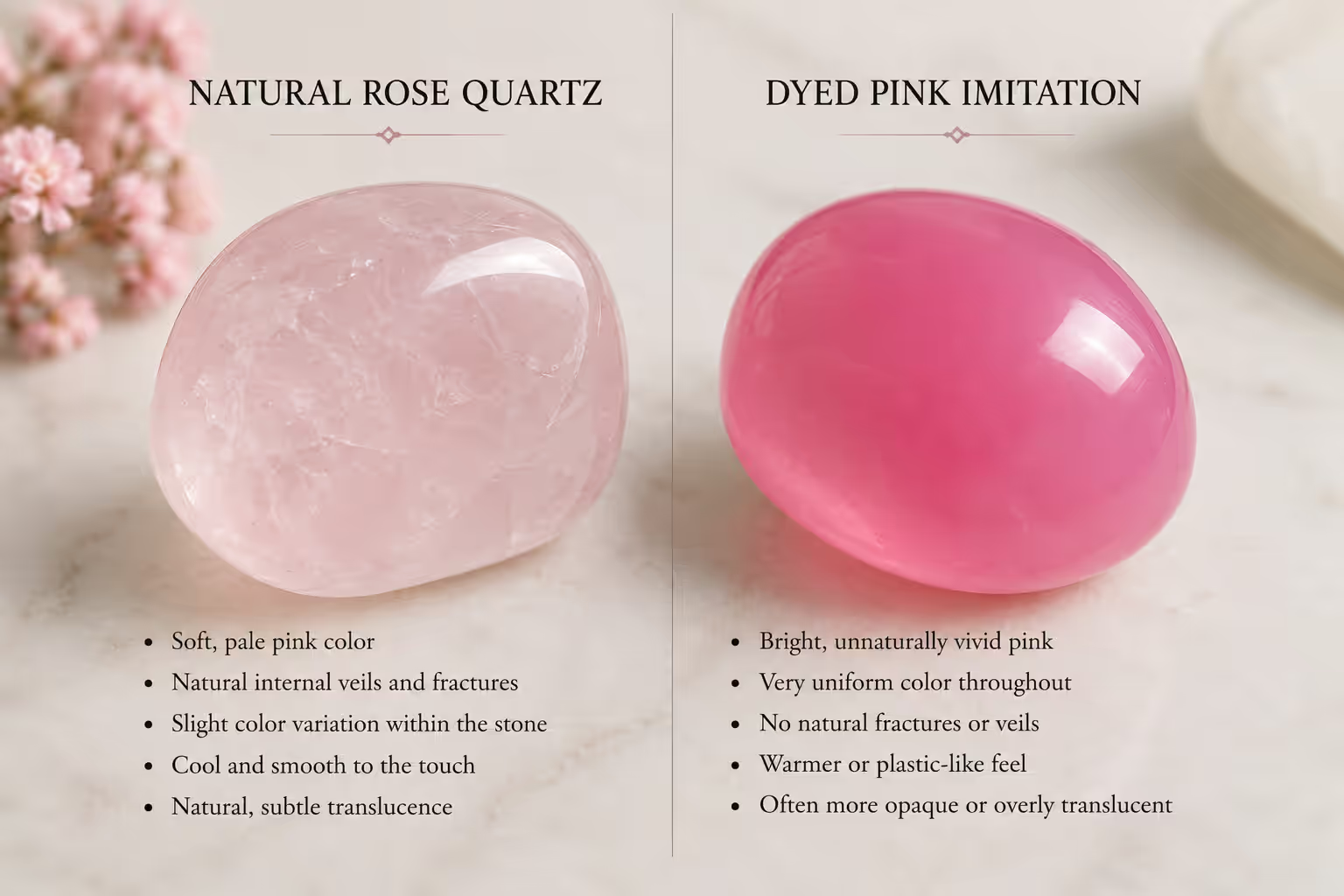
Real vs Fake Rose Quartz: Dye, Glass and Synthetic Tests
Real rose quartz is the familiar translucent-to-opaque pink variety of massive quartz. Its color commonly ranges from nearly white with a blush tint to medium pink, while its internal appearance is often cloudy, hazy or softly veiled.
Microscopic aligned silicate fibers are associated with the color and optical behavior of ordinary massive rose quartz. In some well-oriented material, those inclusions produce a six-rayed star when the stone is cut as a sphere or cabochon.
A different and much rarer material occurs as transparent, well-formed pink quartz crystals. It is sometimes called pink quartz or crystalline rose quartz, and its color arises through a different mechanism. Laboratory-grown synthetic pink quartz also exists.
Common imitations include dyed crackle quartz, dyed chalcedony, glass, resin, ceramic, pink calcite and other pink stones. Natural rose quartz may also be irradiated to intensify its color.
Therefore, identification should establish whether the object is quartz, whether it belongs to massive rose quartz or rare crystalline pink quartz and whether its color is natural, treated or manufactured.
This page owns the direct authenticity and dyed-imitation workflow. The completed treated and synthetic rose quartz guide retains irradiation, dyeing, coating, crackling and laboratory-growth details.
Genuine Rose Quartz vs Common Imitations
| Feature | Natural massive rose quartz | Synthetic crystalline pink quartz | Dyed crackle quartz | Pink glass | Resin or plastic |
|---|---|---|---|---|---|
| Material | Naturally formed massive quartz | Laboratory-grown crystalline quartz | Natural quartz with artificial fractures and dye | Manufactured glass | Manufactured polymer |
| Typical appearance | Cloudy, translucent, veiled or softly granular | Transparent crystal or faceted quartz | Bright color concentrated in cracks | Uniform or flowing color with possible bubbles | Molded, poured or glitter-filled |
| Color | Very pale to medium pink, occasionally stronger | Pink to purple-pink | Neon pink, red-pink or purple-pink possible | Any manufactured shade | Any manufactured shade |
| Crystal form | Usually massive without well-formed faces | Well-formed growth from a seed | Original quartz shape or polished crackled form | Molded or faceted | Molded or cast |
| Mohs hardness | 7 | 7 | 7 in the quartz body | Commonly about 5–6 | Much softer |
| Refractive index | About 1.544–1.553 | Same quartz range | Same quartz range | Variable | Variable |
| Specific gravity | About 2.65–2.66 | About 2.65–2.66 | About 2.65–2.66 | Variable | Usually lower |
| Common internal clues | Fibrous haze, veils, fractures and possible asterism | Synthetic growth and seed-related structures | Dye filling a fracture network | Round bubbles and curved flow lines | Mold seams, casting bubbles and soft scratches |
| Main challenge | Confirming natural color and quartz identity | Separating laboratory growth from rare natural crystals | Recognizing treated natural quartz | Separating glass from quartz | Identifying manufactured polymer |
| Best confirmation | Optical testing, microscopy, Raman and spectroscopy | Advanced growth-origin analysis | Microscopy and treatment analysis | Standard gemological testing | Material testing |
A bright color is a warning sign, not an automatic conclusion. Natural and treated quartz can overlap in appearance.
What Is Genuine Rose Quartz?
The planned rose quartz meaning guide owns geology, symbolism, healing beliefs and general use.
Rose quartz belongs to the wider quartz family.
Quartz consists of silicon dioxide and ranks 7 on the Mohs scale. Ordinary rose quartz is commonly found as massive material in pegmatites and hydrothermal settings rather than as transparent, sharply terminated crystals.
Its cloudy body makes it suitable for beads, cabochons, spheres, carvings and ornamental objects.
Fine color often becomes more visible in larger pieces. A small bead may appear almost colorless even when cut from genuine material.
Natural Rose Quartz Color
Natural rose quartz ranges from pale pastel pink through medium pink and occasional stronger purple-pink or reddish-pink areas.
The color may be distributed unevenly. Some pieces contain pale zones, colorless quartz, smoky patches, iron staining or internal clouds.
An even pink cabochon can still be natural because cutting removes weakly colored areas and concentrates the best material.
Nevertheless, perfectly uniform neon color across many inexpensive beads raises concern about dye, coating or glass.
Lighting strongly affects perception. Warm light can increase peach tones, while cool LEDs may make the same stone look more purple.
Why Natural Rose Quartz Looks Cloudy
Ordinary rose quartz commonly contains microscopic fibers and other inclusions.
These fine structures scatter light, creating a milky, hazy or softly translucent appearance.
The cloudiness does not indicate poor authenticity. In fact, it is characteristic of much genuine massive rose quartz.
A perfectly transparent pink stone may still be quartz, but it belongs to a rarer crystalline pink-quartz category or may be synthetic material, irradiated quartz, glass, morganite, kunzite or another gem.
The distinction should be investigated rather than reduced to “clear means fake.”
Rare Crystalline Pink Quartz
Transparent pink quartz crystals with well-developed faces are much rarer than massive rose quartz.
The material is sometimes called crystalline rose quartz, pink quartz or euhedral pink quartz.
Its color mechanism differs from the microscopic-fiber coloration associated with ordinary massive rose quartz. Some examples can fade under natural light and have their color restored by irradiation.
Well-formed natural specimens may command collector premiums far beyond ordinary carved rose quartz.
Synthetic growers can produce transparent pink quartz with similar appearance, making laboratory analysis important for expensive crystal claims.
Synthetic Pink Quartz
Hydrothermal synthetic quartz can be grown in pink colors.
The process uses a seed crystal, silica nutrient, hot solution and high pressure. Aluminum- and phosphorus-related impurities followed by irradiation can create pink color centers.
Synthetic material shares quartz hardness, density, refractive index and chemical composition.
A scratch test, simple weight comparison or ordinary refractometer reading cannot separate natural from synthetic quartz.
Microscopy, twinning analysis, infrared spectroscopy, growth structures and trace-element chemistry may be required.
A disclosed synthetic pink quartz is a legitimate laboratory-grown gemstone. It should not be represented as mined rose quartz.
Dyed Crackle Quartz
Crackle quartz is deliberately fractured, commonly by heating and rapid cooling.
Dye enters the fracture network and creates bright pink, red, purple or multicolor patterns.
Under magnification, color follows thin cracks rather than existing evenly within the quartz body.
Drill holes and chipped edges may reveal intense dye concentrations.
The host material can be genuine natural quartz. However, its fracture pattern and color are treated.
A seller should not describe dyed crackle quartz as untreated rose quartz or naturally high-energy pink crystal.
Dyed Chalcedony and Quartzite
Chalcedony, quartzite and pale massive quartz can be dyed pink.
Dyed chalcedony may appear more uniformly translucent and fine-grained than ordinary rose quartz. Quartzite may show a sugary granular texture.
Dye often concentrates in pores, fractures and grain boundaries.
Because all these materials can be silica-rich, basic hardness tests provide limited separation.
Raman spectroscopy, microscopic texture and treatment examination identify the host and color origin more reliably.
Surface-Coated Quartz
Colorless quartz, milky quartz or pale rose quartz may receive a pink coating.
Inspect facet edges, scratches, drill holes and carving recesses. Wear can expose a colorless interior beneath the film.
A pavilion coating can make a faceted stone look pink throughout when viewed from the front.
Metallic or iridescent coatings can produce colors far stronger than ordinary rose quartz.
The completed gemstone-treatment guide explains why coating differs from dyeing and irradiation.
Irradiated Rose Quartz
Rose quartz is occasionally irradiated to intensify pink color.
The treatment changes color centers rather than adding a surface pigment.
Consequently, color does not collect in cracks as it does with dye.
Detecting irradiation can be difficult and may require spectroscopy or reliable treatment history.
A treated stone remains quartz. The color enhancement should be disclosed when it affects price, stability or buyer expectations.
Pink Glass
Glass can imitate translucent rose quartz in beads, spheres, towers and faceted stones.
Round gas bubbles, curved flow lines, mold seams and a homogeneous interior provide clues.
Some glass is deliberately clouded to resemble natural quartz. Fine bubbles can create a hazy appearance similar to fibrous inclusions.
High-quality glass may show no obvious bubbles under a basic loupe.
Glass generally lacks quartz’s birefringence and has different refractive index, density and hardness.
The completed real-versus-fake clear-quartz guide owns the broader quartz-versus-glass workflow.
Resin and Plastic
Resin can be cast into rose-quartz-colored beads, hearts, towers, spheres and carvings.
Manufacturers may add glitter, fibers, stone chips, dried flowers or cloudy pigment.
Look for mold seams, casting bubbles, soft scratches, low weight and repeated internal swirls.
Some resin contains genuine quartz powder or chips, creating a composite rather than one natural stone.
Do not use a hot needle or flame. These tests damage the object and may release hazardous fumes.
Rose Quartz Versus Morganite
Morganite is pink beryl and is generally more transparent and brilliant than ordinary massive rose quartz.
It is denser, slightly harder and has a higher refractive index.
The completed morganite-versus-rose-quartz guide owns the full side-by-side comparison.
A pale transparent faceted stone may be morganite, synthetic spinel, glass or crystalline pink quartz rather than massive rose quartz.
Color alone cannot resolve the material.
Rose Quartz Versus Rhodonite
Rhodonite commonly appears opaque pink, rose-red or reddish pink with black manganese-oxide veins.
Rose quartz is usually more translucent and does not normally contain the same bold black network.
Fine rhodonite can be comparatively clean, while included rose quartz can contain dark minerals. Therefore, one vein is not enough for identification.
The planned rose-quartz-versus-rhodonite guide retains the complete comparison.
Rose Quartz Versus Pink Opal
Pink opal is hydrated silica rather than crystalline quartz.
It commonly appears opaque to translucent with a waxy or porcelaneous surface.
Rose quartz is harder and has different refractive properties.
Pink opal may contain white, brown or gray matrix patterns, while rose quartz commonly has cloudy internal veils.
Neither material needs display transparency to be genuine.
Rose Quartz Versus Strawberry Quartz
Strawberry quartz is a commercial name for quartz containing visible red or pink inclusions, particles or color-producing structures.
Its body may be transparent to translucent, with discrete speckles or flakes.
Rose quartz usually displays a more diffuse overall pink caused by microscopic inclusions.
Glass containing glitter or red flakes is frequently sold as strawberry quartz, creating a separate identification problem.
A speckled appearance should not be assigned automatically to rose quartz.
Rose Quartz Versus Pink Calcite
Pink calcite is softer, has perfect cleavage and reacts with acid.
It can look cloudy, pastel and translucent like rose quartz.
Do not use acid to test a finished object. The procedure damages calcite and may affect dye, metal or coatings.
Refractive index, hardness instruments, Raman spectroscopy and cleavage observation separate the minerals safely.
A commercial name such as rose calcite should not be shortened to rose quartz.
Star Rose Quartz
Some rose quartz displays asterism.
Aligned microscopic inclusions reflect light as a six-rayed star when the material is cut into a sphere or cabochon and illuminated by a small direct light source.
The star should move across the surface as the light or stone moves.
A painted, engraved or fiber-optic star can imitate the effect. An artificial star may appear too sharp, stay fixed or arise from a surface film.
Natural asterism can be weak and visible only under sunlight or a focused lamp.
Color Concentration in Cracks
Dye commonly enters existing or artificially created fractures.
Under a loupe, the cracks appear darker pink or purple than the surrounding quartz.
Natural iron staining can also follow fractures, so color concentration is a strong warning rather than absolute proof.
Inspect several cracks and drill holes. A consistent artificial network supports dye treatment.
A stable dye may not rub off with solvent. Acetone testing is unreliable and can damage glue, coating, resin and jewelry components.
Hardness
Rose quartz ranks 7 on the gemstone-hardness chart.
It is harder than calcite, fluorite, common glass, resin and plastic.
A deliberate scratch test can damage genuine stone and cannot separate natural rose quartz from synthetic quartz or dyed crackle quartz.
Surface coating may scratch even when the underlying object is genuine quartz.
Hardness is best measured with proper gemological tools on an expendable or inconspicuous test area.
Refractive Index and Density
Rose quartz shares macrocrystalline quartz properties, with refractive index around 1.544–1.553 and specific gravity near 2.65–2.66.
Natural massive, irradiated and synthetic quartz overlap in these measurements.
Glass, calcite, beryl, opal, resin and many substitutes provide different combinations.
Aggregate or curved objects may give only approximate readings.
A laboratory uses these properties to confirm quartz before assessing treatment or growth origin.
Birefringence and Polariscope Testing
Quartz is doubly refractive.
A transparent or translucent object can show anisotropic behavior between crossed polarizers, depending on orientation and internal strain.
Ordinary glass is isotropic, although strain can create anomalous light patterns.
A polariscope can separate many glass imitations but does not distinguish natural from synthetic quartz.
Cloudy massive material may produce complicated aggregate responses requiring experienced interpretation.
Ultraviolet Light
Rose quartz fluorescence varies according to inclusions, defects, treatment and source.
Natural, irradiated, synthetic and imitation materials may react or remain inert.
Dye and resin can produce localized fluorescence along fractures or repaired areas.
No one ultraviolet color proves natural rose quartz.
Sunlight and Fading
Ordinary massive rose quartz is generally stable under normal display conditions.
Some rare crystalline pink quartz can fade in natural light because its color mechanism differs. Irradiation can restore color in selected material.
Dyes and coatings may also fade at rates unrelated to natural quartz.
The completed sunlight-sensitive crystals guide provides broader display guidance.
Do not use prolonged sunlight as an authenticity test. A fading experiment can damage the very object being examined.
Raman, FTIR and Growth Analysis
Raman spectroscopy confirms quartz and separates glass, calcite, opal, beryl and many polymers.
FTIR can provide information about hydroxyl-related defects and synthetic growth.
Twinning analysis and microscopic growth structures help distinguish natural crystalline quartz from hydrothermal synthetic material.
Trace-element chemistry may supply additional evidence.
The completed gemstone-certification guide explains when reports are worthwhile. Use how to read a gem-lab report to determine whether the document confirms natural origin or merely identifies quartz.
A Safe Home Inspection Sequence
Observe the stone under neutral daylight and warm indoor light. Record whether the pink is pale, zoned, cloudy or unnaturally neon.
Use a 10× loupe to search for fibrous haze, bubbles, curved glass flow, dye-filled fractures, coating wear and resin seams.
Inspect drill holes, chips and the back of carvings.
Consider the form. Massive cloudy material is ordinary for rose quartz, while a transparent well-formed pink crystal deserves natural-versus-synthetic scrutiny.
Use a polariscope or professional refractive-index test when available.
Do not scratch, burn, acid-test, heat or solvent-soak the object.
Buying Genuine Rose Quartz
The completed rose quartz buying guide owns color, translucency, size, workmanship and seller selection.
The rose quartz price guide retains market ranges and collector premiums.
Ask whether the stone is natural, irradiated, dyed, crackled, coated, synthetic or composite.
A high price does not prove untreated color, while low cost does not prove glass because common massive rose quartz is abundant.
For remote purchases, follow how to buy gemstones online and request photographs of the exact object in neutral light.
Jewelry and Care
A rose quartz ring can tolerate ordinary wear but may abrade over time.
A rose quartz bracelet receives more impact than rose quartz earrings or a rose quartz necklace.
Use the completed rose quartz jewelry cleaning guide rather than steam or ultrasonic cleaning when fractures, dye, coating or glue may be present.
Warm soapy water and a soft cloth are suitable for many stable untreated pieces, but prolonged soaking is unnecessary.
Frequently Asked Questions
1. What is genuine rose quartz?
Genuine rose quartz is naturally formed pink quartz, usually occurring as cloudy or translucent massive material.
2. Does real rose quartz have to be cloudy?
Most ordinary massive rose quartz is cloudy or hazy, but rare transparent crystalline pink quartz also occurs.
3. Is transparent rose quartz always fake?
No. Rare natural crystalline pink quartz exists, although synthetic pink quartz and other transparent pink gems also occur.
4. How can I spot dyed rose quartz?
Look for intense color concentrated in cracks, drill holes, pores and artificially created fracture networks.
5. Is dyed crackle quartz real rose quartz?
Its base may be genuine quartz, but the cracks and color are treated. It should not be sold as untreated natural rose quartz.
6. Can rose quartz be irradiated?
Yes. Irradiation is occasionally used to intensify pink color.
7. Does synthetic rose quartz exist?
Laboratory-grown pink quartz exists and can share natural quartz’s hardness, density and refractive index.
8. Do bubbles prove a rose quartz object is glass?
Smooth round bubbles within a homogeneous body support glass identification, although natural fluid inclusions require careful interpretation.
9. Can a scratch test identify rose quartz?
It may separate some soft imitations, but it damages the object and cannot distinguish natural, treated and synthetic quartz.
10. Why does some rose quartz show a star?
Aligned microscopic inclusions can produce six-rayed asterism in suitably cut spheres and cabochons.
11. Can rose quartz fade in sunlight?
Ordinary massive rose quartz is generally stable, but some crystalline pink quartz, dyes and coatings can fade.
12. When should rose quartz receive laboratory testing?
Testing is worthwhile for transparent crystal specimens, expensive untreated claims, suspected synthetic material and unusual color or treatment.
Rose quartz authentication begins with form and internal texture. Cloudy massive pink quartz is ordinary, while transparent well-formed crystals require a different natural-versus-synthetic assessment. Dye commonly exposes itself in fractures, and glass often reveals bubbles or flow, but irradiation and laboratory-grown quartz need more advanced evidence. Accurate identification should state both the quartz identity and the origin of its color.
Rose quartz appears in Crystals That Start With R and Gemstones That Start With R.