
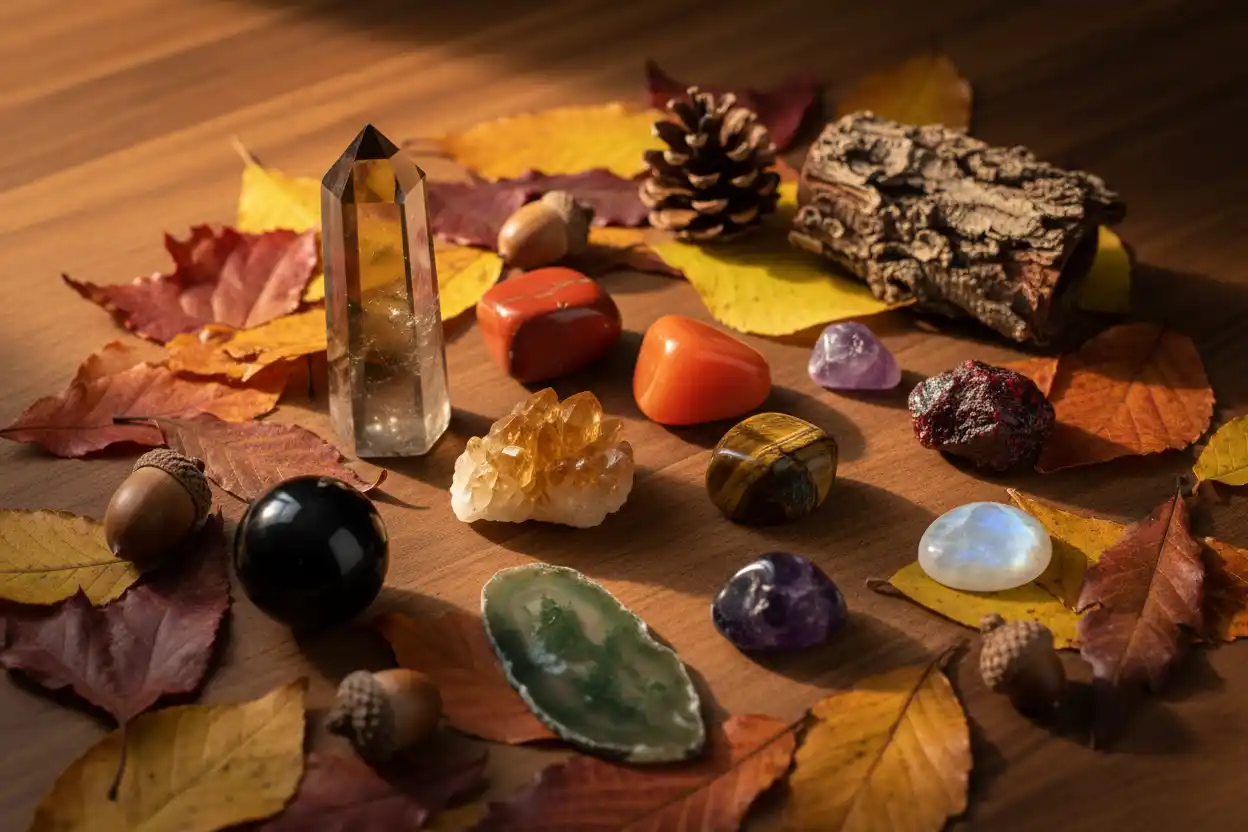

The best crystals for autumn symbolism include smoky quartz, red jasper, carnelian, citrine, tiger’s eye, moss agate, amber and garnet. Their colors and traditional meanings reflect common seasonal themes such as preparing for change, reviewing resources, completing unfinished work and releasing commitments that no longer fit.
Autumn does not occur at the same time everywhere, and its emotional meaning is not universal. In one hemisphere, September may begin autumn; in the other, it begins spring. Some regions experience dramatic leaf color and cooling temperatures, while tropical climates follow different rainfall, harvest and daylight patterns. A seasonal crystal practice should therefore respond to the user’s actual environment rather than one idealized image of fall.
Autumn Crystals at a Glance
| Crystal | Traditional autumn theme | Grounded seasonal use |
|---|---|---|
| Smoky quartz | Grounding and release | Separate what must be completed from what can be released |
| Red jasper | Endurance and practical stability | Maintain essential routines as conditions change |
| Carnelian | Creative action and warmth | Finish one project before beginning another |
| Citrine | Resources and purposeful prosperity | Review money, supplies and winter preparation |
| Tiger’s eye | Observation and practical judgment | Assess risks before making a seasonal change |
| Moss agate | Natural cycles and patient growth | Observe what continues beneath visible change |
| Amber | Memory, warmth and preservation | Record a meaningful story or tradition |
| Garnet | Continuity and commitment | Decide which responsibility deserves continued effort |
| Obsidian | Truth and boundaries | Identify what needs a direct ending or limit |
| Amethyst | Reflection and moderation | Create space for review rather than constant activity |
| Moonstone | Cycles and transition | Adapt routines as light and schedules change |
| Agate | Layers and gradual development | Build seasonal habits one step at a time |
What Autumn Symbolizes
Autumn symbolism commonly centers on maturity, harvest, preparation, decline and transition.
The season often reveals the results of earlier work. Crops are gathered, daylight changes and some plants reduce visible growth. Consequently, autumn can represent both completion and release.
However, harvest imagery should not be treated as proof that everyone experiences abundance. Financial pressure, grief, displacement, illness and difficult weather can make the season demanding.
A grounded seasonal practice asks:
- What produced a useful result?
- Which resource needs protection?
- What remains unfinished?
- What can be released responsibly?
- Which routine must adapt?
- What support will be needed next?
- What continues even when it is not visible?
Crystals provide symbols for those questions. They do not control seasonal events or guarantee prosperity.
Astronomical and Meteorological Autumn
Autumn can be defined in more than one way.
Astronomical autumn begins around an equinox and ends around a solstice. Meteorological seasons divide the year into complete three-month periods for consistent weather records.
Local ecological seasons may follow rainfall, migration, temperature or harvest rather than either calendar definition.
Therefore, a crystal practice does not need to begin on one exact date.
Start when the seasonal transition becomes meaningful in your own location and routine.
Someone living in the Southern Hemisphere should reverse Northern Hemisphere seasonal assumptions. A person in a tropical climate may connect the practice with monsoon change, cooling evenings or a local agricultural cycle rather than falling leaves.
Best Overall Autumn Crystal: Smoky Quartz
Smoky quartz traditionally represents grounding, perspective and releasing an unhelpful attachment.
Its brown-to-gray color also fits autumn palettes without requiring the spiritual meaning to be taken literally.
A useful smoky quartz exercise divides responsibilities into three groups:
| Complete | Continue | Release |
|---|---|---|
| Tasks with a real deadline | Commitments that still support current priorities | Work retained mainly from guilt or habit |
Releasing does not mean abandoning obligations irresponsibly.
A commitment may require notice, documentation, delegation or a final conversation before it can end.
Likewise, some unfinished work must be completed even when motivation has decreased.
Smoky quartz cannot clear emotional or physical toxins. It can mark the decision to examine what still deserves energy.
Red Jasper for Stability
Red jasper is opaque microcrystalline quartz traditionally associated with endurance and practical stability.
Autumn often changes routines. School schedules begin, daylight shifts and outdoor activities may become less predictable.
A red jasper stone can represent protecting a few essential habits:
- Regular meals.
- Medication schedules.
- Planned movement.
- Sleep preparation.
- Weekly financial review.
- Necessary household maintenance.
- Time with supportive people.
Stability does not require repeating every summer routine unchanged.
Instead, it means deciding which foundations need to remain while the rest of the schedule adapts.
Red jasper does not increase physical stamina or prevent seasonal illness.
Carnelian for Completing Creative Work
The drafted carnelian guide associates orange-to-red chalcedony with creativity, confidence and purposeful action.
Carnelian suits an autumn practice focused on finishing rather than endlessly generating new ideas.
Choose one project that can reach a meaningful stopping point before the next season.
Define what “finished” means. A project may be complete when it is submitted, published, given away, stored properly or consciously discontinued.
A carnelian stone beside the work area can mark the session’s first action.
The mineral cannot create motivation or artistic skill. Its purpose is to reduce the distance between intention and beginning.
Citrine for Reviewing Resources
The drafted citrine guide connects yellow-to-orange quartz with optimism, generosity and purposeful prosperity.
Autumn resource planning may include money, food, clothing, home repairs, travel, education or energy use.
A citrine practice can accompany a realistic review:
- Which expenses are seasonal?
- What supplies are already available?
- Which purchase can wait?
- What maintenance prevents a larger cost?
- Where is generosity sustainable?
- Does the budget include recovery and emergencies?
Most commercial citrine is heat-treated amethyst.
This treatment is generally stable but should be disclosed.
Citrine cannot attract money or guarantee a successful harvest, investment or business period.
Tiger’s Eye for Seasonal Decisions
Tiger’s eye is chatoyant quartz traditionally linked with observation, practical confidence and risk awareness.
Seasonal changes can involve travel, outdoor conditions, work transitions and large purchases.
A tiger’s-eye prompt asks:
- What has changed since the original plan?
- Which risk is realistic?
- What evidence supports the decision?
- Who else is affected?
- What is the exit plan?
- When should the choice be reviewed?
Its moving optical band offers a useful symbol for checking conditions from more than one angle.
The stone cannot predict weather, financial markets or personal outcomes.
Moss Agate for Hidden Continuity
Moss agate is chalcedony containing dendritic or moss-like mineral inclusions.
It does not contain actual moss.
The stone traditionally symbolizes growth, patience and connection with natural processes.
Autumn can make growth appear to stop, although roots, soil organisms, seeds and many ecological processes remain active.
A moss agate practice can focus on progress that is not immediately visible:
- Learning occurring before measurable results.
- Recovery that requires rest.
- Planning beneath a paused project.
- Relationships maintained through ordinary contact.
- Skills developing through repetition.
The stone does not improve plant growth or soil fertility scientifically.
Amber for Memory and Preservation
Amber is fossilized tree resin rather than a mineral crystal.
Its warm yellow-to-brown color and preserved inclusions connect naturally with autumn symbolism involving memory and time.
An amber-inspired practice may involve recording:
- A family recipe.
- A seasonal story.
- A photograph with its context.
- The origin of an inherited object.
- A local ecological observation.
- A personal lesson from the year.
Preservation should not become refusal to change.
A memory can remain important without requiring the original circumstances to continue.
Amber is soft and vulnerable to heat, chemicals and strong light.
It should not be burned, placed in hot water or tested with a flame.
Garnet for Commitments Worth Keeping
Garnet is a mineral group available in red, orange, green, pink and other colors.
Traditional meanings include continuity, commitment and safe return.
An autumn garnet practice asks which responsibility deserves continued effort.
Not every difficult commitment should be abandoned, and not every long-standing commitment should be preserved automatically.
Evaluate:
- Whether the responsibility still has a valid purpose.
- Whether consent remains present.
- Whether the workload is sustainable.
- Whether expectations are clear.
- Whether support is available.
- Whether harm outweighs the benefit.
Garnet cannot bind a person to a promise or make an unhealthy obligation meaningful.
Obsidian for Honest Release
Obsidian is natural volcanic glass traditionally connected with truth, boundaries and self-examination.
Autumn release language can become vague or overly positive.
Some endings involve grief, uncertainty, conflict or practical consequences.
An obsidian practice names the exact ending:
“I am ending this subscription.”
“I am withdrawing from this role after giving notice.”
“I am discarding items that are damaged beyond safe use.”
“I am limiting contact because the current pattern is harmful.”
The stone cannot remove another person, memory or emotion.
Obsidian also fractures into extremely sharp edges, so chipped pieces require careful handling.
Amethyst for Seasonal Reflection
The drafted amethyst guide associates purple quartz with contemplation and moderation.
Autumn can become crowded with planning, holidays and year-end demands.
An amethyst stone may mark a scheduled review period.
Useful questions include:
- What worked during the previous season?
- Which goal became irrelevant?
- Where did effort exceed the benefit?
- Which relationship needs attention?
- What should remain unfinished for now?
- What form of rest is realistically available?
Reflection should lead to one decision rather than another collection of observations.
Amethyst does not treat seasonal depression, anxiety or sleep disorders.
Moonstone for Changing Cycles
Moonstone is feldspar known for adularescence.
It traditionally symbolizes cycles, transitions and adapting without abandoning core values.
Autumn often changes daylight, social calendars and energy demands.
A moonstone practice can compare:
| What remains important | What needs a different form |
|---|---|
| Connection with friends | Earlier meeting times |
| Exercise | Indoor or weather-adjusted activity |
| Creative work | Shorter but more consistent sessions |
| Rest | A routine that accounts for schedule changes |
Moonstone does not regulate hormones, sleep or mood medically.
Its cleavage also makes it more vulnerable to impact than quartz.
Agate for Layered Habits
Agate is banded or patterned chalcedony.
Its layers provide an effective image for habits built gradually.
An autumn routine may begin with one weekly action rather than a complete lifestyle redesign.
For example:
Week one: Review outdoor equipment.
Week two: Prepare lighting and heating needs.
Week three: Establish a revised evening routine.
Week four: Evaluate what is working.
Small adjustments can become more reliable than a dramatic seasonal reset.
Brightly colored agate may be dyed, particularly vivid blue, pink, purple and green pieces.
Choosing Crystals by Autumn Theme
| Seasonal intention | Suitable crystals |
|---|---|
| Grounding during change | Smoky quartz, red jasper and hematite |
| Completing a project | Carnelian, garnet and tiger’s eye |
| Reviewing finances | Citrine, jade and pyrite |
| Releasing a commitment | Obsidian, smoky quartz and amethyst |
| Preserving memories | Amber, agate and garnet |
| Adjusting routines | Moonstone, moss agate and red jasper |
| Creating a reflective space | Amethyst, smoky quartz and clear quartz |
| Preparing the home | Agate, jade and tiger’s eye |
The stones do not perform these actions.
They provide consistent symbols for the decisions attached to them.
A Four-Stone Autumn Set
A coherent beginner set could contain:
| Crystal | Seasonal role |
|---|---|
| Smoky quartz | Decide what to release |
| Carnelian | Complete one unfinished task |
| Citrine | Review resources |
| Red jasper | Protect essential routines |
This set follows the sequence:
Release → Complete → Prepare → Maintain
A large seasonal collection is unnecessary.
Choose stones that can be handled and stored safely in the actual household.
Autumn Equinox Reflection
An equinox practice may mark changing daylight and the transition between seasons.
It does not need to claim that the day produces a special measurable crystal energy.
Place one stone beside a journal and review:
- What reached maturity?
- What did not develop as expected?
- Which resource is available now?
- What requires preparation?
- What can be returned, donated or recycled?
- Which responsibility needs a clear ending?
Complete one practical action after writing.
The ritual creates a review point; the equinox does not guarantee balance in work, health or relationships.
Autumn Crystals in the Home
The drafted guide to placing crystals at home explains room-specific safety.
Warm-colored stones may suit an entryway, desk or living area, but placement should not depend on color alone.
Amber and amethyst need protection from prolonged intense light.
Pyrite should remain dry.
Spheres require fitted stands, while clusters need stable bases.
Do not mix crystals with candles, dry leaves or flammable seasonal decorations.
Transparent quartz and glass forms can concentrate sunlight, while dried botanical materials ignite easily.
Autumn Crystal Jewelry
Carnelian, garnet, tiger’s eye, jasper and smoky quartz provide durable options for many jewelry styles.
Amber is softer and requires greater protection from fragrance, heat and impact.
Moonstone has cleavage, while amethyst can fade under prolonged intense sunlight.
The drafted crystal-necklace guide explains chain, pendant and wearing considerations.
Remove seasonal crystal jewelry during gardening, heavy work, sports and activities where it can catch or strike hard surfaces.
Collecting Natural Materials Responsibly
Autumn walks may inspire people to collect stones, leaves, seeds and branches.
Check land ownership, park rules and local regulations before removing any material.
Do not disturb archaeological sites, protected habitats or active wildlife shelters.
Avoid collecting rocks from unstable slopes, road cuts, cliffs and waterways during dangerous conditions.
A photograph or written observation may preserve the experience without removing anything.
Seasonal spirituality does not override conservation, safety or property boundaries.
Care During Cooler and Wetter Weather
Autumn may bring increased humidity, rain and temperature variation.
Pyrite can oxidize in damp storage.
Gypsum and calcite should remain away from water.
Rapid temperature changes can stress some stones and repaired specimens.
The completed guide to crystals that fade in sunlight explains color sensitivity.
The completed crystal-cleansing guide offers symbolic methods that do not require leaving stones outdoors in rain, frost or strong sunlight.
Frequently Asked Questions
1. What is the best crystal for autumn?
Smoky quartz is a strong overall choice because it symbolizes grounding, perspective and responsible release.
2. Which crystals match autumn colors?
Carnelian, citrine, tiger’s eye, amber, red jasper, garnet and smoky quartz reflect common orange, gold, red and brown palettes.
3. Which autumn crystal symbolizes letting go?
Smoky quartz, obsidian and amethyst commonly represent release, truth and reflection.
4. Which crystal represents autumn abundance?
Citrine, jade, pyrite and garnet carry prosperity or resource-related symbolism, but they cannot guarantee wealth.
5. Which crystal is suitable for an autumn equinox practice?
Smoky quartz, clear quartz, amethyst or a balanced four-stone seasonal set can support reflection.
6. Is moss agate an autumn crystal?
Yes. Its natural-cycle and patient-growth symbolism can represent processes continuing beneath visible seasonal change.
7. Is amber a crystal?
No. Amber is fossilized tree resin, although it is commonly included in gemstone and crystal traditions.
8. Do autumn crystals need to be orange or brown?
No. Amethyst, moonstone, obsidian and moss agate offer useful seasonal meanings without matching a fall color palette.
9. Can autumn crystals help with seasonal depression?
Crystals do not treat depression or other mood conditions. Persistent seasonal symptoms deserve qualified care.
10. Should autumn crystals be left outside?
Not necessarily. Rain, frost, sunlight and temperature changes can damage many minerals and repairs.
11. Does autumn begin on the same date everywhere?
No. Definitions and timing vary by hemisphere, calendar system, climate and local ecology.
12. Are autumn crystal meanings scientifically proven?
No. Their grounding, prosperity and release meanings reflect seasonal and spiritual traditions rather than established physical effects.
Prepare Without Treating Change as Loss
Autumn can involve harvest and release at the same time. Something may be complete, another commitment may need to end and a quieter form of progress may already be beginning.
Choose a few stones that represent the season you are actually experiencing. Let one mark what must be finished, one what can be released and one what needs protection. The crystals can structure the review; practical preparation carries it into the next season.
Disclaimer: Autumn crystal meanings involving grounding, release, protection, mood and prosperity reflect cultural and spiritual traditions rather than established medical or financial effects. Crystals cannot treat seasonal depression, predict weather or guarantee abundance, and they should not replace healthcare, financial planning or practical seasonal preparation.