
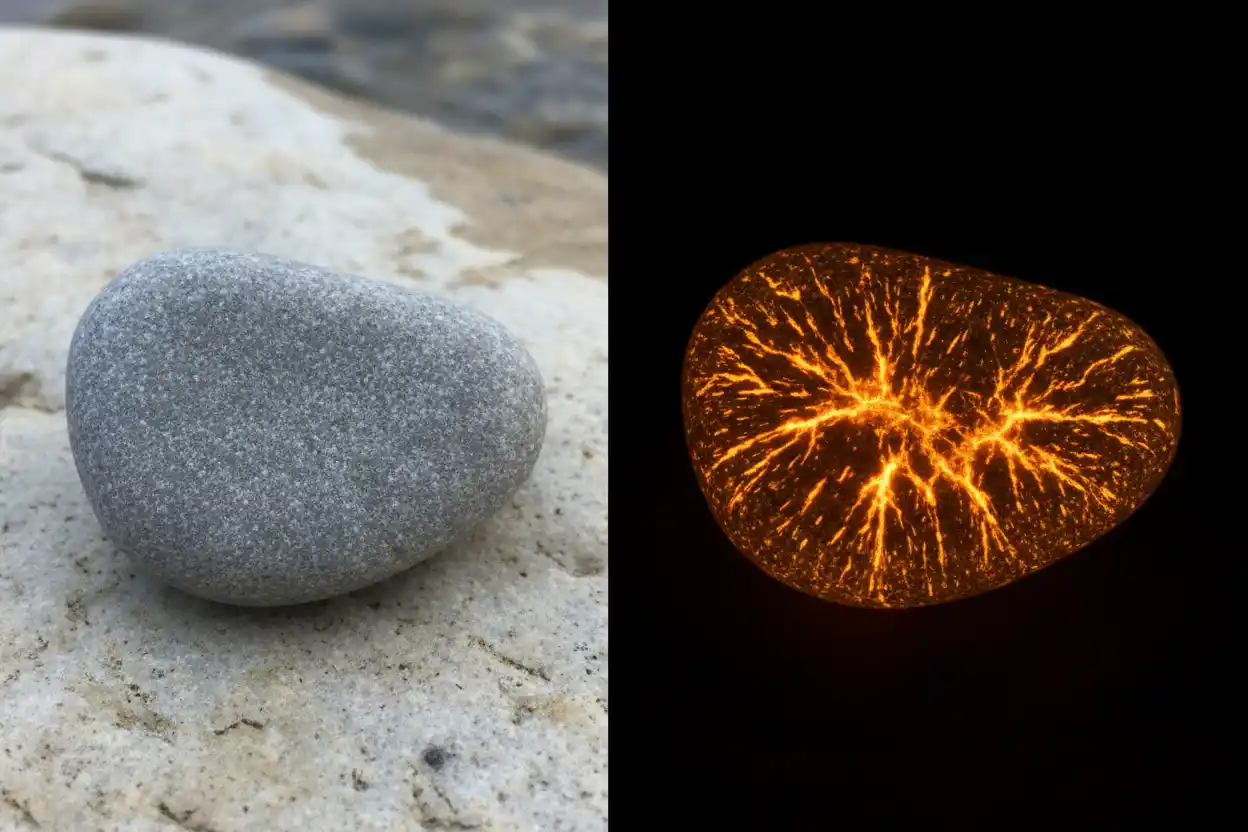

Yooperlite is a trademarked trade name for gray-to-dark syenitic rock containing sodalite that fluoresces vivid orange or yellow-orange under ultraviolet light. It is not a newly discovered mineral species, and the entire rock does not consist of sodalite.
The best-known pieces are wave-rounded glacial pebbles found along Lake Superior in Michigan’s Upper Peninsula. Geological evidence indicates that their probable bedrock source lies within the Coldwell Alkaline Complex of Ontario, from which glaciers transported them southward.
Yooperlite at a Glance
| Property | Yooperlite |
|---|---|
| Material type | Fluorescent sodalite-bearing syenitic rock |
| Name status | Commercial trade name and registered U.S. trademark |
| Underlying rock | Commonly sodalite-bearing syenite or related feldspathoid-rich syenitic rock |
| Fluorescent mineral | Sodalite, locally described as sulfur-bearing hackmanite or fluorescent sodalite |
| Daylight colors | Gray, tan, brown, black, cream and white with pale mineral patches |
| UV response | Bright orange, yellow-orange or ember-like fluorescence |
| Most effective common light | Filtered longwave UV around 365 nm |
| Structure | Multi-mineral igneous rock; no single crystal system |
| Common constituents | Feldspar, nepheline or related feldspathoids, sodalite and dark mafic minerals |
| Transparency | Opaque |
| Luster | Dull to granular when rough; matte to vitreous after polishing |
| Approximate hardness | Variable, commonly about 5.5–6.5 |
| Specific gravity | Variable, commonly approximately 2.5–2.8 |
| Common forms | Lake-rounded pebbles, rough chunks, slabs, spheres, cabochons, towers and worry stones |
| Main care concern | Misleading trade names, resin or fluorescent coatings, UV-light safety and silica-bearing dust during cutting |
What Is Yooperlite?
Yooperlite is a rock rather than a mineral.
A rock contains several mineral components. In this case, the host is syenitic igneous rock containing patches or grains of fluorescent sodalite.
Syenite is broadly comparable with granite in texture but contains little or no quartz and is dominated by alkali feldspar and related minerals.
Some Yooperlite material is described more specifically as nepheline syenite or sodalite syenite because it contains feldspathoid minerals such as nepheline and sodalite.
The fluorescent areas form irregular veins, spots, patches and branching networks.
Under ordinary daylight, those areas may look cream, pale gray or nearly indistinguishable from the surrounding rock.
Under suitable ultraviolet light, they emit a bright orange-to-yellow glow.
The underlying mineral relationship belongs with the sodalite guide, while this page owns the regional trade name, fluorescent rock, collecting and lapidary intent.
Is Yooperlite a New Mineral?
No.
The sodalite group and syenitic rocks were known long before the Yooperlite name appeared.
What was new to the popular rockhounding community was the recognition of strongly fluorescent sodalite-bearing shoreline pebbles in Michigan’s Upper Peninsula.
The name describes a memorable regional material and collecting phenomenon rather than a newly approved mineral species.
A specimen should not be labeled with a fictional chemical formula for Yooperlite.
Its composition varies from one pebble to another because it is a natural multi-mineral rock.
Discovery and Naming
Erik Rintamaki found the glowing shoreline rocks while searching with ultraviolet light in Michigan’s Upper Peninsula in 2017.
He coined the name from Yooper, the regional term for a resident of the U.P., combined with the common rock-name ending lite.
The plural Yooperlites is a registered United States trademark associated with fluorescent-sodalite mineral products.
The geological description remains fluorescent sodalite-bearing syenite or sodalite-syenite.
Sellers using the trade name should still explain the actual rock rather than presenting Yooperlite as one formal mineral.
Where Do Yooperlites Come From?
The best-known pebbles occur along the Lake Superior shoreline of Michigan’s Upper Peninsula.
They are glacial erratics, meaning glaciers transported them away from their original bedrock source.
The probable source lies to the north within Ontario’s Coldwell Alkaline Complex near Marathon.
That complex contains nepheline-syenitic and related alkaline rocks with sodalite or hackmanite.
During the Pleistocene ice ages, glaciers moved southward across the region, broke rock from Canadian bedrock and carried it toward the present Great Lakes basin.
Melting ice left the rock fragments in glacial deposits.
Lake waves later rounded and redistributed the pebbles along beaches.
Therefore, a Michigan beach Yooperlite may have formed geologically in Ontario even though it was discovered and collected in Michigan.
The Coldwell Alkaline Complex
The Coldwell Alkaline Complex is a large igneous body on the northern shore of Lake Superior in Ontario.
Its rocks include varieties of syenite, nepheline syenite and other alkaline igneous compositions.
Certain units contain fluorescent sulfur-bearing sodalite or hackmanite.
The mineral assemblage and location make the complex the leading proposed source for Michigan shoreline Yooperlites.
Not every fluorescent sodalite-bearing pebble can be traced to one exact outcrop.
Glacial transport mixed material from different source areas, while lake currents redistributed pebbles after deposition.
The source model is therefore strong but does not provide mine-level provenance for every collected stone.
What Makes Yooperlite Glow?
The orange fluorescence comes principally from sulfur-bearing centers within sodalite-group minerals.
Ultraviolet radiation supplies energy to electrons associated with those centers.
The electrons enter an excited state and then release part of that energy as visible orange or yellow-orange light when returning toward a lower-energy state.
This visible emission is fluorescence.
The effect generally stops almost immediately when the ultraviolet source is removed.
The host feldspar and dark minerals usually do not glow as strongly, creating the dramatic ember-like pattern.
The amount and distribution of fluorescent sodalite determine how bright and extensive the pattern appears.
A rock with small isolated grains can show only a few orange points, while sodalite-rich material develops broad lava-like networks.
Sodalite and Hackmanite
Sodalite is a sodium-aluminum silicate containing chlorine and commonly sulfur-bearing species.
Hackmanite is a sulfur-rich sodalite variety known for fluorescence and, in some material, reversible color change called tenebrescence.
The fluorescent phase in Yooperlite has been described as sodalite and, in probable source rocks, as hackmanite.
Not every fluorescent sodalite shows obvious daylight tenebrescence.
A Yooperlite can glow strongly without becoming visibly pink or purple after ultraviolet exposure.
Fluorescence and tenebrescence are separate phenomena and should not be treated as synonyms.
Fluorescence Versus Phosphorescence
Fluorescence appears while the ultraviolet lamp is shining.
Phosphorescence continues after the light source has been removed.
Yooperlite’s defining orange effect is primarily fluorescence.
Some specimens or associated minerals may show a short afterglow, but persistent phosphorescence is not required for the trade name.
A seller should not claim that every stone glows in complete darkness after charging.
Without an active ultraviolet source, most specimens return immediately to their ordinary gray appearance.
Why 365 nm UV Works Better
Filtered 365 nm longwave ultraviolet flashlights are widely favored for finding Yooperlites.
They produce a strong fluorescent response while reducing the visible violet light that can wash out the orange glow.
Common 395 nm flashlights can still reveal some fluorescence, but their stronger visible purple output often lowers contrast.
A quality filtered lamp helps the collector see smaller or weaker fluorescent grains.
Greater power is not automatically safer or better.
The light should illuminate the ground rather than people, animals, reflective signs or vehicles.
Never look directly into the LED or point the beam toward another person’s eyes.
Daylight Appearance
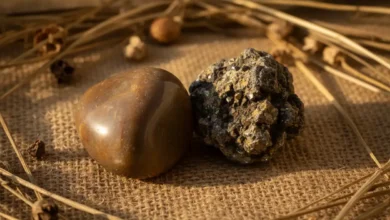
Most unpolished Yooperlites look ordinary in daylight.
They are commonly gray, brown, black, tan or mottled.
Pale feldspar and sodalite form irregular spots and veins.
Dark minerals can create black or greenish grains.
Wave-rounded surfaces may hide the strongest fluorescent areas beneath a thin weathered rind.
Wet stones often appear darker and show more visible contrast than dry ones.
A pebble cannot be authenticated reliably from daylight color alone.
Fluorescent Patterns
Ember Pattern
Small orange points scattered through dark rock resemble glowing embers.
This pattern can be attractive in polished worry stones and cabochons.
Lava Pattern
Broad connected orange veins create the familiar lava-like appearance used in commercial photographs.
Patch Fluorescence
Large isolated patches may represent concentrated sodalite zones.
Network Pattern
Fine branching lines follow fractures, mineral boundaries or irregular sodalite distribution.
Speckled Pattern
Numerous small grains produce a starry or granular effect.
Pattern value depends on brightness, contrast and coverage rather than one formally graded category.
Yooperlite Versus Ordinary Sodalite
Conventional blue sodalite is valued for deep blue color with white calcite or feldspar veins.
Yooperlite is usually gray or dark and sold for orange ultraviolet fluorescence.
Both can contain the same mineral family, but the host-rock appearance and commercial use differ.
Some blue sodalite also fluoresces orange.
A glowing blue sodalite carving should not automatically be described as a Michigan Yooperlite.
The complete authenticity checks appear in Real vs Fake Sodalite.
Yooperlite Versus Hackmanite
Hackmanite is a mineral variety of sodalite.
Yooperlite is a multi-mineral rock containing fluorescent sodalite or hackmanite.
A hackmanite crystal can be removed from a host rock and studied as one mineral.
A Yooperlite pebble retains feldspar, nepheline, dark minerals and other rock components.
The terms are therefore related but not interchangeable.
Yooperlite Versus Other Fluorescent Rocks
Calcite, willemite, fluorite, scapolite, feldspar and many other minerals can fluoresce.
Some Lake Superior rocks contain fluorescent calcite or other phases.
Orange fluorescence alone does not prove Yooperlite identity.
The pattern should occur within sodalite-bearing syenitic rock.
Laboratory testing can identify sodalite through Raman spectroscopy, X-ray diffraction or chemical analysis.
A seller should avoid applying the name to every rock that glows orange.
Identifying Real Yooperlite
Begin with a clean, dry specimen in a dark setting.
Illuminate it with filtered 365 nm longwave ultraviolet light.
Authentic material should show orange or yellow-orange fluorescence within irregular mineral grains or veins.
The glow should emerge from within the rock rather than sit as a smooth painted film.
Under ordinary light, inspect the granular igneous texture.
Magnification may reveal pale feldspar or feldspathoid minerals beside dark amphibole or pyroxene.
Raman spectroscopy can identify fluorescent sodalite.
X-ray diffraction can characterize the rock’s principal mineral phases.
The full approach follows How to Identify Crystals while recognizing that a rock requires multi-mineral analysis.
Fake and Misrepresented Yooperlite
Fluorescent Paint
A stone can be painted with orange-fluorescent pigment.
Paint often gathers in cracks, forms brush marks or glows as one continuous surface layer.
Fluorescent Resin
Rock fragments may be coated or impregnated with fluorescent resin.
Bubbles, plastic luster and unnaturally uniform glow provide warning signs.
Non-Michigan Sodalite-Syenite
Fluorescent sodalite-bearing syenite occurs outside Michigan and Ontario.
Such material can be sold accurately as fluorescent sodalite-syenite or Yooperlite-type rock.
Michigan provenance should not be claimed without documentation.
Ordinary Nonfluorescent Syenite
A gray syenite pebble without fluorescent sodalite is not a Yooperlite merely because it came from Lake Superior.
Enhanced Photography
Long exposures, extreme color saturation and dark editing can make weak fluorescence look much brighter than it appears in person.
A seller should provide ordinary-light and ultraviolet video under realistic conditions.
Treatments and Stabilization
Most beach pebbles are sold untreated.
Polished stones may receive wax or oil to deepen daylight color.
Fractured material can be stabilized with clear resin before cutting.
A surface coating may create a stronger shine or intensify contrast.
Fluorescent resin and paint can imitate or exaggerate the glow.
Dye is less important than coating because the defining appearance occurs under ultraviolet light.
Treatment should be disclosed, especially when resin affects care or the fluorescent pattern.
The broad terminology appears in Gemstone Treatments Explained and How to Spot Treated or Synthetic Sodalite.
Cutting and Polishing
Yooperlite is cut into cabochons, spheres, slabs, palm stones, towers and carvings.
A cutter examines the rough under ultraviolet light before sawing.
The strongest fluorescent zone may lie beneath an ordinary-looking surface.
Cutting across the pattern can expose larger orange patches, while an unfavorable cut can remove the best sodalite area.
The different minerals can polish unevenly.
Feldspar, sodalite and dark mafic minerals may undercut or retain different surface textures.
Resin stabilization may improve weak or fractured pieces.
Finished stones should be examined under both ordinary and ultraviolet light because a good daylight polish does not guarantee an attractive fluorescent design.
Tumbling Yooperlite
Dense Yooperlite can be tumbled with rocks of similar hardness.
Fractured or strongly mixed material may chip or develop pits.
A small test batch is advisable before tumbling valuable collected stones.
Fluorescent patterns may become stronger after the weathered outer rind is removed.
However, tumbling can also grind away small concentrated sodalite patches.
The complete tumbling workflow appears in Rock Tumbling for Beginners.
Finished pieces fit within the broader category of tumbled stones.
Hardness and Durability
Yooperlite does not have one exact hardness because it is a multi-mineral rock.
Sodalite commonly measures about 5.5–6.
Feldspar commonly measures about 6.
Other included minerals, fractures and weathered areas change the local response.
A practical whole-rock range of approximately 5.5–6.5 is reasonable for many specimens, but individual bands may be softer.
The distinction between scratching and breaking appears in Gemstone Toughness vs Hardness.
Thick cabochons, spheres and palm stones are more durable than thin carvings or pointed towers.
Jewelry Suitability
Yooperlite can be used in pendants, earrings and occasional-wear rings.
A cabochon should have enough thickness to tolerate the different mineral grains.
Bezel settings protect exposed edges.
Bracelets receive repeated impacts and can abrade polished surfaces.
The ultraviolet effect will not be visible under ordinary indoor light unless a UV source is present.
Jewelry photography should therefore show both daylight and ultraviolet appearance.
People buying the stone for daily visual color may be disappointed if they expect it to look orange without a UV lamp.
Yooperlite Prices in 2026
Small raw pebbles commonly retail for approximately $2–$10 each.
Better rough pieces with strong fluorescence often range from $10–$30.
Bulk or larger selected rough commonly sells for approximately $15–$40 per pound.
A current 3.33-pound rough stone is listed near $85, or roughly $25 per pound.
Polished worry stones and small palm stones commonly range from $5–$25.
Current polished worry stones appear around $5.
Spheres commonly range from approximately $30–$100, depending on size, pattern and provenance.
One current 2.55-inch fluorescent sodalite-syenite sphere is listed around $75.
Large Michigan-provenance specimens, exceptional fluorescence or artistic carvings can exceed $100–$300.
The price normally reflects pattern, brightness, polish, size and regional provenance rather than gem-grade rarity.
What Determines Value?
Fluorescence brightness is the leading factor.
A vivid orange pattern visible under a practical handheld light commands more than weak fluorescence requiring complete darkness and long exposure.
Coverage matters. Broad networks or balanced patches often attract more interest than one tiny glowing point.
Contrast between dark host rock and orange sodalite improves visual impact.
Daylight appearance also matters for jewelry and decorative objects.
Michigan shoreline provenance can add regional collector value.
Polish, symmetry and carving quality affect finished prices.
Cracks, weak grain boundaries and resin should be disclosed.
Artificial fluorescent coating sharply reduces natural-rock value.
Buying Guidance
Ask whether the stone was collected in Michigan, originated from Ontario or came from another fluorescent sodalite-syenite source.
Request daylight photographs and realistic ultraviolet video.
Confirm the wavelength and type of lamp used.
A seller using an unusually long camera exposure should disclose it.
Inspect polished pieces for fluorescent paint, coating and resin.
Ask whether the stone is solid rock or a composite.
Do not pay a regional premium for material described only as China Yooperlite, Greenland Yooperlite or generic glowing rock.
Those products may be genuine fluorescent sodalite-syenite but lack Michigan provenance.
The broader sodalite seller checklist appears in Where to Buy Real Sodalite.
Finding Yooperlites
Nighttime or twilight hunting provides the strongest contrast.
Scout the beach in daylight before returning after dark.
Use a filtered 365 nm ultraviolet flashlight and a separate white light for safe walking.
Move the ultraviolet beam slowly across exposed pebbles.
Search near the waterline, storm deposits and fresh areas of wave-washed gravel.
New stones can appear after storms, seasonal ice movement and changing lake levels.
Go with another person and tell someone where you will be.
Lake Superior water and weather can become dangerous quickly, even in summer.
Never turn away from active waves for extended periods.
Legal and Ethical Collecting
Rules depend on land ownership and the specific park or shoreline.
Michigan guidance currently states an annual limit of 25 pounds total per person for hobby rock, mineral and invertebrate-fossil collecting from state-owned land.
National parks generally prohibit removal of natural objects.
Private property requires permission.
Some protected sites, historic areas and nature preserves may prohibit collecting even when nearby beaches allow it.
Local rules can change, so collectors should verify the exact location before removing stones.
Take a few representative pieces rather than every fluorescent pebble.
Leave large, unusual and ecologically embedded stones for others to see.
Avoid digging into dunes, vegetation or unstable banks.
UV Flashlight Safety
A 365 nm lamp emits UVA radiation that is invisible or only faintly visible.
Do not look directly into the LED.
Never shine the beam into another person’s or animal’s eyes.
Avoid prolonged illumination of bare skin.
Use ultraviolet-blocking safety glasses from a reliable supplier, especially with high-output lamps or extended searches.
Keep the beam directed at the ground.
Be cautious around water, glass, vehicle reflectors and polished metal because reflections can redirect ultraviolet radiation.
Children should use UV flashlights only under close adult supervision.
The orange fluorescence may look harmless, but the ultraviolet energy producing it still requires responsible handling.
Cleaning and Storage
Wash durable untreated stones briefly with lukewarm water, mild soap and a soft brush.
Rinse and dry them thoroughly.
Avoid prolonged soaking when resin, glue or fractures are present.
Do not use acids or strong alkaline cleaners because the rock contains several minerals with different chemical responses.
Ultrasonic and steam cleaning are unnecessary.
Store polished stones away from harder sapphire and diamond jewelry.
Natural fluorescence does not need to be recharged.
Ordinary room light will not exhaust the sodalite permanently.
For symbolic cleansing practices, use gentle methods from How to Cleanse and Charge Sodalite without confusing spiritual tradition with physical fluorescence.
Meaning and Symbolism
Yooperlite has no ancient gemstone tradition because the trade name dates from the twenty-first century.
Modern collectors associate it with discovery, curiosity and the idea that ordinary appearances can conceal unexpected features.
The dramatic transition from gray daylight rock to orange ultraviolet glow encourages symbolism involving hidden ability, changing perspective and looking beyond first impressions.
Its glacial journey from Ontario toward Michigan can represent movement, resilience and landscapes shaped over long periods.
These meanings are cultural, spiritual or personal rather than scientifically demonstrated effects.
The stone belongs in regional and fluorescent-mineral collecting rather than being presented as a universal healing crystal.
Frequently Asked Questions
1. Is Yooperlite a mineral?
No. It is a sodalite-bearing syenitic rock containing several minerals.
2. What mineral makes Yooperlite glow?
Sulfur-bearing sodalite, sometimes described as hackmanite, produces the bright orange fluorescence.
3. Does Yooperlite glow in the dark by itself?
No. Its defining fluorescence requires ultraviolet light and normally stops when the lamp is switched off.
4. What UV light is best for Yooperlite?
A filtered 365 nm longwave UV flashlight normally provides stronger orange contrast than an unfiltered 395 nm lamp.
5. Where do Yooperlites originate?
Michigan beach pebbles were likely transported by glaciers from sodalite-bearing rocks in Ontario’s Coldwell Alkaline Complex.
6. Can Yooperlites be found only in Michigan?
The trade name is strongly associated with Michigan, but fluorescent sodalite-syenite occurs in Ontario and other parts of the world.
7. Is Yooperlite the same as sodalite?
No. Sodalite is one mineral within the multi-mineral Yooperlite rock.
8. Can Yooperlite show tenebrescence?
Some sodalite or hackmanite can change daylight color after UV exposure, but strong tenebrescence is not required for Yooperlite.
9. How can fake Yooperlite be identified?
Look for fluorescent paint, resin, surface-only glow, bubbles and patterns that do not follow the rock’s mineral texture.
10. Is it legal to collect Yooperlites in Michigan?
Collecting rules depend on the site. Michigan currently limits hobby collecting from state-owned land to 25 pounds per person per year, while some protected areas prohibit removal entirely.
11. How much is Yooperlite worth?
Small rough pieces often cost $2–$10, polished stones $5–$25 and spheres roughly $30–$100. Exceptional Michigan material can cost more.
12. Does Yooperlite have scientifically proven healing properties?
No. Its fluorescence and geology are real, but scientific evidence does not establish healing effects.
Yooperlite’s appeal comes from a genuine contrast between appearance and structure. In daylight it may resemble an ordinary glacial pebble, but filtered ultraviolet light reveals sulfur-bearing sodalite patterns carried across the Lake Superior region by ice and waves.
Yooperlite appears in Crystals That Start With Y and Gemstones That Start With Y.
Safety disclaimer: Never look into a UV flashlight or point it at another person’s eyes. Use UV-blocking eye protection for prolonged or high-output use. Follow land-specific collecting rules, avoid dangerous nighttime shoreline conditions, and use wet cutting, ventilation and appropriate respiratory protection when grinding silica-bearing rock.