
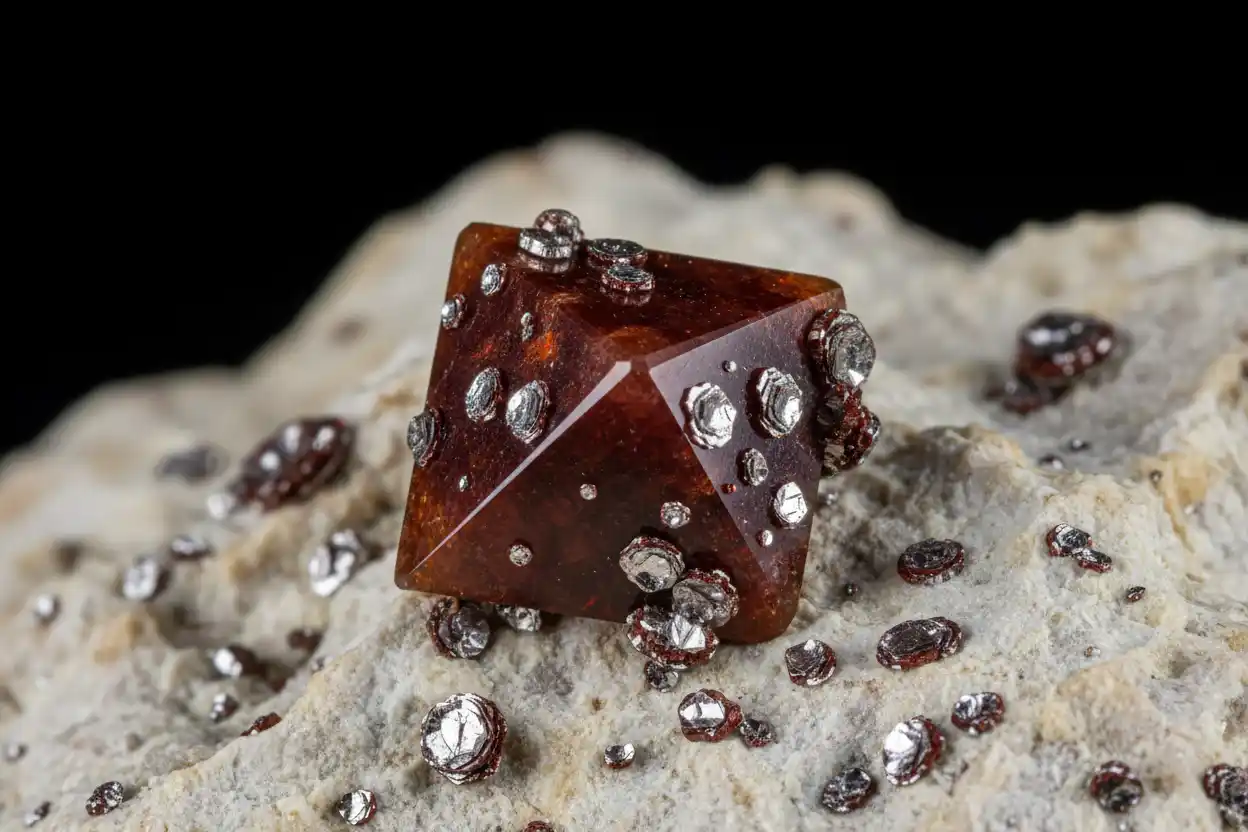

Zunyite is a rare aluminum-rich silicate containing hydroxyl, fluorine and chlorine. It forms distinctive tetrahedral and pseudo-octahedral crystals that range from colorless and gray-white to flesh-red, reddish brown and dark brown.
Although its hardness approaches quartz, Zunyite has good cleavage and brittle tenacity. Fine crystals are therefore collected as mineral specimens rather than used routinely in jewelry.
Zunyite at a Glance
| Property | Zunyite |
|---|---|
| Mineral class | Aluminum sorosilicate |
| Chemical formula | Al₁₃Si₅O₂₀Cl(OH,F)₁₈ |
| Essential elements | Aluminum, silicon, oxygen, hydrogen, fluorine and chlorine |
| Crystal system | Cubic or isometric |
| Crystal class | Hextetrahedral |
| Typical colors | Colorless, gray-white, cream, flesh-red, pinkish red, reddish brown and dark brown |
| Common habit | Tetrahedral, pseudo-octahedral and cube-modified crystals |
| Twinning | Contact and penetration twins on tetrahedral planes |
| Luster | Vitreous |
| Transparency | Transparent to translucent; inclusions can make crystals opaque |
| Refractive index | Approximately 1.592–1.600 |
| Optical character | Isotropic |
| Specific gravity | Approximately 2.87–2.90 |
| Mohs hardness | Approximately 7 |
| Cleavage | Good in the octahedral direction |
| Tenacity | Brittle |
| Possible fluorescence | Some specimens fluoresce red under ultraviolet light |
| Common use | Mineral specimens, micromounts, alteration studies and rare collector cuts |
| Main care concern | Cleavage, brittle crystal points, matrix repairs and dust from cutting |
What Is Zunyite?
Zunyite is an unusual aluminum-rich silicate whose formula also includes chlorine, hydroxyl and variable fluorine.
Its structure contains compact silicate groups surrounded by aluminum-bearing polyhedra.
The mineral crystallizes in the cubic system and commonly produces forms dominated by tetrahedral faces.
These crystals can look like simple four-sided pyramids, pairs of interpenetrating tetrahedra or octahedron-like forms with beveled edges.
Zunyite is not a variety of Quartz, even though both minerals can reach hardness 7.
It is also distinct from fluorite, spinel and other cubic minerals that produce similarly geometric crystals.
How Zunyite Got Its Name
Zunyite was named for the Zuni Mine near Silverton in San Juan County, Colorado.
The spelling reflects the mine name rather than the modern spelling used for the Zuni people or geographic region.
The mineral was discovered during nineteenth-century study of altered volcanic and ore-bearing rocks.
The type locality produced small crystals associated with advanced hydrothermal alteration minerals.
Because the name comes from one mine, it should not be interpreted as a general trade word for every brown tetrahedral crystal.
Zunyite’s Chemical Formula
The idealized formula is written as:
Al₁₃Si₅O₂₀Cl(OH,F)₁₈
Aluminum dominates the composition.
Silicon forms a distinctive silicate unit.
Chlorine occupies a specific structural site, while fluorine can replace part of the hydroxyl.
Natural analyses vary in the relative proportions of fluorine and hydroxyl.
Minor iron, phosphorus, sodium, potassium and other elements can occur as impurities or substitutions.
The formula does not mean the intact crystal releases free chlorine or fluoride during ordinary handling. Those elements remain chemically bound within the mineral structure.
However, cutting or grinding any fluorine-bearing silicate requires professional dust control.
Crystal Shape
Tetrahedral Zunyite
The classic crystal resembles a tetrahedron with four triangular faces.
Tetrahedral crystals may sit on one face or project from matrix with one point upward.
The simple shape can be surprisingly sharp and symmetrical.
Cube-Modified Tetrahedra
Small cube faces can bevel the edges and corners.
These modifications produce more complex reflections and help distinguish well-developed collector specimens.
Pseudo-Octahedral Crystals
Intergrowth or modification can make a crystal resemble an octahedron.
A true octahedron has eight triangular faces, whereas Zunyite’s combination of tetrahedral and cube forms may imitate that outline.
Penetration Twins
Two or more tetrahedral crystals can grow through one another.
These penetration twins form dramatic star-like or complex geometric groups.
Complete twins are especially desirable because their projections chip easily.
Crystal Aggregates
Some localities produce many small crystals coating matrix rather than isolated large tetrahedra.
Microcrystalline coatings may require magnification to recognize their geometry.
Zunyite Colors
Colorless and Gray-White Zunyite
Pure or thin material can appear colorless.
Gray-white and cream crystals commonly contain numerous inclusions or microscopic defects that scatter light.
Pale material can be difficult to distinguish from quartz or another colorless silicate without testing.
Flesh-Red Zunyite
Historic descriptions frequently use flesh-red for pale pinkish or reddish crystals.
The tone may be muted and slightly brown rather than vivid pink.
Reddish-Brown Zunyite
Modern Iranian material is famous for sharp reddish-brown crystals.
Some crystals contain numerous metallic hematite platelets that deepen the apparent color.
Dark Brown Zunyite
Thick crystals can become nearly opaque and dark brown.
Strong lighting may reveal warmer red tones along thin edges.
Color Caused by Inclusions
Not every Zunyite crystal has a strongly colored structure.
Hematite inclusions, iron oxides and other mineral particles can contribute red, brown and metallic appearances.
Laboratory analysis is required to separate structural color from included pigment.
Hematite Inclusions
Recent Iranian Zunyite commonly contains thin, metallic Hematite flakes.
These platelets can appear as dark scales, sparkling internal reflections or metallic coatings.
Some inclusions lie entirely inside the crystal, while others reach the surface.
The contrast between reddish-brown Zunyite and silvery-black hematite creates the most recognizable modern collector material.
Heavy inclusion can reduce transparency but increase visual and locality interest.
A seller should distinguish naturally included hematite from an external metallic coating or attached matrix mineral.
How Zunyite Forms
Zunyite forms in aluminum-rich rocks affected by acidic hydrothermal fluids.
Hot fluids move through volcanic rock, shale and breccia, removing some elements while concentrating aluminum, fluorine and chlorine.
This intense chemical alteration creates an assemblage known as advanced argillic alteration.
Minerals such as pyrophyllite, kaolinite, alunite and diaspore form under these acidic conditions.
Zunyite crystallizes where the fluid contains suitable aluminum, silica, fluorine and chlorine.
Its presence can help geologists recognize hydrothermal systems associated with high-sulfidation epithermal and porphyry-related mineralization.
The mineral is not itself usually a valuable ore. Instead, it acts as an alteration indicator within a larger geological system.
Advanced Argillic Alteration
Advanced argillic alteration develops when strongly acidic hydrothermal fluid reacts with volcanic or sedimentary rock.
Feldspar and many ordinary silicates break down.
Aluminum-rich minerals remain or crystallize from the altered material.
Alunite commonly forms where sulfate-rich acidic fluid is present.
Diaspore may develop under aluminum-rich conditions with limited silica.
Pyrophyllite and kaolinite represent different combinations of temperature, silica activity and acidity.
Zunyite indicates that fluorine and chlorine also participated in the hydrothermal system.
Its occurrence can therefore provide information about fluid composition rather than merely adding another crystal to the rock.
Type Locality in Colorado
The Zuni Mine lies near Silverton in Colorado’s San Juan Mountains.
The region contains extensive volcanic rocks and hydrothermal ore deposits.
Type-locality Zunyite usually occurs as small crystals within altered rock and mineralized matrix.
Historic Colorado specimens appeal to locality and species collectors even when their crystals are less dramatic than modern Iranian material.
Original mine labels are valuable because several Colorado workings have similar alteration minerals and collecting histories.
Silver City, Utah
The Tintic district near Silver City, Utah, is a classic source of reddish-brown Zunyite.
Crystals may form sharp tetrahedra and pseudo-octahedra associated with hematite and altered volcanic rock.
Some Utah crystals reach sizes suitable for display without magnification.
Older specimens with precise mine labels can command a premium.
The district’s complex ore and alteration history makes associated mineral identification important.
Arizona
Zunyite occurs in altered rock in parts of western Arizona, including the Dome Rock Mountains and Quartzsite region.
Some Arizona localities have produced comparatively large crystals.
The mineral may also occur as microscopic alteration grains rather than isolated display specimens.
Arizona material can be associated with quartz, sericite-like mica, pyrite and advanced argillic minerals.
Because several pale tetrahedral minerals can occur in altered volcanic rock, analytical confirmation is especially useful.
Iranian Zunyite
The Qalat-e Payeen and Qalat-e Balat salt-dome areas near Bandar Abbas, Hormozgan Province, produced important Zunyite beginning in the late 2010s.
The finest crystals are reddish to dark brown, tetrahedral and commonly beveled by cube faces.
Some occur as complete floaters, while others rest on metallic hematite-rich matrix.
Crystal sizes around one centimeter are common among better specimens, while exceptional examples can approach or exceed two centimeters.
The sharp form, smooth faces and hematite inclusions established Iranian material as a modern standard for the species.
Not every brown tetrahedral crystal from Iran is automatically Zunyite. Dealer labels and analytical work remain important.
Other Localities
South Africa has produced Zunyite from highly aluminous deposits near Postmasburg.
Turkey contains documented occurrences in altered rock.
Beni Embarek in Algeria supplied material used for classic structural and chemical studies.
Morocco, Slovakia, England, Uzbekistan and Japan contain additional occurrences.
Zunyite also appears as a microscopic alteration mineral in several copper-gold and high-sulfidation systems worldwide.
Most deposits do not yield crystals suitable for the collector market.
Associated Minerals
Zunyite commonly occurs with pyrophyllite and kaolinite, although the tracker does not assign those minerals separate Gemstone Guide pages.
Alunite reflects acidic sulfate-rich alteration.
Diaspore represents another aluminum-rich alteration mineral.
Rutile may form dark red, brown or black accessory crystals.
Pyrite can occur as metallic grains and cubes in the wider hydrothermal system.
Hematite produces important inclusions and matrix in Iranian specimens.
Quartz can occur beside or after advanced alteration zones.
These minerals may have different hardness, chemical stability and cleaning requirements from the Zunyite itself.
Zunyite Versus Spinel
Spinel commonly forms octahedral crystals and can be red, brown, black or colorless.
Spinel has hardness 8, greater density and different refractive properties.
Zunyite forms tetrahedra and cube-modified tetrahedra rather than the most familiar spinel octahedra.
Both are cubic and optically isotropic.
A broken or heavily modified crystal can therefore require Raman spectroscopy or X-ray diffraction for reliable separation.
Zunyite Versus Fluorite
Fluorite is calcium fluoride with hardness 4.
It commonly forms cubes and octahedra and splits readily along octahedral cleavage.
Zunyite has hardness 7 and aluminum-rich silicate chemistry.
Fluorite normally has a lower refractive index and may show strong color zoning.
Both can fluoresce and display cubic symmetry, so ultraviolet response alone is not diagnostic.
Zunyite Versus Quartz
Quartz and Zunyite can both measure approximately 7 on the Mohs scale.
Quartz crystallizes in the trigonal system and commonly forms six-sided prisms.
Zunyite is cubic and forms tetrahedral crystals.
Quartz has no cleavage, while Zunyite has good cleavage.
Their refractive indices and optical characters differ: quartz is doubly refractive, while Zunyite is isotropic.
Zunyite Versus Topaz
Topaz can occur in altered or fluorine-rich geological systems and may be colorless, pale brown or pink.
Topaz has hardness 8 and an orthorhombic prismatic habit.
Zunyite forms cubic-system tetrahedra.
Both have important cleavage and can contain fluorine.
A small colorless fragment should be tested rather than identified through hardness alone.
How to Identify Zunyite
Crystal shape provides the most useful first clue.
A sharp tetrahedron with cube-beveled edges from a documented locality strongly supports Zunyite.
Hardness near 7 separates it from fluorite, calcite and many alteration minerals.
Specific gravity around 2.88 lies close to several silicates and cannot confirm the species alone.
Zunyite is isotropic under crossed polarizers, though inclusions and internal strain can create anomalous effects.
A refractive index near 1.592–1.600 supports identification.
Raman spectroscopy provides a non-destructive structural fingerprint.
X-ray diffraction confirms the cubic lattice and separates Zunyite from spinel, quartz and other lookalikes.
Electron-microprobe analysis measures aluminum, silicon, fluorine and chlorine distribution.
The complete approach follows How to Identify Crystals.
Fluorescence
Some Zunyite fluoresces red under ultraviolet light.
The response can vary between localities, crystals and included zones.
Hematite-rich crystals may appear less transparent and show a weaker internal response.
Associated calcite, fluorite, coatings or adhesive may fluoresce independently.
The lamp wavelength should be recorded when describing the reaction.
A specimen that does not fluoresce can still be genuine Zunyite.
Ultraviolet behavior should support identification rather than replace spectroscopy or crystallography.
Treatments, Repairs and Synthetic Material
Zunyite is not normally heat treated, irradiated or dyed.
Its collector value depends on natural crystal shape, locality and condition rather than enhanced color.
Matrix specimens can be repaired when a tetrahedral crystal detaches.
Clear adhesive may stabilize fractured altered rock or reconnect a crystal.
A loose crystal can also be mounted with removable mineral putty inside a specimen box. This is normal display preparation and should not be confused with repair.
Oil or coating could deepen brown color and luster, though such enhancement would reduce confidence.
Synthetic Zunyite has been produced for structural and scientific research, but no meaningful synthetic gemstone market exists.
The distinction between natural, laboratory-grown and imitation material follows Lab-Grown vs Natural Gemstones and Gemstone Treatments Explained.
Can Zunyite Be Faceted?
Transparent Zunyite can theoretically be faceted.
However, suitable rough is exceptionally rare.
Most crystals contain hematite, fractures, cloudy inclusions or valuable complete faces.
Good cleavage creates a breakage risk during cutting and setting.
Its refractive index is moderate, so the finished brilliance would be similar to several ordinary silicates rather than unusually intense.
A complete one-centimeter tetrahedron is normally worth more as a specimen than as small cut fragments.
Any faceted Zunyite offered at a high price should carry an independent laboratory report.
Hardness, Cleavage and Jewelry Suitability
Zunyite measures approximately 7 on the gemstone hardness chart.
This provides reasonable scratch resistance.
However, good cleavage and brittle tenacity reduce impact durability.
The difference between hardness and resistance to breaking appears in Gemstone Toughness vs Hardness.
The cleavage risk is explained further in Gemstone Cleavage Explained.
Sharp tetrahedral points can chip when the crystal is dropped or pressed against packaging.
Mineral specimens should remain in protective boxes.
A rare cut stone would be better suited to a collection or protected pendant than to a ring or bracelet.
Zunyite Prices in 2026
Zunyite has a thin, specimen-driven market.
Microcrystalline matrix pieces and small incomplete crystals commonly sell for approximately $20–$75.
Current low-end loose crystal listings appear near $28, although identification and provenance should be checked carefully.
Small sharp tetrahedral crystals and modest matrix specimens commonly range from approximately $75–$250.
Specialist dealer inventories place several Iranian Zunyite-with-Hematite specimens within the equivalent of roughly $100–$250.
Better one- to two-centimeter crystals with clean form, strong luster and minimal damage may range from approximately $250–$750.
Exceptional penetration twins, complete floaters, published specimens and crystals exceeding typical size can reach $750–$1,250 or more.
Historic type-locality material may command a premium even when the crystals are small.
Zunyite has no dependable standardized per-carat market because faceted stones are extremely uncommon.
What Determines Value?
Crystal form is the leading factor.
A sharp complete tetrahedron commands more than an indistinct grain or broken crystal.
Cube modifications and penetration twins add geometric complexity.
Size creates a strong premium because well-formed crystals larger than one centimeter are unusual.
Reddish-brown color and metallic hematite inclusions characterize desirable Iranian material.
Luster should remain bright and glassy.
Damage at the tetrahedral points reduces value quickly.
Matrix composition and balance affect aesthetics.
Locality, analytical documentation, old labels and publication history strengthen collector importance.
Repairs and glued crystals should be disclosed.
Buying Guidance
Buy from a dealer experienced in rare mineral species.
Request the exact mine, district, province and country.
Ask how the specimen was identified.
Inspect each point, edge and crystal face for chips.
Look closely around the base for adhesive.
For Iranian material, compare the crystal shape with the hematite matrix and ask whether the piece is a floater or attached crystal.
Treat extremely large inexpensive Zunyite claims with skepticism.
Do not rely on an online hardness claim, fluorescence photograph or pyramid shape alone.
Preserve every original label because provenance may contribute materially to future value.
A laboratory report is appropriate for a faceted stone or an unusually expensive specimen with uncertain identification.
Cleaning, Water and Storage
Use a hand air bulb or very soft brush for routine cleaning.
Hold the specimen by solid matrix rather than a tetrahedral point.
Avoid compressed air because it can dislodge crystals and spread dust.
Do not soak altered matrix specimens. Water can enter fractures, weaken adhesives and affect associated pyrite or clay minerals.
The guidance in Which Crystals Can and Cannot Go in Water should be applied conservatively.
Avoid ultrasonic and steam cleaning.
Store loose crystals individually in padded boxes.
Keep direct pressure away from crystal corners.
Natural color is generally stable in ordinary indoor light, although adhesives and associated minerals may respond differently. The broader guidance appears in Crystals That Fade in Sunlight.
Meaning and Symbolism
Zunyite has little historical gemstone symbolism because it remained obscure outside mineralogical and mining circles.
Modern collectors associate its tetrahedral shape with structure, stability and several parts supporting one balanced form.
Its occurrence in intensely altered rock encourages symbolism involving rebuilding after major environmental change.
The mineral’s role as a hydrothermal indicator can represent noticing small clues that reveal a much larger hidden system.
Hematite-rich crystals may receive modern associations with combining analytical clarity and practical grounding.
These meanings are cultural, spiritual or personal rather than scientifically demonstrated effects.
Frequently Asked Questions
1. Is Zunyite a real mineral?
Yes. Zunyite is a recognized aluminum-rich silicate mineral with fluorine, chlorine and hydroxyl in its structure.
2. What is Zunyite’s chemical formula?
Its idealized formula is Al₁₃Si₅O₂₀Cl(OH,F)₁₈.
3. Why does Zunyite form tetrahedral crystals?
Its cubic crystal symmetry allows tetrahedral faces to dominate the external form.
4. What color is Zunyite?
It occurs in colorless, gray-white, flesh-red, reddish-brown and dark-brown crystals.
5. What creates the metallic flakes inside Iranian Zunyite?
Many Iranian crystals contain thin hematite platelets.
6. Where was Zunyite discovered?
It was discovered at the Zuni Mine near Silverton in San Juan County, Colorado.
7. Where are the best modern Zunyite crystals found?
The Qalat-e Payeen and Qalat-e Balat areas of Hormozgan Province, Iran, have produced excellent reddish-brown tetrahedra with hematite.
8. Does Zunyite fluoresce?
Some specimens fluoresce red under ultraviolet light, but the reaction varies and is not required for identification.
9. Is Zunyite suitable for jewelry?
Its hardness is adequate, but cleavage, brittleness and rarity make it unsuitable for ordinary exposed jewelry.
10. Can Zunyite go in water?
Soaking is not recommended, especially when the crystal is on altered matrix or has been repaired.
11. How much is Zunyite worth?
Small pieces may cost $20–$75, while sharp one-centimeter crystals commonly range from $100 to several hundred dollars. Exceptional crystals can exceed $1,000.
12. Does Zunyite have scientifically proven healing properties?
No. Its symbolism may hold personal meaning, but scientific evidence does not establish healing effects.
Zunyite’s appeal comes from the precision of its natural geometry. A small reddish tetrahedron can preserve evidence of highly acidic, fluorine-bearing hydrothermal alteration while also revealing how a complex aluminum silicate organizes itself into one of the mineral world’s cleanest geometric forms.
Zunyite appears in Crystals That Start With Z.
Safety disclaimer: The fluorine and chlorine in intact Zunyite are chemically bound within the mineral, but the specimen should not be ingested or used in crystal water. Cutting and grinding can release respirable silicate and aluminum-bearing dust, while matrix may contain pyrite or other ore minerals. Preserve complete crystals and use wet methods, ventilation, eye protection and appropriate respiratory protection when professional cutting is unavoidable.