
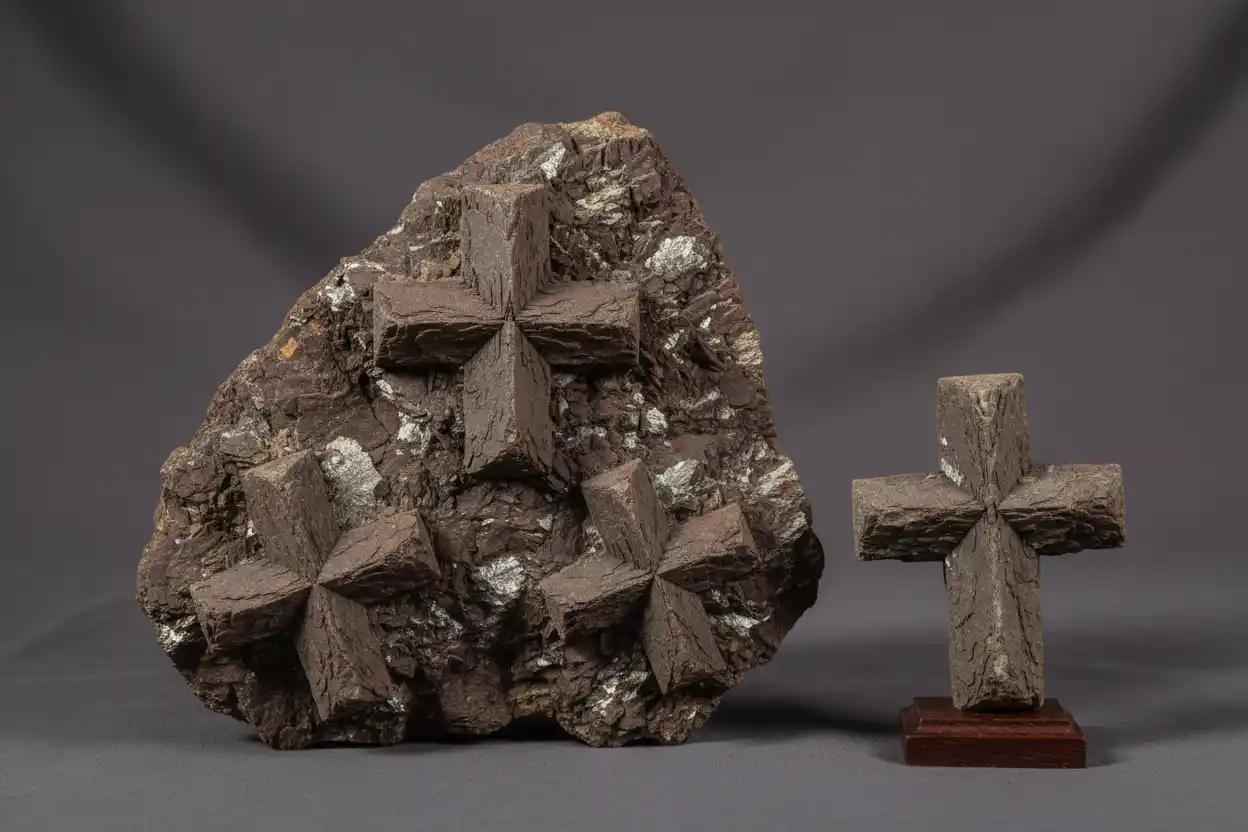

Staurolite is a hard, iron- and aluminum-rich silicate mineral best known for naturally twinned crystals that form angled or nearly right-angled crosses. It develops mainly in medium-grade metamorphic schists and gneisses, where dark reddish-brown prisms grow with mica, quartz, garnet, and kyanite.
Most staurolite remains opaque and valuable as a geological or collector specimen. Transparent facetable crystals are exceptionally uncommon, while cross-shaped twins have acquired regional names and folklore that should remain separate from scientific identification.
Staurolite at a Glance
| Property | Staurolite |
|---|---|
| Composition | Complex iron-magnesium-aluminum silicate, approximately (Fe²⁺,Mg,Zn)₂Al₉(Si,Al)₄O₂₀(O,OH)₄ |
| Group or type | Staurolite-group nesosilicate mineral |
| Color | Reddish brown, dark brown, blackish brown, yellow-brown; rarely pale yellow, blue, or nearly colorless |
| Crystal system or texture | Monoclinic, commonly appearing pseudo-orthorhombic |
| Habit | Prismatic, porphyroblastic, granular, massive; common penetration and contact twins |
| Luster | Subvitreous, resinous, or dull |
| Transparency | Transparent in rare thin crystals; commonly translucent to opaque |
| Mohs hardness | Approximately 7–7.5 |
| Cleavage | Distinct in one principal direction |
| Tenacity | Brittle |
| Common uses | Mineral specimens, natural cross pendants, geological teaching material, rare faceted collector gems |
| Primary care concern | Brittleness, cleavage, matrix fractures, damaged twin junctions, and misrepresented “fairy stones” |
What Is Staurolite?
Staurolite is a rock-forming metamorphic mineral containing iron, aluminum, silicon, oxygen, hydroxyl, and variable magnesium or zinc. Its composition is less simple than that of quartz or corundum because several elements can substitute across different structural positions.
The name comes from the Greek words for cross and stone. It refers to the mineral’s characteristic twinning rather than a carved symbol.
Staurolite belongs to the nesosilicate class, in which silica tetrahedra occur as comparatively isolated structural units linked through metal-bearing sites.
Most visible crystals are reddish brown to almost black. Thin edges can transmit honey-yellow or golden-brown light even when the crystal appears opaque in ordinary room lighting.
Staurolite falls within the mineral-specimen side of the broader types of gemstones guide. It also appears in the crystals that start with S and gemstones that start with S directories.
Staurolite Composition
A commonly used approximate formula is (Fe²⁺,Mg)₂Al₉(Si,Al)₄O₂₀(O,OH)₄. Natural compositions can also contain zinc, manganese, ferric iron, cobalt, titanium, and other minor elements.
Iron commonly contributes to the dark red-brown or blackish color. Magnesium- and zinc-rich compositions may be lighter, although color cannot reveal exact chemistry reliably.
Aluminum occupies a large part of the structure, which helps explain why staurolite forms in aluminum-rich metamorphic rocks.
The mineral can contain substantial microscopic inclusions of quartz and other phases. As a result, a chemical test on one spot may not represent the entire crystal.
Staurolite-group nomenclature includes compositionally specialized members, but most collector specimens are appropriately labeled simply as staurolite unless analytical work proves otherwise.
How Staurolite Forms
Staurolite forms mainly during regional metamorphism of clay-rich sedimentary rocks. Burial, mountain-building pressure, heat, and fluid activity transform shale or mudstone into slate, phyllite, schist, and eventually gneiss.
At appropriate metamorphic conditions, earlier chlorite, mica, garnet, and aluminum silicates react to form staurolite. Its presence therefore helps geologists estimate the pressure-temperature history of a rock.
Staurolite commonly grows as a porphyroblast—a crystal larger than the surrounding fine-grained matrix. Mica and quartz may wrap around the growing crystal as deformation continues.
The interior often traps grains of quartz, graphite, mica, and other minerals. In thin section, these inclusions can create a porous or “Swiss cheese” appearance.
At higher metamorphic grades, staurolite may break down and contribute to the formation of kyanite, sillimanite, garnet, or other minerals. Its presence therefore marks a specific interval within a metamorphic sequence rather than unlimited temperature conditions.
The wider how gemstones are formed guide explains metamorphic processes, while staurolite remains a particularly useful index mineral within that framework.
Why Staurolite Forms Crosses
Staurolite crystals frequently twin according to specific crystallographic laws. Two crystals intergrow in structurally controlled orientations rather than merely resting against each other.
The most common twins intersect at approximately 60 degrees. These often resemble an X or an angled cross.
Less common twins meet at close to 90 degrees and produce the familiar upright cross shape. Repeated or cyclic twinning can form more complex groups.
The junction should be structurally continuous. Natural surface texture, matching luster, and crystal faces should pass coherently into the intersection.
Not every cross-shaped object sold as staurolite is a natural twin. Broken pieces can be glued together, ordinary crystals can be carved, and resin casts can imitate the form.
The word “fairy stone” is especially ambiguous. It may refer to staurolite crosses in parts of the United States, but elsewhere it can describe calcite concretions, unusual pebbles, or unrelated regional materials.
Crystal Habits and Internal Features
Untwinned staurolite typically forms short-to-long prismatic crystals. Cross-sections may appear roughly six-sided because of the combination of crystal faces.
Surfaces are often rough, pitted, striated, rounded, or coated with mica and iron oxides. Sharp lustrous crystals are less common.
Porphyroblasts may sit partly exposed in mica schist. Weathering can release complete crystals from the softer surrounding rock, leaving loose crosses in soil and streams.
Quartz inclusions are common and may make the interior lighter, patchy, or porous. Graphite and mica can create dark reflective specks.
Fractures often follow inclusions or twin boundaries. A complete-looking cross can therefore remain structurally weak at its intersection.
Transparent crystal sections may contain veils, needles, mineral crystals, color zoning, and extensive internal stress. These features make faceting difficult even before rarity is considered.
Staurolite and Associated Minerals
Staurolite commonly occurs with kyanite in aluminum-rich schists. The two minerals indicate overlapping but not identical metamorphic conditions.
Andalusite may occur in lower-pressure metamorphic environments, while sillimanite becomes stable under higher-temperature conditions. Their relationships help geologists interpret metamorphic pathways.
Almandine garnet is a frequent companion in mica schist. Its rounded red-brown crystals can contrast strongly with prismatic staurolite.
Muscovite and other micas form the glittering matrix seen around many crosses. The sheet-like mica bends around growing porphyroblasts and contributes to schistosity.
Quartz may occur both in the matrix and as inclusions inside staurolite. Abundant quartz inclusions can weaken a crystal or affect polishing.
The broader garnet and mica pages own family-level explanations rather than staurolite-specific metamorphic relationships.
Staurolite Colors
Dark reddish brown is the classic color. Many crystals appear blackish brown until a thin edge is held against a bright light.
Yellow-brown, chestnut, mahogany, and rusty brown tones are also common. Surface weathering can add orange or reddish iron-oxide coatings.
Transparent faceting material may appear honey yellow, golden brown, orange-brown, or deep red-brown.
Rare blue staurolite has been documented, although blue material is not representative of the species and should receive analytical confirmation.
Staurolite naturally overlaps with collections of brown gemstones and black gemstones. Nevertheless, its cross twins and metamorphic associations are more diagnostic than color.
Important Staurolite Localities
The Keivy Mountains of Russia’s Kola Peninsula have produced sharp crystals and attractive twins in mica-rich metamorphic rocks. Russian crosses are widely represented in the modern specimen market.
Brittany in France is historically famous for loose twinned staurolite crystals collected from weathered metamorphic rocks and alluvial deposits.
Switzerland has yielded staurolite with kyanite from Alpine metamorphic localities, including classic matrix specimens from the Ticino region.
Georgia in the United States is well known for staurolite and recognizes it as the state mineral. Fannin County has produced both loose and matrix crystals.
Virginia is associated with naturally weathered staurolite crosses, particularly around the region commemorated by Fairy Stone State Park.
Maine, New Hampshire, North Carolina, New Mexico, Colorado, and other US states contain staurolite-bearing schists and gneisses.
Brazilian localities in Minas Gerais have yielded unusual crystals, including rare transparent material suitable for faceting. Additional occurrences are known from Canada, Austria, Italy, Scotland, Namibia, Madagascar, Australia, and India.
How to Identify Staurolite
Identification begins with the mineral’s brown prismatic habit, hardness, metamorphic association, white-to-grey streak, and characteristic twinning.
Staurolite has a hardness of approximately 7–7.5. It can scratch glass and may resist a steel point, although destructive testing should not be used on a natural cross or finished gem.
Specific gravity commonly falls around 3.7–3.8, giving solid crystals noticeable weight for their size.
Cleavage is distinct rather than perfect. Fracture ranges from uneven to subconchoidal, and the mineral remains brittle.
Transparent material is biaxial and can show weak pleochroism from pale yellow to golden yellow or brown. Refractive indices commonly fall around 1.73–1.76.
Raman spectroscopy, X-ray diffraction, chemistry, optical testing, and microscopic analysis provide stronger confirmation than appearance alone.
The how to identify crystals guide explains how to combine habit, hardness, density, matrix, and laboratory evidence.
Common Lookalikes and Mislabels
Brown andalusite can resemble transparent staurolite, but its optical properties, cleavage, crystal habit, and chemistry differ.
Dark garnet crystals may occur in the same schist. Garnet generally forms equant dodecahedral or trapezohedral shapes rather than elongated cross twins.
Rutile can produce dark red-brown prismatic or twinned crystals, yet it is much denser, usually shows a red-brown streak, and belongs to the tetragonal system.
Tourmaline may form brown prismatic crystals in metamorphic rocks. It typically has triangular or rounded three-sided cross-sections and strong longitudinal striations.
Artificial crosses may be carved from brown stone, molded from resin, or assembled from two crystals. Glue lines, mismatched surfaces, identical repeated shapes, or an unnatural polished intersection provide warning signs.
Calcite concretions sold as “fairy stones” are not staurolite. The seller should identify the mineral and locality rather than relying on a folklore name.
Treatments and Repairs
Staurolite usually reaches the market without color treatment. Its value lies in natural twinning, geological context, and crystal form.
Cleaning may involve water, soft brushing, mechanical matrix removal, or cautious chemical treatment. Acids used to remove carbonate matrix can also alter associated minerals or leave unnatural surfaces.
Loose crosses may be oiled or waxed to deepen color. The treatment can temporarily hide scratches and weathered areas.
Repairs are more important than color enhancement. Broken arms may be glued, detached crystals may be reattached to matrix, and a twin intersection may be reinforced with resin.
A repaired specimen can remain collectible when the work is disclosed. Undisclosed reconstruction should reduce value substantially.
Dyed, coated, or stabilized staurolite is uncommon but possible in decorative pieces. The disclosure principles in gemstone treatments explained still apply.
Synthetic Staurolite and Imitations
Staurolite can be synthesized for petrological experiments, but laboratory-grown gem material is not a commercial jewelry product.
The principal imitations are carved brown stones, glued natural crystals, molded resin, ceramic, and reconstructed mineral powder.
A resin cross may feel light, show bubbles, possess rounded mold seams, and scratch easily. Painted surfaces can reveal a different color beneath chips.
Glued crosses can be made from genuine staurolite crystals. In that case, the mineral is real but the twin form is artificial.
An independent mineralogist or gemological laboratory can confirm the mineral species, although proving a natural twin may also require examination of the junction and crystallographic orientation.
Faceting and Lapidary Use
Transparent staurolite rough is extremely rare. Most crystals are too dark, included, fractured, or structurally important as specimens to justify cutting.
Faceting orientation must balance pleochroism, color, cleavage, internal inclusions, and yield. A cutter may remove most of the rough to isolate one transparent section.
Despite its hardness, staurolite can chip because it is brittle. Included quartz grains may polish differently from the host and create pits or drag marks.
Finished gems are often small-to-medium collector stones in brown, golden brown, or reddish tones. Brilliant, oval, cushion, and emerald-style cuts are possible.
Cabochons may be cut from included material, although they generally have less commercial recognition than natural cross specimens.
A well-formed cross should not be cut merely to create a polished stone. Its natural crystallography often holds greater collector and educational value.
Durability and Jewelry Suitability
Staurolite’s hardness gives it good resistance to ordinary scratching. Its brittleness, inclusions, and distinct cleavage are more significant weaknesses.
A solid faceted gem can work in pendants, earrings, brooches, or protected occasional-wear rings. A bezel offers better edge protection than exposed prongs.
Natural crosses are frequently drilled or wire-wrapped as pendants. Drilling near the twin junction can cause breakage, so a noninvasive mounting may be safer.
Thin arms and projecting crystal corners chip readily. A pendant should not swing against metal chains, buttons, or hard surfaces.
Matrix specimens are even less suitable for jewelry because mica schist can flake or split along its foliation.
The gemstone hardness chart provides scratch-resistance context, but hardness alone does not measure a crystal’s ability to survive impact.
Staurolite Value and July 2026 Asking Prices
Staurolite is valued through two distinct markets: natural mineral specimens and extremely rare faceted gems.
As of July 2026, small loose crosses and ordinary twins commonly carry asking prices around $10–$35. Current Russian matrix crosses often appear around $12–$45.
Larger or sharper twin specimens, attractive mica-schist pieces, and well-documented regional material commonly range from $40–$200.
Fine crystals from classic localities, unusual multiple twins, aesthetic kyanite associations, and older collection specimens may ask $200–$1,000 or more. Exceptional Swiss matrix pieces and important locality examples can exceed $1,000.
Simple cabochons commonly appear around $10–$60, though many marketplace examples have uncertain identification or treatment.
Transparent faceted staurolite occupies a very narrow collector market. Current specialist offerings support asking prices around $200–$300 per carat for attractive verified stones, with exceptional clarity, size, color, or cutting potentially moving higher.
The natural cross shape does not automatically guarantee value. Condition, symmetry, completeness, locality, matrix, repair disclosure, and provenance remain decisive.
Buying Staurolite
First decide whether the target is a natural loose twin, a matrix specimen, a faceted collector gem, or cross-shaped jewelry.
For a twin, inspect the junction under magnification. Crystal texture and growth features should continue coherently through the intersection.
Ask whether the cross is natural, carved, glued, repaired, coated, or drilled. “Fairy cross” is a marketing term rather than adequate disclosure.
For a matrix specimen, request photographs from the back and sides. These views reveal glue, trimming, broken arms, and whether the crystal is securely attached.
A faceted stone should have refractive, density, or laboratory evidence supporting the identification. Brown color and rarity claims are not enough.
Locality is important. “Russia,” “France,” “Virginia,” or “Georgia” provides a starting point, but mine, district, county, or collection information adds confidence.
The general how to buy gemstones online framework helps evaluate seller language, measurements, photographs, returns, and independent testing.
Cleaning and Storage
Use a soft dry brush or rubber air blower for routine specimen cleaning. Brush along the crystal rather than forcing bristles into the twin junction.
A solid loose crystal can usually receive a brief wash in lukewarm water with mild soap. Matrix specimens require more caution because mica, weathered rock, glue, and associated minerals may react differently.
Avoid steam and ultrasonic cleaning. Vibration can extend fractures or detach a crystal from schist.
Do not use acids on a collectible specimen. They may attack associated carbonates, alter weathered surfaces, or remove provenance-bearing matrix.
Store loose crosses in individual padded boxes. A fitted box should prevent movement without pressing on the crystal arms.
Faceted stones should remain separate from diamond, sapphire, and other staurolite gems that could scratch them.
Staurolite Meaning and Symbolism
Staurolite crosses have accumulated religious, regional, and folkloric associations because of their natural shape. In parts of Europe and the United States, they have been carried as protective objects, pilgrimage tokens, keepsakes, or symbols of faith.
One well-known regional legend describes the crystals as the tears of fairies. Versions of the story differ, and the term “fairy stone” has also been applied to unrelated natural objects.
Modern crystal traditions commonly associate staurolite with resilience, responsibility, grounding, community, and remaining steady during change.
Its metamorphic origin provides a natural symbolic parallel. The mineral forms as an earlier rock responds to pressure, heat, fluids, and deformation without losing every trace of its original components.
The crossed crystals may also symbolize intersection, commitment, choice, or the meeting of different paths.
These interpretations belong to cultural, spiritual, and personal belief systems. Scientific evidence does not show that staurolite prevents accidents, cures illness, guarantees protection, or changes emotional states.
Frequently Asked Questions
1. Why does staurolite form natural crosses?
Specific crystallographic twin laws cause two crystals to intergrow at approximately 60- or 90-degree angles.
2. Are all staurolite crosses 90 degrees?
No. Sixty-degree X-shaped twins are more common, while near-right-angle crosses are less frequent.
3. What does the name staurolite mean?
It comes from Greek words meaning cross and stone, referring to the mineral’s common twinning.
4. Is a “fairy stone” always staurolite?
No. The term can also describe calcite concretions and other regional materials, so the mineral identity should be stated.
5. Is staurolite a metamorphic index mineral?
Yes. Geologists use its presence with other minerals to interpret medium-grade metamorphic conditions.
6. Why does staurolite often contain quartz?
The crystal grows inside quartz- and mica-rich metamorphic rocks and can trap surrounding grains as it enlarges.
7. Can staurolite be transparent?
Rarely. Thin or unusually clean crystals can be transparent enough for faceting, but most material is opaque.
8. Is blue staurolite natural?
Rare blue material has been reported, although unusual color should receive laboratory confirmation.
9. Can a staurolite cross be glued together?
Yes. Sellers sometimes assemble two genuine crystals, so the twin junction and repair disclosure require inspection.
10. Is staurolite suitable for an everyday ring?
Its hardness is adequate, but brittleness, inclusions, and cleavage make protected occasional wear safer.
11. What is the best way to clean a staurolite cross?
Use a soft dry brush or brief lukewarm hand washing, avoiding ultrasonic vibration, acids, and pressure at the junction.
12. What most affects staurolite value?
Natural twin form, symmetry, completeness, crystal quality, matrix, locality, condition, rarity, and repair disclosure determine value.
Staurolite is most persuasive when its natural geometry remains intact and documented. A modest weathered cross with credible locality and no reconstruction can hold greater mineralogical value than a polished or repaired piece designed only to look perfect.