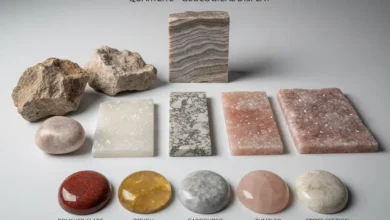

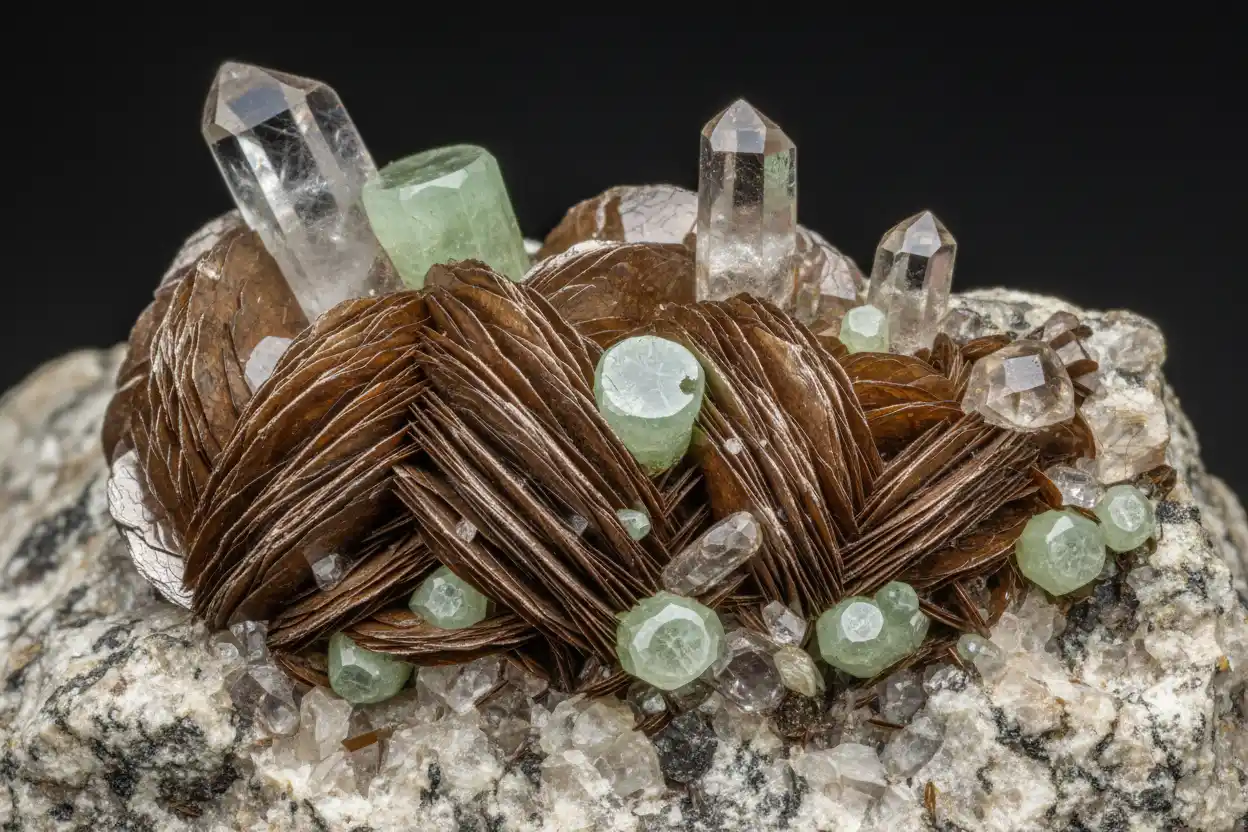

Zinnwaldite is a lithium- and iron-bearing mica name applied to brown, gray, pale violet, greenish or silvery sheet-like crystals found mainly in tin-bearing greisens and evolved granitic pegmatites. Its thin layers split cleanly, bend without breaking immediately and often occur beside topaz, cassiterite, fluorite and quartz.
Modern mica nomenclature treats Zinnwaldite more accurately as a compositional series or field between iron-rich siderophyllite and lithium-rich polylithionite rather than one chemically uniform mineral species. Consequently, an old specimen labeled Zinnwaldite may require chemical analysis before it can receive a more precise modern mineral name.
Zinnwaldite at a Glance
| Property | Zinnwaldite |
|---|---|
| Name status | Historical and compositional mica-series name |
| Mineral group | Trioctahedral mica group |
| Approximate traditional formula | KLiFe²⁺Al(AlSi₃)O₁₀(F,OH)₂ |
| Modern compositional relationship | Intermediate material along the siderophyllite–polylithionite join |
| Typical colors | Gray-brown, yellow-brown, bronze, silvery gray, pale violet, greenish brown and dark green |
| Crystal system | Monoclinic |
| Common habit | Tabular pseudohexagonal books, plates, rosettes, fans, scales and foliated masses |
| Luster | Vitreous to pearly |
| Transparency | Transparent in thin sheets to translucent or opaque in thick books |
| Refractive indices | Variable, commonly approximately 1.54–1.59 |
| Specific gravity | Approximately 2.90–3.02 |
| Mohs hardness | Approximately 2.5–4 |
| Cleavage | Perfect basal cleavage |
| Tenacity | Thin sheets are flexible and commonly elastic |
| Common use | Mineral specimens, geological study and lithium-bearing ore research |
| Main care concern | Thin plates split, scratch and bend easily; matrix may contain additional ore minerals |
What Is Zinnwaldite?
Zinnwaldite belongs to the broader mica group, whose members consist of layered silicate sheets held together by comparatively weak interlayer bonds.
These weak bonds allow mica to split into thin, flat flakes. Each flake can remain flexible because the strong internal silicate sheet stays intact even after separation from the surrounding layers.
Traditional mineral references describe Zinnwaldite with a representative formula containing potassium, lithium, iron, aluminum, silicon, fluorine and hydroxyl.
However, natural specimens vary substantially in lithium, iron, aluminum and fluorine content. Many lie between the idealized compositions of siderophyllite and polylithionite.
Therefore, Zinnwaldite is best understood as a useful historical, geological and collector name for a range of lithium-iron micas rather than as one perfectly fixed chemical substance.
Is Zinnwaldite a Valid Mineral Species?
The answer depends on whether the speaker is using historical or current mineral nomenclature.
Older mineral books and specimen labels commonly treat Zinnwaldite as a separate mineral species. The name remains widely used by collectors, geologists, miners and dealers.
Modern International Mineralogical Association mica nomenclature places Zinnwaldite on or near the continuous compositional join between siderophyllite and polylithionite.
Material once identified visually as Zinnwaldite may therefore prove chemically closer to one recognized end member or another.
This does not make an old labeled specimen fake. Instead, it means the label reflects an earlier or less compositionally precise classification.
A carefully written modern label may read:
Zinnwaldite-series mica, siderophyllite–polylithionite series
When detailed chemical data are available, a precise species name should replace the broad series label.
Zinnwaldite and the Mica Group
Micas have a layered structure often described as tetrahedral–octahedral–tetrahedral sheets.
Silicon and aluminum occupy tetrahedral sites, while iron, lithium, aluminum and other elements occupy octahedral positions.
Potassium commonly sits between the large silicate sheets.
The interlayer potassium bonds are weaker than the bonds inside each sheet. Consequently, a crystal separates readily along its basal plane.
This structure produces the perfect cleavage, flexible flakes and pearly reflections seen in Zinnwaldite.
The parent Mica guide retains group-level structure, industrial uses and classification. This page focuses on the lithium-iron compositional range historically called Zinnwaldite.
Zinnwaldite Colors
Gray-Brown Zinnwaldite
Gray-brown and smoky brown are among the most common colors.
Iron produces much of the darkening compared with pale lithium micas.
Thin flakes may become nearly transparent even when the complete crystal book looks dark.
Yellow-Brown and Bronze Zinnwaldite
Yellow-brown crystals can show warm bronze reflections under strong light.
A pearly surface may create a metallic-looking shimmer even though the mineral is nonmetallic.
Iron oxidation and surface weathering can increase golden or rusty tones.
Silvery Zinnwaldite
Pale material may appear silvery gray, cream or nearly white.
Some specimens sold as silvery Zinnwaldite may prove chemically closer to polylithionite or another pale mica.
Green Zinnwaldite
Greenish brown and dark green material occurs where iron composition, crystal thickness and trace substitutions alter light absorption.
Green color alone cannot distinguish Zinnwaldite from other iron-bearing micas.
Pale Violet Zinnwaldite
Lithium-rich material can develop a subtle violet or lilac tone.
This appearance may overlap Lepidolite, especially where the two occur together or form compositional transitions.
Crystal Habits
Pseudohexagonal Books
Zinnwaldite commonly forms flat books with six-sided outlines.
The apparent hexagon results from crystal-face development and twinning rather than a truly hexagonal crystal system.
A book consists of numerous thin sheets stacked together.
Tabular Crystals
Tabular crystals are broad and flat relative to their thickness.
Their basal surfaces commonly show pearly luster and fine growth lines.
Rosettes and Fans
Several plates can grow outward from one area, producing fan-shaped or rosette-like groups.
These forms are attractive but fragile because the edges are exposed.
Scaly and Foliated Aggregates
Fine flakes may coat quartz, feldspar or ore matrix.
In massive greisen, Zinnwaldite can occur as a dense scaly component rather than isolated crystals.
Disseminated Grains
Ore and granitic rock can contain small Zinnwaldite flakes distributed through the matrix.
Such material may be economically important even when it lacks specimen-quality crystal form.
How Zinnwaldite Forms
Zinnwaldite forms during the late stages of granitic magmatism.
As granite crystallizes, common minerals remove much of the silicon, aluminum, potassium and other major elements from the melt.
Lithium, fluorine, tin, tungsten and several additional elements become concentrated in the remaining fluid-rich portion.
These chemically evolved fluids can alter the surrounding granite and create greisen.
Greisen is typically rich in quartz and mica and may contain cassiterite, wolframite, topaz and fluorite.
Zinnwaldite also crystallizes in granitic pegmatites, particularly in pockets containing rare elements and volatile components.
High-temperature hydrothermal quartz veins provide another environment, though they are less common than classic greisen and pegmatite occurrences.
What Is Greisen?
Greisen is an altered granitic rock produced when hot, chemically active fluids react with granite.
Feldspar breaks down and is replaced by quartz, mica, topaz and other alteration minerals.
Tin and tungsten ore minerals may crystallize during the same process.
Zinnwaldite-rich greisen is especially associated with deposits containing cassiterite and wolframite.
The mica’s presence can therefore help geologists recognize highly evolved, fluorine-rich systems with potential lithium, tin or tungsten mineralization.
However, the presence of one mica flake does not prove that a deposit contains economically recoverable ore.
Cínovec and Zinnwald
Zinnwaldite was named for Zinnwald, an historic mining district in the Ore Mountains on the modern German–Czech border.
The Czech side is known as Cínovec, while the German side includes Zinnwald-Georgenfeld.
The district has a long history of tin and tungsten mining.
Lithium-bearing mica occurs in greisen and altered granite alongside quartz, topaz, cassiterite, wolframite and fluorite.
Because the old mining district crosses a modern national boundary, specimen labels may list Zinnwald, Cínovec, Bohemia, Saxony, Germany or the Czech Republic.
A precise label should retain the historic mine or side of the district whenever that information is known.
Other Important Localities
Brazil
Pegmatites in Minas Gerais have produced large brown Zinnwaldite-series mica books and clusters.
Some commercial specimens contain pale green fluorapatite, black tourmaline or quartz.
Brazilian material can form much larger decorative clusters than the classic small greisen flakes.
Cornwall, England
Cornish tin districts contain Zinnwaldite-series mica in greisen, granite and mineralized veins.
Historic specimens may occur with cassiterite, topaz and wolframite.
Germany and the Czech Republic
Beyond the immediate type district, Erzgebirge deposits such as Altenberg and Sadisdorf contain related lithium-iron mica.
Old mine labels can add substantial collector value.
Norway and Greenland
Alkaline and evolved igneous complexes in Norway and southern Greenland contain lithium-iron micas associated with rare minerals.
Some material formerly called Zinnwaldite may require modern compositional reassessment.
United States
New Hampshire, California, South Dakota, Alaska and Colorado contain reported occurrences.
The Pikes Peak Batholith in Colorado is particularly known for mica books associated with Amazonite, Smoky Quartz and topaz.
Madagascar and Namibia
Evolved pegmatites and granitic systems have produced brown-to-greenish mica books associated with feldspar, quartz and other pegmatite minerals.
Associated Minerals
Zinnwaldite commonly occurs with Quartz, which forms much of the host greisen and pegmatite.
Topaz reflects the fluorine-rich nature of many deposits.
Fluorite supplies another indicator of fluorine-bearing fluids.
Lepidolite may occur in more lithium-rich pegmatite zones.
Muscovite can form pale sheets that resemble low-iron Zinnwaldite.
Cassiterite is the principal tin oxide associated with many classic greisen deposits.
Wolframite represents an important tungsten ore in the same systems.
Beryl and Tourmaline occur in evolved pegmatites.
Fluorapatite can form green, violet or blue tabular crystals on brown mica.
These associated minerals may determine more specimen value than the Zinnwaldite itself.
Zinnwaldite Versus Lepidolite
Zinnwaldite and Lepidolite are both lithium-bearing micas.
Lepidolite is normally paler and frequently pink, lilac or purple because of its chemistry and fine-grained texture.
Zinnwaldite generally contains more iron and appears brown, gray, bronze or greenish.
Nevertheless, color is unreliable. Pale Zinnwaldite and brownish Lepidolite can overlap.
Both show perfect basal cleavage and flexible sheets.
Chemical analysis is needed to determine lithium, iron, aluminum and manganese proportions accurately.
Modern nomenclature also treats Lepidolite as a compositional mica name rather than one simple uniform mineral species, creating an additional reason for careful labeling.
Zinnwaldite Versus Muscovite
Muscovite is commonly colorless, silvery, pale gray, greenish or light brown.
It contains little lithium and less iron than typical Zinnwaldite.
Zinnwaldite is generally denser and darker.
Both split into flexible, elastic sheets and can form pseudohexagonal books.
A specimen from a lithium-rich tin greisen is more likely to contain Zinnwaldite-series mica, but locality alone does not prove composition.
Raman spectroscopy and chemical analysis provide a stronger answer than color.
Zinnwaldite Versus Biotite
Biotite is a broad name for dark iron- and magnesium-rich mica.
It commonly appears black, dark brown or green-black.
Zinnwaldite generally contains more lithium and fluorine and develops in more chemically evolved granitic environments.
Biotite is widespread in ordinary granite, metamorphic rock and many igneous settings.
Zinnwaldite is much more closely linked with rare-element pegmatites, greisen and tin-tungsten mineralization.
A dark mica cannot be assigned to either group from appearance alone.
Zinnwaldite, Siderophyllite and Polylithionite
Siderophyllite is the iron-rich end-member relevant to the Zinnwaldite compositional range.
Polylithionite is a lithium-rich mica containing substantially more lithium and less iron.
Zinnwaldite traditionally describes intermediate compositions between them.
As lithium increases and iron decreases, the mica generally becomes paler and less dense.
As iron increases, brown, green and darker tones become more likely.
Natural substitutions do not always follow one perfectly simple line because aluminum, fluorine, hydroxyl and other elements vary as well.
Therefore, precise species assignment requires a complete structural formula rather than one partial chemical test.
Zinnwaldite as a Lithium-Bearing Ore
Zinnwaldite can contain several percent lithium oxide by weight.
Large deposits of Zinnwaldite-bearing granite or greisen are therefore being evaluated as potential lithium resources.
The mica requires processing because lithium is locked inside its crystal structure.
Mining companies may crush, concentrate, roast and chemically leach the mica to recover lithium compounds.
A collector specimen has no practical lithium-extraction value by itself.
Likewise, a lithium-bearing label does not mean the intact mica releases useful lithium into water or provides a nutritional source.
Zinnwaldite should never be ingested or used to prepare drinking water.
Inclusions and Intergrowths
Zinnwaldite plates may contain quartz, feldspar, apatite, iron oxides and other microscopic inclusions.
Several mica compositions can grow together in one crystal book.
A pale rim may differ chemically from a darker core.
Weathering can alter edges into clay-like material.
Iron oxidation creates rusty stains and dark surface films.
Fine quartz or feldspar crystals may become trapped between sheets.
These intergrowths complicate laboratory analysis because a bulk chemical test can average several phases instead of measuring one pure mica layer.
How to Identify Zinnwaldite
The first clues are perfect basal cleavage, flexible elastic flakes and pseudohexagonal mica habit.
However, these properties identify mica rather than Zinnwaldite specifically.
Density and optical data may narrow the range but overlap other trioctahedral micas.
Pleochroism can make one thin flake appear pale yellow-brown in one direction and darker brown or green in another.
Raman spectroscopy identifies structural features, though closely related micas can produce similar spectra.
X-ray diffraction determines mica polytype and sheet structure.
Electron-microprobe analysis measures iron, aluminum, silicon, potassium and fluorine.
Lithium requires specialized analysis because ordinary electron microprobes cannot measure it accurately.
A complete mica formula provides the strongest basis for deciding whether a specimen lies near siderophyllite, polylithionite or the traditional Zinnwaldite field.
The broader sequence appears in How to Identify Crystals.
Treatments, Repairs and Mislabeling
Zinnwaldite is not normally heated, irradiated or dyed for commercial enhancement.
Most market concerns involve misidentification, coating and specimen repair.
Brown muscovite, biotite, siderophyllite, polylithionite and other mica can be sold under the more familiar Zinnwaldite name.
Mineral clusters may be repaired when mica books detach from their matrix.
Clear adhesive can stabilize quartz, apatite or topaz crystals attached to fragile mica.
Oil and wax may deepen color and make sheets look more lustrous temporarily.
Artificially assembled specimens can combine unrelated crystals on mica-rich matrix.
The seller should disclose repairs under the principles in Gemstone Treatments Explained.
Laboratory-grown mica exists for industrial and research applications, but synthetic Zinnwaldite jewelry has no meaningful commercial market. The broader distinction appears in Lab-Grown vs Natural Gemstones.
Can Zinnwaldite Be Cut or Polished?
Thin sheet structure makes Zinnwaldite unsuitable for conventional faceting.
A faceting wheel would separate the layers and damage the edges.
Compact mica-rich rock can be shaped into slabs or decorative pieces, but polishing may expose flakes that peel away.
Resin stabilization can hold weak layers together.
Individual mica books are more valuable as mineral specimens than as lapidary rough.
Some artists incorporate natural mica into pendants or resin objects, although the mica should be enclosed rather than exposed to friction.
A seller offering a transparent faceted Zinnwaldite should provide laboratory confirmation because such use is highly unusual.
Hardness, Cleavage and Durability
Zinnwaldite commonly measures approximately 2.5–4 on the gemstone hardness chart.
Its broad range reflects variable composition and testing direction.
The basal surface may respond differently from an edge crossing several layers.
Perfect cleavage allows the mineral to separate into thin sheets with little force.
The sheets may bend and spring back, but repeated flexing can create permanent creases or broken edges.
The difference between scratching and breaking appears in Gemstone Toughness vs Hardness.
The layered structural weakness is explained further in Gemstone Cleavage Explained.
Zinnwaldite is not suitable for exposed rings, bracelets or frequently handled jewelry.
Zinnwaldite Prices in 2026
Zinnwaldite has a small specimen market rather than a standardized gemstone market.
Small mica books and modest matrix specimens commonly retail for approximately $20–$60.
Current Brazilian specimens with tabular crystals appear around $34–$40.
Larger clusters and specimens with fluorapatite commonly range from approximately $75–$150.
Better decorative Brazilian clusters with numerous apatite crystals currently appear around $175–$240.
Classic Zinnwald or Cínovec specimens with old labels, sharp mica books, cassiterite, quartz or topaz may range from $150–$750.
Exceptional historic ore specimens, unusually large crystals or pieces from important collections can exceed $750–$1,500.
Most pieces should be priced by specimen quality rather than by gram or carat.
A common brown mica cluster does not become highly valuable simply because a seller calls it a lithium crystal.
What Determines Value?
Modern identification or credible historical labeling creates the foundation for value.
Crystal size matters, particularly when the mica forms an intact pseudohexagonal book.
Luster should remain bright and pearly rather than dull or heavily weathered.
Complete edges are desirable because thin mica plates chip easily.
Association can add major value. Fluorapatite, topaz, cassiterite, quartz and fluorite create more attractive compositions.
Type-locality provenance and old collection labels appeal to historical-mineral collectors.
Large Brazilian clusters receive decorative value from size and color contrast.
Repairs, detached sheets, unstable matrix and unsupported species claims reduce confidence.
Buying Guidance
Ask whether Zinnwaldite is being used as a historical series name or confirmed modern species assignment.
Request the exact locality and original labels.
Inspect the mica edges for broken, bent or repaired plates.
Look for adhesive around attached topaz, apatite or quartz crystals.
Ask whether the specimen has been chemically analyzed.
Do not assume every brown lithium mica is Zinnwaldite.
A specimen from Cínovec or Zinnwald has strong historical context but can still contain several mica compositions.
Avoid products marketed for ingestion, lithium supplementation or crystal-infused water.
For expensive pieces, compare crystal form, locality, association and provenance rather than seller claims about spiritual strength.
Cleaning, Water and Storage
Clean Zinnwaldite with a hand air bulb or an extremely soft dry brush.
Do not press across the mica sheets.
Avoid compressed air because a strong stream can lift flakes or spread matrix dust.
Do not soak the specimen. Water can enter between sheets, affect clay-rich weathering products and weaken matrix repairs.
The general guidance in Which Crystals Can and Cannot Go in Water should be applied conservatively.
Avoid ultrasonic and steam cleaning.
Store the specimen horizontally in a padded box so another object cannot press against the plate edges.
Natural brown and gray color is generally stable under ordinary indoor light, but adhesives and associated minerals may not be. The broader display guidance appears in Crystals That Fade in Sunlight.
Ore-zone matrix can contain additional minerals requiring greater caution. The Toxic Crystals Safety List provides broader handling context for mixed specimens.
Meaning and Symbolism
Zinnwaldite has limited ancient gemstone lore because it was primarily known within mining, mineralogical and geological contexts.
Modern crystal traditions associate its layered structure with examining a problem one level at a time.
Its intermediate chemistry encourages symbolism involving balance between two extremes rather than fixed identity.
The mineral’s connection with lithium, tin and tungsten deposits can represent hidden resources becoming visible only through detailed investigation.
Flexible sheets are sometimes interpreted as reminders that adaptability does not require losing one’s underlying structure.
These meanings are cultural, spiritual or personal rather than scientifically demonstrated effects.
Frequently Asked Questions
1. Is Zinnwaldite a real mineral?
The name refers to real lithium-iron mica material. Modern nomenclature treats it mainly as a compositional series between siderophyllite and polylithionite rather than one uniform species.
2. Why is Zinnwaldite no longer treated as one simple species?
Natural specimens vary continuously in lithium, iron, aluminum, fluorine and hydroxyl content, making a series classification more accurate.
3. What is Zinnwaldite made of?
It is a potassium-bearing lithium-iron-aluminum mica. A commonly used approximate formula is KLiFe²⁺Al(AlSi₃)O₁₀(F,OH)₂.
4. Is Zinnwaldite a type of mica?
Yes. It belongs to the trioctahedral mica group and splits into flexible sheets.
5. Is Zinnwaldite the same as Lepidolite?
No. Both are lithium-bearing micas, but Zinnwaldite generally contains more iron and is usually brown or gray rather than lilac.
6. Where was Zinnwaldite discovered?
It was named for the historic Zinnwald–Cínovec mining district on the German–Czech border.
7. Does Zinnwaldite contain lithium?
Yes. Natural Zinnwaldite-series mica can contain several percent lithium oxide and is being evaluated as a lithium ore in some deposits.
8. Can lithium be obtained by soaking Zinnwaldite in water?
No. Lithium is locked within the mica structure, and soaking a mineral specimen is neither an effective nor safe nutritional method.
9. Is Zinnwaldite suitable for jewelry?
It is unsuitable for exposed jewelry because it is soft and separates easily along perfect basal cleavage.
10. Can Zinnwaldite go in water?
Soaking is not recommended. Water can enter between sheets, damage repairs and interact with unknown associated ore minerals.
11. How much is Zinnwaldite worth?
Small specimens commonly cost $20–$60, while large associated clusters and classic locality pieces may range from $100 to several hundred dollars.
12. Does Zinnwaldite have scientifically proven healing properties?
No. Its symbolism may hold personal meaning, but scientific evidence does not establish healing effects.
Zinnwaldite is most accurately appreciated as a bridge between historic mining terminology and modern compositional mineralogy. Its brown mica books record late-stage granite fluids rich in lithium and fluorine, while careful chemical work may reveal that each specimen occupies a different position between recognized mica end members.
Zinnwaldite appears in Crystals That Start With Z.
Safety disclaimer: Intact Zinnwaldite can be kept as an ordinary mineral specimen, but cutting, grinding or crushing mica and its host rock can create respirable silicate dust. Ore-zone matrix may contain additional metallic or hazardous minerals. Never ingest the material or use it in drinking water, and use wet methods, ventilation, eye protection and appropriate respiratory protection for professional cutting.