Where to Buy Real Calcite and Avoid Dyed or Misidentified Stones
Calcite is one of the most abundant and varied minerals in the collector and crystal markets. It appears as transparent optical crystals, sharp rhombohedra, dogtooth scalenohedra, cave formations, fluorescent specimens, massive colored material, spheres, towers, carvings, cabochons and beads.
That diversity makes shopping more complicated than choosing a color. Natural calcite may be white, colorless, blue, green, yellow, orange, red, pink, brown, gray or nearly black. It can also occur with aragonite, dolomite, quartz, sulfides and many other minerals.
Most buying problems involve incorrect variety names, dyed pale calcite, resin-filled carvings, repaired crystal specimens, mixed carbonate rock, glass, gypsum, fluorite, celestite or aragonite—not a purpose-grown synthetic calcite created to deceive ordinary crystal buyers.
The calcite meaning and properties guide covers the mineral’s identity and traditional symbolism. This page focuses on sellers, product forms, identification limits, treatments, quality, care and choosing the correct calcite variety.
Understand Calcite Before Comparing Listings
Calcite is calcium carbonate, CaCO3, and crystallizes in the trigonal system. It has Mohs hardness 3, perfect rhombohedral cleavage and a strong reaction to weak acids.
Those properties explain many of its buying and care risks. Calcite scratches easily, splits along cleavage planes and can be etched by acidic cleaners, vinegar, lemon juice and some perspiration or cosmetic residues.
The types of calcite guide separates major colors, crystal habits and commercial varieties. The calcite color guide keeps color symbolism distinct from the practical question of whether a stone is naturally colored or treated.
A seller who recommends an acid test on a finished piece does not understand responsible gem handling. Even when the reaction supports a carbonate identification, the test permanently damages the surface.
Choose the Calcite Product You Actually Need
| Product form | Best buying source | Main issue |
|---|---|---|
| Fine crystal specimen | Specialist mineral dealer | Repairs, locality, cleaning damage and unstable matrix |
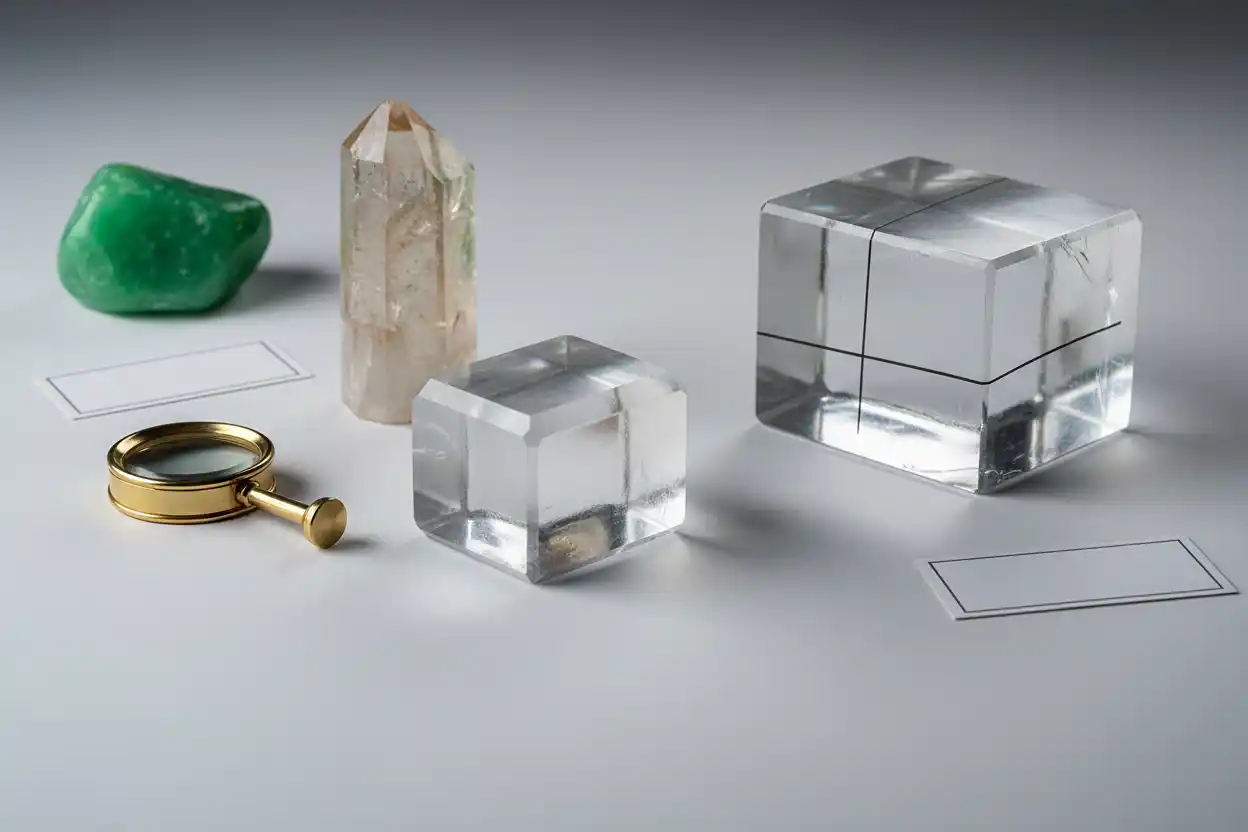
| Optical calcite or Iceland spar | Mineral or educational supplier | Clarity, cleavage damage and mislabeling |
| Rough or lapidary block | Lapidary supplier | Hidden cleavage, dye and low cutting yield |
| Sphere or tower | Experienced carving retailer | Filled fractures, mixed minerals and repaired tips |
| Carving | Skilled stone seller | Soft details, coating and structural cracks |
| Cabochon | Lapidary or gem dealer | Backing, filler and low durability |
| Beads | Established bead supplier | Dye, drill-hole fractures and mixed materials |
| Jewelry | Jeweler familiar with soft carbonates | Exposed settings, adhesive and unrealistic wear advice |
| Fluorescent specimen | Mineral dealer with UV information | Incorrect wavelength claims and coating |
| Cave or locality specimen | Specialist dealer | Legal collection, provenance and fragile formations |
Collector specimens require condition and locality documentation. Decorative objects require treatment disclosure and realistic handling advice.
Where to Buy Genuine Calcite
Specialist mineral dealers
A mineral dealer is the best source for well-formed crystals, unusual habits, fluorescent calcite and locality specimens.
The listing should state dimensions, weight, locality, matrix minerals, crystal damage and repairs. Strong photographs show the back, base, terminations and matrix contacts.
Ask whether the specimen was acid-cleaned, stabilized or repaired. Chemical cleaning can remove matrix or staining while also etching calcite faces and altering luster.
Mineral and gem shows
Shows let you compare rhombohedral, scalenohedral, prismatic, massive and fibrous calcite in person. Under a loupe, inspect cleavage, bruised edges, repaired terminations and glossy filler.
Move transparent crystals over printed text. Strong double refraction can be visible in clear material, although that observation is not a complete identification test.
Do not use vinegar, acid or a scratch tool. The crystal identification guide explains how to begin with habit, luster, cleavage and associations.
Lapidary suppliers
Lapidary sellers are appropriate for rough blocks, slabs and decorative material. Ask whether the piece is pure calcite, calcite-rich marble, mixed calcite-aragonite or another carbonate rock.
Request dry photographs. Water and oil deepen color, temporarily hide scratches and can make fractured rough look more coherent than it is.
A reliable seller should also explain whether sample spheres or cabochons have been cut from the same batch.
Established online shops
Online sellers should provide exact-item photographs for crystals, spheres and carvings. Color-specific batch listings should show the full range buyers may receive.
The online gemstone buying guide explains seller verification, protected payment and return terms.
For calcite, request neutral-light photographs because pale material is easily shifted toward blue, green or yellow through white-balance editing.
Educational and optical suppliers
Clear calcite sold for demonstrations should include usable dimensions, clarity information and condition. Optical pieces may display cleavage chips yet remain functional.
The Iceland spar guide covers transparent optical calcite and its double-refraction association.
Avoid paying a collector premium for a simple cleaved teaching rhomb unless the clarity, size or locality justifies it.
What Natural Calcite Looks Like
Calcite has hundreds of described crystal forms and combinations. Common retail habits include rhombohedra, scalenohedra or “dogtooth” crystals, prismatic crystals, tabular crystals, fibrous masses, stalactites, botryoidal forms and massive material.
Luster can range from vitreous to pearly or dull, depending on surface and aggregate structure. Transparent specimens may show strong birefringence, while massive colored calcite is usually translucent to opaque.
Cleavage is one of the most important visual clues. Broken calcite often reveals flat rhombohedral surfaces rather than the curved conchoidal fracture typical of glass.
Natural color distribution can be even, zoned, cloudy or inclusion-related. White veins, brown iron staining, black matrix and colorless cleavage surfaces may occur.
A carved “crystal point” is not proof that calcite grew in that shape. Many towers and points are cut from massive material and should be described as carved.
Buying Colorless and White Calcite
Colorless calcite ranges from transparent optical material to cloudy cleavage pieces. White calcite includes massive, crystalline and fibrous forms.
The white calcite guide covers that color variety. When buying transparent material, evaluate clarity, cleavage damage and internal strain rather than judging only size.
Milky carved objects may contain marble or another calcite-rich rock. That material can be natural, but the seller should distinguish rock from a single calcite crystal.
Buying Blue Calcite
Blue calcite commonly appears pale sky blue, gray-blue or turquoise-leaning, often with white zones and visible cleavage.
The completed guide to buying real blue calcite addresses dyed material, angelite, celestite and the trade product often called Caribbean blue calcite.
This general page should not replace color-specific treatment checks. When the purchase depends on natural blue color, use the dedicated guide.
Buying Green Calcite
Green calcite can range from pale mint to stronger yellow-green.
The planned guide to buying green calcite will cover dye, fluorite, serpentine and green-glass lookalikes.
Within a general calcite parcel, confirm that green color belongs to the stone rather than a coating concentrated around fractures.
Buying Honey and Yellow Calcite
Honey calcite is a commercial color term generally applied to warm honey-yellow, amber or golden-brown calcite.
The planned guide to buying honey calcite owns the boundary between honey, yellow and orange trade labels.
Yellow calcite may overlap in color, and seller terminology is not perfectly standardized. Buy according to actual appearance and treatment rather than assuming that “honey” indicates a separate mineral species.
Buying Orange, Red and Pink Calcite
Orange calcite is common in carvings, spheres and rough. The planned guide to buying orange calcite will focus on dye, aragonite mixtures and orange carbonate products.
Red calcite is less common in ordinary retail material and may be confused with iron-stained calcite, dyed stone or other carbonates.
Mangano calcite is associated with manganese-bearing pink calcite. The planned guide to buying mangano calcite will address pink color, fluorescence and confusion with cobalt-bearing material.
Cobaltocalcite can display strong pink to purplish-red color. Sellers should not use mangano calcite and cobaltocalcite interchangeably merely because both are pink.
Zebra and Mixed Calcite Products
Zebra calcite is a trade-name decorative material with contrasting bands or zones. It may include calcite with aragonite or other carbonate components.
Likewise, many “onyx marble” objects are banded calcite or aragonite rather than true chalcedony onyx. The naming can be traditional within the decorative-stone trade, but a mineral retailer should clarify the composition.
Mixed-material objects require care based on the most vulnerable component and any resin used during cutting.
Calcite Versus Aragonite
Aragonite has the same chemical formula as calcite but a different crystal structure. It often forms prismatic, radiating, fibrous or twinned crystals.
The completed guide to buying genuine aragonite addresses reconstructed clusters, dye and calcite substitution.
Well-formed crystals can be distinguishable by habit, but massive or polished material may require Raman spectroscopy or X-ray diffraction. Acid testing cannot separate them reliably because both are calcium carbonates and both can be damaged.
Calcite Versus Dolomite
Dolomite is a calcium-magnesium carbonate. It can resemble calcite in crystals, marble and pale decorative material.
Dolomite is generally harder and reacts less vigorously with cold dilute acid unless powdered, but those are laboratory or field-geology distinctions—not instructions for testing finished merchandise.
Raman spectroscopy, X-ray diffraction and careful mineralogical observation provide safer answers.
Calcite Versus Gypsum and Selenite
Gypsum is much softer than calcite and can form clear, white, fibrous or massive material. Selenite and satin spar are gypsum varieties or forms commonly confused with pale calcite products.
Calcite usually shows rhombohedral cleavage, while gypsum has different cleavage and crystal habits. Still, a carved white tower can be difficult to identify from a photograph.
Do not rely on scratching with a fingernail or knife after purchase. The result damages the object and may test a coating or filler rather than the interior.
Calcite Versus Fluorite
Fluorite can occur in purple, green, blue, yellow, colorless and other shades, overlapping calcite’s color range.
Fluorite has Mohs hardness 4 and perfect octahedral cleavage, whereas calcite has hardness 3 and rhombohedral cleavage. Crystal shape and fracture fragments can help experienced observers.
Polished spheres and carvings may require refractive-index, density or spectroscopy testing.
Calcite Versus Celestite and Angelite
Celestite is strontium sulfate and often forms pale blue crystals. Angelite is a trade name for blue anhydrite.
Both can resemble blue calcite in carvings or damaged specimens. Density, crystal habit and instrumental testing provide better separation than color.
These distinctions matter because care, value and locality expectations differ.
Calcite Versus Quartz and Glass
Quartz is much harder and lacks calcite’s rhombohedral cleavage and acid sensitivity. Glass is amorphous and commonly displays conchoidal fracture, bubbles or flow lines.
Transparent calcite may show strong double refraction, unlike ordinary glass. However, a home observation should support—not replace—professional testing for an expensive specimen.
The fake-crystal buyer’s guide explains how glass, resin and coatings can enter many mineral markets.
Common Fake, Treated and Misrepresented Calcite
Dyed calcite
Pale or colorless calcite can be dyed blue, orange, pink, green or other colors. Dye often collects in cleavage cracks, fractures, pores and drill holes.
A dyed stone remains calcite, but it should not receive a natural-color premium.
Resin-filled carvings
Large decorative calcite objects frequently contain cleavage fractures. Clear or color-matched resin can stabilize those cracks and improve polish.
Filling is not automatically unacceptable, but it affects value, cleaning and repair.
Coated material
Surface coating can intensify color, produce iridescence or disguise a chalky polish. Wear around edges may reveal the underlying stone.
Reconstituted calcite
Calcite powder and fragments can be mixed with resin and molded. Bubbles, resin seams and repeated patterns support composite construction.
Glass or resin casts
Transparent rhombs, carved animals and spheres can be copied in glass or polymer. Mold seams, bubbles and an absence of cleavage may provide clues.
Misidentified marble
Marble is a metamorphic rock composed largely of calcite or dolomite. A marble carving contains natural carbonate material, but it is not one single calcite crystal.
The gemstone treatments guide explains the disclosure differences among dye, filling, coating and composite manufacture.
How to Evaluate Crystal Specimens
Crystal form
Look for recognizable rhombohedral, scalenohedral, prismatic or tabular geometry. Natural crystals often show growth steps, contacts and minor irregularities.
Luster
Fresh faces can be highly vitreous. Dullness may reflect weathering, chemical etching or abrasive cleaning.
Condition
Minor contact points are normal. Large fresh cleavage breaks, reattached terminations and crushed edges should influence price.
Repairs
Inspect for glossy adhesive, mismatched fracture lines and filler beneath crystals. A restored specimen can remain collectible when disclosure is complete.
Matrix stability
Calcite may sit on fragile sulfide, clay, limestone or other matrix. Ask whether loose crystals or friable areas require special shipping.
Locality
A precise label can add scientific and collector value. Appearance alone rarely proves a famous mine.
Evaluating Optical Calcite
Transparent optical material should be judged for clarity, double refraction, cleavage damage, size and internal strain.
A teaching specimen may be a simple cleaved rhomb rather than a naturally bounded crystal. That is acceptable when described accurately.
Large flawless transparent pieces are less common than cloudy cleavage fragments. Scratches and corner chips are easy to create because calcite is soft.
Avoid sellers who polish or coat a damaged piece and represent it as an untouched natural crystal.
Evaluating Rough and Slabs
Request dry photographs of every side and any sawn face. Wet surfaces conceal scratches and improve apparent saturation.
Look for cleavage planes that cross the intended cutting area. A heavy block can split unexpectedly and produce little usable material.
Ask whether the rough is pure calcite or mixed carbonate rock. Mixed material may polish unevenly and require stabilization.
Evaluating Spheres, Towers and Carvings
A sphere should be shown through a full rotation. Check for flat spots, large filled fractures and color concentrated around cracks.
Towers need stable bases and sound tips. Because calcite cleaves easily, a sharp point can break during shipping or a minor impact.
Carvings should use rounded designs rather than thin unsupported projections. Fine details abrade quickly in a Mohs 3 material.
A high-gloss coating should not substitute for competent polish without disclosure.
Buying Beads and Jewelry
Drill holes are common failure points. Inspect for chips, radial fractures and concentrated dye.
Calcite beads can scratch against harder stone or metal spacers. Knotting or softer separators reduce repeated impacts.
Pendants and earrings are more practical than rings or bracelets. A protective bezel supports cabochon edges, but household chemicals and impacts remain concerns.
The gemstone hardness chart explains calcite’s low scratch resistance. The gemstone toughness-versus-hardness guide explains why perfect cleavage creates a second durability limitation.
Price and Value
Common massive calcite is affordable. Collector pricing rises with crystal perfection, transparency, color, unusual habit, fluorescence, locality, size and aesthetics.
A small undamaged crystal from a documented classic locality can be worth more than a large common carving.
For decorative objects, price reflects usable rough, cutting labor, polish, size and breakage risk. Resin filling and repair should be factored into the comparison.
Color-specific rarity should be supported by mineral identity and treatment disclosure. Labels such as “AAA calcite” provide little useful information.
The gemstone pricing guide explains how rarity, condition, workmanship and documentation interact.
Questions to Ask the Seller
Ask whether the object is a single calcite mineral specimen, massive calcite, calcite-rich rock or mixed carbonate material.
Request locality and the basis for that claim. Confirm whether the item has been dyed, acid-cleaned, coated, waxed, oiled, filled, stabilized, repaired or assembled.
For crystals, request views of every termination and the base. For carvings, ask about filled fractures. For beads, request drill-hole close-ups.
Determine whether photographs show the exact item under neutral light. Finally, obtain a return policy that does not require destructive testing.
Professional Identification
Raman spectroscopy and X-ray diffraction can confirm calcite and separate it from aragonite, dolomite, gypsum, celestite and other lookalikes.
A gemologist may also use refractive properties, birefringence, specific gravity and microscopy. Ultraviolet fluorescence can provide supporting information for some specimens, but response varies and is not definitive by itself.
Professional testing is most useful for expensive locality specimens, transparent optical pieces, unusual colors, disputed treatments and mixed polished material.
Ethical Sourcing and Legal Collection
Calcite is widespread, but individual caves, protected formations and heritage localities can be legally sensitive. Avoid specimens claimed to have been removed recently from protected caves, parks or archaeological sites.
The ethical crystal sourcing guide provides questions about legal collection, labor and traceability.
For common carvings, country-level origin may be the realistic limit. For high-value locality specimens, original labels and collection history matter more.
Cleaning and Storage
Do not use vinegar, lemon juice, acidic bathroom cleaner, descaler or abrasive powder. These substances can etch calcite rapidly.
Begin specimen cleaning with a hand air blower or very soft dry brush. A sound untreated polished piece can be wiped with a barely damp soft cloth and dried promptly.
The calcite cleansing guide provides non-destructive options for traditional practices.
Avoid steam and ultrasonic cleaning when a stone is fractured, cleaved, filled, repaired or glued. Store calcite separately from harder minerals and support specimens from the base.
Frequently Asked Questions
1. Is calcite commonly faked?
Common calcite is inexpensive, so sophisticated synthetic substitutes are uncommon. Dye, resin, glass, misidentification and repaired specimens are more realistic problems.
2. What is the easiest property to recognize in calcite?
Its low hardness, rhombohedral cleavage and strong birefringence in clear material are useful clues, but no finished piece should be damaged to test them.
3. Can calcite be dyed?
Yes. Pale calcite can be dyed many colors, with color often concentrating in fractures, cleavage and drill holes.
4. Should I test calcite with vinegar?
No. Vinegar etches calcite and permanently damages the surface. Use nondestructive observations or professional testing.
5. Is Iceland spar a separate mineral?
No. Iceland spar is a transparent optical variety of calcite known for strong double refraction.
6. How is calcite different from aragonite?
They share the formula CaCO3 but have different crystal structures. Massive or polished pieces may require Raman spectroscopy or X-ray diffraction.
7. Is Caribbean blue calcite pure calcite?
Not always. The trade material can include blue calcite with white or brown carbonate zones, sometimes described as aragonite.
8. Can calcite carvings contain resin?
Yes. Clear or color-matched resin may stabilize cleavage fractures and fill cavities. The treatment should be disclosed.
9. Is calcite suitable for everyday rings?
Generally, no. Its low hardness, cleavage and acid sensitivity make exposed daily rings impractical.
10. Does fluorescence prove that a specimen is calcite?
No. Calcite can fluoresce in many colors, but response varies, and other minerals also fluoresce.
11. Do ordinary calcite pieces need certificates?
Usually not. Detailed seller disclosure and return rights are sufficient for common material. Testing is more useful for costly or disputed pieces.
12. What is the biggest warning sign in a calcite listing?
Be cautious when a seller recommends acid testing, calls a carved point a natural termination and refuses to discuss dye, filler or repairs.
Buy According to Form, Not Color Alone
Calcite’s abundance does not make every purchase simple. A transparent optical rhomb, a dogtooth specimen, a pink manganese-bearing crystal and a resin-stabilized orange carving belong to very different markets.
The C crystal directory, C gemstone directory and visual gemstone guide provide broader context. Choose a seller who can identify the specific calcite form, disclose every treatment and explain why the piece is priced as it is.