

Crystals for emotional healing are traditionally used as tangible reminders of self-compassion, reflection, acceptance and gradual change. They cannot process an emotion on someone’s behalf, erase painful experiences or replace professional care, but they may give a personal ritual a clear physical focus.
The best choice depends on the kind of emotional support a person wants to cultivate. Rose quartz emphasizes gentleness, rhodonite is commonly linked with repair and accountability, blue lace agate supports calm expression, and lepidolite represents steadiness during periods of transition.
Best Crystals for Emotional Healing at a Glance
| Crystal | Traditional emotional theme | May suit someone working on | Suggested reflective practice |
|---|---|---|---|
| Rose quartz | Compassion and emotional softness | Harsh self-judgment or difficulty receiving care | Pair with a self-compassion journal prompt |
| Rhodonite | Repair, responsibility and forgiveness | Responding constructively after conflict | Hold while identifying what can be repaired |
| Rhodochrosite | Emotional honesty and tenderness | Reconnecting with personal needs | Use during private reflection |
| Chrysoprase | Hope, renewal and openness | Moving beyond an old emotional pattern | Carry while beginning a new routine |
| Blue lace agate | Calm communication | Expressing feelings without escalation | Keep nearby while preparing a conversation |
| Lepidolite | Transition and emotional steadiness | Adapting to uncertainty or change | Use during a quiet evening routine |
| Moonstone | Cycles, intuition and acceptance | Recognizing changing emotional needs | Pair with regular mood journaling |
| Unakite | Integration and gradual release | Holding mixed or conflicting feelings | Reflect on what can be kept and released |
| Malachite | Transformation and honest self-examination | Recognizing repetitive patterns | Use for focused journaling rather than constant wear |
| Clear quartz | Intention and clarity | Defining a specific emotional goal | Assign it one concise intention |
What Emotional Healing Means in a Crystal Practice
Emotional healing is not a single event or an expectation that difficult feelings should disappear quickly. In a grounded crystal practice, it can mean noticing emotions without immediate judgment, developing more supportive responses and deciding which actions are within personal control.
A stone may contribute by becoming a consistent sensory cue. Seeing rose quartz on a bedside table might prompt a kinder internal response, while holding blue lace agate before a conversation may remind someone to speak slowly and clearly.
The crystal does not create the emotional skill. Instead, the person develops the skill through repetition, reflection, communication and, when needed, appropriate professional support.
Rose Quartz for Self-Compassion
Rose quartz is the most widely recognized crystal for emotional gentleness. Its pale pink color and longstanding association with love have made it a popular symbol of affection, comfort and self-acceptance.
However, using rose quartz for emotional healing should involve more than repeating a positive phrase that feels disconnected from reality. A practical approach is to pair the stone with a specific question:
- What would a fair and compassionate response to this situation sound like?
- Am I holding myself to a standard I would never impose on someone else?
- What form of support would be useful today?
Rose quartz can also complement confidence work, although its role differs from the action-oriented stones discussed in the guide to crystals for confidence. Here, its purpose is emotional softness rather than performance or visibility.
Rhodonite for Repair and Constructive Accountability
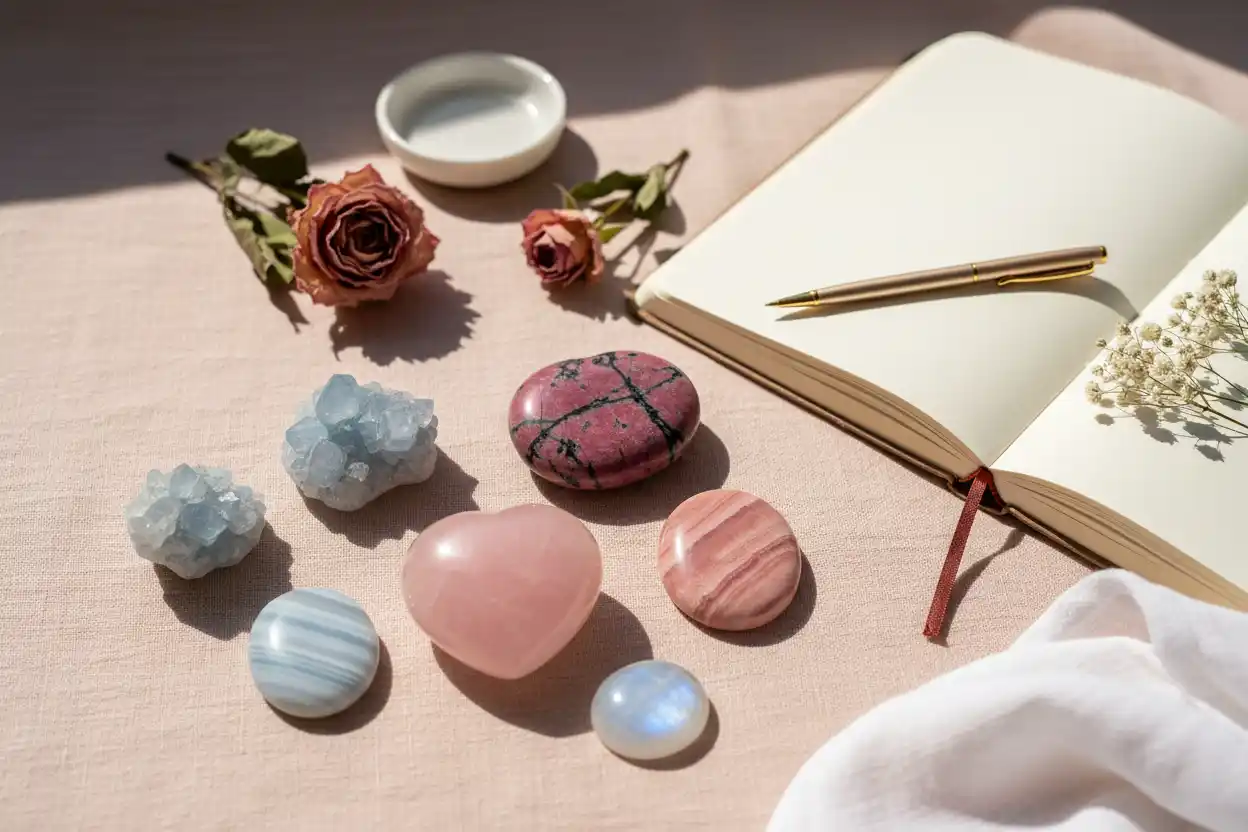
Rhodonite is traditionally linked with emotional balance, forgiveness and relationship repair. Its pink base with dark veining visually reflects the idea that tenderness and difficult experience can exist together.
For emotional healing, rhodonite is particularly appropriate after conflict. It can represent the distinction between taking responsibility and accepting blame for everything. A useful practice involves identifying what happened, which part belongs to you, what can be repaired and which outcome cannot be controlled.
Rhodonite should not be used to pressure someone into reconciliation with a person who remains unsafe or harmful. Forgiveness, contact, trust and reconciliation are separate decisions.
Rhodochrosite for Emotional Honesty
Rhodochrosite is associated in modern crystal traditions with tenderness, emotional awareness and the needs of the inner self. Its pink-to-red banding gives it a warmer, more expressive character than pale rose quartz.
This stone may suit someone who understands a situation intellectually but has not acknowledged how it feels. During journaling, rhodochrosite can act as a prompt to describe the emotion precisely rather than reducing everything to “fine,” “bad” or “stressed.”
Emotional honesty does not require immediate disclosure to another person. Private recognition may be the safest and most constructive first step.
Chrysoprase for Hope and Renewal
Chrysoprase is traditionally associated with optimism, renewal and openness. Therefore, it fits the stage of emotional healing in which a person begins making room for a new experience rather than repeatedly reviewing the old one.
Its bright green color can symbolize movement, possibility and a return to ordinary life. Someone might carry chrysoprase while starting a new class, returning to a neglected hobby or establishing a routine that is not organized around a past disappointment.
Hope should not be confused with forced positivity. A chrysoprase practice can acknowledge uncertainty while still permitting a constructive next step.
Blue Lace Agate for Calm Emotional Expression
Blue lace agate is commonly associated with measured speech, calmness and gentle communication. It can be useful when emotions are valid but difficult to express without shutting down, becoming defensive or speaking impulsively.
Before a conversation, write the central message in one sentence. Then identify the observable event, the emotional response and the specific request. The crystal can remain nearby as a cue to return to that message when the discussion becomes complicated.
For situations dominated by acute worry or persistent tension, the dedicated guide to crystals for anxiety keeps that narrower intent separate from broader emotional processing.
Lepidolite for Emotional Transitions
Lepidolite contains lithium as part of its mineral composition, but wearing or holding the stone does not deliver a therapeutic lithium dose. Its emotional reputation comes from spiritual symbolism and its soft lilac appearance, not a medicinal mechanism.
Within personal practice, lepidolite is often chosen during transitions such as moving, changing work, ending a routine or adapting to an unfamiliar stage of life. Its symbolism centers on steadiness while circumstances remain unsettled.
Pair it with a brief evening check-in: identify one change that cannot be controlled, one response that can be controlled and one task that can wait until tomorrow.
Moonstone for Emotional Cycles
Moonstone is traditionally connected with cycles, intuition and changing internal states. It may appeal to people who expect themselves to feel consistent even when sleep, relationships, workload and ordinary life circumstances naturally affect emotion.
A moonstone practice can involve tracking patterns without turning every fluctuation into a problem. Note the situation, emotion, physical sensations and immediate need. Over time, those observations may reveal practical triggers or recurring circumstances that deserve attention.
Moonstone is not a diagnostic tool. Persistent or severe mood changes should be discussed with an appropriate health professional.
Unakite for Integrating Mixed Feelings
Unakite combines green epidote, pink feldspar and quartz. Its mixed colors make it a fitting symbol for emotional experiences that do not resolve into one simple feeling.
A person can be relieved and disappointed, grateful and tired, or hopeful and afraid at the same time. Unakite supports a reflective practice that allows those emotions to coexist without demanding an immediate verdict.
Try dividing a journal page into three parts: what I want to preserve, what I am ready to release and what I have not decided yet. This approach makes room for uncertainty instead of forcing premature closure.
Malachite for Recognizing Repeating Patterns
Malachite is often given intense transformational symbolism. Its bold banding can make it an effective focal stone for honest reflection, particularly when the same emotional situation seems to repeat.
Use malachite with one defined question rather than treating it as a constant emotional amplifier. For example: What boundary did I overlook? What need did I avoid communicating? Which warning sign did I reinterpret because I preferred a different outcome?
Malachite contains copper and should never be ingested, placed in drinking water or used to prepare a crystal elixir. Broken, powdered or poorly polished pieces require especially cautious handling.
Clear Quartz for a Defined Emotional Intention
Clear quartz is traditionally described as an amplifier. In practical terms, its transparent appearance makes it a neutral object onto which a person can assign a specific purpose.
Avoid giving clear quartz a broad instruction such as “heal everything.” A narrower intention is easier to translate into action: pause before responding, ask for help directly, record one emotion each evening or practice a kinder internal statement.
If the purpose changes, write down the new intention. Clarity comes from the wording and behavior surrounding the stone, not from assuming the crystal automatically understands an unspoken need.
Emotional Healing Versus Anxiety, Anger and Breakup Support
Several related intentions have distinct search needs:
| Situation | Primary focus | Relevant completed guide |
|---|---|---|
| Anxiety or persistent worry | Grounding attention and reducing escalation | Crystals for anxiety |
| Anger and irritability | Pausing, cooling reactivity and responding deliberately | Crystals for anger |
| Relationship ending | Stabilizing routines and processing separation | Crystals for breakups |
| Difficulty stating limits | Defining needs and communicating boundaries | Crystals for boundaries |
| Broad emotional healing | Self-awareness, integration and gradual constructive change | This guide |
Emotional healing may include aspects of each situation, but it should not reproduce their complete methods. Start with the most immediate need and use the narrower guide when one issue clearly dominates.
A Simple Emotional-Healing Crystal Routine
Begin with one stone rather than assembling a large collection. Choose the crystal whose symbolism matches the present task, then use it consistently for one or two weeks.
At the start of the routine, write one realistic intention. During a daily two-minute check-in, hold or observe the stone while naming the strongest emotion, its likely trigger and one supportive next action. Finally, review the notes at the end of the week for patterns.
The action should remain small enough to complete. Examples include taking a walk, requesting clarification, delaying a reactive message, contacting a trusted person or scheduling professional support.
Wearing Crystals for Emotional Support
Smooth pendants, bracelets and pocket stones can provide a discreet tactile reminder during the day. Nevertheless, constant wear is not necessary, and a crystal should be removed if its setting catches on clothing, causes skin irritation or becomes uncomfortable.
Avoid depending on a stone as the only way to feel safe or regulated. The aim is to reinforce personal skills and supportive routines, not create fear about being without a particular object.
When a stone feels emotionally intense, place it aside. Personal preferences matter more than claims that a certain crystal must feel powerful to be effective.
Caring for Emotional-Healing Crystals
Different minerals require different care. Quartz varieties such as rose quartz are reasonably durable, whereas moonstone can chip along cleavage planes and lepidolite is relatively soft. Malachite requires protection from acids, abrasive cleaners and prolonged moisture.
For symbolic maintenance, use a method compatible with the material. The guide to cleansing crystals explains several options, while the dedicated instructions for cleansing malachite address that stone’s specific limitations.
When Crystal Practice Is Not Enough
A crystal ritual may complement reflection, but it cannot replace treatment for trauma, depression, anxiety disorders, self-harm risk, abuse or another serious mental-health concern. Seek qualified help when emotions feel unmanageable, persistently disrupt daily life or create a risk of harm.
Professional support and a personal spiritual practice do not need to compete. Many people use meaningful objects while also working with therapists, physicians, counselors, support groups or trusted community resources.
Conclusion
The best crystals for emotional healing are those that support a clear, realistic practice. Rose quartz emphasizes self-compassion, rhodonite represents constructive repair, rhodochrosite encourages emotional honesty and blue lace agate supports measured expression. Meanwhile, lepidolite, moonstone, unakite, chrysoprase and malachite suit different stages of transition, integration and renewal.
No stone can remove grief, repair a relationship or resolve trauma by itself. Its most grounded role is to provide a consistent reminder of the emotional skill or action a person has chosen to develop.
Frequently Asked Questions
1. What is the best crystal for emotional healing?
Rose quartz is the most versatile starting point because it is traditionally associated with compassion, comfort and emotional gentleness. Rhodonite may be more appropriate when repair, conflict or accountability is the central issue.
2. Can crystals heal emotional trauma?
Crystals have not been scientifically shown to treat trauma. They may serve as meaningful reflective objects, but trauma should be addressed with appropriate professional, medical or psychological support.
3. How can rose quartz be used for emotional healing?
Keep it beside a journal, carry a smooth stone or wear it as comfortable jewelry. Pair it with a specific self-compassion question or behavior instead of expecting the stone to change emotions automatically.
4. What is the difference between rhodonite and rhodochrosite?
Rhodonite is commonly associated with repair, forgiveness and accountability after conflict. Rhodochrosite is more often connected with emotional honesty, tenderness and recognizing personal needs.
5. Are emotional-healing crystals the same as anxiety crystals?
The categories overlap, but the intentions differ. Anxiety-focused practices emphasize grounding and managing escalating worry, whereas emotional healing covers broader reflection, acceptance, communication and gradual change.
6. Which crystal is suitable after a breakup?
Rose quartz can support self-compassion, rhodonite may help with constructive reflection and chrysoprase symbolizes renewal. However, a breakup-specific practice should also prioritize support, boundaries and stable daily routines.
7. Can emotional-healing crystals be worn every day?
Yes, provided the jewelry is comfortable, securely set and suitable for the stone’s durability. Remove it if it irritates the skin, interferes with work or creates anxiety about being without it.
8. Is it safe to sleep with emotional-healing crystals?
Small, smooth stones can remain on a stable bedside surface. Avoid placing heavy, sharp, brittle or loose pieces in a bed where they may cause injury, damage or interrupted sleep.
9. Can several emotional-healing crystals be combined?
Yes, although two or three stones are usually enough. Give each one a distinct purpose, such as rose quartz for compassion, blue lace agate for communication and smoky quartz for grounding.
10. How often should emotional-healing crystals be cleansed?
There is no scientifically required schedule. Clean them physically when necessary and perform symbolic cleansing whenever it helps reset the intention, using a method that will not damage the mineral.
11. How do I choose a crystal when several descriptions fit?
Start with the most immediate emotional task rather than the most dramatic description. Choose the stone you find comfortable, meaningful and practical to use consistently.
12. When should someone seek professional emotional support?
Professional help is important when distress is severe, persistent, linked with trauma or abuse, disrupts sleep or daily functioning, or involves thoughts of self-harm or harming another person.
Disclaimer: Crystals are not medical or psychological treatments and should not replace therapy, medication, crisis support or care from a qualified professional. Never ingest crystals or use crystal-infused drinking water, especially with copper-bearing, soluble, treated or unidentified materials.