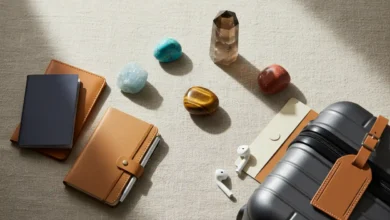

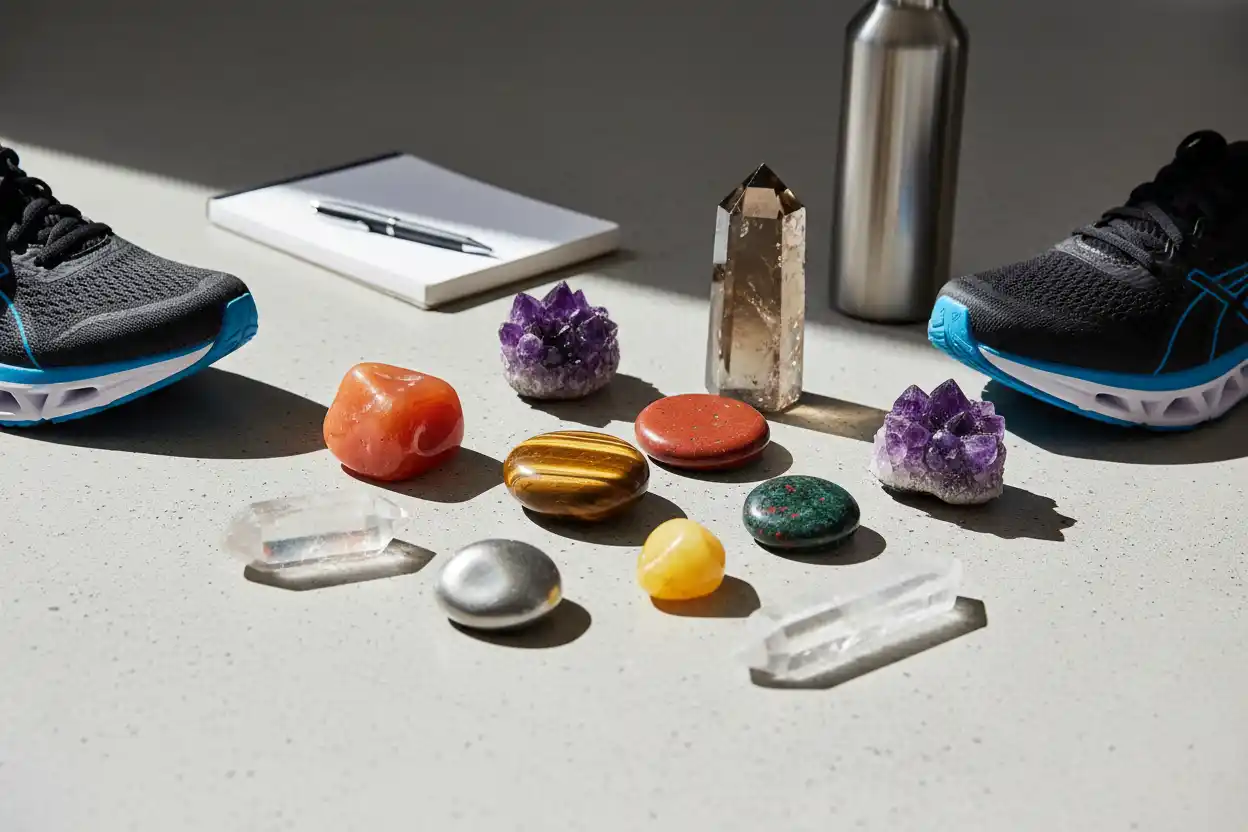

Crystals commonly chosen by athletes include carnelian, tiger’s eye, red jasper, hematite, bloodstone, clear quartz and citrine. Their traditional meanings involve preparation, confidence, endurance, focus and following through under pressure.
Crystals are not established sports-performance aids. They do not increase strength, speed, oxygen delivery, endurance or recovery through a proven mineral energy. Their responsible role is symbolic: a stone can cue a warm-up, pacing strategy, hydration plan, recovery routine or mental-performance skill that the athlete has already practiced.
Crystals for Athletes at a Glance
| Crystal | Traditional athletic theme | Grounded performance cue |
|---|---|---|
| Carnelian | Initiative and confident action | Begin the planned warm-up |
| Tiger’s eye | Observation and risk awareness | Read conditions and avoid unnecessary risk |
| Red jasper | Endurance and steady effort | Maintain the planned pace |
| Hematite | Structure and physical orientation | Check posture, equipment and surroundings |
| Bloodstone | Resilience and service | Continue without ignoring warning signs |
| Clear quartz | Defined intention | Choose one process goal |
| Citrine | Purposeful optimism | Approach competition without guaranteeing the result |
| Smoky quartz | Grounding and perspective | Return attention to the current play or movement |
| Amethyst | Reflection and moderation | Review training rather than adding more automatically |
| Sodalite | Evidence and communication | Report symptoms and feedback accurately |
| Aquamarine | Composed expression | Communicate clearly with coaches and teammates |
| Black tourmaline | Boundaries | Protect recovery time and leave unsafe environments |
What Crystals Can and Cannot Do for Athletes
A crystal can act as a cue because people assign meaning to objects.
An athlete may touch a smooth stone before training and remember to complete a breathing routine. A bracelet stored in the kit bag may represent pacing rather than starting too fast. A tiger’s-eye desk stone can accompany film review or training notes.
The crystal itself does not produce the physical adaptation.
Athletic performance develops through factors such as:
- Appropriate training.
- Sport-specific skill.
- Recovery.
- Nutrition and hydration.
- Sleep.
- Equipment.
- Coaching.
- Medical and rehabilitation support.
- Environmental conditions.
- Genetics and individual circumstances.
A crystal should never be used to override pain, illness, concussion symptoms, heat stress or professional advice.
Best Overall Crystal for Athletes: Carnelian
The drafted carnelian guide associates orange-to-red chalcedony with initiative, confidence and purposeful action.
Carnelian suits a pre-training cue because its meaning focuses on beginning.
The stone might represent a standard sequence:
- Check the session plan.
- Inspect equipment.
- Complete the warm-up.
- Begin at the programmed intensity.
- Record the result.
This routine is more useful than holding the stone while skipping preparation.
Carnelian does not raise energy levels, improve circulation or enhance muscle power medically.
Its role is to connect the start of training with a familiar process.
Tiger’s Eye for Situational Awareness
Tiger’s eye is chatoyant quartz traditionally associated with observation, confidence and assessing risk.
In sport, situational awareness includes conditions, opponents, teammates, equipment and the athlete’s own state.
A tiger’s-eye cue can ask:
- What has changed since the plan was made?
- Is the surface wet, hot or unstable?
- Is the equipment functioning properly?
- Am I compensating for pain?
- Does the current pace match the strategy?
- Is continuing safe?
The stone cannot protect against collision, falls or poor decisions.
Its symbolic value lies in prompting the athlete to look before acting.
Red Jasper for Sustainable Pace
Red jasper traditionally represents endurance, stability and sustained effort.
It suits endurance sport, repeated-sprint training and long skill sessions when interpreted as pacing rather than limitless stamina.
A red jasper cue might mean:
“Follow the plan for the first third.”
“Do not turn the warm-up into a competition.”
“Maintain technique before increasing load.”
“Finish the programmed session rather than proving more.”
Endurance includes recognizing when conditions require reduction or stopping.
The stone cannot delay fatigue, improve aerobic capacity or prevent overtraining.
Hematite for Equipment and Body Position
Hematite is iron oxide traditionally associated with structure and grounded physical attention.
A hematite-style object can represent a pre-session check:
- Footwear.
- Protective equipment.
- Fasteners.
- Surface hazards.
- Body position.
- Bar or apparatus setup.
- Available space.
- Emergency communication.
Strongly magnetic metallic beads sold as hematite are often manufactured hematine or another material.
The mineral’s iron content does not enter the body through ordinary handling or increase blood oxygen.
Hematite cannot correct technique or replace qualified coaching.
Bloodstone for Resilience Without Denial
Bloodstone is green chalcedony marked by red inclusions or spots.
Its historical symbolism includes courage, endurance and service.
Athletic resilience does not mean ignoring every symptom.
A bloodstone reflection asks:
“Is this ordinary effort, or is something wrong?”
“Has technique changed because of pain?”
“Am I continuing because the plan remains safe, or because stopping feels embarrassing?”
“Would I advise a teammate to continue under these conditions?”
Bloodstone does not stop bleeding, improve circulation or speed recovery medically.
Resilience includes reporting concerns early enough to address them.
Clear Quartz for Process Goals
The drafted clear quartz guide represents clarity and defined intention.
Outcome goals such as winning, qualifying or setting a personal record depend partly on factors outside the athlete’s control.
A clear quartz practice emphasizes process goals.
Examples include:
- Maintain form through every repetition.
- Follow the pacing plan.
- Communicate early.
- Complete the recovery routine.
- Make the next technically sound decision.
- Return attention after an error.
The stone does not amplify performance.
It provides a visible reminder of the goal chosen before the intensity of competition begins.
Citrine for Constructive Confidence
The drafted citrine guide associates yellow-to-orange quartz with optimism, generosity and purposeful growth.
For athletes, citrine can symbolize confidence based on preparation rather than guaranteed victory.
A constructive statement is:
“I have prepared for this demand, and I will execute the next step.”
An unhelpful statement is:
“This crystal means I cannot lose.”
Most commercial citrine is heat-treated amethyst.
The stone cannot improve reaction time, salary, selection or competitive outcome.
Confidence remains compatible with uncertainty.
Smoky Quartz for Returning to the Present
Smoky quartz traditionally symbolizes grounding and perspective.
After a mistake, athletes may replay the previous movement while the next one is already beginning.
A smoky quartz cue can represent:
“Review later. Respond now.”
The athlete notices the current position, breath, opponent, teammate or technical task.
This does not mean avoiding analysis.
The error can be recorded and reviewed after the immediate performance demand.
Smoky quartz cannot stop panic, dissociation or concussion symptoms.
Amethyst for Recovery Decisions
The drafted amethyst guide associates purple quartz with reflection and moderation.
Athletes may interpret dedication as always adding more work.
An amethyst recovery prompt asks:
- What was the planned training load?
- What did I actually complete?
- How did technique change?
- What symptoms developed?
- What recovery is scheduled?
- Does the next session need modification?
The stone does not improve sleep, repair muscle or reduce inflammation medically.
It can represent the decision to treat recovery as part of training rather than a failure to work.
Sodalite for Accurate Feedback
Sodalite symbolizes reason, evidence and communication.
Accurate feedback helps coaches, clinicians and athletes make better decisions.
Instead of saying “my knee feels bad,” describe:
- The exact location.
- When the symptom began.
- Which movement causes it.
- Whether it worsens.
- Any swelling, instability or reduced function.
- Previous injury.
- What has already been tried.
The stone cannot diagnose the cause.
A clear description supports—not replaces—professional assessment.
Aquamarine for Team Communication
The drafted aquamarine guide associates blue-green beryl with composed communication.
Athletic communication may involve calling a play, requesting clarification, reporting a hazard or telling a coach that symptoms have changed.
A direct statement can be more useful than trying to appear unaffected:
“I felt dizzy after that repetition.”
“The equipment is loose.”
“I do not understand the drill.”
“I need the instruction repeated.”
“I cannot continue safely.”
Aquamarine cannot make others listen or guarantee a supportive response.
Black Tourmaline for Recovery Boundaries
The drafted black tourmaline guide represents protection and boundaries.
For athletes, its practical symbolism may involve protecting:
- Sleep time.
- Rehabilitation appointments.
- Rest days.
- Private medical information.
- Time away from online criticism.
- Limits on additional competitions.
- Space from an unsafe coach or environment.
A boundary is not laziness.
It can be necessary for health, performance and long-term participation.
Black tourmaline cannot block injury, abusive conduct or environmental hazards physically.
Crystals for Endurance Athletes
Endurance athletes may prefer red jasper, tiger’s eye, smoky quartz and clear quartz.
A four-part sequence could be:
| Stone | Process cue |
|---|---|
| Clear quartz | Confirm the pacing plan |
| Tiger’s eye | Read weather and conditions |
| Red jasper | Maintain sustainable effort |
| Smoky quartz | Return attention after difficult moments |
The stones should remain at home, in a support bag or securely stored unless carrying them is permitted and safe.
A loose stone can become uncomfortable, fall onto the course or interfere with equipment.
No crystal replaces fluid planning, heat precautions, nutrition or medical readiness.
Crystals for Strength Training
Carnelian can represent beginning the warm-up, while hematite symbolizes setup and equipment checks.
Tiger’s eye may cue risk assessment before changing load.
Clear quartz can represent one technical focus, such as maintaining the planned range of motion.
Do not place stones near lifting platforms, racks or moving equipment.
Remove rings, bracelets and pendants when they can catch, pinch or alter grip.
A crystal cannot improve force production, stabilize a joint or protect the spine.
Technique, programming, spotting and equipment determine physical safety.
Crystals for Team Sports
Aquamarine and sodalite suit communication symbolism.
Tiger’s eye represents reading the play, while garnet or red jasper can symbolize consistent participation.
A team crystal ritual should remain optional.
No athlete should be pressured to share a spiritual belief or blamed for a result because they did not use the stone.
The most useful team practice connects the object with a behavioral standard:
- Communicate hazards.
- Support the next play.
- Correct errors without humiliation.
- Follow concussion and injury protocols.
- Respect officials and opponents.
The stone does not create teamwork by itself.
Crystals for Combat and Contact Sports
Jewelry and carried stones can become hazards during contact.
Rings can injure the wearer or another participant. Necklaces may catch. Bracelets can break and scatter beads.
A stone inside clothing or protective equipment may create a pressure point.
Follow the rules of the sport, event, facility and governing body.
Keep the crystal in a locker, kit bag or home practice area rather than carrying it during contact.
No protection crystal can reduce the need for approved equipment and proper supervision.
Crystals for Runners
A runner may use a small desk stone while planning or reviewing training rather than carrying it.
Carnelian can represent starting the warm-up, red jasper steady pacing and smoky quartz returning attention to current form.
Transparent spheres and heavy stones should never be left loose near a treadmill.
A pendant or bracelet may bounce, chafe or catch.
The stone cannot prevent blisters, falls, heat illness or overuse injury.
Footwear, progressive training, environmental awareness and appropriate care remain practical priorities.
Crystals for Yoga and Mobility Work
A smooth stone may be placed beside the mat as a visual cue.
Do not put loose crystals where hands, knees or feet may land on them.
Sharp points and spheres are particularly unsuitable.
Rose quartz may symbolize self-respect, while amethyst represents avoiding competitive comparison during a personal practice.
A crystal cannot increase flexibility, correct alignment or make an unsafe pose appropriate.
Pain, numbness, dizziness and joint instability are reasons to stop and reassess rather than push through because of spiritual symbolism.
Wearing Crystal Jewelry During Sport
The drafted crystal-bracelet guide explains bead construction and fit.
The drafted crystal-necklace guide covers chain and pendant safety.
Remove jewelry when it can:
- Catch machinery or equipment.
- Alter grip.
- Press beneath protective gear.
- Strike the body repeatedly.
- Scratch another participant.
- Break and scatter parts.
- Violate sport or facility rules.
- Trap sweat and irritate skin.
A safer option is to keep the stone with the training journal or use it before entering the activity area.
Crystals, Hydration and Heat
Do not place crystals in a water bottle or sports drink.
Minerals can carry surface contamination, treatments, metal-bearing inclusions or fragments.
A crystal cannot structure water, replace electrolytes or prevent heat illness.
Hydration needs vary with the athlete, activity, duration, environment and medical circumstances.
Heat symptoms should not be interpreted as energetic cleansing.
Confusion, collapse, severe weakness or worsening heat symptoms require immediate practical action and appropriate emergency response.
Crystals and Injury Recovery
A crystal may sit beside a rehabilitation plan as a reminder to complete the prescribed work.
It cannot heal a fracture, repair a ligament, reduce swelling or shorten concussion recovery through mineral energy.
Do not rub a crystal over an acute injury, surgical site, infected area or unexplained swelling.
Pain should not automatically be treated as something to overcome.
The appropriate response depends on the injury and may require assessment, imaging, rehabilitation or modified activity.
A stone should never be used to pressure an athlete back into participation.
Crystals and Pain
Some athletes use a smooth stone as a sensory focus while resting or breathing.
That does not establish that the stone is treating the cause of pain.
Pain can signal tissue injury, illness, overload or another condition requiring attention.
Do not use crystal symbolism to hide symptoms from coaches, clinicians or caregivers.
Likewise, an athlete should not be praised for ignoring pain that changes movement or function.
The object may accompany coping, but it cannot determine whether continuing is safe.
Crystals and Sleep
Recovery depends partly on adequate sleep, but a crystal cannot produce it medically.
The completed guide to wearing crystals while sleeping explains why necklaces, rings and bracelets may create entanglement, pressure or breakage risks.
Keep training jewelry outside the bed.
An amethyst or smoky quartz object can remain on a safe bedside surface as a routine cue.
However, persistent sleep problems deserve attention to schedule, environment, stress, health and professional support where needed.
Crystals for Competition Day
Use the crystal before entering the competition environment.
Choose one statement:
- Carnelian: “Begin with the planned routine.”
- Tiger’s eye: “Read the conditions.”
- Clear quartz: “Focus on the next process.”
- Smoky quartz: “Return after the error.”
- Aquamarine: “Communicate early.”
- Red jasper: “Maintain the pace.”
Then store the stone safely.
The athlete should not believe that leaving it behind removes the ability to perform.
Skills and preparation remain available without the object.
Building a Pre-Performance Routine
A crystal can occupy one small place inside a larger routine:
- Review the process goal.
- Check equipment.
- Confirm hydration and environmental planning.
- Complete the warm-up.
- Use the chosen cue.
- Store the crystal.
- Begin the activity.
Rituals become problematic when the athlete believes performance is impossible without one exact object.
A flexible routine can use a word, breath, visual mark or gesture when the stone is unavailable.
Choosing a Crystal for an Athlete
Begin with the sport and intended use.
A desk stone for journaling has different requirements from jewelry worn casually outside training.
Choose a smooth, durable material such as quartz, jasper or agate when handling is likely.
Avoid fragile fluorite, gypsum and calcite in kit bags.
Ask the seller for:
- Exact mineral identity.
- Treatment.
- Dimensions and weight.
- Sharp edges.
- Coatings or dye.
- Jewelry construction.
- Return policy.
The completed toxic-crystals safety list provides broader mineral-handling guidance.
Frequently Asked Questions
1. What is the best crystal for athletes?
Carnelian is a common overall choice because it symbolizes initiative and beginning a planned action.
2. Which crystal symbolizes endurance?
Red jasper, garnet and bloodstone commonly represent endurance and sustained effort.
3. Which crystal is associated with athletic confidence?
Tiger’s eye, carnelian, citrine and ruby commonly symbolize confidence and purposeful action.
4. Can crystals improve sports performance?
Crystals are not established performance aids and do not reliably increase speed, strength, endurance or skill.
5. Can a crystal improve recovery?
No. A crystal may cue a recovery routine, but it does not repair tissue, restore hydration or replace sleep and rehabilitation.
6. Should athletes carry crystals during competition?
Only when rules and physical safety allow it. Jewelry and loose stones are inappropriate in many sports.
7. Can athletes put crystals in drinking water?
No. Minerals should not be placed in water bottles or sports drinks because of contamination, treatment and fragment risks.
8. Which crystal is associated with focus during competition?
Clear quartz, tiger’s eye and sodalite commonly symbolize clear attention and decision-making.
9. Is hematite useful because it contains iron?
Holding hematite does not supply dietary iron or improve blood oxygen. Its athletic use is symbolic.
10. Can crystals prevent injuries?
No. Injury prevention depends on training, equipment, conditions, technique and appropriate medical guidance.
11. Can a crystal help an athlete ignore pain?
Pain should not be ignored because of crystal symbolism. New, worsening or function-changing symptoms require assessment.
12. Are athletic crystal benefits scientifically proven?
No. Their energy, endurance and recovery meanings are spiritual traditions rather than established sports-science effects.
Let the Crystal Mark the Process, Not Claim the Result
An athlete cannot control every score, opponent, selection decision or environmental condition. The most reliable focus remains the process: preparation, pacing, communication, technique and recovery.
Choose one stone for one cue, then store it safely before the activity. The crystal can mark the routine, while training and informed decisions create performance.
Safety Disclaimer: Crystal energy, endurance, pain-relief and recovery properties reflect cultural and spiritual traditions rather than established sports or medical effects. Crystals cannot prevent injury, treat concussion, replace hydration or speed tissue healing. Stop activity and seek appropriate help for collapse, confusion, chest pain, severe breathing difficulty, suspected concussion, major injury or worsening heat illness.