
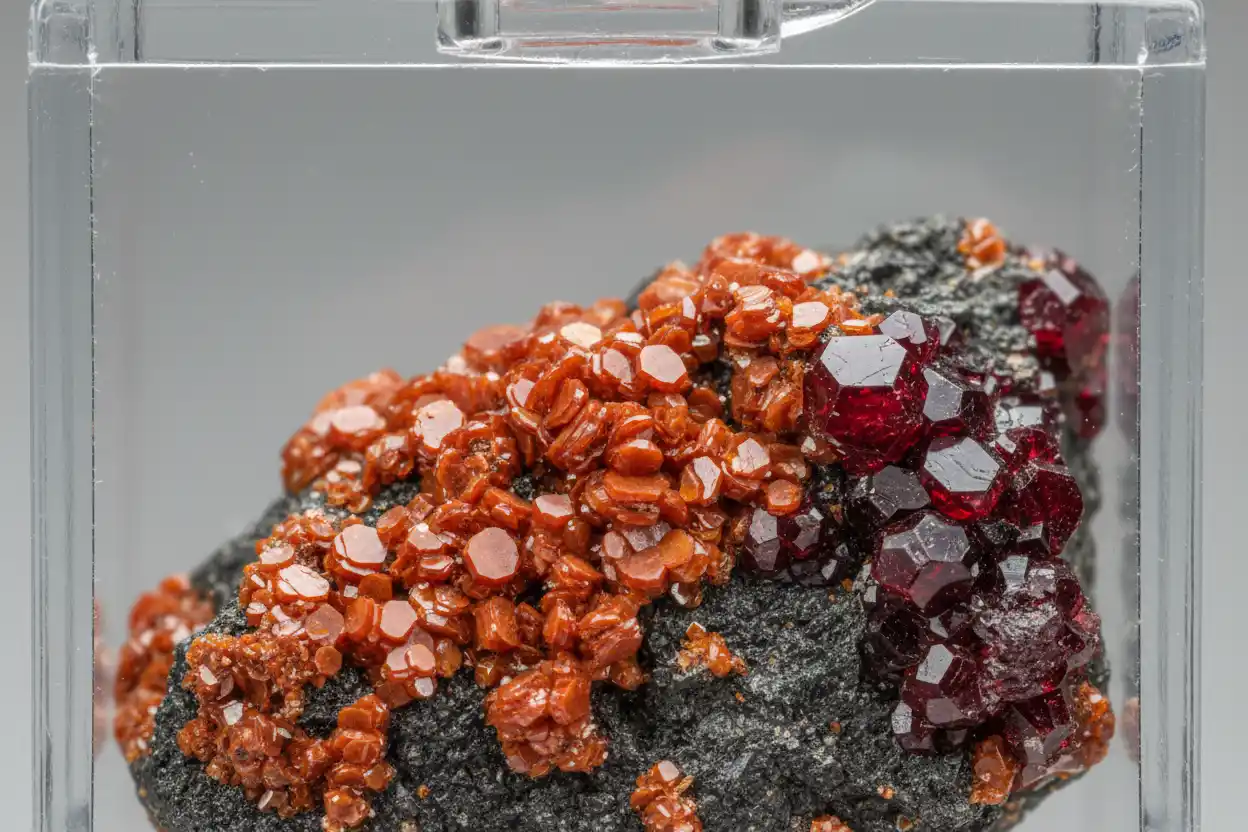
Xanthoconite Meaning, Properties, Rarity and Safe Handling

Xanthoconite is an exceptionally rare silver arsenic sulfosalt that occurs as tiny orange-red, yellow-orange, brown or dark red crystals in silver-bearing hydrothermal veins. Its brilliant luster and high density can make microscopic crystals visually striking, but its softness, rarity and arsenic content restrict it to protected mineral collections.
The mineral has the same ideal composition as proustite but a different crystal structure. Consequently, identification often requires microscopy, Raman spectroscopy or X-ray analysis rather than color alone.
Xanthoconite at a Glance
| Property | Xanthoconite |
|---|---|
| Mineral class | Sulfosalt |
| Chemical formula | Ag₃AsS₃ |
| Principal elements | Silver, arsenic and sulfur |
| Structural relationship | Dimorph of proustite |
| Crystal system | Monoclinic |
| Typical colors | Dark red, red-orange, yellow-orange, clove brown and lemon yellow in transmitted light |
| Streak | Orange-yellow |
| Common habit | Thin tablets, flat pseudo-rhombohedra, laths, radial aggregates and reniform crusts |
| Luster | Adamantine |
| Transparency | Translucent to opaque |
| Refractive index | Extremely high, approximately 3 |
| Optical character | Biaxial negative |
| Specific gravity | Approximately 5.53–5.56 |
| Mohs hardness | About 2–3 |
| Cleavage | Distinct in one direction |
| Tenacity | Brittle |
| Common use | Micromounts, mineral specimens and scientific collections |
| Main care concern | Arsenic-bearing dust, extreme softness and tiny fragile crystals |
What Is Xanthoconite?
Xanthoconite contains three silver atoms for each arsenic and three sulfur atoms in its ideal formula.
Although silver accounts for much of the mineral’s weight, xanthoconite is not a metallic-looking native silver mineral. Its translucent crystals can show deep red, orange and yellow colors with an exceptionally brilliant luster.
Most crystals remain microscopic or only a few millimeters across. Well-developed pieces approaching half a centimeter are unusual.
The mineral commonly forms thin tablets or flattened crystals rather than the long prismatic forms associated with proustite.
Its small size and rare occurrence make xanthoconite more important to systematic mineral collectors than to conventional gemstone buyers.
How Xanthoconite Got Its Name
The name comes from Greek words meaning yellow and powder.
This refers to its orange-yellow or yellow streak rather than its most common face-up crystal color.
A streak is the color of a mineral’s powder when rubbed across an unglazed testing plate. However, streak testing should never be performed on a valuable xanthoconite specimen because the mineral is rare, soft and arsenic-bearing.
The name was applied during nineteenth-century study of European silver ores.
Xanthoconite and Proustite
Xanthoconite and proustite share the formula Ag₃AsS₃, making them dimorphs.
Dimorphs have the same chemical composition but different internal crystal arrangements.
Xanthoconite is monoclinic. Proustite is trigonal and commonly develops elongated scarlet-red prisms.
Xanthoconite more often forms thin tablets, laths, low rounded aggregates or flattened pseudo-rhombohedral crystals.
Their streak colors also differ. Proustite commonly gives a vermilion-red streak, while xanthoconite produces a more orange-yellow powder.
Nevertheless, weathering, small crystal size and intergrowth can obscure these differences. Laboratory testing provides the strongest distinction.
Xanthoconite and Pyrargyrite
Pyrargyrite is a silver antimony sulfosalt with the formula Ag₃SbS₃.
Its chemistry replaces arsenic with antimony, while its dark red-to-black color can overlap xanthoconite and proustite.
Pyrargyrite commonly forms trigonal crystals and may appear nearly metallic in thick sections.
Xanthoconite can occur beside pyrargyrite in the same silver vein. Therefore, association does not identify an individual crystal.
Raman spectroscopy and elemental analysis distinguish arsenic-rich xanthoconite from antimony-rich pyrargyrite.
Crystal Habits
Tabular Crystals
Thin plates on the basal face are the classic habit. Their broad surfaces can show intense adamantine reflections.
The plates may resemble flattened rhombohedra even though the mineral is monoclinic.
Lath-Like Crystals
Some crystals form narrow flattened blades elongated in one direction.
These laths commonly remain microscopic and require strong magnification to examine.
Radial Aggregates
Small crystals can grow outward from a central point, creating hemispherical or radial groups.
The individual crystals may be visible only as sparkling ridges along the surface.
Reniform and Crust-Like Material
Rounded kidney-shaped masses and thin crusts occur in mineralized cavities.
Such material can be difficult to separate visually from other red-brown silver sulfosalts.
Color and Optical Appearance
Thick crystals commonly appear dark red, dull orange, reddish brown or clove brown.
Thin edges and transmitted-light views can reveal lemon-yellow or orange-yellow colors hidden by the dense body.
Its refractive index is exceptionally high, contributing to strong surface brilliance.
However, opaque matrix and microscopic size prevent xanthoconite from behaving like a conventional brilliant-cut gem.
Fresh surfaces can appear brighter than weathered material. Tarnish and alteration may dull the luster or darken exposed areas.
How Xanthoconite Forms
Xanthoconite forms in silver-rich hydrothermal veins.
Hot mineral-bearing fluids move through fractures and deposit silver, arsenic, sulfur and associated metals as temperature and chemistry change.
The mineral commonly appears during relatively late stages of vein development, particularly in silver-enriched zones.
It occurs with proustite, pyrargyrite, acanthite, stephanite, native silver, native arsenic and several other silver minerals.
White calcite often fills the same cavities and can provide a contrasting background.
Galena and other sulfides may form part of the host ore.
Because xanthoconite occurs only in small quantities, it has never served as a major independent source of silver.
Important Localities
The type locality is the Himmelsfürst Mine near Brand-Erbisdorf in Saxony, Germany.
The wider Freiberg, Annaberg, Marienberg, Johanngeorgenstadt and Schneeberg districts have produced xanthoconite and related silver minerals.
Jáchymov and Příbram in the Czech Republic are classic sources, often yielding complex specimens containing proustite, native arsenic and other rare silver phases.
Chañarcillo in Chile is historically famous for ruby-silver minerals and has produced xanthoconite in small quantities.
Cobalt in Ontario, Canada, contains xanthoconite in silver-cobalt vein assemblages.
Other reported localities include Romania, France, Mexico, Morocco and several mining districts in the United States.
Precise locality labels add substantial value because an isolated microscopic orange crystal cannot establish origin.
Associated Minerals
Proustite is the most important association because it shares xanthoconite’s ideal chemistry.
Pyrargyrite, stephanite, pearceite, polybasite and acanthite represent additional silver-bearing phases.
Native arsenic can form dark gray or black botryoidal matrix beneath red and orange crystals.
Calcite commonly creates white rhombohedra or vein filling.
Galena and sphalerite may occur in the wider ore system.
Some mixed specimens include several rare minerals within a few millimeters. Their identification should be based on mapping or analysis rather than a generalized label.
Xanthoconite Versus Realgar
Realgar is an arsenic sulfide with orange-red color and resinous luster.
It contains no silver and has a much lower density.
Realgar commonly forms prismatic crystals, crusts and granular masses rather than xanthoconite’s tiny adamantine tablets.
Both minerals require cautious handling because they contain arsenic.
Realgar is also strongly light-sensitive, while xanthoconite’s long-term display behavior is less comprehensively documented.
Xanthoconite Versus Wulfenite
Wulfenite can show orange-red tabular crystals.
However, wulfenite usually forms square tetragonal plates and consists of lead molybdate.
Xanthoconite tablets are monoclinic, usually much smaller and associated with silver-arsenic ores.
Both are soft, dense and unsuitable for ordinary jewelry.
Xanthoconite Versus Crocoite and Vanadinite
Crocoite forms vivid orange-red lead-chromate prisms. Its crystals are generally elongated rather than flattened.
Vanadinite develops hexagonal red, orange or brown barrels.
Xanthoconite’s crystal symmetry, silver-arsenic chemistry and orange-yellow streak distinguish it from both lead minerals.
Because all three can be hazardous when powdered, destructive testing is inappropriate.
Identifying Xanthoconite
Color provides only a preliminary clue.
The mineral’s high specific gravity near 5.54 reflects its substantial silver content, but measuring a microscopic crystal accurately may be impossible.
Its hardness of 2–3 and distinct basal cleavage match several silver sulfosalts.
Raman spectroscopy can identify the molecular vibration pattern without removing much material.
X-ray diffraction establishes the monoclinic structure and separates it from trigonal proustite.
Electron microscopy with elemental analysis can confirm silver, arsenic and sulfur.
The full methodology follows the principles in how to identify crystals.
Treatments, Repairs and Synthetic Material
Xanthoconite has no established commercial color-enhancement system.
Its rarity means repairs and specimen preparation matter more than heating or irradiation.
Microscopic crystals may be reattached to matrix, while fractured matrix sections can be stabilized with adhesive.
Oil or coating could temporarily deepen luster, although such treatment would reduce scientific and collector confidence.
Synthetic silver arsenic sulfide phases can be produced for research, but there is no significant synthetic gemstone market.
A constructed specimen using unrelated crystals glued to matrix is more plausible than a commercially grown synthetic xanthoconite gem.
The disclosure principles in gemstone treatments explained remain relevant to repairs and coatings.
Can Xanthoconite Be Faceted?
Faceting is theoretically possible only for an unusually large translucent fragment.
In practice, the mineral is far too rare, soft, cleavable and hazardous to justify conventional cutting.
Most crystals are smaller than the size needed for even a tiny gemstone.
A hardness of 2–3 means facet edges would abrade almost immediately.
The distinct cleavage and brittle tenacity add a serious breakage risk, as explained in gemstone cleavage explained.
A rare intact crystal carries far more mineralogical value than a cut fragment.
Hardness and Durability
Xanthoconite sits near calcite on the gemstone hardness chart.
A fingernail may not scratch every specimen easily, but metal, dust and packaging materials can damage crystal faces.
The mineral is also brittle and cleavable.
The difference between scratch resistance and breakage resistance appears in gemstone toughness versus hardness.
Direct-contact jewelry is inappropriate. The safest presentation is an enclosed micromount or mineral box.
Light and Display Conditions
Proustite, which frequently occurs with xanthoconite, is strongly photosensitive and can darken under prolonged light.
Xanthoconite itself is not documented as consistently undergoing the same dramatic transformation. Nevertheless, mixed ruby-silver specimens should receive conservative display conditions.
Use low-intensity LED lighting and limit total exposure time.
Avoid direct sunlight and ultraviolet display lamps.
The broader guidance in crystals that fade in sunlight should be applied cautiously because associated phases may be more sensitive than xanthoconite.
Store important specimens in a closed box when they are not being viewed.
Xanthoconite Prices in 2026
Xanthoconite has no standardized gem or per-carat market.
Small identified micromounts containing a few crystals may retail for approximately $25–$150.
Better labeled specimens with visible orange crystals commonly range from $150–$750.
Historic European pieces containing xanthoconite with proustite, stephanite, native arsenic or other rare silver minerals may sell for approximately $750–$5,000.
Exceptional old-collection specimens with rich associations, important provenance or numerous analyzed crystals can exceed these ranges considerably.
Value normally belongs to the complete multi-mineral specimen rather than xanthoconite alone.
Asking prices vary sharply because crystals are microscopic, identification can be difficult and comparable sales are scarce.
What Determines Value?
Confirmed identification is essential. An orange grain labeled xanthoconite without analysis carries limited confidence.
Crystal size and visibility affect value. A collector should be able to locate the mineral without guessing from an overly broad label.
Luster and color matter, particularly when thin crystals retain bright red-orange or yellow transmitted color.
Mineral association adds substantial interest. Proustite, native arsenic and uncommon silver phases can create a more important specimen.
Locality, old labels and collection history often matter more than physical size.
Repairs and glued matrix should be disclosed.
Buying Guidance
Purchase from a specialist mineral dealer rather than a generic crystal marketplace.
Ask how the xanthoconite was identified and whether analytical confirmation is available.
Request a close macro or microscope photograph with the crystals marked.
Confirm the full locality, mine and country.
Check whether the specimen also contains arsenic, proustite or other light-sensitive and hazardous minerals.
Treat extremely large crystals with skepticism because most xanthoconite is microscopic or only a few millimeters across.
Do not buy the mineral for jewelry, handling practice or crystal-infused water.
Safe Handling and Cleaning
Xanthoconite contains arsenic and should be handled as a display specimen rather than a tactile object.
Keep it in a closed box or case, preferably with a clear mineral label noting the arsenic content.
Wear disposable gloves when repacking a dusty or damaged specimen.
Wash hands after contact and keep the mineral away from food-preparation surfaces.
Never cut, grind, drill, sand or tumble it.
Avoid compressed air, which can spread dust. Use a hand air bulb inside a controlled area only when necessary.
Do not soak the specimen. Water can spread residue, affect associated silver minerals and enter repairs.
The guidance in which crystals can and cannot go in water should be overridden by the mineral’s arsenic chemistry.
For belief-based cleansing practices, use a contact-free method from how to cleanse crystals.
The broader handling context appears in the toxic crystals safety list.
Meaning and Symbolism
Xanthoconite has little historical crystal lore because it is rare, microscopic and confined largely to specialist ore collections.
Modern symbolic interpretations may associate its hidden yellow-orange color with careful observation, specialist knowledge and value concealed within ordinary-looking rock.
Its structural relationship with proustite can also represent how the same ingredients can produce different outcomes when arranged differently.
Some collectors connect the mineral with patience and the willingness to verify details rather than relying on first impressions.
These interpretations are cultural, spiritual or personal rather than scientifically demonstrated effects.
Frequently Asked Questions
1. What is xanthoconite made of?
Xanthoconite is silver arsenic sulfide with the ideal formula Ag₃AsS₃.
2. Is xanthoconite the same as proustite?
No. They have the same chemical formula but different crystal structures, making them dimorphs.
3. What color is xanthoconite?
It can appear dark red, orange-red, yellow-orange or brown, while thin sections may look lemon yellow.
4. Why is it called xanthoconite?
The name refers to its yellow-to-orange powder or streak.
5. How large are xanthoconite crystals?
Most are microscopic or only a few millimeters across. Crystals approaching half a centimeter are unusual.
6. Where is xanthoconite found?
Classic sources include Germany, the Czech Republic, Chile, Canada, Romania, France, Mexico and Morocco.
7. Is xanthoconite toxic?
It contains arsenic. An intact enclosed specimen presents less exposure potential than dust, but handling should still be minimized.
8. Can xanthoconite go in water?
No soaking is recommended. Water may spread arsenic-bearing residue and affect associated minerals or repairs.
9. Does xanthoconite darken in light?
Its close relative proustite is strongly light-sensitive. Xanthoconite is less consistently documented, so low-light storage remains prudent for mixed specimens.
10. Can xanthoconite be faceted?
It is theoretically possible but not practical because the mineral is tiny, soft, brittle, cleavable and arsenic-bearing.
11. How much is xanthoconite worth?
Small micromounts may cost tens of dollars, while verified historic silver-ore specimens can sell for hundreds or thousands.
12. Does xanthoconite have scientifically proven healing properties?
No. It should be treated as an arsenic-bearing collector mineral, not as a therapeutic or direct-contact stone.
Xanthoconite rewards close examination rather than physical handling. Its best specimens reveal only a few tiny orange crystals, yet those grains record a rare structural form of silver arsenic sulfide within some of the world’s most historically important silver veins.
Xanthoconite appears in Crystals That Start With X.
Safety disclaimer: Xanthoconite contains arsenic. Keep it enclosed, minimize handling, wash after contact and never ingest, lick, soak, cut, grind, drill or tumble it. Avoid creating or inhaling dust.