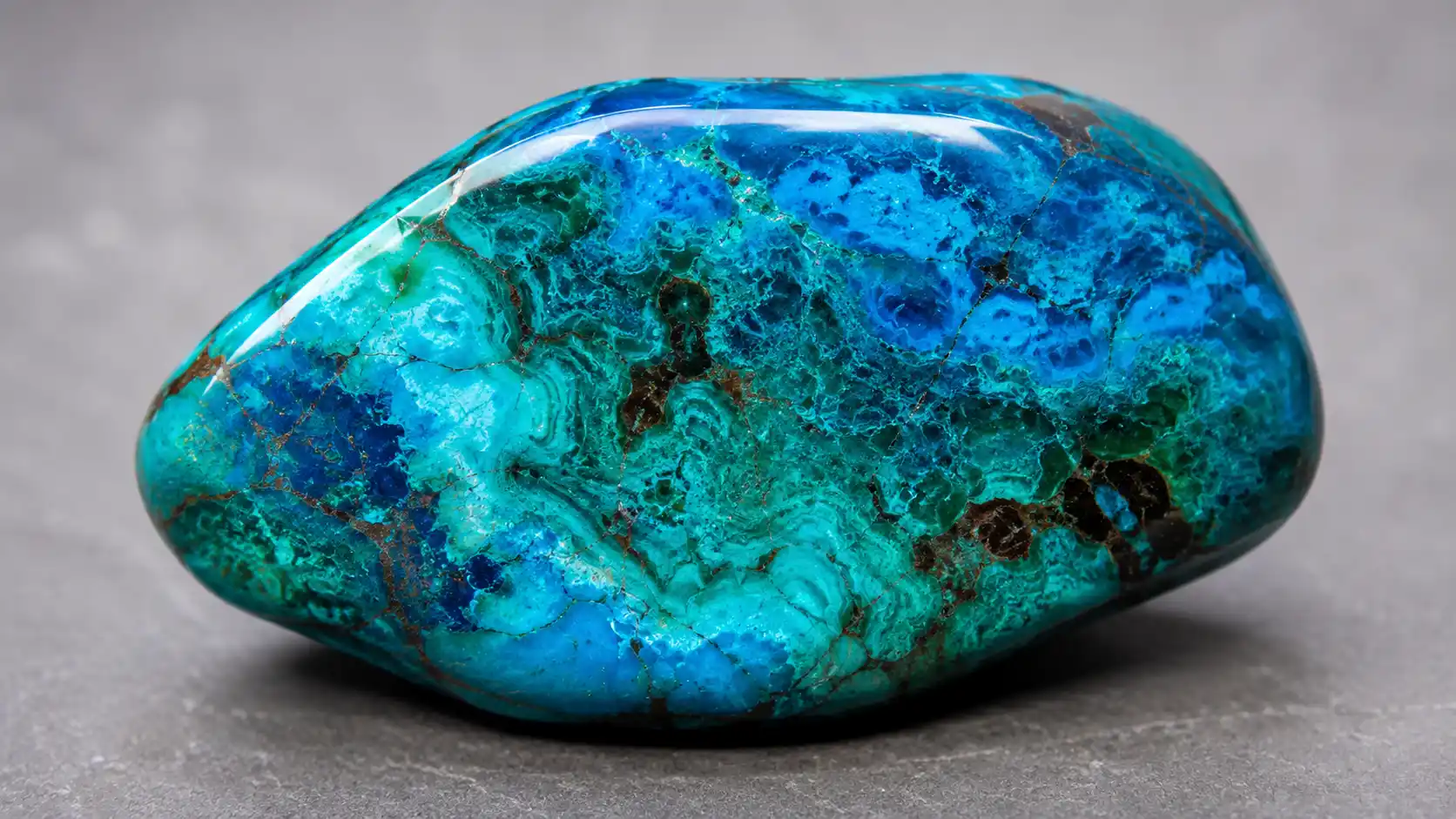
Chrysocolla Meaning: Physical Evidence, History & Symbolism
Chrysocolla meaning begins with an important distinction: chrysocolla is a natural copper-bearing mineral material whose blue-green appearance, geological setting, and physical behavior can be examined, while the emotional and spiritual meanings attached to it belong to history, culture, and modern personal belief. That separation matters because chrysocolla is often marketed in language that mixes mineral facts with claims about communication, calmness, healing, feminine energy, or chakra work. A useful understanding should first establish what the material is, how it forms, why specimens vary so dramatically, and what can actually be inferred from appearance before discussing symbolism. Within Gems Lore’s Healing Crystal coverage, measurable evidence and personal interpretation are treated as different kinds of information rather than using one as proof of the other.
The name chrysocolla is commonly applied to hydrated copper-bearing silicate material found in the oxidized portions of copper deposits. It is often poorly crystalline to amorphous and may occur intimately mixed with silica, iron oxides, malachite, azurite, cuprite, and other secondary copper minerals, which is one reason simplified formulas and descriptions do not capture every specimen equally well. This complexity is not a flaw in the material; it is part of what makes chrysocolla geologically interesting. It also explains why two objects sold under the same name can differ substantially in hardness, polish quality, density, matrix pattern, and suitability for jewelry.
What Chrysocolla Actually Is
Chrysocolla is usually described as a hydrated copper aluminum silicate, but the name has long been applied to material whose structure and composition can be variable, especially when it forms as fine-grained, poorly ordered masses rather than obvious crystals. For readers, the practical consequence is more important than memorizing a rigid formula: chrysocolla should not be treated as though every blue-green specimen is a chemically uniform single crystal. Some pieces are soft, porous, and earthy, while others are impregnated with or intergrown with quartz or chalcedony and can take a much brighter polish. A more detailed look at chrysocolla formation and deposit geology examines those geological relationships, but the essential point here is that chrysocolla is a secondary copper-zone material whose physical identity is shaped by both its chemistry and its associations.
| Property | Practical reference |
|---|---|
| Material identity | Hydrated copper-bearing silicate material, commonly poorly crystalline to amorphous and compositionally variable |
| Typical color | Blue, turquoise-blue, blue-green, green, sometimes mixed with brown or black matrix |
| Common habit | Massive, botryoidal, crusty, vein-filling, earthy, or compact material rather than large transparent crystals |
| Geological setting | Secondary mineralization in oxidized copper deposits |
| Durability | Often soft when relatively pure; quartz- or chalcedony-rich material may be considerably harder |
| Common associates | Quartz/chalcedony, malachite, azurite, cuprite, iron oxides, and other copper alteration minerals |
| Key identification limit | Color and photographs alone cannot establish exact composition, treatment status, or provenance |
This identity framework also explains why hardness numbers quoted for chrysocolla can appear contradictory. Relatively pure, porous chrysocolla is soft enough to scratch or abrade readily, whereas highly silicified material sold as chrysocolla can behave much more like chalcedony in cutting and wear. A single hardness figure therefore needs context. The distinction becomes particularly important for cabochons, beads, inlay, and jewelry because the attractive blue-green color may belong to chrysocolla while much of the mechanical strength comes from silica-rich material around or through it.
How Chrysocolla Forms in Copper Deposits
Chrysocolla typically develops where copper-bearing primary minerals have been exposed to oxygenated water and near-surface weathering. In these oxidized environments, copper is mobilized and reprecipitated in new secondary minerals, producing assemblages that may include bright blue, green, red-brown, or black phases within the same piece of rock. Chrysocolla can coat cavities, fill fractures, form rounded botryoidal surfaces, or occur as irregular masses in altered host rock. Because the environment is chemically active and mineralogically diverse, a specimen may represent a small geological system rather than a single pure phase.
That context is one reason visual interpretation should include the matrix instead of focusing only on saturated blue-green areas. Brown iron staining, quartz veins, malachite patches, darker copper oxides, and porous fracture surfaces can all help a viewer understand how the specimen developed, even though none of those features alone proves locality or exact composition. A close look at the chrysocolla microscope and inclusion notebook can help readers understand which textures become more informative under magnification and which remain ambiguous without analytical testing.
Why Chrysocolla Is Blue, Green, or Turquoise
Copper is central to chrysocolla’s characteristic color range, but color is not a simple identity test. Blue, cyan, turquoise, teal, and green can vary with composition, particle size, associated minerals, surface hydration, silica content, iron staining, and the way light interacts with a rough or polished surface. A porous matte crust can look powdery blue under diffuse light, while a compact quartz-rich cabochon may appear deeper, glossier, and more saturated even when both are legitimately sold within the chrysocolla trade category.
This is also where trade photographs can mislead. Strong white balance shifts, excessive saturation, wetting, polarized lighting, and contrast enhancement can make ordinary material look unusually vivid. Conversely, poor lighting can flatten the color and conceal subtle matrix structure. Readers who want the deeper optical explanation can use the chrysocolla optical properties and color behavior reference, but the practical rule is straightforward: attractive color supports a visual description, not a complete mineral identification.
Color-based confusion is especially easy when different minerals share a similar palette. Chrysoprase is a green variety of chalcedony whose identity and coloring mechanism differ from chrysocolla, while celestite is a strontium sulfate mineral that may be pale blue but belongs to an entirely different mineral group. These comparisons are useful because they show why color names are not enough; they should not be used to collapse distinct materials into one broad “blue-green crystal” category.
Diagnostic Traits: What Can and Cannot Be Read From a Specimen
A chrysocolla specimen can offer useful visual clues through habit, matrix, surface texture, polish response, fracture, and associated minerals, but those clues have different evidentiary strength. Massive or botryoidal blue-green material in an oxidized copper matrix is visually consistent with chrysocolla, especially when accompanied by common copper alteration minerals. Yet the same appearance can occur in mixtures, composites, dyed materials, silica-rich variants, or other blue-green copper minerals, so responsible identification should leave room for uncertainty whenever provenance and testing are absent.
Polished material deserves particular caution because cutting can hide the original surface and matrix. A cabochon may show swirling blue, green, brown, and black patterns that are commercially attractive but mineralogically complex. The presence of a good polish does not prove that the piece is pure chrysocolla, and a very hard, glassy surface may indicate substantial chalcedony or quartz. Likewise, unusual uniformity does not automatically prove dye or stabilization; it is a reason to ask better questions rather than jump to a treatment conclusion.
A Specimen and Photo Evaluation Framework
Start by reading the specimen as a whole. Look for whether the blue-green material appears as a coating, vein filling, rounded crust, compact mass, or dispersed color within a silica-rich body, then note the host matrix and any visible associations. Natural pieces often show transitions rather than perfectly separated zones, and those transitions can be more informative than the most saturated patch. Record what is plainly visible without turning every color boundary into a mineral name, because visual observation supports description more reliably than chemical identification.
Next, examine texture and surface character. A chalky or earthy surface suggests a very different mechanical material from a dense, glossy cabochon, while tiny cavities, botryoidal contours, iron staining, and quartz seams may support a secondary copper-deposit context. If a seller provides multiple photographs, compare the same area under different lighting rather than judging from a single hero image. Consistent color and texture across angles are more useful than one highly saturated photograph, though they still cannot establish composition.
Then separate claims into what the photograph can reasonably support and what requires documentation or testing. A photo can show visible color, pattern, polish, fractures, matrix, and apparent craftsmanship; it cannot by itself prove exact chemical identity, natural versus treated status, mine locality, country of origin, or the absence of fillers and coatings. Provenance statements should therefore be evaluated through records and seller disclosure rather than appearance alone, which is why the chrysocolla provenance disclosure checklist is more useful for origin claims than trying to identify a mine from color.
Finally, treat disputed names and market labels as hypotheses rather than diagnoses. Phrases such as “gem silica chrysocolla,” “chrysocolla chalcedony,” or other composite trade descriptions may refer to materially different proportions of silica and chrysocolla-like coloration, and sellers do not always use those terms consistently. The most defensible description states what is known, names uncertainty where it remains, and avoids pretending that a marketing label is equivalent to a laboratory conclusion.
Chrysocolla in History: The Name Is Older Than the Modern Mineral Definition
The historical story of chrysocolla requires restraint because the ancient word associated with the name did not necessarily refer to the exact mineral material recognized today. The term is derived from Greek words connected with gold and glue, and ancient references to “chrysokolla” have been associated with substances used in work involving gold. That linguistic history is interesting, but it does not prove that every ancient mention described modern chrysocolla in the mineralogical sense, nor does it justify attaching a continuous spiritual doctrine to the stone across thousands of years.
This distinction protects the historical record from a common modern error: taking an old color term, trade substance, or broad mineral name and retroactively identifying it as one precise modern mineral. Copper minerals have been used, traded, ground as pigments, worked ornamentally, and valued for color in many societies, but the evidence for those activities must be evaluated material by material. When documentation is broad, it is more accurate to speak about copper-bearing blue-green substances or the history of the name than to claim an unbroken ancient tradition for modern chrysocolla.
Chrysocolla Meaning in Modern Symbolism
In modern crystal traditions, chrysocolla meaning is commonly associated with communication, calm reflection, emotional expression, compassion, and a gentler approach to conflict. Some practitioners connect its blue-green color with symbolic systems involving the throat or heart, while others use it as a visual reminder to speak thoughtfully, listen carefully, or pause before reacting. These are interpretations and personal practices, not measurable properties of the mineral.
That boundary is especially important when phrases such as “chrysocolla healing properties” appear in shops or social media. There is no established scientific evidence that holding, wearing, or placing chrysocolla treats anxiety, hormonal conditions, pain, blood pressure, inflammation, infection, trauma, or any other medical condition. The copper present in the material also does not function as a nutritional or therapeutic supplement simply because the stone contains copper-bearing compounds; biological effects depend on chemical form, concentration, dose, solubility, exposure route, and metabolism.
A grounded way to use chrysocolla symbolism is to treat the stone as a prompt rather than an agent. Someone might place a polished piece near a journal and ask what they want to communicate more clearly, what conversation needs better boundaries, or which assumptions should be checked before speaking. The meaning comes from the reflective practice and the person’s chosen symbolism, not from a demonstrated force emitted by the mineral. This approach preserves the cultural and personal value of symbolic use without converting belief into a medical or predictive claim.
Jewelry, Cutting, and Everyday Wear
Chrysocolla jewelry varies dramatically because durability depends heavily on the material’s structure and silica content. Soft, porous chrysocolla can abrade, pit, or fracture more readily than quartz-rich material, while chalcedony-bearing pieces may be suitable for a high polish and more practical daily wear. Lapidaries therefore pay close attention to orientation, fractures, undercutting, porosity, matrix stability, and the way mixed materials respond to sanding and polishing. Those technical choices are covered more fully in the chrysocolla cutting, orientation, and polish guide.
Setting design matters for the same reason. A protected pendant or earring generally exposes the stone to less impact than a ring worn on the hand, and a soft or fractured cabochon may benefit from a setting that shields vulnerable edges. The chrysocolla setting and wear engineering reference focuses on these construction issues rather than symbolism, allowing the discussion here to remain centered on identity and interpretation.
Buying Chrysocolla Without Overreading the Label
When buying chrysocolla, the most useful questions concern what the object actually is, how stable it is, whether it has been treated, how the seller describes associated silica or matrix, and whether any locality claim is documented. A low-priced rough specimen and a high-polish blue-green cabochon may both be sold as chrysocolla while representing very different proportions of chrysocolla, quartz, chalcedony, and matrix material. Price alone does not resolve that distinction, nor does an unusually vivid photograph.
The dedicated where to buy chrysocolla guide addresses seller evaluation and purchase-specific questions, while the interpretive limit remains the same: a commercial label is a starting point for identification, not proof of purity, treatment status, or origin. If a seller claims a precise mine, rare variety, or exceptional natural color, the stronger evidence is disclosure and documentation rather than a story attached to the stone.
Safe Ownership and Care
For normal ownership, an intact chrysocolla specimen or finished piece of jewelry is generally handled as a mineral object rather than as a special chemical exposure. The greater concern arises when material is drilled, ground, sanded, crushed, heated, or otherwise worked in ways that create dust or expose associated phases. Chrysocolla can contain copper-bearing material, and silica-rich pieces may generate respirable silica dust during lapidary work, so cutting and polishing require appropriate wet methods, ventilation, dust control, and professional safety practices rather than casual dry grinding.
Direct-water elixirs are not a sensible use for chrysocolla because composition can be variable, associated minerals may be present, and surface treatments or contaminants may be unknown. Symbolic cleansing does not require ingestion or prolonged soaking; readers who want non-destructive options can use the separate guide on how to cleanse chrysocolla. For physical preservation, avoid harsh chemicals, aggressive ultrasonic cleaning, prolonged soaking of porous material, and impact against harder objects unless the specific piece is known to be durable.
Long-term storage should also reflect the specimen rather than a generic crystal-care rule. Soft, crumbly, porous, or matrix-rich pieces benefit from protection against abrasion, while polished silica-rich material may tolerate more routine handling. The chrysocolla specimen conservation record provides a more detailed framework for documenting condition changes, repairs, surface instability, and storage decisions over time.
What Chrysocolla Meaning Can Responsibly Mean
Chrysocolla meaning is most useful when it does not ask one object to carry four different kinds of evidence. Mineralogy can describe a copper-bearing silicate material, its associations, textures, and formation environment. Historical research can examine where the name and related substances appear in records while acknowledging uncertainty about ancient identification. Modern symbolism can describe themes such as communication or calm reflection as cultural and personal interpretations. Metaphysical practice can exist as a private or community belief without being presented as a scientific mechanism.
That separation does not make the stone less interesting; it makes the story more precise. Chrysocolla’s value as a specimen comes partly from its vivid copper-derived colors, variable textures, geological associations, and the challenge of understanding mixed or silica-rich material. Its symbolic value comes from what people choose to associate with those visual and cultural qualities. Readers can appreciate both without claiming that the mineral medically heals, predicts outcomes, transfers copper as a benefit, or proves a spiritual interpretation.
Gems Lore explains its broader authorship and site context on the About page, while the site Disclaimer clarifies the limits of educational and symbolic material. Readers who spot a factual problem, have a question about a mineral description, or want to share documentation relevant to a claim can use the Contact page. Those boundaries are part of responsible mineral communication: say what the evidence supports, mark what remains uncertain, and keep personal meaning separate from measurable fact.