
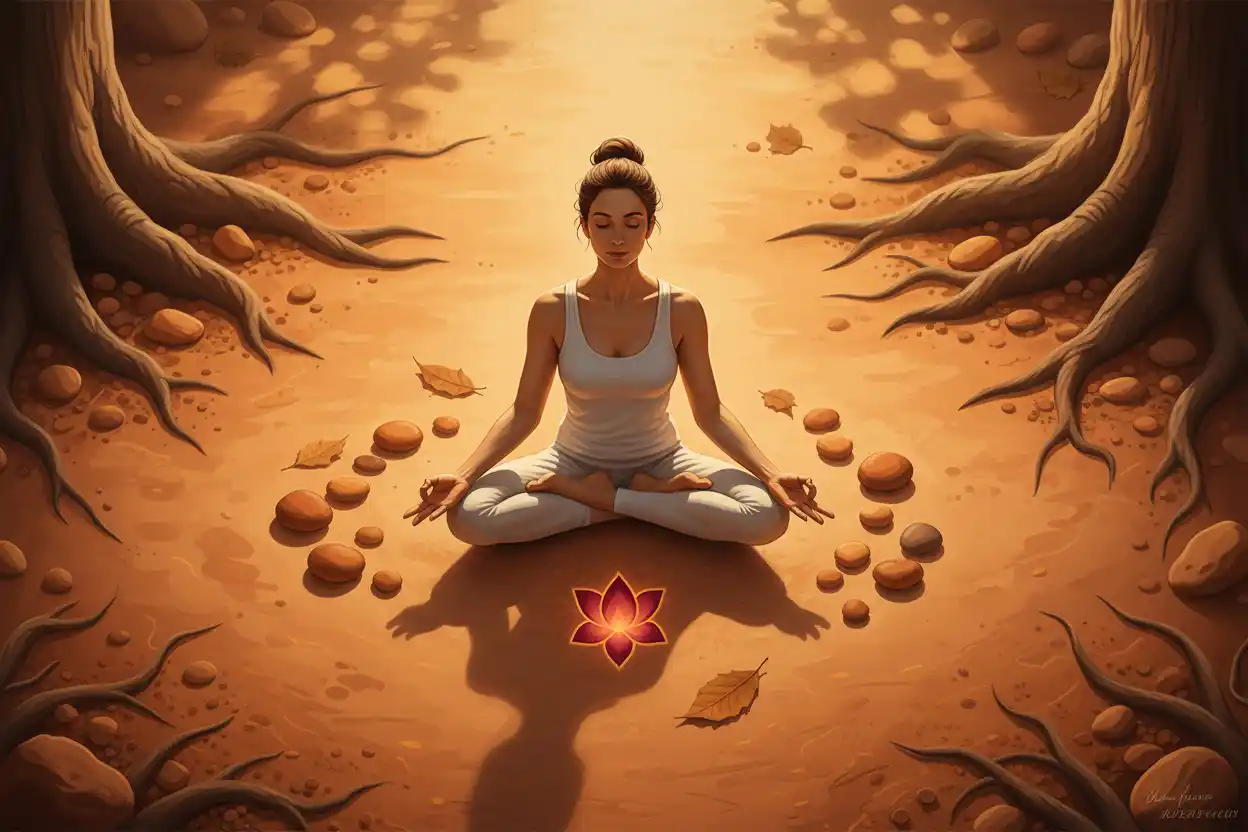

The root chakra is known as Muladhara, a Sanskrit term commonly translated as “root support” or “root foundation.” In contemporary seven-chakra practice, it is treated as the first energy center and associated with physical presence, safety, shelter, belonging and the practical conditions that support life.
Modern illustrations commonly place it at the base of the spine or pelvic floor and represent it with red, a four-petaled lotus and the earth element. However, chakra systems developed across diverse Hindu and Buddhist traditions, and historical texts did not all use one fixed arrangement, color scheme or set of interpretations.
The root chakra belongs to a spiritual subtle-body framework rather than physical anatomy. References to opening, healing or balancing it describe religious, meditative or symbolic practices. They should not be used to diagnose pain, anxiety, digestive symptoms or other medical conditions.
This page owns the root chakra itself: its history, symbolism, themes, reflective practices and balancing framework. The dedicated root chakra crystals guide owns the full stone list and crystal-selection intent.
Root Chakra at a Glance
| Aspect | Common modern association |
|---|---|
| Sanskrit name | Muladhara or Mooladhara |
| General translation | Root support, root foundation or base |
| Position in modern seven-chakra system | First chakra |
| Symbolic location | Base of the spine, pelvic floor or lower body |
| Color | Red |
| Element | Earth |
| Lotus symbol | Four petals |
| Seed syllable | Lam in many modern and tantric presentations |
| Main themes | Safety, stability, survival, shelter, belonging, resources and embodiment |
| Balanced expression | Practical steadiness, grounded attention and flexible security |
| Underactive description | Disconnection, instability, avoidance and difficulty creating routine |
| Overactive description | Rigidity, control, hoarding, resistance to change or excessive material fixation |
| Common practices | Meditation, grounding, movement, breath, practical planning and symbolic crystal work |
These associations vary among schools. They should be presented as traditions rather than universal biological facts.
What Is the Root Chakra?
The root chakra is the foundational center in the familiar modern sequence of seven chakras.
Within subtle-body traditions, chakras are described as centers or intersections within a non-physical network of channels and energies. Their purpose and number vary across lineages.
In the popular seven-center model, the root chakra forms the base beneath the sacral chakra, solar plexus, heart, throat, third eye and crown.
Its themes address the practical question: What allows a person to feel sufficiently supported to participate in life?
That support may involve housing, food, physical safety, predictable routines, financial resources, social belonging and trust in one’s ability to respond to ordinary problems.
A root-chakra practice can therefore be spiritual while remaining strongly practical.
Historical Context
Chakra ideas developed within South Asian religious and yogic traditions over centuries.
Some systems described four, five, six or more centers. A six-chakra arrangement with an additional lotus above the head became influential in later tantric and yogic literature.
The contemporary rainbow-colored seven-chakra chart reflects later synthesis and global yoga culture. It should not be projected backward as the single original system.
Muladhara is commonly described as the lower foundational center from which subtle channels or ascending practices begin.
Respectful practice recognizes these origins rather than presenting chakras as newly discovered scientific organs.
Meaning of Muladhara
Mula means root.
Adhara refers to support, foundation, base or receptacle.
Together, the name suggests the supporting root of a system.
The symbolism resembles a building foundation. Higher development cannot remain stable when basic support is neglected.
This does not mean that spiritual practice requires wealth, perfect health or complete certainty. It means that food, rest, safety, boundaries and material realities deserve attention rather than being dismissed as less spiritual.
The root image also suggests connection with place, ancestry, land and the conditions from which a person has grown.
Root Chakra Symbol
Modern images usually show a red lotus with four petals.
A square inside the symbol represents earth, solidity and structure. An inverted triangle and other tantric elements may appear in more detailed traditional diagrams.
The seed syllable Lam is associated with the center in many teachings.
Symbols function as contemplative tools. Their meaning arises from practice, text, lineage and interpretation rather than from a measurable physical emission.
A person can work with the root-chakra themes without reproducing every visual element.
Why Red Is Associated With the Root Chakra
Red evokes blood, warmth, visibility, danger, life, action and physical intensity.
In the modern rainbow sequence, it becomes the lowest-frequency visible color and anchors the progression toward violet at the crown.
This color mapping is influential but not universal across historical traditions.
Red stones such as red jasper and garnet became popular symbolic tools because their appearance fits the chakra’s contemporary color.
The larger color family appears in red crystals.
Color can support visualization, but it does not prove that an object affects a chakra biologically.
The Earth Element
The earth element represents solidity, weight, structure and practical support.
A root-chakra meditation may focus on the contact between the body and the floor, the pressure of the feet against the ground or the stability of a chair.
The earth association also extends to home, land, food, work and material resources.
Balance does not mean becoming immovable. Healthy stability allows adaptation because a person has enough support to respond without collapsing.
Excessive attachment to certainty can become rigidity, while lack of structure can create avoidable instability.
Root Chakra Themes
Safety
Safety includes protection from immediate harm and the ability to recognize unsafe conditions realistically.
Spiritual language should never be used to tell someone that danger exists only because of their mindset or blocked energy.
Practical safety planning, legal support, healthcare and emergency assistance take priority when needed.
Shelter and Home
The root chakra is associated with the physical environment that supports rest and daily life.
Cleaning one small area, repairing something broken or organizing essential documents can become a grounding practice.
Food and Physical Needs
Eating regularly, resting and attending to health are practical forms of embodiment.
A chakra practice should not encourage restrictive eating, ignoring symptoms or replacing medical advice.
Resources
Money, transportation, employment, time and access to support influence felt security.
A realistic budget or assistance application may be more meaningful root work than an elaborate ritual.
Belonging
Belonging can involve family, community, culture, friendship or connection with place.
A healthy sense of belonging does not require tolerating mistreatment to remain included.
Boundaries
Boundaries protect time, safety, energy and consent.
They help distinguish grounded compassion from self-abandonment.
What Does a Balanced Root Chakra Mean?
In spiritual language, a balanced root chakra represents enough stability to participate in life without demanding complete certainty.
A person may feel connected with the body, aware of practical needs and capable of addressing ordinary responsibilities.
Routines provide support without becoming inflexible.
Possessions and money are treated as tools rather than the sole source of identity.
Change may still feel uncomfortable, but it does not automatically destroy the sense of self.
This description is an interpretive ideal, not a psychological diagnosis or permanent state.
Signs Commonly Described as an Underactive Root Chakra
Practitioners may use “underactive” to describe patterns such as disconnection from the body, difficulty maintaining routines, avoidance of practical responsibilities or a persistent sense of not belonging.
Someone may move frequently between plans without establishing the basic conditions required to complete them.
The term can also be used when spiritual practice becomes an escape from financial, domestic or health responsibilities.
These experiences have many possible causes, including stress, trauma, disability, poverty and mental or physical illness.
They should not be reduced to one chakra explanation.
Signs Commonly Described as an Overactive Root Chakra
“Overactive” usually refers to security-seeking that has become rigid.
Examples include excessive control, hoarding, fear of change, defining identity through possessions or remaining in familiar situations solely because they are familiar.
A person may focus on worst-case scenarios even after reasonable preparation is complete.
This framework can support reflection, but it is not a clinical category.
Severe anxiety, compulsive behavior or impairment deserves qualified professional assessment.
Root Chakra Healing
The phrase root chakra healing describes spiritual practices intended to restore a felt sense of grounding and foundational support.
Responsible practice combines symbolism with observable actions.
A meditation about security can be followed by checking a door lock, making a budget, arranging transport or contacting a support service.
A grounding crystal can sit beside a written routine rather than being expected to create stability on its own.
Healing language should not imply that illness, poverty or trauma resulted from spiritual failure.
Many forms of insecurity arise from external conditions that require practical, social or political solutions.
Root Chakra Meditation
Sit or stand in a stable position.
Notice where the body meets the floor, chair or ground.
Allow the breath to remain natural before gradually lengthening the exhalation without strain.
Imagine weight moving downward through the legs and feet. A red square, roots or earth can be used as symbolic imagery.
Ask one practical question: What would increase stability slightly today?
The answer might be eating, resting, making a call, organizing medication, reviewing expenses or asking for help.
End the meditation by completing one manageable action.
A Five-Minute Root Chakra Practice
During the first minute, notice the physical points of support beneath the body.
During the second, observe the breath without changing it aggressively.
During the third, name three facts about the present environment. This keeps attention connected with what is actually occurring.
During the fourth, identify one current need and one available resource.
During the fifth, choose a small action that can be completed today.
The practice does not require sensing energy, heat or vibration. Attention and intention are sufficient.
Root Chakra Breathing
Slow comfortable breathing can accompany root-chakra meditation.
Avoid extreme breath retention, rapid breathing or forceful techniques without qualified instruction, particularly when health conditions are present.
A simple pattern is to inhale comfortably and allow the exhalation to become slightly longer.
The goal is not to produce dizziness, tingling or an altered state.
Breath supports attention. It should never become a test of spiritual ability.
Movement and Yoga
Standing postures, supported squats, gentle forward folds and slow walking are commonly used in grounding practices.
The symbolic focus remains on contact, balance and weight distribution.
Movement should be adapted to the person’s body, mobility and health.
Pain is not evidence that a chakra is opening. Stop a posture that causes sharp pain, numbness or loss of balance.
Chair-based movement and simple foot awareness can provide the same grounding symbolism without requiring advanced flexibility.
Walking as Root-Chakra Practice
Walking creates repeated contact between the feet and the ground.
A mindful walk can focus on pace, temperature, sound and the shifting pressure beneath each foot.
The practice does not need to occur barefoot. Shoes may be necessary for safety, disability support, climate or local conditions.
Walking in a familiar indoor space can be as meaningful as a natural trail.
The purpose is attentive embodiment, not proving a stronger connection with Earth through discomfort.
Practical Grounding
Root-chakra work becomes more useful when it includes material reality.
Practical grounding may involve:
- Preparing food for the next day
- Reviewing upcoming bills
- Organizing identification and essential records
- Repairing a broken household item
- Setting a sleep schedule
- Cleaning one usable surface
- Confirming transport for an appointment
- Contacting someone trustworthy
These actions are not less spiritual than visualization. They embody the chakra’s themes directly.
Financial Grounding
Money can create intense insecurity, so financial practices should remain realistic and non-shaming.
Begin with current facts: income, essential expenses, debt, deadlines and available support.
A root-chakra ritual might involve sitting with a grounding stone while opening financial documents that have been avoided.
The stone does not create income or remove debt. It can mark the decision to look clearly at the situation.
Professional financial, legal or social-service assistance may be appropriate when the problem exceeds personal planning.
Home Grounding
A stable home practice does not require an ideal or expensive space.
Choose one small area that can be made more functional.
Clear an exit, wash bedding, organize medication, place keys consistently or create a safe location for important documents.
These actions reduce friction in daily life and strengthen practical support.
Housing insecurity is not a spiritual imbalance. People facing unsafe or unstable accommodation need material assistance, not blame.
Root Chakra Affirmations
Affirmations should remain believable and connected with action.
Useful examples include:
“I can respond to today’s needs one step at a time.”
“I am allowed to create boundaries that support safety.”
“My body deserves food, rest and care.”
“I can ask for practical help.”
“I build stability through repeated choices.”
The crystal-programming guide explains how to pair an intention with a symbolic object.
An affirmation should not deny real danger or demand that fear disappear immediately.
Root Chakra Stones
Red, black and brown stones are commonly associated with the root chakra.
Red jasper represents endurance and practical action. Black tourmaline and obsidian are used in protection-centered traditions. Smoky quartz and hematite are associated with grounding, while garnet represents commitment and vitality.
This page does not own the complete list. The dedicated root chakra crystals guide compares stones, physical properties and traditional uses.
The broader best crystals for grounding guide addresses grounding by intention rather than by one chakra.
Root Chakra and Garnet
Garnet’s deep red color aligns naturally with the modern root-chakra palette.
Traditional garnet symbolism emphasizes protection, endurance and commitment.
The dedicated garnet chakra guide owns garnet’s relationship with different energy centers and varieties.
A garnet can be worn or held as a reminder of commitment, but it does not correct blood, reproductive or circulatory conditions.
Root Chakra and Black Stones
Black stones are often associated with boundaries, protection and absorption symbolism.
The category includes black tourmaline, black obsidian, onyx and several unrelated minerals.
Their shared color does not mean they have the same composition, safety or care requirements.
The black-crystals guide organizes the broader color family.
Black should not be framed as spiritually negative. In many practices, it represents depth, protection and containment.
Root Chakra and Brown Stones
Brown stones emphasize earth, soil, wood and practical stability.
Tiger’s eye, smoky quartz, petrified wood and brown jasper are common examples.
Their symbolism can feel less intense than vivid red and less defensive than black.
The complete color family appears in brown crystals.
A person may choose by visual resonance rather than following one mandatory list.
Root Chakra Versus Sacral Chakra
The root chakra focuses on support, safety, embodiment and basic stability.
The sacral chakra focuses more strongly on emotion, creativity, pleasure and connection.
Red jasper is often assigned to the root, while orange carnelian is frequently assigned to the sacral chakra.
The boundary is interpretive rather than absolute. Red-orange stones can appear in both systems.
The dedicated sacral chakra crystals guide owns the creativity-centered list.
Root Chakra Versus Solar Plexus Chakra
The solar plexus chakra is commonly associated with identity, choice, confidence and personal power.
The root asks whether enough support exists to act. The solar plexus asks how action is directed.
A person may need practical stability before confidence practices become sustainable.
Yellow and gold stones dominate the modern solar-plexus palette, while red, black and brown dominate root-chakra symbolism.
Root Chakra Versus Heart Chakra
The heart chakra emphasizes compassion, love, grief and connection.
The root chakra emphasizes the support and boundaries that make connection safer.
A relationship practice that ignores physical safety or material dependence may need root-centered attention before heart-centered reconciliation.
The two themes complement one another rather than existing as competing spiritual levels.
Cleansing Root Chakra Crystals
No cleansing method suits every stone.
Quartz-based jasper and smoky quartz tolerate different conditions from soft calcite, metallic hematite or porous lava rock.
The completed how to cleanse crystals guide explains symbolic methods while respecting physical care.
The crystal water-safety guide should be checked before soaking any material.
Dry placement, intention-setting, sound used at a distance and gentle wiping avoid many common risks.
When Root-Chakra Practice Is Not Enough
A spiritual practice may support reflection, but it does not replace emergency, medical, psychological, legal or financial assistance.
Persistent panic, pain, dizziness, digestive problems, sleep disruption or inability to function should not be attributed automatically to a blocked chakra.
Threats, abuse and housing insecurity require safety-oriented support.
Food insecurity and debt require material resources.
Seeking professional help is compatible with spiritual practice. It is not evidence of failure to balance the chakra independently.
Frequently Asked Questions
1. What is the root chakra?
It is the foundational energy center in the modern seven-chakra system, associated with safety, stability, embodiment and material support.
2. What does Muladhara mean?
It is commonly translated as root support, root foundation or base.
3. Where is the root chakra located?
Modern descriptions place it symbolically near the base of the spine or pelvic floor. It is part of subtle-body practice rather than physical anatomy.
4. What color represents the root chakra?
Red is the dominant modern association, although historical systems did not all use the same color mapping.
5. What element is connected with the root chakra?
Earth is the traditional element associated with structure, weight and stability.
6. What does a balanced root chakra feel like?
Practitioners describe practical steadiness, connection with the body, flexible routines and a sufficient sense of support.
7. What does a blocked root chakra mean?
It is a spiritual description for patterns such as instability, disconnection or avoidance. It is not a medical diagnosis.
8. Which crystals are used for the root chakra?
Red jasper, black tourmaline, smoky quartz, hematite, garnet and obsidian are common traditional choices.
9. What is the root-chakra seed mantra?
Lam is commonly associated with Muladhara in many teachings.
10. Can yoga balance the root chakra?
Standing, walking and grounded movement can support chakra meditation symbolically, but physical limits and medical guidance still apply.
11. Can root-chakra healing cure anxiety?
No. Chakra practice may support reflection or relaxation, but anxiety disorders require appropriate professional assessment and treatment.
12. How often should root-chakra meditation be practiced?
A short regular practice can be more useful than an occasional intense ritual. Frequency should fit the person’s comfort and routine.
Root-chakra work is strongest when symbolism and practical reality support one another. Red visualization, mantra, meditation and crystals can create meaningful ritual, but housing, food, boundaries, rest and access to help form the foundation those symbols represent.
The root chakra is a spiritual subtle-body concept, not a medical organ. Chakra balancing should not replace healthcare, mental-health treatment, safety planning or practical support.