

The sacral chakra is commonly known by the Sanskrit name Svadhisthana. Within the familiar modern seven-chakra model, it is treated as the second energy center and associated with emotion, creativity, pleasure, sexuality, relationships and the ability to adapt without losing personal boundaries.
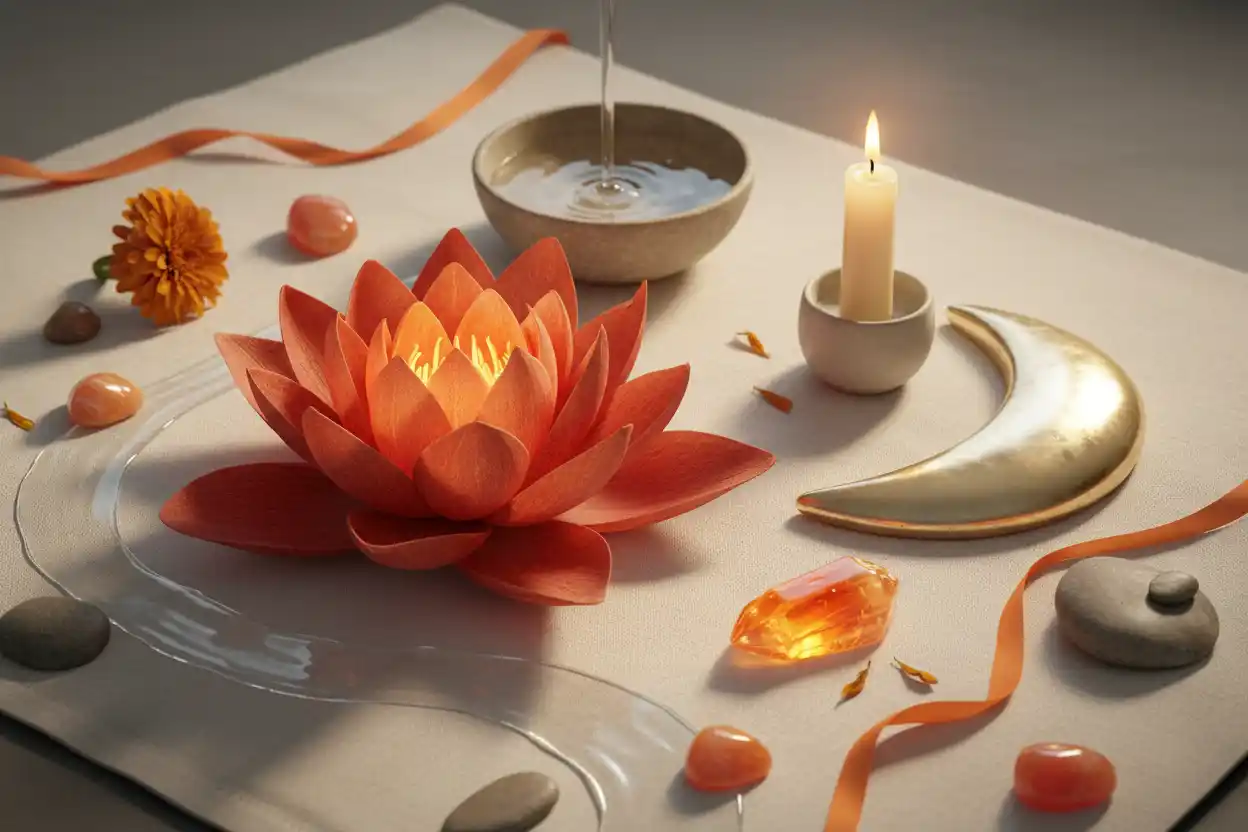
Modern illustrations usually place it in the lower abdomen and color it orange. Earlier tantric descriptions were not identical to this popular rainbow presentation. Svadhisthana was represented through a six-petaled lotus, a crescent or water region, the seed syllable Vam and other ritual symbols that varied by lineage and text.
The chakra belongs to a spiritual subtle-body framework rather than physical anatomy. A blocked or unbalanced sacral chakra is therefore an interpretive description, not a diagnosis of infertility, bladder disease, menstrual problems, sexual dysfunction or a mental-health condition.
This page focuses on Svadhisthana itself: its symbolism, history, themes and reflective practices. The full comparative stone list belongs in Sacral Chakra Crystals.
Sacral Chakra at a Glance
| Aspect | Common association |
|---|---|
| Sanskrit name | Svadhisthana or Svadhishthana |
| Position in modern seven-chakra model | Second chakra |
| Symbolic location | Lower abdomen, pelvis or region below the navel |
| Modern color | Orange |
| Traditional lotus | Six petals |
| Element | Water |
| Seed syllable | Vam |
| Symbol | Crescent or water region |
| Main themes | Emotion, pleasure, creativity, sexuality, adaptability and connection |
| Balanced expression | Emotional awareness, flexible boundaries and healthy enjoyment |
| Underactive description | Emotional numbness, creative avoidance or discomfort with pleasure |
| Overactive description | Compulsion, emotional flooding, possessiveness or unstable boundaries |
| Common practices | Meditation, movement, art, journaling, water imagery and boundary work |
These associations vary among traditions. They describe a spiritual framework rather than measurable biological structures.
What Does Svadhisthana Mean?
The Sanskrit components are commonly interpreted as sva, meaning one’s own, and adhisthana, meaning seat, base, dwelling or established place.
Translations therefore include one’s own abode, one’s own seat and the place where the self is established.
The name suggests an interior place of experience rather than a physical organ.
In contemporary practice, that symbolism is associated with the ability to notice desire, emotion and pleasure without becoming controlled by them.
The chakra is not simply about sexuality. It concerns the wider question of how a person relates to sensation, change, attachment and creative movement.
Historical Context
Chakra systems developed within diverse South Asian tantric, yogic and Buddhist traditions.
Historical texts did not all describe the same number of centers or assign the same colors and psychological meanings.
The six-plus-one arrangement that influenced many later presentations placed several lotuses along a subtle central channel, with another center above.
The standardized red-to-violet rainbow system familiar today reflects later synthesis, popular yoga and Western esoteric interpretation.
Respectful practice acknowledges those layers rather than presenting one modern diagram as an unchanged universal map.
The Six-Petaled Lotus
Svadhisthana is traditionally represented as a lotus with six petals.
The petals may carry Sanskrit syllables and are interpreted differently across schools.
The number six is part of the ritual iconography rather than a measurable anatomical feature.
A practitioner can use the lotus as a meditation image without claiming that a six-petaled structure exists inside the pelvis.
The symbol can represent several emotional tendencies becoming organized around one center of awareness.
The Water Element
Water is the element most strongly associated with the sacral chakra.
It symbolizes movement, adaptation, sensation and the way emotion changes shape according to circumstances.
Healthy flexibility does not mean accepting every demand. Water can flow, collect, recede and form boundaries.
A sacral practice may therefore ask whether a person is adapting thoughtfully or simply abandoning their own needs to avoid conflict.
Water imagery can support meditation, but physical contact with water is not required.
The Orange Color
Orange is the dominant modern sacral-chakra color.
It combines the activity associated with red and the brightness associated with yellow, making it a useful symbol for warmth, participation and creativity.
Earlier textual iconography often emphasized vermilion, white, lunar and water imagery rather than the exact modern orange assigned on a rainbow chart.
Both systems can be discussed without claiming they are historically identical.
The wider symbolic color family appears in Orange Crystals and Orange Gemstones.
The Seed Mantra Vam
Vam is commonly associated with Svadhisthana.
In mantra practice, the syllable may be repeated aloud, whispered or contemplated mentally.
Pronunciation and ritual use differ across traditions, so learners seeking formal practice should study with a qualified teacher from the relevant lineage.
A simple modern meditation may use the sound as a focus for breathing and attention.
The mantra should not be forced or used to produce dizziness, pain or extreme altered states.
Sacral Chakra Themes
Emotion
The sacral chakra is associated with recognizing and moving through emotion.
Balance does not mean feeling pleasant all the time. It means noticing a feeling, understanding what it may communicate and choosing a proportionate response.
Pleasure
Pleasure includes rest, food, art, touch, play, nature and satisfying work.
Healthy pleasure is consensual, sustainable and compatible with responsibilities.
Creativity
Creativity involves experimenting, combining ideas and tolerating imperfect first attempts.
It is broader than professional art and can appear in problem-solving, cooking, design, conversation and daily adaptation.
Sexuality
Sacral symbolism includes sexuality, desire and intimacy.
Responsible practice must center consent, safety, personal orientation and individual boundaries.
Relationships
The chakra is associated with connection and emotional exchange.
Healthy connection allows closeness without requiring loss of identity.
Adaptability
Water symbolism emphasizes adjustment.
Flexible response differs from chronic instability or changing oneself continually to gain approval.
What Does a Balanced Sacral Chakra Mean?
A balanced sacral chakra is described as an ability to experience emotion and pleasure without becoming overwhelmed or numb.
Creativity can move from imagination into experimentation.
Relationships include both connection and boundaries.
Desire can be acknowledged without controlling every decision.
A person may be able to enjoy rest without intense guilt and work without demanding constant productivity.
This is a spiritual ideal rather than a permanent psychological state.
Everyone experiences changes in mood, creativity, desire and social energy.
Underactive Sacral Chakra
Practitioners use the term underactive for patterns such as emotional numbness, avoidance of pleasure, rigid routine, creative inhibition and difficulty accepting change.
A person may dismiss every enjoyable activity as unproductive or feel uncomfortable expressing preferences.
These experiences can also arise from stress, depression, trauma, medication, disability, exhaustion or social circumstances.
They should not be reduced to one chakra explanation.
Persistent emotional numbness, loss of interest or inability to function deserves professional assessment.
Overactive Sacral Chakra
An overactive sacral chakra is commonly described through emotional flooding, impulsive pleasure-seeking, possessiveness, unstable attachments or difficulty maintaining limits.
The idea can support reflection on whether a short-term feeling is directing a long-term decision.
However, the term is not a diagnosis of addiction, mania, personality disorder or sexual behavior.
Compulsive behavior and unsafe impulsivity require appropriate clinical or practical support.
Spiritual language should never be used to shame consensual sexuality or diverse relationship structures.
Sacral Chakra Healing
Sacral chakra healing refers to practices intended to restore a healthier relationship with emotion, pleasure and creativity.
A responsible approach combines ritual with observable action.
Meditation about creativity can be followed by ten minutes of drawing, writing or problem-solving.
A practice about boundaries can be followed by a clear conversation or a decision to delay one.
A ritual involving pleasure can include planning rest that does not create harm or avoid essential responsibilities.
Healing does not mean forcing happiness. It means making more room for honest feeling and deliberate choice.
Sacral Chakra Meditation
Sit in a stable, comfortable position.
Notice the breath without pushing it deeply into the abdomen.
Imagine a gentle orange or vermilion light, a crescent moon or a pool of calm water.
Name one emotion currently present.
Instead of judging it, ask what information it may contain.
Then identify one action that respects both the feeling and the wider situation.
End the practice by returning attention to the room and completing the chosen step.
A Water-Visualization Practice
Imagine a clear container of water.
Notice whether the surface appears still, turbulent, shallow or overflowing.
Use the image as a metaphor rather than a supernatural diagnosis.
Ask what would help the water move more freely without spilling into areas that need protection.
The answer may be rest, expression, support, exercise, a creative outlet or a boundary.
Write the response before the image fades.
Physical immersion is optional and should be avoided when swimming conditions, health or access make it unsafe.
Movement and the Sacral Chakra
Slow rhythmic movement is often used in sacral practice.
Walking, swaying, dance and gentle hip mobility can emphasize fluidity and coordination.
Movement should be adapted to the person’s body and ability.
Pain, dizziness or numbness is not evidence that the chakra is opening.
Chair-based movement, hand gestures or music-guided breathing can provide the same symbolic quality for someone who cannot perform standing poses.
The goal is responsive movement, not flexibility performance.
Creativity as Sacral Practice
Creative work gives sacral symbolism a practical form.
Choose an activity with a low cost of failure.
Write one paragraph, sketch for five minutes, rearrange a room, try a recipe or generate several imperfect solutions to a problem.
The process should emphasize experimentation rather than evaluation.
Finishing a polished product is not required.
The comparative stone list for this intention appears in Best Crystals for Creativity and Inspiration.
Pleasure Without Guilt
Some people find it difficult to enjoy anything unless it produces income, status or measurable improvement.
Sacral-chakra practice can challenge that pattern by allowing limited, intentional enjoyment.
Pleasure does not need to be excessive to be meaningful.
A warm drink, music, a comfortable texture, time outdoors or a conversation can be sufficient.
The practice should remain compatible with health, consent, finances and responsibilities.
Guilt may contain useful information, but it should not govern every harmless source of enjoyment.
Sacral Chakra and Sexuality
Sexuality is one sacral-chakra theme, not the entire chakra.
Practices should respect consent, privacy, orientation, gender identity, cultural context and personal boundaries.
No crystal, meditation or mantra can create another person’s attraction or consent.
Sexual pain, dysfunction, fertility concerns or reproductive symptoms require qualified healthcare.
A spiritual practice may support reflection on communication and values, but it cannot diagnose or treat a physical condition.
Sacral Chakra and Relationships
The sacral chakra is associated with emotional exchange and attachment.
Balanced connection allows closeness without demanding constant access.
A reflective practice may ask whether a relationship permits honesty, pleasure, disagreement and personal space.
Strong attraction does not automatically indicate compatibility.
Likewise, emotional intensity should not be mistaken for spiritual destiny.
The neighboring heart chakra emphasizes compassion, while sacral work focuses more closely on desire, enjoyment and relational movement.
Sacral Chakra Versus Root Chakra
The root chakra focuses on safety, embodiment, shelter and foundational support.
The sacral chakra focuses on movement, feeling, pleasure and connection.
Root work asks whether enough stability exists. Sacral work asks how a person moves and relates within that stability.
The two themes often need to operate together.
Pleasure becomes difficult when basic safety is absent, while rigid security can suppress exploration.
Their stone lists are separated in Root Chakra Crystals and the sacral-crystal guide.
Sacral Chakra Versus Solar Plexus Chakra
The solar plexus chakra is associated with identity, confidence, choice and directed will.
Sacral symbolism emphasizes desire and creative possibility.
Solar-plexus symbolism emphasizes deciding what to do with that possibility.
A creative idea may begin in sacral exploration and require solar-plexus confidence to become a finished project.
Their modern color systems also overlap near orange and yellow.
The corresponding confidence-centered list appears in Solar Plexus Chakra Crystals.
Sacral Chakra Crystals
Carnelian is the best-known modern sacral stone because of its orange-red color and traditions involving motivation and creativity.
Orange Calcite is associated with gentle emotional movement, while Sunstone represents participation and confidence.
Peach Moonstone and Moonstone are commonly used for reflective and cyclical symbolism.
The complete mineral comparison, care requirements and combinations remain in the dedicated crystal-list article.
How to Use a Sacral Chakra Crystal
Choose one stone whose physical care requirements suit the intended use.
Hold it during meditation, place it beside creative materials or wear it as jewelry.
Assign one specific intention.
For example, “I will write for fifteen minutes” is clearer than “open my creativity.”
Review whether the object helped you remember and perform the action.
The stone does not need to be felt as warm, vibrating or energetic for the practice to be meaningful.
Sacral Chakra Affirmations
Affirmations should support realistic choices.
Examples include:
“I can notice my feelings without obeying every impulse.”
“I am allowed to enjoy experiences that do not harm me or others.”
“I can create before I know whether the result will be good.”
“My boundaries can remain flexible without disappearing.”
“I can communicate desire and listen for consent.”
“I make room for both pleasure and responsibility.”
For a structured intention process, use How to Program Crystals.
Cleansing Sacral Chakra Stones
Sacral stones have different mineral properties.
Carnelian and most quartz-based materials tolerate different conditions from calcite, amber and moonstone.
Do not place an entire orange collection in water or sunlight under one universal rule.
The completed How to Cleanse Crystals guide compares symbolic methods.
The crystal water-safety guide explains why brief washing, soaking and elixir preparation are separate questions.
When Spiritual Practice Is Not Enough
A chakra practice cannot replace healthcare, psychotherapy, relationship safety or addiction treatment.
Pelvic pain, menstrual changes, urinary symptoms, fertility concerns and sexual dysfunction require medical assessment.
Persistent emotional numbness, severe impulsivity, depression or trauma symptoms also deserve qualified support.
Seeking help is compatible with spiritual practice.
A chakra framework can supply language and ritual, while professionals provide diagnosis, treatment and practical safety.
Frequently Asked Questions
1. What is the sacral chakra?
It is the second center in the popular seven-chakra system and is associated with emotion, creativity, pleasure, sexuality and adaptability.
2. What does Svadhisthana mean?
It is commonly translated as one’s own seat, abode or established place.
3. Where is the sacral chakra located?
Modern practice places it symbolically in the lower abdomen or pelvic region. It is not a physical organ.
4. What color represents the sacral chakra?
Orange is the dominant modern color, although earlier iconography also used vermilion, white, lunar and water symbolism.
5. What element belongs to the sacral chakra?
Water is its most common traditional element.
6. How many petals does the sacral-chakra lotus have?
Svadhisthana is commonly represented with six petals.
7. What is the sacral-chakra mantra?
Vam is the seed syllable commonly associated with it.
8. What does a balanced sacral chakra mean?
It describes a flexible relationship with emotion, pleasure, creativity and connection while maintaining boundaries.
9. What are signs of a blocked sacral chakra?
Spiritual descriptions include numbness, creative inhibition and discomfort with pleasure, but these are not medical diagnoses.
10. Which crystal is most associated with the sacral chakra?
Carnelian is the most widely used modern choice.
11. Can sacral-chakra work treat fertility or reproductive problems?
No. Chakra practice cannot diagnose or treat reproductive, urinary or sexual-health conditions.
12. How often should sacral-chakra meditation be practiced?
Short regular sessions can be used when helpful, but there is no medically required schedule or universal spiritual frequency.
The sacral chakra is best understood as a framework for examining movement: how emotion moves, how creativity develops, how desire is communicated and how relationships change. Its water symbolism becomes most useful when flexibility remains connected with consent, safety and clear boundaries.
For a wider overview of all energy-center stones, see Best Crystals for Chakras. Related intention roundups include Best Crystals for Motivation and Best Crystals for Confidence.
The sacral chakra is a spiritual subtle-body concept, not a medical organ. Chakra practices should not replace healthcare, mental-health treatment, reproductive care, consent or relationship safety.