
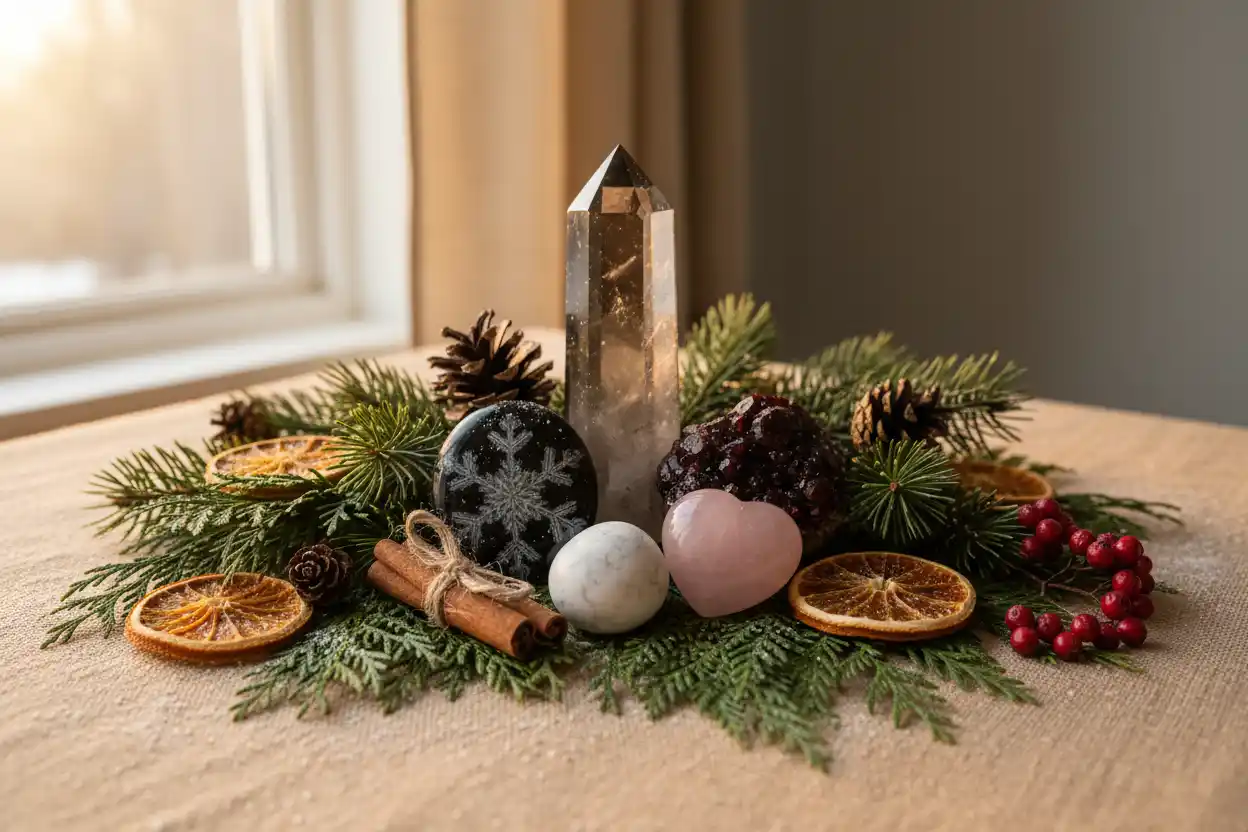

Winter crystals are traditionally associated with grounding, rest, reflection and the quieter work of preparing for a new cycle. Dark stones such as smoky quartz and snowflake obsidian reflect the season’s introspective mood, while rose quartz, clear quartz and almandine garnet add warmth, compassion and direction.
Crystals cannot treat seasonal depression, regulate body temperature or prevent winter illness. However, they may provide meaningful visual cues for slowing down, maintaining supportive routines and deciding what deserves attention before the next season begins.
Best Winter Crystals at a Glance
| Crystal | Traditional winter theme | Best seasonal use | Practical reminder |
|---|---|---|---|
| Smoky quartz | Grounding, release and perspective | Decompressing after demanding days | Separate action from repetitive worry |
| Snowflake obsidian | Balance, patterns and acceptance | Reviewing the year honestly | Notice patterns without harsh judgment |
| Howlite | Patience and slower mental pace | Evening routines and quiet periods | Allow rest without demanding instant calm |
| Clear quartz | Clarity and intention | Choosing a winter priority | Define one observable goal |
| Rose quartz | Compassion and emotional warmth | Self-care and close relationships | Respond fairly to reduced capacity |
| Chevron amethyst | Reflection and contemplation | Journaling and brief meditation | Keep reflection structured and time-limited |
| Red jasper | Stability and consistent action | Maintaining essential routines | Use sustainable effort |
| Moonstone | Cycles and changing needs | Tracking seasonal adjustments | Observe patterns before interpreting them |
| Black tourmaline | Boundaries and grounding symbolism | Protecting rest and private time | Communicate and maintain limits |
| Almandine garnet | Warmth, commitment and endurance | Sustaining valued relationships and goals | Connect intensity with steady behavior |
Why Certain Crystals Suit Winter Symbolism
Winter often represents stillness, preservation and inward attention. Plants may become dormant, daylight may shorten and everyday routines can change because of weather, holidays or reduced outdoor activity.
These seasonal experiences vary by climate and hemisphere. December through February occur during winter across much of the Northern Hemisphere, while those months belong to summer in much of the Southern Hemisphere.
Therefore, winter crystal practices should follow actual local conditions rather than a fixed social-media calendar. Someone living in a mild climate may focus on reflection and year-end transitions, while another person may need stronger attention to physical safety, isolation and disrupted travel.
Crystals do not absorb cold, darkness or seasonal energy scientifically. Their role remains symbolic and behavioral.
1. Smoky Quartz for Winter Grounding
Smoky quartz is one of the strongest winter crystals because its dark translucent color reflects the season’s quieter visual palette.
Traditional meanings connect it with grounding, release and practical perspective. It may support the transition from work, caregiving or holiday demands into private recovery time.
At the end of the day, write down any responsibility that still requires action. Then identify when it will be reviewed and put the list away.
Smoky quartz can mark the decision to stop solving tomorrow’s problems during tonight’s rest period.
The stone does not remove stress or negative energy independently. Instead, the routine prevents unfinished concerns from remaining mentally active without structure.
2. Snowflake Obsidian for Recognizing Patterns
Snowflake obsidian combines black volcanic glass with pale cristobalite patterns that resemble snowflakes.
It is traditionally associated with balance, pattern recognition and acceptance of contrasting experiences. Those themes make it useful for a winter review.
Choose one area of the past season or year. Record what repeated, what changed and which result deserves a different response.
Avoid turning reflection into a list of personal failures. A useful review identifies behavior and circumstances accurately enough to guide the next decision.
Obsidian can chip and develop sharp edges, so keep it on a protected surface rather than carrying a damaged piece loosely.
3. Howlite for a Slower Winter Pace
Howlite is traditionally associated with patience, awareness and reduced reactivity.
Winter schedules may slow naturally, yet some people respond by filling every open period with work, planning or digital activity. Howlite can symbolize allowing part of the day to remain unproductive.
Place it near a reading chair, evening journal or device-charging area. When the stone becomes visible, begin a quieter activity without demanding a particular emotional result.
Rest does not need to feel peaceful immediately to remain useful. The body and mind may take time to shift after prolonged activity.
Howlite is porous and often dyed, so keep it away from soaking, oils and wet winter clothing.
4. Clear Quartz for a Winter Intention
Clear quartz is commonly used for intention-setting. It can prevent winter reflection from remaining vague.
Choose one realistic priority for the season. Examples include maintaining social contact, completing a defined home project, protecting a regular bedtime or preparing for an upcoming transition.
Write the intention in observable language and place the stone beside it.
“Use winter to transform my life” offers little direction. “Call one supportive person each week” or “finish the first draft by March” provides a clear action.
Clear quartz does not amplify an intention scientifically. It keeps the chosen direction visible.
5. Rose Quartz for Emotional Warmth
Rose quartz is traditionally associated with compassion, affection and emotional gentleness.
Winter may increase loneliness, family pressure or frustration about reduced energy. Rose quartz can support a fair response to those circumstances.
Ask what care is realistically needed now. The answer may involve rest, practical assistance, direct communication or professional support.
Compassion should not become forced positivity. Someone can acknowledge that winter feels difficult without treating the entire season as a personal failure.
The drafted guide to crystals for self love explores compassionate self-respect more broadly.
6. Chevron Amethyst for Structured Reflection
Chevron amethyst combines purple amethyst and white quartz in distinctive bands.
Traditional symbolism connects it with contemplation, spiritual reflection and inner awareness. It can accompany a short winter meditation or journal review.
Use one question and one time limit. For example: “Which responsibility no longer deserves the same priority?”
Write the answer, identify one practical implication and end the session.
Reflection becomes less useful when every dream, coincidence or emotion requires an elaborate interpretation. Chevron amethyst should support perspective rather than certainty about hidden messages.
Prolonged strong sunlight may fade purple quartz, so winter-window displays still need protected placement.
7. Red Jasper for Essential Routines
Red jasper is traditionally associated with stability, endurance and practical action.
Winter can disrupt exercise, travel, work and household routines. Red jasper may support maintaining the small responsibilities that matter most.
Choose a sustainable minimum rather than an ideal schedule. That might involve preparing regular meals, completing essential maintenance or maintaining one appropriate movement routine.
The stone cannot increase physical stamina or protect against cold-related health risks. Clothing, shelter, medical care and local safety guidance remain essential.
Red jasper represents consistency within realistic capacity.
8. Moonstone for Seasonal Cycles
Moonstone is traditionally connected with cycles, transitions and emotional awareness.
Use it beside a winter log that tracks sleep, energy, social contact and changing routines. Patterns may become easier to understand when observations include dates and context.
A difficult day does not establish a permanent seasonal pattern. Likewise, one energetic period does not mean that the same capacity will continue indefinitely.
Moonstone encourages observation before interpretation.
Because it can chip along cleavage planes, keep it in a protective setting or stable tray.
9. Black Tourmaline for Winter Boundaries
Black tourmaline carries traditional associations with grounding and symbolic protection.
During winter, its most constructive meaning involves protecting time, privacy and recovery.
A boundary may limit holiday obligations, work messages, visitors or emotionally demanding conversations. State the limit clearly and describe what you will do when it is crossed.
The stone cannot block outside pressure independently. Communication, scheduling and follow-through create the boundary.
Raw tourmaline may have brittle ridges, so use a polished piece in frequently used living spaces.
10. Almandine Garnet for Warmth and Commitment
Almandine garnet has a deep red color traditionally associated with commitment, vitality and enduring connection.
It suits winter intentions involving relationships, long-term goals and the preservation of what remains valuable.
Use almandine garnet while identifying one commitment that deserves steady care. Then define the action that demonstrates that commitment.
Intensity alone does not maintain a relationship or project. Consistent behavior provides stronger evidence.
Garnet is also the traditional January birthstone, and the January birthstone guide explores its calendar history and symbolism in greater depth.
Choosing a Winter Crystal by Intention
| Winter intention | Recommended crystals | Grounded seasonal action |
|---|---|---|
| Slow down after a demanding period | Howlite and smoky quartz | Create a simple transition into rest |
| Review the past year | Snowflake obsidian and clear quartz | Identify one pattern and one next action |
| Maintain essential routines | Red jasper and moss agate | Choose a sustainable minimum |
| Protect private time | Black tourmaline and smoky quartz | Communicate availability limits |
| Practice self-compassion | Rose quartz and moonstone | Adjust expectations to current capacity |
| Begin a reflective practice | Chevron amethyst and clear quartz | Use one question and a defined endpoint |
| Stay connected with others | Rose quartz and almandine garnet | Make one specific contact or invitation |
| Prepare for a new cycle | Clear quartz and snowflake obsidian | Decide what will continue and what will change |
| Ground seasonal worry | Smoky quartz and red jasper | Separate present action from future possibilities |
| Create a warm home atmosphere | Rose quartz and almandine garnet | Add practical comfort and respectful connection |
Winter Versus Autumn Crystal Themes
Autumn commonly symbolizes harvest, evaluation and release. Winter places greater emphasis on preservation, rest and internal preparation.
The autumn crystal guide uses grounding stones to review what has developed and decide what should end.
Winter begins after that review. The season asks how energy and resources can be protected while the next direction remains under consideration.
Smoky quartz may appear in both practices, but its winter role focuses more strongly on quiet recovery.
Winter Versus Spring Crystal Themes
Spring traditionally represents emergence, experimentation and renewed activity.
The drafted guide to crystals for spring focuses on beginning, growth and re-engagement.
Winter provides the reflection that can make spring plans more deliberate. Clear quartz and moss agate may cross between both seasons, although the intention shifts from planning and preservation to action and growth.
There is no need to force spring energy before the current season or personal circumstances support it.
Winter Versus Summer Crystal Themes
Summer symbolism tends to emphasize participation, warmth and outward expression.
The drafted summer crystal guide includes brighter stones for activity, social connection and seasonal enjoyment.
Winter does not represent a deficient version of summer. Rest, maintenance and slower work can have equal value.
Almandine garnet and rose quartz add warmth without demanding constant activity.
Winter Crystals for Rest
Howlite, smoky quartz and rose quartz provide a balanced symbolic set for rest.
Howlite marks the slower routine, smoky quartz supports the transition away from active concerns and rose quartz encourages a compassionate response when rest does not feel immediately successful.
The drafted guide to crystals for sleep focuses specifically on bedtime routines, sleep tracking and safety.
A winter rest practice can also include daytime recovery, reduced scheduling and quieter social activities.
Winter Crystals for Reflection
Snowflake obsidian, chevron amethyst and clear quartz suit structured reflection.
Snowflake obsidian identifies patterns, chevron amethyst supports contemplation and clear quartz defines the resulting decision.
The drafted guide to crystals for inner peace examines broader acceptance and values-based calm.
Winter reflection should not become a demand to discover a profound lesson from every difficult experience.
Winter Crystals for the Home
Place smoky quartz near a work-to-home transition area, rose quartz in a shared conversation space and clear quartz beside the seasonal planner.
Keep stones away from heaters, fireplaces and candle flames. Strong heat and rapid temperature changes may damage minerals, treatments and display stands.
Avoid placing heavy crystals on shelves above sofas, beds or chairs.
A safe, functional room contributes more to winter comfort than a large crystal collection.
Winter Crystals Near Windows
Windows may expose stones to condensation, cold surfaces and strong sunlight.
Selenite, pyrite and other moisture-sensitive materials should not remain on damp windowsills. Even durable stones may experience staining or stand damage.
Rose quartz and purple quartz can fade after prolonged bright exposure.
Keep the display several inches away from glass and choose a stable shaded surface.
Winter Crystal Combinations
A balanced three-stone winter set may include one stone for grounding, one for compassion and one for intention.
Smoky quartz, rose quartz and clear quartz form a versatile combination. Their roles involve perspective, emotional gentleness and direction.
For deeper seasonal review, snowflake obsidian, chevron amethyst and red jasper may be more suitable.
Use each crystal for a distinct function rather than describing the complete set only as restful.
Cleansing Winter Crystals
Winter weather does not make snow, ice or cold outdoor exposure safe cleansing methods.
Water may damage certain minerals, while freezing conditions can worsen fractures. Salt and road residue may also contaminate stones.
The completed guide to cleansing crystals safely provides lower-risk symbolic options such as sound, visualization and careful dry placement.
Physical cleaning must still match the mineral’s actual properties.
When Winter Feels Emotionally Difficult
Reduced daylight, isolation, illness, financial pressure and holiday stress can make winter difficult.
A crystal practice should not frame persistent depression, severe fatigue or loss of functioning as low vibration or failure to appreciate the season.
Maintain social contact where possible, follow appropriate healthcare guidance and seek qualified support when symptoms persist or worsen.
Immediate danger or thoughts of self-harm require urgent assistance rather than a seasonal ritual.
Conclusion
The best winter crystals support rest without turning the season into complete inactivity. Smoky quartz provides grounding, snowflake obsidian encourages honest pattern recognition and howlite marks a slower pace. Rose quartz adds compassion, while clear quartz and red jasper connect reflection with practical direction.
Moonstone, black tourmaline and almandine garnet help manage changing capacity, boundaries and long-term commitments. Winter symbolism works best when it protects what matters and prepares for the next cycle without forcing premature transformation.
Frequently Asked Questions
1. What is the best overall crystal for winter?
Smoky quartz is one of the strongest overall choices because it symbolizes grounding, release and practical perspective.
2. Which crystal represents winter snow?
Snowflake obsidian has pale cristobalite patterns that resemble snowflakes and traditionally symbolizes balance and pattern recognition.
3. Which winter crystal supports rest?
Howlite, smoky quartz and rose quartz suit slower routines and compassionate recovery.
4. Which crystal is suitable for winter reflection?
Chevron amethyst and snowflake obsidian support contemplation and honest review, while clear quartz defines the resulting intention.
5. Which red crystal suits winter?
Almandine garnet adds traditional symbolism involving warmth, commitment and endurance.
6. Can several winter crystals be combined?
Yes. Smoky quartz, rose quartz and clear quartz form a balanced set for grounding, compassion and direction.
7. Are winter crystals the same as winter birthstones?
No. Winter birthstones follow monthly calendar traditions, while winter crystals are selected for seasonal themes and practical intentions.
8. Can winter crystals be left outside in snow?
No. Cold, moisture, salt and temperature changes may damage stones and displays.
9. Can crystals treat seasonal depression?
No. Crystals cannot treat seasonal affective disorder, depression or another mental-health condition.
10. Should winter crystals be placed near a fireplace?
No. Keep stones and stands outside required heat and spark clearances.
11. Do winter crystals need moonlight or snow to be charged?
No. Crystals do not require moonlight, snow or outdoor exposure to retain personal meaning.
12. How should winter crystals be cleansed?
Use a method compatible with the mineral. Sound, visualization and careful dry placement avoid many water, salt and freezing risks.
Disclaimer: Crystals cannot treat seasonal affective disorder, depression, sleep problems or winter illness. Keep stones away from snow, ice, heaters, flames and damp windows, and seek qualified support for persistent mood, energy or safety concerns.