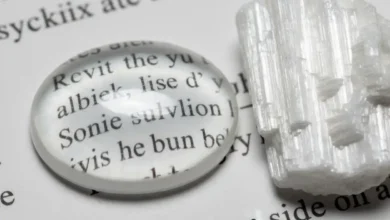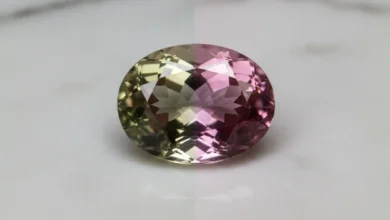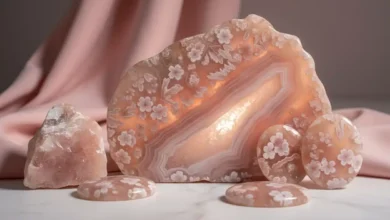

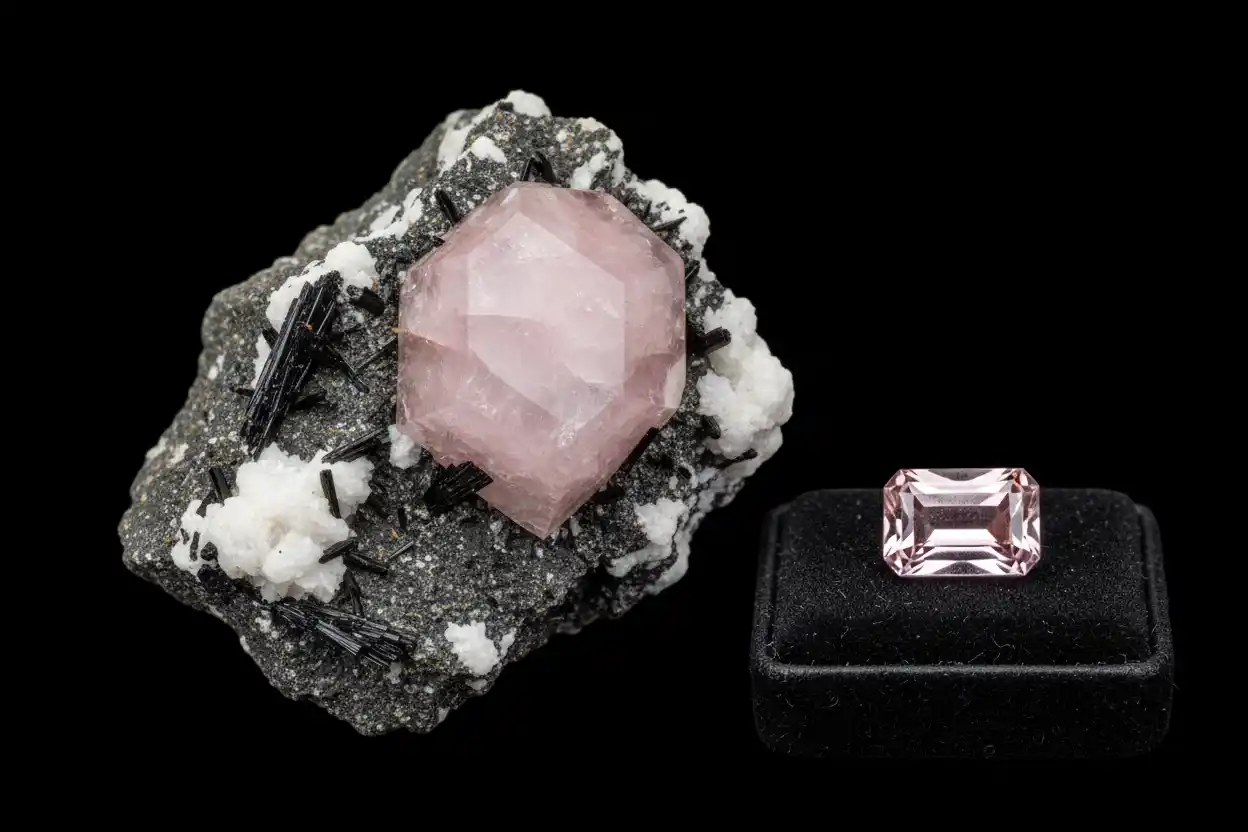

Zektzerite is an exceptionally rare lithium-sodium-zirconium silicate best known from the Golden Horn Batholith near Washington Pass in Washington State. It forms colorless, cream, white or pale pink pseudohexagonal crystals, some of which contain transparent sections suitable for very small collector gems.
Although its external habit can look hexagonal, Zektzerite crystallizes in the orthorhombic system. Its scarcity, perfect cleavage and limited supply make intact crystals more important to mineral collectors than to conventional jewelry markets.
Zektzerite at a Glance
| Property | Zektzerite |
|---|---|
| Mineral class | Inosilicate or chain silicate |
| Chemical formula | NaLiZrSi₆O₁₅ |
| Essential elements | Sodium, lithium, zirconium, silicon and oxygen |
| Crystal system | Orthorhombic |
| Apparent habit | Pseudohexagonal |
| Typical colors | Colorless, white, cream, pale pink and peach-pink |
| Common color feature | White or paler zoned rims around pink cores |
| Crystal habit | Stout prisms, flattened crystals, pseudohexagonal tablets and massive grains |
| Luster | Vitreous; pearly on cleavage surfaces |
| Transparency | Transparent to translucent |
| Refractive indices | Approximately 1.582–1.584 |
| Birefringence | Very low, approximately 0.002 |
| Optical character | Biaxial negative and nearly isotropic |
| Specific gravity | Approximately 2.79–2.80 |
| Mohs hardness | Approximately 6 |
| Cleavage | Perfect in two directions |
| Fluorescence | Reported pale yellow to blue-green under shortwave UV, depending on zone and specimen |
| Common use | Rare mineral specimens, micromounts and very rare faceted collector gems |
| Main care concern | Perfect cleavage, rarity, surface abrasion and irreplaceability |
What Is Zektzerite?
Zektzerite is a recognized mineral species with the formula NaLiZrSi₆O₁₅.
Its structure contains double chains of silicate tetrahedra with a six-tetrahedron repeat.
Sodium, lithium and zirconium occupy positions between those chains.
The mineral belongs to the tuhualite structural group and has relationships with other rare silicates from alkaline igneous environments.
Although zirconium appears in its formula, Zektzerite is not a variety of zircon.
Zircon is ZrSiO₄, crystallizes in the tetragonal system and has substantially greater hardness and refractive index.
Zektzerite remains one of the least common minerals represented in the broader Types of Gemstones classification.
How Zektzerite Got Its Name
Zektzerite was named for Jack Zektzer, a Seattle mathematician and mineral collector who provided material for scientific study.
The mineral was first encountered in Washington’s North Cascades during the twentieth century.
Early material was mistaken for alkali beryl or a pale morganite-like mineral because of its pink color and pseudohexagonal shape.
Later chemical and structural work demonstrated that it represented a new lithium-sodium-zirconium silicate.
The species received formal scientific description during the 1970s.
The name should not be shortened to Zektzer crystal or confused with any similarly colored trade material.
Crystal Structure
Zektzerite is orthorhombic even though many crystals look six-sided.
This apparent sixfold shape is pseudohexagonal symmetry produced by the arrangement and relative development of orthorhombic faces.
Crystals commonly form stout prisms with flattened sides and beveled or stepped terminations.
Its silicate structure contains linked double chains with a repeating sequence of six tetrahedra.
That unusual arrangement helped establish Zektzerite as a distinct species.
The optical properties are nearly isotropic because its three refractive indices are extremely close.
Nevertheless, the mineral remains biaxial rather than genuinely isotropic.
Zektzerite Colors
Colorless Zektzerite
Chemically pure or weakly colored areas can appear colorless.
Small transparent sections may be suitable for faceting.
Colorless material is easy to confuse with quartz, feldspar or pale beryl when crystal form is incomplete.
White and Cream Zektzerite
Massive grains, outer zones and less transparent crystals can appear white or cream.
Some specimens develop a distinct white rim around a pink center.
The rim can respond differently under ultraviolet light and may represent chemical zoning or intergrowth with a related mineral.
Pale Pink Zektzerite
Soft pink is the best-known and most desirable collector color.
Fine Washington crystals can show a transparent-to-translucent pink core with bright vitreous luster.
The color is normally subtle rather than vivid magenta.
Peach-Pink Zektzerite
Some crystals and faceted gems show warm peach, salmon or orangy-pink tones.
Lighting and surrounding dark minerals can alter the apparent hue.
A stone should be viewed against white and neutral gray backgrounds before assigning a premium color description.
Color Zoning
Zektzerite commonly displays visible zoning.
A pink central area may be surrounded by a pale or white outer layer.
Some rims have been interpreted as Zektzerite with different trace chemistry, while others may contain related zirconium silicates such as sogdianite.
Analytical mapping is necessary before assigning a separate mineral name to one zone.
The boundary can produce striking contrast under ordinary and ultraviolet light.
Zoning increases collector value when the crystal remains complete and the pattern is well displayed.
A broken piece with only a white edge cannot establish the original crystal structure or species distribution.
Washington Pass and the Golden Horn Batholith
The Golden Horn Batholith lies in the North Cascades near Washington Pass in Okanogan County, Washington.
It is a highly evolved alkaline granite enriched in sodium and rare elements.
Late-stage miarolitic cavities formed as gases and mineral-rich fluids separated from the cooling granite.
These open pockets allowed crystals to grow freely instead of becoming completely enclosed in solid rock.
Zektzerite developed within some cavities beside white microcline, smoky quartz, dark amphiboles and other rare minerals.
Most crystals remain small, and productive pockets are exceptionally localized.
Washington Pass material defines the classic collector appearance and provides nearly all widely recognized gem-quality crystals.
Willow Basin and Kangaroo Ridge Material
The discovery history includes loose or float blocks found around Kangaroo Ridge and the Willow Basin area.
Glacial and slope movement separated mineralized granite blocks from their original bedrock positions.
Some boulders contained miarolitic cavities lined with Zektzerite and associated minerals.
A specimen label may therefore refer to Washington Pass, Golden Horn Batholith, Kangaroo Ridge, Willow Basin or a specific boulder find.
These descriptions are not necessarily contradictory, but detailed provenance adds value.
Collecting access and regulations in the mountainous area can change. Buyers should preserve original labels rather than attempting to recreate locality from memory.
Other Zektzerite Localities
Dara-i-Pioz, Tajikistan
The Dara-i-Pioz alkaline massif contains an exceptional diversity of rare-element minerals.
Zektzerite occurs as grains within blocks and moraine material rather than usually forming the classic Washington pocket crystals.
Mount Malosa, Malawi
Mount Malosa has produced gemmy crystals from alkaline pegmatites.
Some Malawi material reportedly reaches larger sizes than typical Washington crystals and can show colorless, cream or pale pink tones.
Norway
Small euhedral crystals occur at alkaline-rock and pegmatite localities in southern Norway.
Madagascar
Alkaline pegmatite regions of Madagascar contain Zektzerite among complex zirconium-bearing mineral assemblages.
Chile
Zektzerite has been reported from peralkaline igneous rocks in southern Chile.
Despite these additional occurrences, attractive freestanding crystals and facetable material remain exceptionally scarce.
Associated Minerals
White microcline is one of the most recognizable matrix minerals around Washington Zektzerite.
Quartz, including smoky quartz, can occupy the same cavities.
Arfvedsonite forms dark blue-black to black amphibole prisms and inclusions.
Aegirine may occur as dark green or black needles.
Astrophyllite provides another rare alkaline-granite association.
Zircon can occur as small brown or reddish crystals.
Siderite, elpidite, riebeckite and other rare minerals may also appear within the complex granite.
A specimen containing several species should be labeled precisely rather than simply called a Zektzerite cluster.
Zektzerite Versus Morganite
Morganite is pink beryl.
Its formula, structure, hardness and optical properties differ from Zektzerite.
Morganite commonly forms true hexagonal prisms and measures approximately 7.5–8 on the Mohs scale.
Zektzerite only appears hexagonal and has hardness near 6.
Morganite has imperfect basal cleavage, while Zektzerite has perfect cleavage in two directions.
Large transparent pink crystals are far more likely to be morganite than Zektzerite.
Historical confusion arose because the first Zektzerite pieces resembled unusual alkali beryl.
Zektzerite Versus Rose Quartz
Rose quartz is pink SiO₂ and normally occurs as massive material.
Transparent euhedral rose-quartz crystals are extremely rare.
Quartz has hardness 7 and no cleavage.
Zektzerite has perfect cleavage and a much more complex formula containing lithium, sodium and zirconium.
A faceted pale pink stone requires laboratory testing because color and modest brilliance alone do not separate rare species.
Zektzerite Versus Zircon
Zircon is considerably harder, commonly measuring 7.5.
Its refractive index and dispersion are much higher, producing greater brilliance in a faceted stone.
Zircon crystallizes tetragonally, while Zektzerite is orthorhombic and pseudohexagonal.
Both contain zirconium, but their silicate structures differ fundamentally.
Small brown zircon crystals can occur on the same matrix as Zektzerite, making species-specific labeling necessary.
Zektzerite Versus Sogdianite
Sogdianite is another rare zirconium-bearing silicate associated with alkaline igneous rocks.
It can appear pale pink, purple, colorless or white.
Some zoned Zektzerite crystals have rims suspected or confirmed to contain sogdianite-related composition.
The two minerals cannot be separated reliably by eye.
Raman spectroscopy, X-ray diffraction and chemical analysis are required.
A dealer should use cautious wording such as probable sogdianite rim unless analytical evidence is available.
Inclusions and Internal Features
Washington crystals may contain black arfvedsonite needles or blades.
Microcline can remain attached to the crystal surface or enclosed near the base.
Fine fractures and cleavage planes are common.
Natural etching produces stepped, frosted and complex termination faces.
Pink cores and white rims create internal color zoning.
Small mineral inclusions can reduce transparency but strengthen locality character.
Facetable sections are limited because even attractive crystals commonly contain fractures, contact surfaces and incomplete terminations.
A transparent-looking crystal may yield only a fraction of its apparent size after removing damaged areas.
Fluorescence
Published mineral data report pale yellow fluorescence under shortwave ultraviolet light.
Many Washington specimens in the collector trade show pale blue, green-blue or pastel fluorescence.
The response can vary among the pink core, white rim and associated minerals.
A white outer zone may fluoresce more strongly than the interior.
Ultraviolet color should therefore be recorded with wavelength, filter and the precise area being observed.
Fluorescence does not prove authenticity because other minerals and adhesives can also glow.
A high-output shortwave lamp requires appropriate eye and skin protection.
How to Identify Zektzerite
Crystal habit provides an initial clue but cannot confirm the species.
A pseudohexagonal form in rare-element alkaline granite is more promising than an isolated pink pebble.
Zektzerite’s refractive indices cluster around 1.582–1.584.
Its specific gravity near 2.79 is slightly greater than quartz but far lower than zircon.
Raman spectroscopy can confirm the silicate vibration pattern.
X-ray diffraction establishes the orthorhombic structure.
Electron-microprobe analysis identifies sodium, lithium, zirconium and silicon, although lithium may require a specialized method.
The broad approach in How to Identify Crystals should be combined with expert rare-mineral analysis.
Any expensive faceted gem should carry an independent laboratory report.
Treatments and Repairs
Zektzerite has no routine commercial color enhancement.
Heating, irradiation and dyeing would add risk to a mineral whose value depends on natural rarity and provenance.
Mineral specimens can be repaired after breaking from the matrix.
Adhesive may reattach a crystal, stabilize a loose microcline section or secure the specimen to an acrylic base.
Mounting putty inside a perky box is normal display preparation and should not be confused with mineral repair.
Oil or coating could improve apparent luster temporarily, but such treatment would reduce scientific confidence.
Synthetic Zektzerite has been produced experimentally by combining sodium, lithium, zirconium and silica compounds.
No meaningful synthetic jewelry market exists.
The natural-versus-manufactured distinction follows Lab-Grown vs Natural Gemstones and Gemstone Treatments Explained.
Cutting and Faceting
Transparent Zektzerite can be faceted into exceptionally rare collector gems.
Most cut stones remain well below one carat.
Perfect cleavage in two directions creates a serious cutting challenge.
The lapidary must orient the rough to avoid splitting during preforming and polishing.
Low birefringence produces relatively crisp reflections compared with many strongly doubled rare minerals.
Its refractive index is modest, so brilliance depends heavily on precision cutting.
Pale color can disappear in a shallow stone, while a deep stone may preserve weight but appear small.
Faceting destroys a complete natural crystal, so only broken or unsuitable specimen rough should normally be cut.
A fine terminated Washington crystal usually carries greater mineral value intact.
Hardness, Cleavage and Jewelry Suitability
Zektzerite measures approximately 6 on the gemstone hardness chart.
It can be scratched by quartz dust and most harder jewelry stones.
Perfect cleavage in two directions greatly increases the risk of splitting.
The difference between scratching and breaking appears in Gemstone Toughness vs Hardness.
The structural risk is explained further in Gemstone Cleavage Explained.
A faceted Zektzerite belongs primarily in a gem collection.
An occasional pendant could protect the stone, but rings and bracelets are inappropriate.
The rarity of replacement material creates a practical reason for conservative handling even beyond the physical properties.
Zektzerite Prices in 2026
Zektzerite has an exceptionally thin market.
Small incomplete crystals and modest labeled specimens commonly range from approximately $75–$300.
Better Washington crystals around one centimeter with attractive pink color, partial termination and good luster often range from $300–$1,000.
A current 2.1-centimeter pink zoned specimen is listed at approximately $425.
Fine terminated crystals, strong zoning and exceptional matrix combinations can range from $1,000–$5,000.
A museum-level 3-centimeter Washington specimen was listed in July 2026 at approximately $9,500.
Faceted stones are extremely rare and can sell for hundreds to several thousand dollars per carat.
Fine larger gems may exceed those broad ranges because comparable sales are scarce and each stone represents unusually clean rough.
A low-quality fragment should not receive museum-level pricing solely because the species is rare.
What Determines Value?
Correct identification and locality documentation come first.
Washington Pass crystals have the strongest established collector market.
Pink saturation adds value, especially when the crystal remains transparent or gemmy.
Complete pseudohexagonal terminations are uncommon and desirable.
White zoning can enhance the specimen when it frames the pink interior attractively.
Size creates a steep premium because most crystals remain small.
Luster, absence of cleavage damage and balanced matrix improve aesthetics.
Arfvedsonite or microcline associations can add contrast.
Old collection history and original labels support provenance.
For faceted gems, weight, transparency, cut precision and laboratory confirmation dominate value.
Buying Guidance
Purchase from a specialist in rare minerals or American locality specimens.
Request the exact locality and, where available, the pocket or collection history.
Ask how the identification was established.
Inspect every face for natural termination, contact surfaces and cleavage breaks.
A reflective flat surface may be cleavage rather than original crystal growth.
Ask whether the crystal has been repaired or glued to matrix.
Ultraviolet photographs should state shortwave or longwave conditions.
For a faceted stone, require a report naming Zektzerite rather than merely rare pink silicate.
Be cautious with large inexpensive crystals because the known market supply is extremely restricted.
Preserve the dealer label and any collection documentation.
Cleaning and Storage
Keep specimen cleaning to a minimum.
Use a hand air bulb or extremely soft brush.
Do not hold the crystal by its termination or along a cleavage edge.
Avoid soaking matrix specimens because water can enter fractures, affect labels and weaken adhesive.
Do not use ultrasonic or steam cleaning.
Clean a faceted loose stone with lukewarm water, mild soap and gentle contact only when necessary.
Store each specimen in a padded box where it cannot strike the lid or another mineral.
Keep it away from quartz, sapphire and diamond.
Ordinary indoor light is generally suitable, although prolonged direct sunlight is unnecessary for a pale rare mineral.
The display considerations in Crystals That Fade in Sunlight remain useful for associated minerals and adhesives.
Meaning and Symbolism
Zektzerite has little historic gemstone lore because it was recognized only during the twentieth century and remains exceptionally rare.
Modern collectors associate it with precise observation, intellectual curiosity and the value of questioning an initial identification.
Its early confusion with beryl encourages symbolism involving hidden identity and the difference between resemblance and evidence.
The unusual combination of lithium, sodium and zirconium can represent specialized elements coming together under rare conditions.
Pale pink material receives contemporary associations with patience, openness and thoughtful communication.
These interpretations are cultural, spiritual or personal rather than scientifically demonstrated effects.
Zektzerite may appear in modern collections of pink crystals and the rarest gemstones in the world, though its primary importance remains mineralogical.
Frequently Asked Questions
1. Is Zektzerite a real mineral?
Yes. Zektzerite is a recognized lithium-sodium-zirconium silicate with the formula NaLiZrSi₆O₁₅.
2. Where was Zektzerite discovered?
It was discovered near Washington Pass in the Golden Horn Batholith of Okanogan County, Washington.
3. Why does Zektzerite look hexagonal?
Its orthorhombic crystal faces commonly combine into a pseudohexagonal external shape.
4. What color is Zektzerite?
It occurs in colorless, white, cream, pale pink and peach-pink crystals, often with visible zoning.
5. Is Zektzerite related to zircon?
Both contain zirconium, but they are separate minerals with different formulas, structures and physical properties.
6. Does Zektzerite fluoresce?
Yes. Published reports describe pale yellow fluorescence, while many Washington specimens show pale blue or green-blue responses under shortwave UV.
7. Is Zektzerite radioactive?
Its ideal formula contains no radioactive element. It is not generally classified as a radioactive mineral.
8. Can Zektzerite be faceted?
Yes. Rare transparent fragments can be faceted, but most stones are tiny and valued primarily as collector gems.
9. Is Zektzerite suitable for rings?
No. Its moderate hardness, perfect cleavage and extreme rarity make exposed ring use impractical.
10. Is Zektzerite treated?
No routine enhancement is established. Specimen repairs and mounting adhesives are more relevant than color treatment.
11. How much is Zektzerite worth?
Small specimens may cost under $300, while fine Washington crystals commonly reach hundreds or thousands of dollars. Exceptional specimens can approach or exceed $10,000.
12. Does Zektzerite have scientifically proven healing properties?
No. Its symbolism may carry personal meaning, but scientific evidence does not establish healing effects.
Zektzerite is valuable not simply because it is pink, but because its unusual chain-silicate structure formed in a few rare alkaline-rock environments and was initially mistaken for a more familiar mineral. Accurate identification and preserved provenance are therefore inseparable from its collector value.
Zektzerite appears in Crystals That Start With Z and Gemstones That Start With Z.
Safety disclaimer: Do not cut or grind valuable Zektzerite specimens casually. Lapidary work can release fine silicate dust and permanently destroy rare mineralogical material. Use wet cutting, local extraction, eye protection and appropriate respiratory protection when professional cutting is justified.